Tag: ChatGPT

  • How to Summarize Documents with ChatGPT: Beginner Guide (2026)

    How to Summarize Documents with ChatGPT: Beginner Guide (2026)

    Estimated reading time: 105–135 minutes

    Last updated: July 28, 2026

    Before Learning

    For the best results, read these beginner-friendly guides first:

    · ChatGPT Basics for Beginners: Complete Guide (2026)

    · Prompt Engineering for Beginners: Complete Guide (2026)

    These guides explain how to use ChatGPT, write clear instructions, review its answers, and improve a prompt when the first response is not suitable.

    Before beginning this tutorial, prepare one short document for practice. It could be:

    · A report

    · An article

    · Meeting notes

    · A letter

    · A study document

    · A product guide

    · A document you created yourself

    Use a document that you own, created, received legally, or have permission to review.

    Before uploading it:

    · Remove passwords, identification numbers, financial details, medical information, private addresses, and other sensitive information.

    · Check whether the document contains confidential business, customer, employee, or family information.

    · Keep the original document unchanged in a safe folder.

    · Create a separate working copy when changes may be needed.

    · Begin with a short, simple document before trying a long or complicated file.

    ChatGPT can help identify and organize important information, but its summary may omit details, misunderstand the document, or present something inaccurately. Always compare the summary with the original document before relying on it.

    What You’ll Learn

    By the end of this guide, you will know:

    · What document summarization means

    · How ChatGPT can help summarize different types of documents

    · Which document formats ChatGPT may be able to read

    · How to prepare a document before uploading it

    · How to remove or protect private and confidential information

    · How to upload a document to ChatGPT

    · How to write a clear summarization prompt

    · How to request a short, detailed, bullet-point, or section-by-section summary

    · How to summarize reports, articles, meeting notes, letters, guides, and study materials

    · How to ask ChatGPT to identify key points, decisions, deadlines, names, and action items

    · How to summarize only selected pages or sections

    · How to handle long documents that may exceed the available upload or context limits

    · How to compare the summary with the original document

    · How to correct missing, unclear, or inaccurate information

    · How to ask follow-up questions about the document

    · How to create simpler summaries for beginners

    · How to create study notes, checklists, tables, and outlines from a document

    · How to save the original file, prompt, summary, and corrected version

    · Which common summarization mistakes beginners should avoid

    · What limitations and myths to understand

    · How to use document summaries responsibly

    ChatGPT can make a long document easier to review, but the summary should not automatically replace the original. Important legal, medical, financial, technical, contractual, or safety information must be checked directly against the source document and, when necessary, reviewed by a qualified professional.

    Introduction

    Long documents can be difficult to review, especially when they contain many pages, repeated explanations, technical terms, tables, meeting notes, or detailed instructions.

    Document summarization means reducing a longer document into a shorter version that keeps its most important information.

    A useful summary may identify:

    · The document’s main purpose

    · Its most important ideas

    · Key facts and explanations

    · Decisions that were made

    · Tasks or action items

    · Important dates and deadlines

    · Names, roles, or organizations

    · Warnings, limitations, or conditions

    · Questions that remain unanswered

    ChatGPT can help you summarize a document after you provide the text or upload a supported file. You can then request a summary in a format that matches your purpose.

    For example, you might ask ChatGPT to create:

    · A short overview

    · A detailed summary

    · A section-by-section summary

    · A bullet-point summary

    · A list of action items

    · Study notes

    · A checklist

    · A table of key information

    · A plain-language explanation

    · A summary for a particular audience

    The quality of the result depends partly on the document and partly on the instructions you provide.

    A request such as:

    Summarize this document.

    may produce a general overview.

    A clearer request might say:

    Summarize this document for a complete beginner. Organize the result under Purpose, Main Points, Important Dates, Action Items, Warnings, and Questions That Need Follow-Up. Do not add information that is not in the document.

    The clearer request tells ChatGPT:

    · Who the summary is for

    · Which information matters

    · How the answer should be organized

    · What ChatGPT should avoid doing

    Document summarization can save time, but it does not guarantee that every important detail will be included or interpreted correctly.

    ChatGPT may:

    · Miss a condition hidden in a long paragraph

    · Misread a table

    · Overlook information shown only in an image

    · Combine separate points incorrectly

    · Simplify an important warning too much

    · Present an uncertain interpretation too confidently

    · Leave out a detail that matters to your specific purpose

    For this reason, the summary should be treated as a review aid rather than automatic proof of what the original document says.

    This is especially important when the document contains:

    · Contracts

    · Government forms

    · Medical information

    · Financial information

    · Legal instructions

    · Insurance conditions

    · Safety procedures

    · Employment rules

    · Technical specifications

    · Business agreements

    Always return to the original document when accuracy matters.

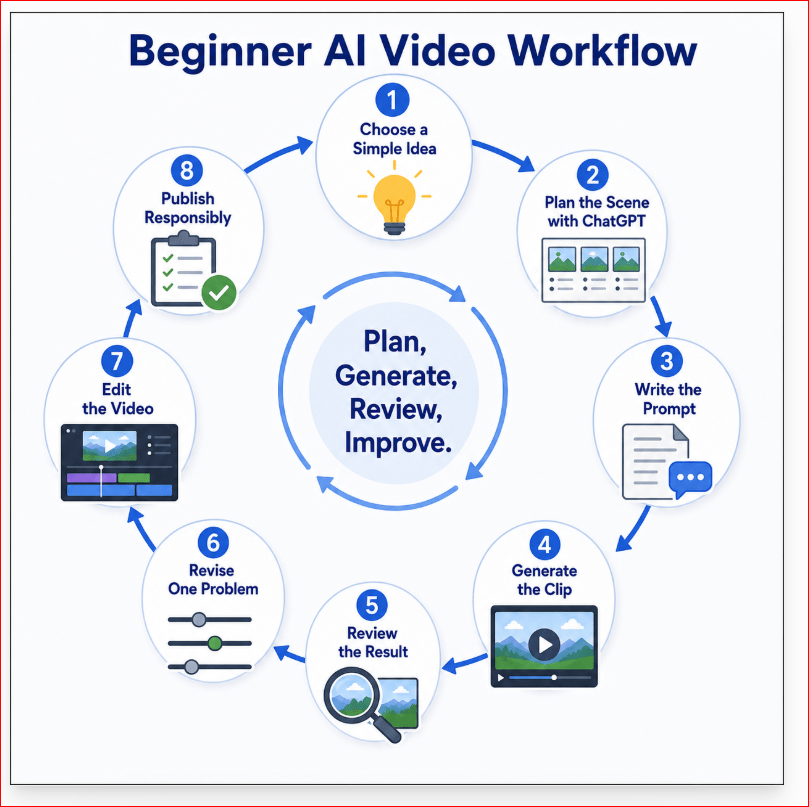
    A practical beginner workflow is:

    1 Prepare a safe working copy of the document.

    2 Remove unnecessary private information.

    3 Upload the file or provide the relevant text.

    4 Explain what kind of summary you need.

    5 Review the summary.

    6 Compare important points with the original.

    7 Ask focused follow-up questions.

    8 Correct and save the final version.

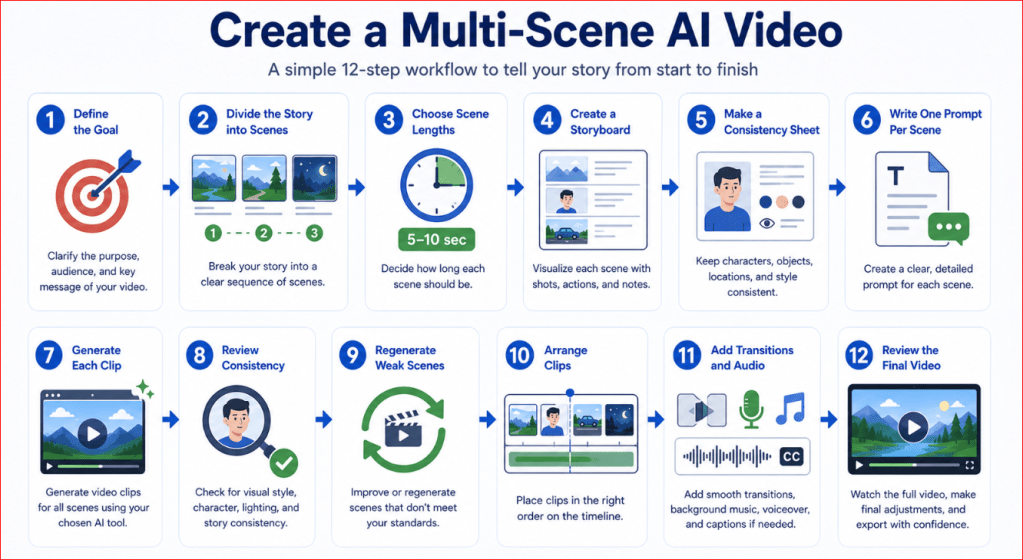
    Figure 1. A careful document-summarization workflow includes preparation, uploading, prompting, reviewing, checking, and saving.

    Figure 1 shows that summarizing a document with ChatGPT is not a one-click process. The user prepares a safe copy, uploads the document, requests a specific summary, compares important details with the source, asks follow-up questions, and saves the reviewed result.

    What Is Document Summarization?

    Document summarization is the process of creating a shorter version of a document while preserving its most important information.

    A summary should help the reader understand the main message without reading every sentence immediately.

    For example, a 20-page report may contain:

    · Background information

    · Research findings

    · Examples

    · Tables

    · Recommendations

    · Warnings

    · Appendices

    A useful summary might reduce that report to one or two pages containing:

    · The purpose of the report

    · The main findings

    · The most important evidence

    · The recommendations

    · Important limitations

    · Actions that may be required

    The summary is shorter, but it should remain faithful to the original document.

    A Summary Is Not the Same as Copying

    Copying reproduces the original wording.

    Summarizing restates the main ideas in a shorter and clearer form.

    For example, an original paragraph might explain a policy in several sentences. A summary may reduce it to one sentence while preserving the main requirement.

    However, exact wording may still be necessary when the document contains:

    · Legal clauses

    · Contract conditions

    · Safety warnings

    · Official definitions

    · Medical instructions

    · Financial terms

    · Deadlines

    · Eligibility requirements

    In these cases, the summary may explain the meaning, but the reader should also check the original wording.

    A Summary Is Not the Same as an Opinion

    A summary should explain what the document says.

    It should not automatically include:

    · Personal opinions

    · Unsupported conclusions

    · New facts

    · Advice that is not in the document

    · Assumptions about the writer’s intentions

    · Information from unrelated sources

    For example, when summarizing a business report, ChatGPT should not invent a recommendation simply because it seems reasonable.

    A useful prompt may include:

    Summarize only the information contained in the document. Clearly label any uncertainty, missing information, or interpretation.

    A Summary Is Not the Same as an Analysis

    A summary reduces and organizes the document.

    An analysis examines the document more deeply.

    An analysis may ask:

    · Is the argument convincing?

    · Is the evidence reliable?

    · Are important details missing?

    · Do different sections contradict each other?

    · What risks or weaknesses are present?

    · How does the document compare with another source?

    You can ask ChatGPT for a summary first and request an analysis afterward.

    Keeping these tasks separate can make the result easier to review.

    Common Types of Document Summaries

    Different purposes require different summary styles.

    Short Overview

    A short overview may contain one paragraph explaining the document’s purpose and main conclusion.

    It is useful when you need a quick understanding before deciding whether to read the complete document.

    Bullet-Point Summary

    A bullet-point summary organizes the main ideas into a short list.

    It is useful for:

    · Reports

    · Meeting notes

    · Instructions

    · Study materials

    · Business documents

    Detailed Summary

    A detailed summary includes more supporting information, explanations, conditions, and examples.

    It is useful when the reader needs a shorter version but cannot afford to lose important context.

    Section-by-Section Summary

    A section-by-section summary follows the document’s original structure.

    For example:

    · Introduction

    · Background

    · Main findings

    · Recommendations

    · Conclusion

    This format makes it easier to compare the summary with the source.

    Action-Item Summary

    An action-item summary focuses on:

    · Tasks

    · Responsibilities

    · Deadlines

    · Decisions

    · Follow-up questions

    · Required documents

    It is especially useful for meeting notes, project updates, and business reports.

    Plain-Language Summary

    A plain-language summary explains difficult wording in simpler terms.

    It may help:

    · Complete beginners

    · Students

    · People reading in a second language

    · Readers unfamiliar with technical terminology

    Simplifying the language should not change the meaning.

    Study Summary

    A study summary may include:

    · Main concepts

    · Definitions

    · Examples

    · Key facts

    · Review questions

    · Important terms

    It can help organize learning material, but facts should still be checked against the original source.

    The Best Summary Depends on Your Purpose

    Before asking ChatGPT to summarize a document, decide what you need from it.

    For example:

    · A manager may need decisions and action items.

    · A student may need definitions and key concepts.

    · A customer may need important conditions and deadlines.

    · A website reader may need a plain-language overview.

    · A researcher may need findings, methods, and limitations.

    A useful prompt could say:

    Create a section-by-section summary for a complete beginner. Include the purpose, main points, important dates, warnings, and action items. Keep important conditions and limitations.

    The more clearly you explain your purpose, the more useful the summary is likely to be.
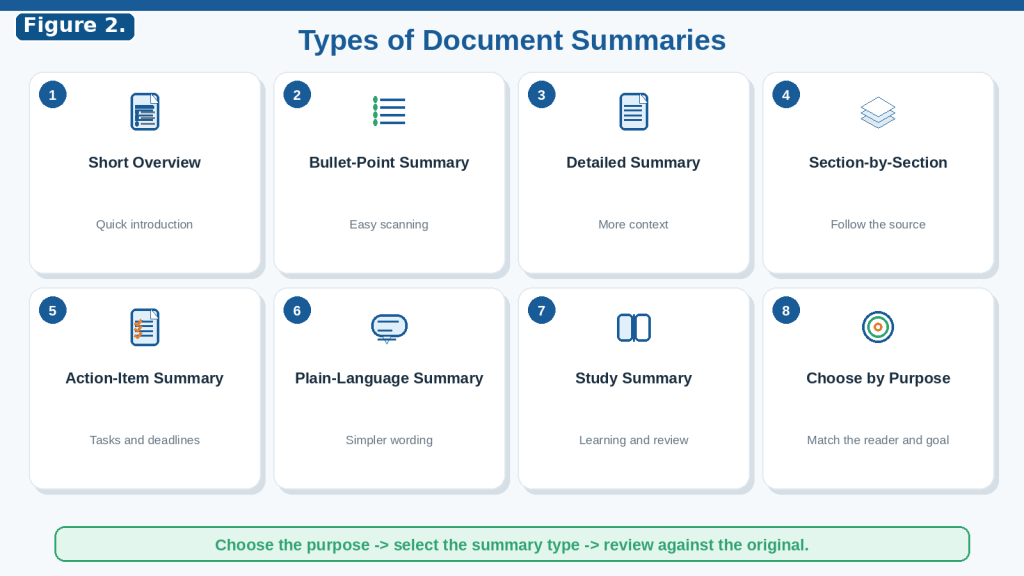
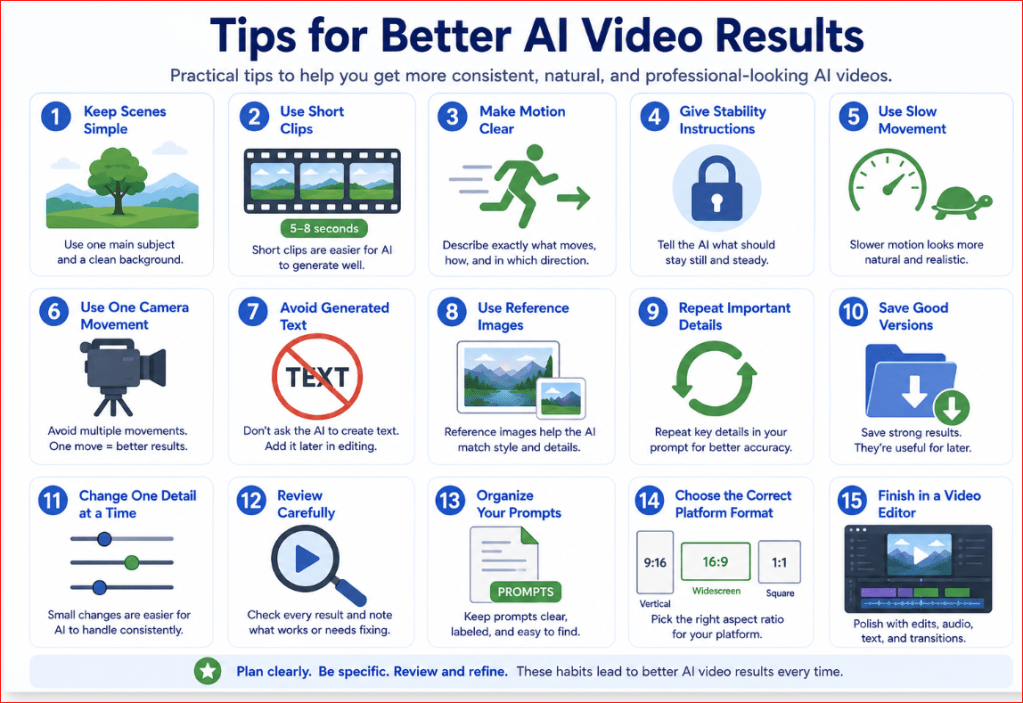
    Figure 2. Different summary formats serve different reading and review purposes.

    Figure 2 compares the main types of document summaries. A short overview provides a quick introduction, while bullet-point, detailed, section-by-section, action-item, plain-language, and study summaries organize information for different needs.

    What Types of Documents Can ChatGPT Summarize?

    ChatGPT can work with many common document formats. OpenAI currently lists supported formats that include:

    · PDF

    · Microsoft Word DOCX

    · PowerPoint PPTX

    · Plain-text TXT

    · Excel XLS and XLSX

    · CSV and TSV

    Available formats and file-handling features can vary by plan, model, workspace settings, device, and future updates. Google Docs files in the native .gdoc format are not currently supported directly; export them as PDF or DOCX before uploading. [1]

    PDF Documents

    PDF files may contain:

    · Reports

    · Articles

    · Manuals

    · Forms

    · Research papers

    · Government documents

    · Downloaded web guides

    · Scanned pages

    A text-based PDF normally works better than a scanned PDF because its words are stored as selectable digital text.

    To check a PDF:

    1 Open the file.

    2 Try selecting a sentence with your mouse.

    3 Copy and paste it into a text editor.

    When the sentence can be copied normally, the PDF probably contains readable digital text.

    When each page behaves like one large photograph, the file may be scanned or image-based.

    ChatGPT may not reliably extract every detail from scanned documents, image-based tables, or complicated visual layouts. When exact numbers or wording matter, use a text-based version or upload the relevant page as a separate clear image and ask ChatGPT to inspect it carefully. [2][7][8][9]

    Microsoft Word Documents

    A DOCX file may be suitable for summarizing:

    · Letters

    · Reports

    · Articles

    · Policies

    · Meeting notes

    · Instructions

    · Drafts

    · Study materials

    Before uploading a Word document:

    · Accept or remove tracked changes when appropriate.

    · Delete hidden comments that should not be shared.

    · Remove private information.

    · Check headers, footers, tables, and text boxes.

    · Save a separate working copy.

    Older Word formats may not work as reliably as DOCX. When necessary, open the document in Word or TextMaker and save a copy as DOCX or PDF.

    Plain-Text Documents

    TXT files contain basic text without complicated formatting.

    They are often suitable for:

    · Notes

    · Transcripts

    · Drafts

    · Lists

    · Instructions

    · Copied article text

    · Meeting records

    Plain-text files are usually easy to process because they do not contain complex page layouts, floating text boxes, or embedded graphics.

    However, they may lose:

    · Headings

    · Bold formatting

    · Tables

    · Page numbers

    · Image captions

    · Footnotes

    Check whether this missing structure affects the meaning before requesting a summary.

    Presentation Files

    PPTX presentations may contain:

    · Slide headings

    · Bullet points

    · Speaker notes

    · Charts

    · Diagrams

    · Photographs

    · Tables

    ChatGPT can summarize presentation text, but embedded visuals may not always be handled in the same way as ordinary text. For most document files and plans, file processing is primarily text-based, so images inside presentations or documents may be omitted. OpenAI currently provides fuller visual retrieval for PDFs only in certain Enterprise situations. [7][8]

    When a chart, diagram, photograph, or screenshot contains important information:

    · Upload it separately as an image.

    · State which slide or section it belongs to.

    · Ask ChatGPT to explain it.

    · Compare the explanation with the original.

    Spreadsheets and Tables

    ChatGPT can work with common spreadsheet formats such as XLSX, XLS, CSV, and TSV. These files are more suitable for structured data than ordinary document summarization. [1][10]

    You may ask ChatGPT to identify:

    · Main trends

    · Highest and lowest values

    · Totals

    · Categories

    · Missing entries

    · Repeated information

    · Important changes

    When exact numbers matter, ask ChatGPT to show the values used in its conclusion and verify them against the original spreadsheet.

    Avoid relying on a summary such as:

    Sales increased significantly.

    Ask for supporting information:

    Identify the exact values and rows that support each conclusion. Do not estimate missing numbers.

    Images of Documents

    You may sometimes have a document only as:

    · A photograph

    · A screenshot

    · A scanned page

    · A JPEG

    · A PNG

    ChatGPT can inspect supported static-image formats, including PNG, JPEG, and non-animated GIF, but unclear or low-quality images may produce less accurate results. [9]

    For better results:

    · Photograph the page straight from above.

    · Use bright, even lighting.

    · Avoid shadows and glare.

    · Keep the complete page visible.

    · Make the text large enough to read.

    · Upload pages in the correct order.

    · Do not combine many tiny pages into one image.

    Review names, numbers, dates, and technical terms carefully because image-based text may be misread.

    Documents with Important Visual Information

    Some documents depend heavily on:

    · Charts

    · Diagrams

    · Maps

    · Photographs

    · Signatures

    · Handwritten notes

    · Colour coding

    · Page layout

    · Tables with merged cells

    A text-only summary may miss the meaning of these elements.

    Before requesting the summary, tell ChatGPT:

    This document contains important charts and diagrams. Identify any visual material you cannot reliably interpret, and do not guess what it shows.

    When necessary, upload each important visual separately and ask a focused question.

    Choose the Cleanest Available Version

    Use this order when several versions are available:

    1 An accessible, text-based DOCX or PDF

    2 A clear TXT export

    3 A properly structured spreadsheet for numerical information

    4 Separate high-quality images for important visuals

    5 A scanned or photographed document only when no better version exists

    The file that looks most attractive is not always the easiest to summarize. A simple, readable document may produce a more reliable result than a heavily designed file containing complex columns, decorations, and embedded text.

    Current Information Note

    Supported file types, upload limits, visual-reading features, storage rules, and plan availability can change. Check OpenAI’s current official file-upload documentation when first using the feature, after changing plans, after receiving a policy or feature notice, or when an important file does not process correctly. [1][2][3][7][8][9]

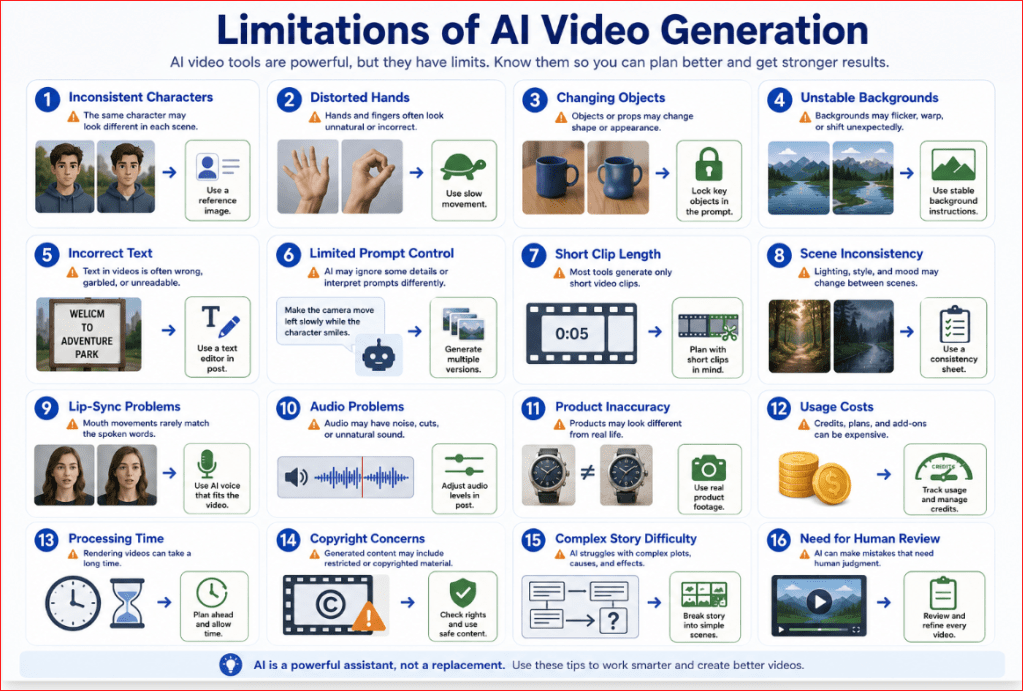
    Figure 3. ChatGPT can summarize several common file types, but text-based and clearly structured documents usually produce more reliable results.

    Figure 3 compares common document formats that beginners may upload. It also shows that scanned pages, complex tables, and embedded visuals require additional checking because important information may not be extracted accurately.

    How ChatGPT Summarizes a Document

    When you upload a document and request a summary, ChatGPT examines the available content and creates a shorter response based on your instructions.

    It does not understand the document exactly as a human reader does. Instead, it identifies patterns in the text, relationships between ideas, repeated topics, headings, keywords, and other signals that appear important.

    A typical summarization process includes several stages.

    1. ChatGPT Reads the Available Content

    ChatGPT first works with the information it can access from the uploaded file.

    This may include:

    · Headings

    · Paragraphs

    · Lists

    · Tables

    · Captions

    · Page text

    · Spreadsheet values

    · Presentation text

    Some information may not be available clearly, especially when it appears inside:

    · Scanned pages

    · Photographs

    · Complicated charts

    · Decorative layouts

    · Handwritten notes

    · Low-quality images

    · Text boxes or unusual formatting

    ChatGPT cannot summarize information it could not read or interpret correctly.

    2. ChatGPT Follows Your Instructions

    Your prompt tells ChatGPT what kind of result you need.

    For example:

    Summarize this document in five bullet points.

    This asks for a short summary.

    A more detailed prompt might say:

    Create a section-by-section summary for a complete beginner. Include the purpose, main ideas, important dates, warnings, responsibilities, and action items. Do not add information that is not in the document.

    This prompt gives ChatGPT more direction.

    It explains:

    · The intended audience

    · The required structure

    · The information to prioritize

    · The information not to invent

    · The level of detail needed

    Clear instructions reduce uncertainty, but they do not eliminate the need to check the result.

    3. ChatGPT Identifies Important Information

    ChatGPT looks for content that appears central to the document.

    This may include:

    · Repeated ideas

    · Main arguments

    · Section conclusions

    · Definitions

    · Dates

    · Names

    · Requirements

    · Decisions

    · Recommendations

    · Warnings

    · Deadlines

    · Action items

    However, ChatGPT may not know which details matter most to you unless you explain your purpose.

    For example, the same meeting record could be summarized in different ways.

    A general summary may focus on the discussion.

    A project summary may focus on:

    · Tasks

    · Responsible people

    · Deadlines

    · Unresolved questions

    A financial summary may focus on:

    · Costs

    · Budgets

    · Payments

    · Approved amounts

    · Missing figures

    This is why your purpose should be included in the prompt.

    4. ChatGPT Reduces Repetition and Detail

    Long documents often repeat information or provide several examples of the same idea.

    ChatGPT may shorten the document by:

    · Combining repeated points

    · Removing less important examples

    · Reducing background information

    · Rewriting long explanations

    · Grouping related ideas

    · Leaving out minor details

    This makes the summary shorter, but it also creates a risk.

    A detail that appears unimportant to ChatGPT may be important to you.

    For example, a contract may repeat a rule in several places but include one important exception in a later paragraph. A general summary could mention the rule and miss the exception.

    Always check:

    · Exceptions

    · Conditions

    · Deadlines

    · Eligibility rules

    · Penalties

    · Warnings

    · Required documents

    · Cancellation terms

    5. ChatGPT Organizes the Summary

    ChatGPT can arrange the result in the format you requested.

    Common formats include:

    · Paragraphs

    · Bullet points

    · Numbered steps

    · Tables

    · Checklists

    · Headings

    · Question-and-answer format

    · Study notes

    You can also request specific headings.

    For example:

    Organize the summary under Purpose, Main Points, Important Dates, Responsibilities, Risks, and Next Steps.

    A consistent structure makes the summary easier to review against the source document.

    6. ChatGPT Generates the Final Response

    ChatGPT creates new wording based on the document and your instructions.

    The response should reflect the source, but it may still contain problems such as:

    · Missing details

    · Oversimplified explanations

    · Incorrect relationships between ideas

    · Confused names or dates

    · Unclear wording

    · Unsupported conclusions

    · Information presented with too much confidence

    The final response should therefore be treated as a draft summary until you verify it.

    ChatGPT Does Not Automatically Know What Matters Most

    A document may contain many kinds of information, but your purpose determines which details are most important.

    Consider a 30-page product manual.

    A customer may want:

    · Setup instructions

    · Safety warnings

    · Troubleshooting steps

    A technician may want:

    · Specifications

    · Maintenance procedures

    · Error codes

    A business owner may want:

    · Warranty conditions

    · Support terms

    · Replacement rules

    The same document can produce several useful summaries depending on the prompt.

    ChatGPT May Simplify Too Much

    A summary should be shorter than the original, but excessive shortening can remove important context.

    For example, the original document may say:

    Customers may cancel within 14 days only when the service has not started and no digital materials have been downloaded.

    An oversimplified summary might say:

    Customers may cancel within 14 days.

    The summary leaves out two important conditions.

    A safer prompt would say:

    Preserve all conditions, exceptions, deadlines, warnings, and eligibility requirements. Do not shorten them in a way that changes their meaning.

    ChatGPT May Combine Separate Statements Incorrectly

    Long documents sometimes discuss similar topics in different sections.

    ChatGPT may accidentally combine them.

    For example:

    · One deadline may apply to new customers.

    · Another deadline may apply to existing customers.

    · One fee may apply to monthly plans.

    · Another fee may apply to annual plans.

    A summary might incorrectly present them as one general rule.

    Ask ChatGPT to:

    Keep separate rules, groups, dates, fees, and conditions clearly separated. State which section or group each one applies to.

    Ask ChatGPT to Show Its Source Location

    For important summaries, ask ChatGPT to identify where each key point came from.

    For example:

    For every important point, include the page number, section heading, table name, or paragraph location when available.

    This can make verification faster.

    However, page references may not always be available or accurate, especially when:

    · The document has no page numbers

    · Text was copied instead of uploaded

    · The file structure is complicated

    · The document was scanned

    · Page numbering differs between the document and the viewer

    Check every important reference against the original file.

    A Safer Summarization Instruction

    The following prompt gives ChatGPT useful boundaries:

    Summarize only the information contained in this document. Preserve important dates, names, numbers, conditions, exceptions, warnings, responsibilities, and deadlines. Do not invent missing information. Clearly label anything uncertain or difficult to read. Organize the result under clear headings and include source locations when available.

    This instruction cannot guarantee a perfect summary, but it makes your expectations clearer.
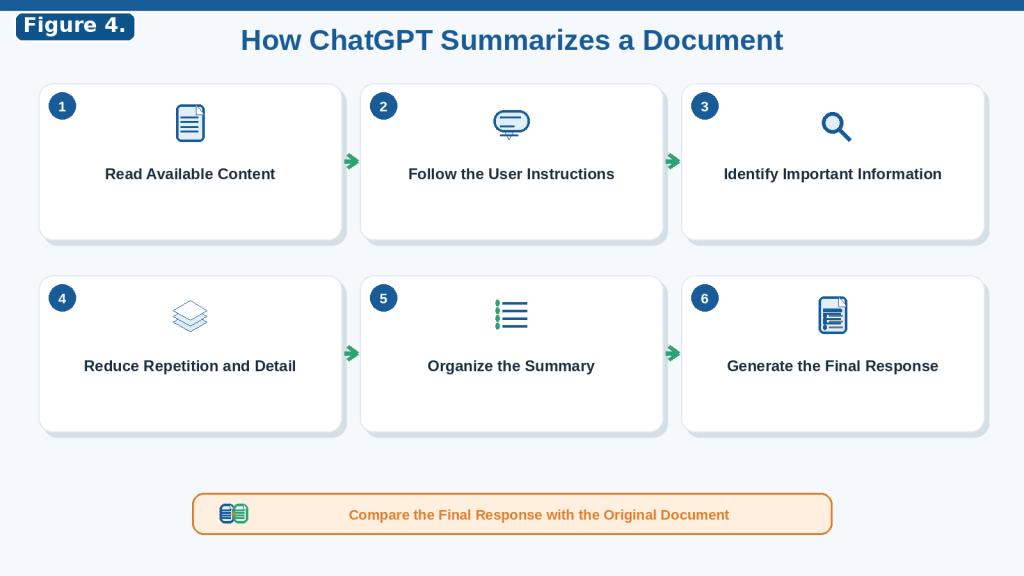
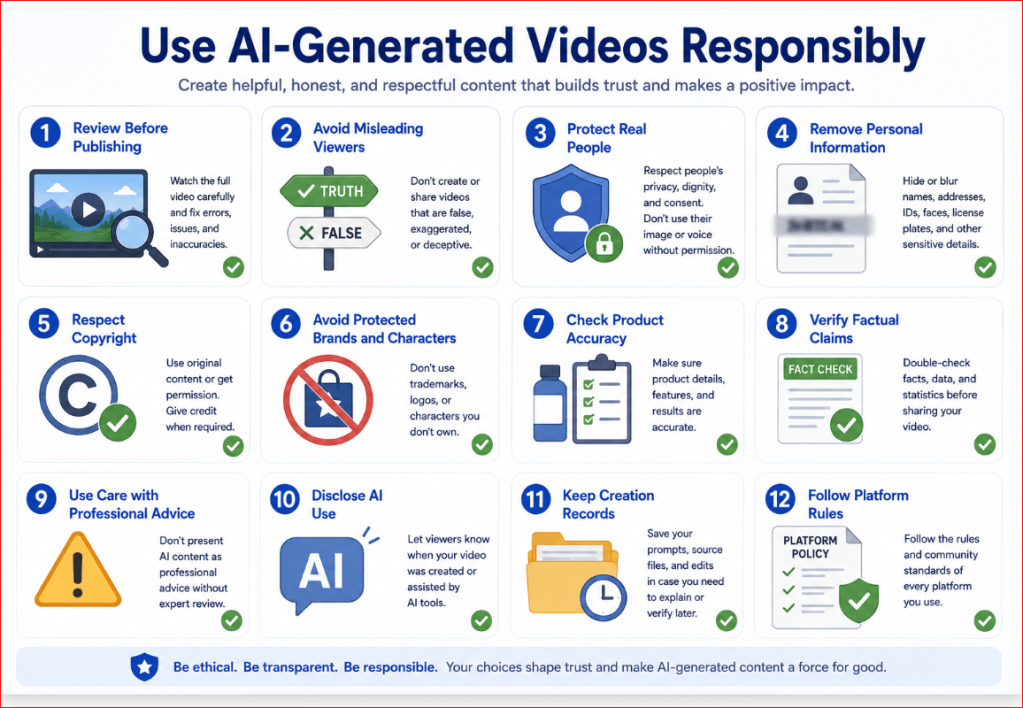
    Figure 4. ChatGPT creates a document summary by reading available content, following the prompt, identifying important information, reducing repetition, and organizing the result.

    Figure 4 shows the main stages involved in document summarization. The process begins with readable source content and clear instructions, but the final summary still requires comparison with the original document because important details may be missed, simplified, or interpreted incorrectly.

    How to Prepare a Document Before Uploading It

    Preparing the document before uploading it can improve the summary and reduce privacy, formatting, and accuracy problems.

    Do not upload the original file immediately. First, make a safe working copy that you can review and clean.

    1. Save an Unchanged Original Copy

    Keep the original document in a safe folder before making any changes.

    A simple folder structure could be:

    · Original Document

    · Safe Upload Copy

    · ChatGPT Summary

    · Reviewed Summary

    This protects the source document and makes it easier to compare the summary with the original later.

    Use clear filenames, such as:

    meeting-notes-original.docx

    meeting-notes-safe-upload-copy.docx

    meeting-notes-chatgpt-summary.docx

    meeting-notes-reviewed-summary.docx

    Do not overwrite the original document with an edited or shortened version.

    2. Confirm That You Have Permission to Use the Document

    Before uploading a document, confirm that you own it, created it, received it legally, or have permission to use it.

    Be especially careful with:

    · Employer documents

    · Customer records

    · School records

    · Government documents

    · Contracts

    · Internal reports

    · Medical records

    · Financial records

    · Documents belonging to another person

    Receiving a document does not always give you permission to upload it to an online service.

    When the document belongs to an employer, customer, school, government office, or organization, check its privacy and technology rules before uploading it.

    3. Remove Private and Confidential Information

    Open the safe working copy and remove information that ChatGPT does not need for the summary.

    This may include:

    · Full names

    · Home addresses

    · Personal telephone numbers

    · Personal email addresses

    · Birth dates

    · Passport numbers

    · Driver’s licence numbers

    · Government identification numbers

    · Bank account information

    · Credit-card information

    · Passwords

    · Login details

    · Medical information

    · Employee numbers

    · Customer numbers

    · Signatures

    · Private photographs

    Replace important identifying details with neutral labels when the relationship still matters.

    For example:

    · Replace a person’s name with Employee A

    · Replace a customer’s name with Customer 1

    · Replace an account number with [account number removed]

    · Replace an address with [address removed]

    · Replace a company name with Company A

    This allows ChatGPT to understand the document without receiving unnecessary identifying information.

    4. Check Hidden and Less-Visible Content

    Private information may appear outside the main paragraphs.

    Check:

    · Headers

    · Footers

    · Comments

    · Tracked changes

    · Document properties

    · Author information

    · Tables

    · Text boxes

    · Speaker notes

    · Hidden spreadsheet rows

    · Hidden spreadsheet columns

    · Hidden worksheets

    · File attachments

    · Embedded images

    · Scanned signatures

    Deleting visible text may not remove comments, tracked changes, metadata, or hidden spreadsheet content.

    Open the safe copy in TextMaker, Word, Excel, PowerPoint, or the appropriate program and inspect the complete file before uploading it.

    5. Remove Unnecessary Pages and Sections

    Upload only the information needed for the task.

    For example, when you need a summary of pages 10–15, you may not need to upload a 200-page document containing unrelated information.

    A smaller, focused file can:

    · Reduce unnecessary data exposure

    · Make your instructions clearer

    · Make verification easier

    · Reduce confusion between unrelated sections

    · Help ChatGPT focus on the relevant material

    Do not remove sections that provide essential context, definitions, exceptions, or conditions.

    6. Improve the Document’s Readability

    A clean and well-organized document is usually easier to summarize than a file with complicated formatting.

    Before uploading it:

    · Use clear headings

    · Keep paragraphs in the correct order

    · Remove duplicated pages

    · Correct upside-down scanned pages

    · Check that pages are not missing

    · Make sure tables are readable

    · Increase the clarity of scanned text

    · Confirm that the language is displayed correctly

    · Check that important captions remain with their images

    · Make sure page numbers match the document order

    When possible, use a text-based DOCX or PDF rather than low-quality photographs of pages.

    7. Check Whether the File Is Too Large

    OpenAI currently states that files uploaded to ChatGPT have a maximum size of 512 MB per file. Text and document files also have a limit of 2 million tokens per file. Spreadsheet files have different practical limits based on their size and structure. These limits and plan allowances may change. [2][3]

    A token is a small unit of text used by an AI system. It may be part of a word, a complete word, punctuation, or another text element.

    Beginners do not normally need to calculate tokens manually. When a long document fails to upload or produces an incomplete result, divide it into logical parts.

    For example:

    · Part 1 — Introduction and Background

    · Part 2 — Main Findings

    · Part 3 — Recommendations

    · Part 4 — Appendices

    Do not divide a document in the middle of an important table, argument, instruction, or contract clause.

    8. Review ChatGPT’s Data Controls

    For personal ChatGPT services, users can control whether their conversations are used to help improve OpenAI’s models through Settings → Data Controls → Improve the model for everyone. Turning this setting off prevents new conversations from being used for model training, while the conversations may still remain in chat history. Menu wording may vary by device or future update. [5][6]

    This setting does not make an unsuitable confidential upload safe. You should still remove unnecessary private information and follow the document owner’s rules.

    OpenAI states that content submitted through business offerings such as ChatGPT Business and ChatGPT Enterprise is not used to improve model performance by default unless the organization explicitly opts in. Workplace administrators may apply additional retention, access, and security rules. [6]

    9. Understand File Storage and Retention

    Uploaded files may remain connected to the conversation, project, custom GPT, or ChatGPT Library in which they were used. Retention depends on where the file was uploaded and the applicable account or workspace rules. Deleted files are generally scheduled for permanent deletion within 30 days, unless they must be retained longer for legal, security, or other stated reasons. [3][4]

    OpenAI states that files uploaded during a Temporary Chat are not saved to the user’s account or Library. Temporary Chats are automatically deleted from OpenAI’s systems within 30 days, subject to stated retention exceptions. [3][4][5]

    Temporary Chat can reduce account-level storage, but it does not replace permission, confidentiality checks, or removal of sensitive information.

    10. Perform a Final Safety Check

    Before uploading the file, ask:

    · Do I have permission to use this document?

    · Am I uploading only the pages needed?

    · Have I removed unnecessary personal information?

    · Have I checked comments, tracked changes, metadata, and hidden content?

    · Is the text clear and readable?

    · Are the pages in the correct order?

    · Have I kept the original file unchanged?

    · Do I understand where the uploaded file may be stored?

    · Will I compare the summary with the original?

    · Is this document too sensitive to upload at all?

    When the answer to the last question may be yes, do not upload the document until you receive appropriate permission or professional guidance.
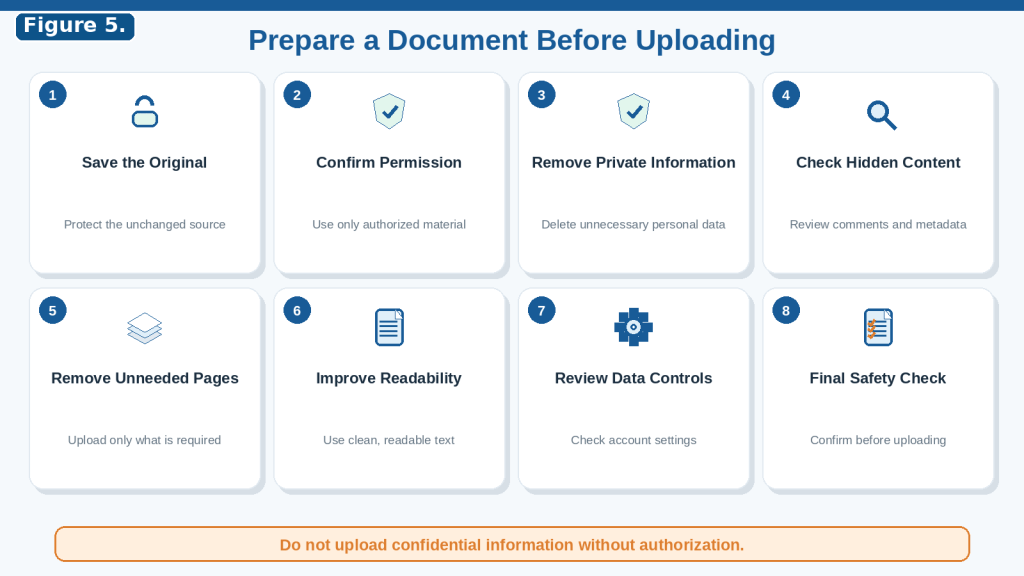
    Figure 5. Preparing a safe document copy includes checking permission, removing private information, improving readability, reviewing data settings, and protecting the original file.

    Figure 5 provides a final preparation checklist for beginners. It shows that a document should be reviewed for privacy, permission, hidden information, readability, file size, and storage considerations before it is uploaded to ChatGPT.

    How to Upload a Document to ChatGPT

    After preparing a safe copy of your document, you can attach it to a ChatGPT conversation and explain what type of summary you need.

    ChatGPT supports common document formats such as PDF, DOCX, PPTX, TXT, XLSX, XLS, CSV, and TSV. Native Google Docs .gdoc files should first be exported as PDF or DOCX. [1]

    The button names and positions may vary slightly between the ChatGPT website, desktop application, mobile application, account plan, and future updates.

    Uploading a Document on a Computer

    Follow these steps on the ChatGPT website or desktop application:

    1. Open ChatGPT and sign in to your account.

    2. Start a new conversation or open the conversation where you want to work.

    3. Locate the attachment or add button beside the message box.

    Depending on the current interface, it may appear as:

    · A plus sign

    · A paperclip

    · An attachment button

    4. Select the option for adding or uploading a file.

    5. Find the safe working copy on your computer.

    6. Select the document and choose Open.

    7. Wait for the file to appear in the message area.

    8. Check that the correct filename is displayed.

    9. Write your summarization instructions in the message box.

    10. Select the Send button.

    OpenAI’s current instructions describe using the attachment or composer menu to add files to a conversation. Files already saved in ChatGPT’s Library may also be added through Add from library, when that feature is available on the account. [2][3]

    Uploading a Document on a Phone or Tablet

    On a mobile device:

    1 Open the official ChatGPT application.

    2 Start a new conversation.

    3 Tap the plus sign or attachment button near the message box.

    4 Select the option for adding photos or files.

    5 Choose the document from your device.

    6 Wait for the attachment to appear.

    7 Enter your summarization prompt.

    8 Tap the Send button.

    OpenAI currently describes the mobile attachment process as tapping the plus icon in the prompt area and selecting the option for adding photos and files. Interface wording may change. [9]

    Check the File Before Sending Your Prompt

    Before asking for a summary, confirm:

    · The correct document was attached.

    · The filename matches the safe working copy.

    · The file opens normally.

    · The document is not password-protected.

    · Unnecessary private information was removed.

    · Pages are in the correct order.

    · Important sections are present.

    · The file is readable.

    · You did not accidentally attach the original confidential version.

    When the filename is unclear, cancel the upload and check the file before continuing.

    Tell ChatGPT Which File to Use

    When only one document is attached, you can refer to it as the attached document.

    For example:

    Summarize the attached document for a complete beginner.

    When several documents are attached, identify the file clearly:

    Summarize the document named project-meeting-notes.docx. Do not use information from the other attached files.

    This reduces the risk of ChatGPT combining information from unrelated documents.

    Start with a Clear Summarization Prompt

    Do not upload the document without explaining what you need.

    A useful beginner prompt is:

    Summarize the attached document for a complete beginner. Include the document’s purpose, main points, important dates, names, responsibilities, warnings, conditions, and action items. Do not add information that is not in the document. Clearly identify anything uncertain or difficult to read.

    This prompt gives ChatGPT:

    · A specific source

    · A target audience

    · A list of information to include

    · A warning against adding unsupported information

    · Instructions for handling uncertainty

    ChatGPT can use uploaded documents for tasks such as summarizing, extracting information, comparing documents, identifying references, and explaining complicated material in simpler language. [2]

    Wait Until the File Has Finished Uploading

    Do not send the summarization request before the attachment has appeared properly in the conversation.

    A slow internet connection, large document, or temporary service problem may delay the upload.

    When the file does not appear:

    · Wait briefly.

    · Check your internet connection.

    · Try attaching the file again.

    · Confirm that the file format is supported.

    · Try a smaller safe copy.

    · Restart the ChatGPT application or refresh the browser.

    · Start a new conversation and try again.

    Do not repeatedly upload confidential files without checking whether earlier copies were already attached.

    Review ChatGPT’s First Response

    After ChatGPT creates the summary, do not assume that the upload and reading process was perfect.

    Ask:

    · Did it summarize the correct document?

    · Did it recognize the document’s main purpose?

    · Are names, dates, numbers, and deadlines correct?

    · Did it miss a page or section?

    · Did it understand tables and headings?

    · Did it mention anything that is not in the document?

    · Did it identify unreadable or uncertain material?

    When ChatGPT appears to have missed information, you can say:

    Review the document again. Identify any pages, tables, images, or sections that you could not read reliably. Do not guess about missing information.

    When information is missed, upload a clearer version, paste the important text, or direct ChatGPT to a particular page or section. [2][9]
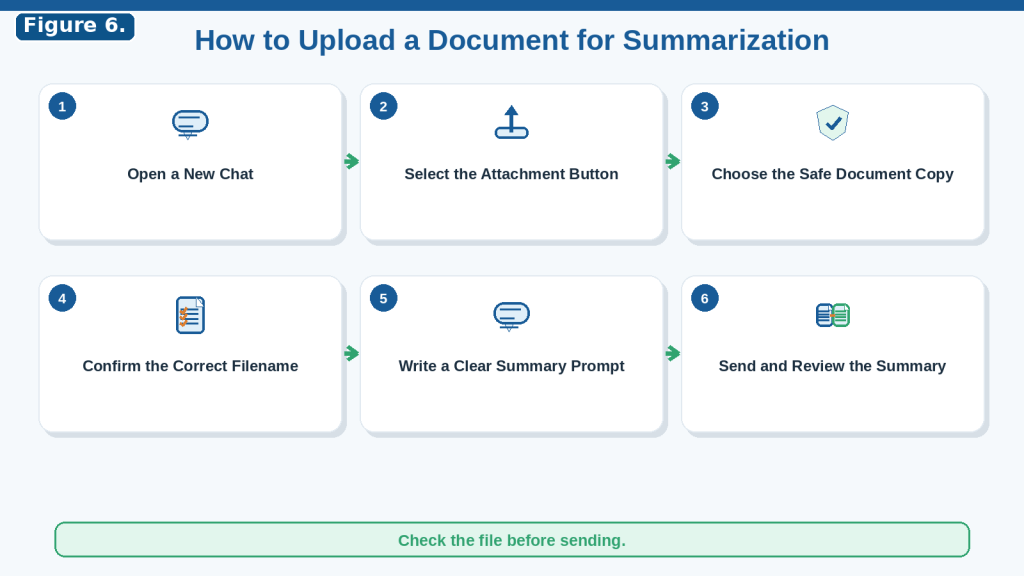
    Figure 6. Uploading a document correctly includes selecting a safe file, confirming the attachment, writing a clear prompt, and reviewing the first summary.

    Figure 6 shows the basic document-upload process for beginners. The user selects a prepared working copy, checks that the correct file is attached, explains what type of summary is needed, sends the request, and reviews the result against the original document.

    How to Write a Clear Document Summarization Prompt

    A summarization prompt tells ChatGPT what information to extract, how much detail to include, and how to organize the result.

    A vague prompt may produce a summary that is too general.

    For example:

    Summarize this document.

    This request does not explain:

    · Who will read the summary

    · Why the summary is needed

    · Which details are most important

    · How long the summary should be

    · Which format to use

    · What ChatGPT should avoid

    A clearer prompt gives ChatGPT more useful direction.

    For example:

    Summarize the attached document for a complete beginner. Explain its purpose, main points, important dates, responsibilities, warnings, conditions, and action items. Organize the result under clear headings. Do not add information that is not in the document. Identify anything uncertain or difficult to read.

    This prompt is more useful because it explains the audience, required content, structure, and accuracy rules.

    A Simple Document-Summary Prompt Formula

    A beginner-friendly prompt can contain seven parts:

    1 Name the document.

    2 Explain your purpose.

    3 Identify the intended reader.

    4 List the information to include.

    5 Choose the output format.

    6 Set the desired length or detail.

    7 Add accuracy and safety instructions.

    You do not always need all seven parts, but including them can make the result more predictable.

    1. Name the Document

    Tell ChatGPT which document it should use.

    For one uploaded file, you may write:

    Summarize the attached document.

    For several files, identify the exact filename:

    Summarize the file named employee-training-guide.pdf. Do not use information from the other attached files.

    This helps prevent information from different files from being combined.

    2. Explain Your Purpose

    Tell ChatGPT why you need the summary.

    For example:

    I need a quick overview before reading the complete report.

    Or:

    I need to identify decisions, deadlines, and action items from these meeting notes.

    Your purpose helps ChatGPT decide which information to emphasize.

    3. Identify the Intended Reader

    The language and detail should match the person who will use the summary.

    You might request a summary for:

    · A complete beginner

    · A student

    · A customer

    · A manager

    · A technical worker

    · A general website reader

    · A person reading in a second language

    For example:

    Explain the document for a complete beginner using simple language.

    Or:

    Create a professional summary for a project manager.

    Avoid requesting an oversimplified summary when the document contains important technical, legal, medical, financial, contractual, or safety information.

    4. List the Information to Include

    Tell ChatGPT which details matter.

    You may request:

    · Purpose

    · Main points

    · Definitions

    · Important dates

    · Names and roles

    · Decisions

    · Responsibilities

    · Deadlines

    · Costs

    · Requirements

    · Conditions

    · Exceptions

    · Warnings

    · Action items

    · Unanswered questions

    · Recommendations

    · Limitations

    For example:

    Include the purpose, main findings, important dates, responsibilities, risks, and next steps.

    When exact details matter, mention them specifically.

    For example:

    Preserve all names, dates, amounts, deadlines, conditions, exceptions, and warnings exactly as stated.

    5. Choose the Output Format

    Ask for a format that matches your purpose.

    Common options include:

    · One short paragraph

    · Bullet points

    · Section-by-section summary

    · Table

    · Checklist

    · Study notes

    · Question-and-answer format

    · Action-item list

    · Timeline

    For example:

    Organize the summary under Purpose, Main Points, Important Dates, Warnings, and Action Items.

    A clear structure makes the summary easier to compare with the original document.

    6. Set the Length or Level of Detail

    Tell ChatGPT how much detail you need.

    For example:

    Create a summary of no more than 300 words.

    Or:

    Create a detailed section-by-section summary that preserves important conditions and examples.

    A very short word limit may force ChatGPT to leave out useful context.

    When the document contains important exceptions, conditions, warnings, or deadlines, request a detailed summary instead of an extremely short one.

    7. Add Accuracy and Safety Instructions

    Tell ChatGPT how to handle missing, unclear, or uncertain information.

    Useful instructions include:

    Do not add facts that are not in the document.

    Clearly label anything uncertain or difficult to read.

    Do not guess missing names, dates, amounts, or conditions.

    Keep separate rules and groups clearly separated.

    Include page numbers or section headings when available.

    Preserve warnings, exceptions, deadlines, and eligibility requirements.

    These instructions reduce the chance of an overconfident or misleading summary, although they do not guarantee perfect accuracy.

    Basic Prompt Template

    You can copy and adapt this template:

    Summarize the attached document for [type of reader]. I need the summary to help me [purpose]. Include [important information]. Organize the result as [format]. Keep it [length or level of detail]. Do not add information that is not in the document. Clearly label anything uncertain, missing, or difficult to read. Include page numbers or section headings when available.

    Example: General Beginner Summary

    Summarize the attached document for a complete beginner. Explain the document’s purpose, main points, important dates, names, conditions, warnings, and action items. Use clear headings and bullet points. Do not add information that is not in the document. Identify anything uncertain or difficult to read.

    Example: Meeting-Notes Summary

    Summarize the attached meeting notes. Organize the result under Decisions, Action Items, Responsible People, Deadlines, Unresolved Questions, and Next Meeting. Keep each task separate. Do not invent missing names or deadlines.

    Example: Report Summary

    Create a section-by-section summary of the attached report. Include its purpose, methods, main findings, evidence, recommendations, limitations, and unanswered questions. Preserve important numbers and dates. Include the section heading or page number for each major point when available.

    Example: Study Summary

    Turn the attached study document into beginner-friendly notes. Include key concepts, definitions, examples, important facts, and five review questions. Do not introduce facts that are not in the document. Mark any unclear information for checking.

    Example: Instructions or Manual

    Summarize the attached instructions as a step-by-step checklist. Preserve all warnings, required tools, preparation steps, conditions, and safety information. Do not shorten any warning in a way that changes its meaning.

    Example: Contract or Policy

    Create a plain-language overview of the attached document. Separate responsibilities, deadlines, fees, conditions, exceptions, cancellation terms, and penalties. Quote only short essential phrases when exact wording matters, and identify the page or section. This summary is for initial review and does not replace the original document or professional advice.

    A summary of a contract, policy, legal notice, medical document, financial document, or safety procedure should always be checked against the original.

    Improve the Prompt After the First Summary

    The first response may be too short, too detailed, or focused on the wrong information.

    You can improve it with a follow-up request.

    For example:

    Rewrite the summary using simpler language, but preserve all dates, amounts, conditions, and warnings.

    Or:

    The summary is too general. Add the main evidence, exceptions, and action items from each section.

    Or:

    Convert the summary into a table with the columns Topic, Key Information, Required Action, Deadline, and Source Location.

    Or:

    Review your previous summary against the document and list any important information that may have been omitted.

    Follow-up prompts let you improve the result without uploading the same document again, provided the file is still available in the conversation.

    Avoid Asking for Too Many Tasks at Once

    A very long prompt may ask ChatGPT to:

    · Summarize the document

    · Translate it

    · Analyze its arguments

    · Check its facts

    · Compare it with another document

    · Create a presentation

    · Write an email

    · Recommend decisions

    Combining too many tasks can make the result harder to review.

    A clearer workflow is:

    1 Request the summary.

    2 Check it against the source.

    3 Ask for missing details.

    4 Request a different format.

    5 Ask for analysis or comparison separately.

    6 Create a final output only after verification.

    Separating the tasks makes it easier to identify where an error occurred.
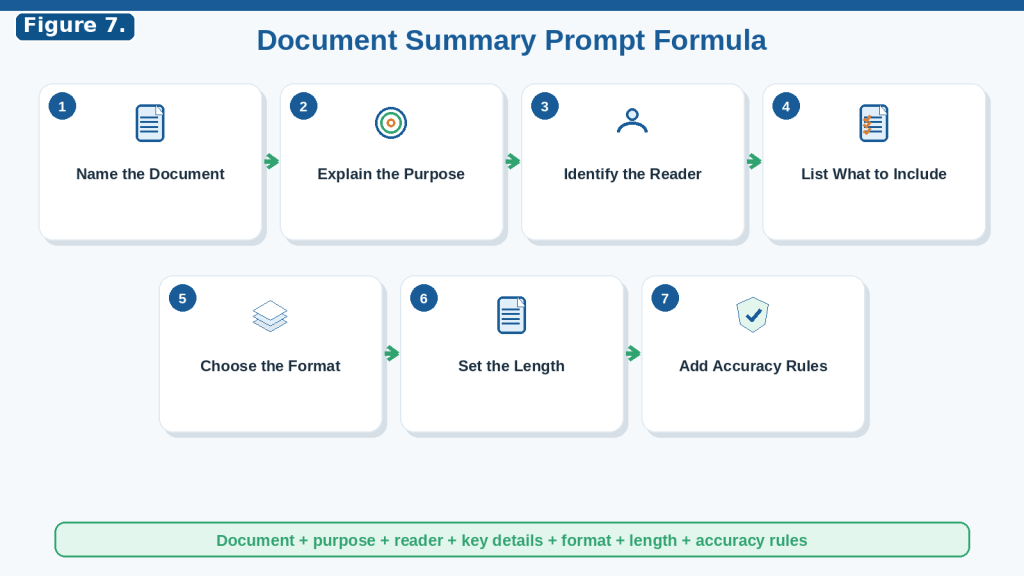
    Figure 7. A clear document-summary prompt identifies the file, purpose, audience, required information, format, length, and accuracy rules.

    Figure 7 shows the seven main parts of a useful summarization prompt. Beginners can use this formula to explain exactly what they need and reduce summaries that are too general, poorly organized, or missing important details.

    How to Request Different Types of Document Summaries

    ChatGPT can create several types of summaries from the same document. The best format depends on what you need to understand, remember, compare, or do next.

    A general request may produce a general summary. A more specific request tells ChatGPT exactly how to organize the information.

    Short Summary

    A short summary gives a quick overview of the document.

    Use it when you want to understand:

    · The document’s main purpose

    · Its central message

    · The most important conclusion

    · Whether the complete document is relevant to you

    Example prompt:

    Summarize the attached document in one short paragraph. Explain its purpose, main message, and most important conclusion. Do not add information that is not in the document.

    A short summary is useful for quick review, but it may omit important details, conditions, examples, and warnings.

    Detailed Summary

    A detailed summary preserves more context than a short overview.

    Use it when the document includes:

    · Several important sections

    · Conditions and exceptions

    · Supporting evidence

    · Examples

    · Technical explanations

    · Recommendations

    · Limitations

    Example prompt:

    Create a detailed summary of the attached document. Preserve the main arguments, supporting evidence, important examples, dates, conditions, exceptions, warnings, and recommendations. Organize the result under clear headings.

    A detailed summary is longer, but it is often safer when important information could be lost through excessive shortening.

    Bullet-Point Summary

    A bullet-point summary separates the main ideas into an easy-to-scan list.

    Use it for:

    · Reports

    · Articles

    · Policies

    · Meeting notes

    · Guides

    · Training documents

    Example prompt:

    Summarize the attached document using clear bullet points. Group related points under headings. Preserve important names, dates, numbers, conditions, and warnings.

    Bullet points are helpful for quick reading, but related information should not be separated in a way that changes its meaning.

    Section-by-Section Summary

    A section-by-section summary follows the document’s original structure.

    Use it when you need to:

    · Compare the summary with the source

    · Confirm that every section was included

    · Review a long report

    · Study a textbook chapter

    · Understand a policy or manual

    Example prompt:

    Summarize the attached document section by section. Use the original section headings when available. Under each heading, explain the main point, important details, conditions, examples, and conclusions.

    This format makes it easier to find the original source of each summary point.

    Action-Item Summary

    An action-item summary focuses on what must be done.

    It is especially useful for:

    · Meeting notes

    · Project updates

    · Work instructions

    · Event planning

    · Business reports

    · Follow-up records

    Ask ChatGPT to identify:

    · The task

    · The responsible person

    · The deadline

    · The current status

    · Required resources

    · Unresolved questions

    Example prompt:

    Review the attached meeting notes and create an action-item table with the columns Task, Responsible Person, Deadline, Status, and Source Section. Write “Not stated” when the document does not provide the information. Do not guess.

    Using Not stated is safer than allowing ChatGPT to invent missing names or deadlines.

    Table Summary

    A table can organize repeated information into clear columns.

    For example:

    TopicKey InformationRequired ActionDeadlineSource

    A table is useful for:

    · Comparing sections

    · Reviewing requirements

    · Organizing deadlines

    · Tracking responsibilities

    · Comparing products or plans described in the document

    · Extracting repeated facts

    Example prompt:

    Summarize the attached document in a table with the columns Topic, Key Information, Conditions, Required Action, Deadline, and Source Location. Use “Not stated” for missing information.

    Tables may oversimplify complicated explanations. Important conditions should remain complete even when they make a table cell longer.

    Plain-Language Summary

    A plain-language summary explains difficult wording using simpler language.

    Use it for:

    · Technical documents

    · Government information

    · Policies

    · Research reports

    · Product instructions

    · Educational materials

    Example prompt:

    Rewrite the main ideas from the attached document in plain language for a complete beginner. Explain technical terms when they first appear. Preserve all important conditions, warnings, dates, and exceptions.

    Plain language should make the document easier to understand without changing its meaning.

    Executive Summary

    An executive summary provides a focused overview for a manager, business owner, decision-maker, or project leader.

    It may include:

    · Purpose

    · Main findings

    · Important evidence

    · Risks

    · Recommendations

    · Decisions required

    · Next steps

    Example prompt:

    Create an executive summary of the attached report. Include the purpose, main findings, important evidence, risks, recommendations, decisions required, and next steps. Keep it under 500 words without removing important conditions or limitations.

    An executive summary should remain based on the source. It should not create recommendations that the original document did not make unless you request a separate analysis.

    Study Notes

    Study notes reorganize a document for learning and review.

    They may include:

    · Main concepts

    · Definitions

    · Examples

    · Important facts

    · Key terms

    · Review questions

    · A short recap

    Example prompt:

    Turn the attached chapter into beginner-friendly study notes. Include key concepts, definitions, examples, important facts, and five review questions. Do not add outside information. Mark any unclear content for checking.

    Study notes can support learning, but they should not replace the complete source when the material may appear in an examination, certification, or professional task.

    Timeline Summary

    A timeline places events, decisions, or deadlines in chronological order.

    Use it for:

    · Historical documents

    · Project records

    · Case notes

    · Business reports

    · Event plans

    · Policy changes

    · Meeting records

    Example prompt:

    Create a chronological timeline from the attached document. Include each date, event, responsible person, decision, and next step. Keep uncertain dates clearly labelled and do not guess missing dates.

    A timeline is especially useful when a long document mentions dates in several different sections.

    Question-and-Answer Summary

    A question-and-answer summary presents the information as common questions followed by clear answers.

    Use it for:

    · Customer guides

    · Policies

    · Training materials

    · Educational documents

    · Product instructions

    · Website FAQs

    Example prompt:

    Turn the attached document into a beginner-friendly question-and-answer summary. Base every answer only on the document. Preserve important conditions, exceptions, dates, and warnings.

    This format can make information easier to find, but the answers should not imply certainty when the source is unclear.

    Key Facts and Figures Summary

    This format focuses on:

    · Dates

    · Amounts

    · Percentages

    · Quantities

    · Measurements

    · Names

    · Deadlines

    · Reference numbers

    Example prompt:

    Extract the key facts and figures from the attached document. Present them in a table with the columns Item, Exact Value, Meaning, and Source Location. Copy numbers carefully and do not estimate missing values.

    Always compare extracted figures with the original because a single incorrect digit can change the meaning.

    Risk and Warning Summary

    A risk and warning summary focuses on information that may affect safety, cost, eligibility, privacy, responsibility, or compliance.

    Example prompt:

    Identify every warning, risk, restriction, condition, exception, penalty, and required action in the attached document. Keep the wording close to the source and include the page or section when available.

    This format is useful for initial review, but it does not replace legal, medical, financial, technical, or professional advice.

    Request More Than One Format

    You can ask ChatGPT to create two versions of the same summary.

    For example:

    First, create a one-paragraph overview. Then create a detailed bullet-point summary under Purpose, Main Points, Dates, Conditions, Warnings, and Action Items.

    This gives you a quick overview and a more complete version.

    Do not request too many formats at once when the document is long or complicated. Create the most important version first, review it, and then request another format.

    Ask ChatGPT to Preserve Missing Information

    When a document does not provide a detail, the summary should not fill the gap automatically.

    Add this instruction:

    Write “Not stated in the document” whenever a name, date, deadline, amount, responsibility, or condition is missing. Do not guess.

    This makes missing information easier to identify and reduces unsupported additions.

    Choose the Format Before Uploading

    Before sending the document, ask yourself:

    · Do I need a quick overview or detailed review?

    · Do I need to follow the original sections?

    · Am I looking for tasks and deadlines?

    · Do I need simple language?

    · Would a table make the information clearer?

    · Do I need exact facts and figures?

    · Am I studying the material?

    · Do I need warnings and conditions separated?

    Choosing the format before writing the prompt usually produces a more useful first summary.

    Figure 8. ChatGPT can organize the same document as a short overview, detailed summary, bullet list, table, timeline, study guide, action list, or question-and-answer summary.

    Figure 8 compares common document-summary formats and the purpose of each one. Beginners should choose a format based on whether they need quick understanding, detailed review, action items, study support, chronological information, or easier comparison.

    Step-by-Step: Summarize Your First Document with ChatGPT

    This beginner exercise uses one short, readable document. Choose a safe file that does not contain confidential, private, medical, financial, legal, customer, employee, or identification information.

    ChatGPT can summarize uploaded documents and answer questions based on their contents. Common supported formats include PDF, DOCX, PPTX, TXT, XLSX, XLS, CSV, and TSV. A native Google Docs .gdoc file must first be exported to a supported format such as PDF or DOCX. [1][2]

    Step 1: Choose a Simple Practice Document

    Start with a short document containing clear headings and ordinary paragraphs.

    Suitable practice documents include:

    · A short article

    · Personal meeting notes

    · A simple instruction guide

    · A public report

    · A document you created yourself

    · A study handout you are permitted to use

    Avoid beginning with a large contract, medical record, financial statement, or complicated scanned document.

    A short practice file makes it easier to compare ChatGPT’s summary with the original.

    Step 2: Create a Safe Upload Copy

    Keep the original file unchanged.

    Create a duplicate and give it a clear filename, such as:

    community-meeting-notes-safe-copy.docx

    Review the copy and remove information ChatGPT does not need, including:

    · Private names

    · Personal email addresses

    · Telephone numbers

    · Home addresses

    · Account numbers

    · Signatures

    · Passwords

    · Identification numbers

    · Confidential comments

    · Hidden tracked changes

    Check the complete document, including headers, footers, tables, comments, and document properties.

    Step 3: Open a New Chat

    Open ChatGPT and start a new conversation.

    Using a separate conversation for the document can make it easier to:

    · Keep the work organized

    · Find the summary later

    · Avoid mixing information from unrelated files

    · Ask follow-up questions about the same document

    Give the conversation a clear name when the option is available.

    For example:

    Practice Document Summary

    Step 4: Attach the Safe Document Copy

    Select the attachment or add button beside the message box.

    Choose the safe copy you prepared.

    Wait until the filename appears in the conversation before sending your request.

    Check that:

    · It is the correct file

    · The filename identifies the safe copy

    · The file is not password-protected

    · The upload appears complete

    · You did not select the confidential original

    Uploaded files may be saved in ChatGPT’s file Library when that feature is available on the account. OpenAI’s current documentation explains that files can also be added later through the composer menu by selecting Add from library. Features and wording may vary by plan, workspace, device, region, and update. [3]

    Step 5: Send a Basic Summary Prompt

    Use this beginner prompt:

    Summarize the attached document for a complete beginner. Explain its purpose and main points using clear headings and bullet points. Include important names, dates, numbers, conditions, warnings, decisions, and action items. Do not add information that is not in the document. Write “Not stated in the document” when important information is missing. Clearly identify anything uncertain or difficult to read.

    This prompt asks ChatGPT to:

    · Use the attached document

    · Write for a beginner

    · Organize the result clearly

    · Preserve important details

    · Avoid inventing information

    · Identify missing or uncertain content

    Select Send and wait for the summary.

    Step 6: Read the Summary Without Editing It

    Read the complete response once before asking ChatGPT to change it.

    Ask yourself:

    · Does the summary explain the document’s purpose?

    · Are the main sections represented?

    · Are important dates and numbers included?

    · Are warnings and conditions preserved?

    · Are action items clearly identified?

    · Did ChatGPT mention anything that does not appear in the source?

    · Did it claim certainty where the document was unclear?

    Do not copy the summary into another document yet.

    The first response should be treated as a draft.

    Step 7: Compare the Summary with the Original

    Open the original document and the ChatGPT summary side by side.

    Check the summary in a logical order:

    1 Document purpose

    2 Main points

    3 Names and roles

    4 Dates and deadlines

    5 Numbers and amounts

    6 Conditions and exceptions

    7 Warnings

    8 Decisions

    9 Action items

    10 Final conclusion

    Mark anything that is:

    · Incorrect

    · Missing

    · Oversimplified

    · Unclear

    · Unsupported

    · Assigned to the wrong person

    · Connected to the wrong date or condition

    ChatGPT can help summarize a document, but important information should still be verified against the source. OpenAI describes summarizing documents and locating information within uploaded files as supported uses of file uploads. [2]

    Step 8: Ask ChatGPT to Check Its Summary

    After performing your own comparison, send this follow-up prompt:

    Review your summary against the attached document. List any important information you may have omitted, simplified too much, or presented without enough context. Pay special attention to names, dates, numbers, conditions, exceptions, warnings, responsibilities, and deadlines. Do not add outside information.

    This asks ChatGPT to inspect its earlier response, but it does not replace your own verification.

    Step 9: Correct Specific Problems

    When you find a problem, describe it clearly.

    For example:

    The original document gives two different deadlines for two different groups. Rewrite that part of the summary and keep the groups and deadlines separate.

    Or:

    You omitted the warning in the section titled “Before You Begin.” Add that warning without changing its meaning.

    Or:

    The document does not name the person responsible for this task. Replace the assigned name with “Not stated in the document.”

    Specific corrections are usually easier to review than asking ChatGPT to rewrite everything.

    Step 10: Request the Final Format

    After checking the content, ask for the format you need.

    For example:

    Create a final beginner-friendly summary using these headings: Purpose, Main Points, Important Dates, Conditions and Warnings, Decisions, Action Items, and Information to Verify. Use only information from the document and the corrections we have confirmed.

    You could also request:

    · A one-paragraph overview

    · A detailed bullet-point summary

    · A table

    · A checklist

    · Study notes

    · A timeline

    · An action-item list

    Choose one format at a time when the document is long or complicated.

    Step 11: Save the Reviewed Summary

    Copy the verified summary into TextMaker or another document program.

    Use a clear filename, such as:

    community-meeting-notes-reviewed-summary.docx

    Save these items together when appropriate:

    · Original document

    · Safe upload copy

    · Original prompt

    · First ChatGPT summary

    · Your correction notes

    · Final reviewed summary

    · Date of review

    This creates a clear record of how the summary was produced and checked.

    Step 12: Delete or Retain the File Appropriately

    Decide whether the conversation and uploaded file should remain in your ChatGPT account.

    OpenAI explains that uploaded-file handling and deletion depend on where the file was used. Deleting a chat or deleting a saved file may begin the deletion process, subject to the service’s stated retention exceptions. Review the current official retention information before uploading sensitive or important material. [3][4]

    Deleting a file later does not correct an upload that should never have been made. Permission and privacy should be checked before uploading.

    Complete Beginner Prompt

    Copy and adapt this prompt:

    Summarize the attached document for a complete beginner.

    Organize the summary under these headings:

    · Purpose

    · Main Points

    · Important Names and Roles

    · Dates and Deadlines

    · Conditions and Exceptions

    · Warnings

    · Decisions

    · Action Items

    · Information That Needs Checking

    Use only information contained in the document. Preserve important names, dates, numbers, conditions, exceptions, and warnings. Write “Not stated in the document” when information is missing. Clearly label anything uncertain or difficult to read. Do not provide outside advice or invent details.
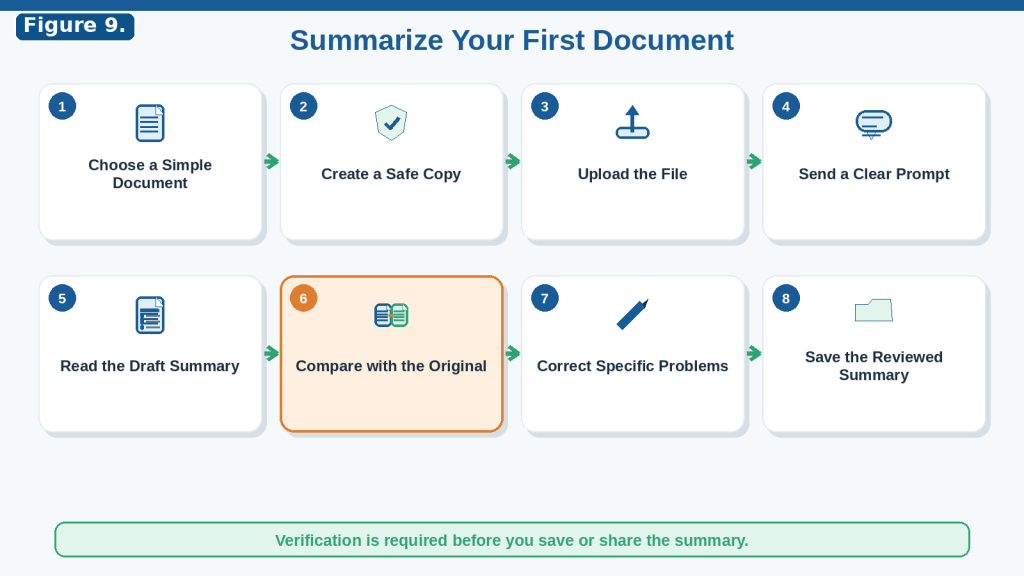
    Figure 9. A reliable first-document workflow includes preparing a safe copy, uploading it, requesting a summary, comparing it with the original, correcting problems, and saving the reviewed result.

    Figure 9 shows the complete beginner workflow for summarizing a document with ChatGPT. Verification is shown as a required stage because the first summary may omit, simplify, or misunderstand important information.

    How to Ask Follow-Up Questions About a Document

    After ChatGPT creates the first summary, you can ask focused questions about the same document.

    Follow-up questions are useful when you need:

    · More detail about one section

    · A simpler explanation

    · A list of dates or deadlines

    · Clarification of technical terms

    · Missing action items

    · Important warnings

    · A comparison between two sections

    · Evidence supporting a conclusion

    · Information from a specific page or heading

    The document must still be available in the conversation for ChatGPT to use it reliably.

    Ask One Clear Question at a Time

    A focused question is usually easier to answer and verify than several unrelated questions combined into one message.

    For example:

    What is the main purpose of the section titled “Project Requirements”?

    This is clearer than:

    Explain everything important, tell me what to do, check the risks, and compare all the sections.

    A useful workflow is:

    1 Ask one specific question.

    2 Review the answer.

    3 Compare it with the source.

    4 Ask the next question.

    This makes it easier to identify mistakes.

    Ask About a Specific Section

    Identify the section, heading, page, table, or paragraph whenever possible.

    For example:

    Explain the section titled “Eligibility Requirements” in simple language. Preserve every condition and exception.

    Or:

    Summarize pages 12–15 only. Do not use information from other pages.

    Or:

    What does the table titled “Project Costs” say about approved and unapproved expenses?

    Specific locations help ChatGPT focus on the correct material.

    Page numbers may not always match the numbers shown in the document viewer, especially when the file includes a cover page or unnumbered introductory pages. Check the heading and surrounding text as well as the page number.

    Ask for Important Dates and Deadlines

    Use a focused prompt such as:

    List every date and deadline in the document. For each one, explain what it applies to and include the source section. Write “Unclear” when the document does not explain the date fully.

    A useful table could include:

    DateWhat It Applies ToRequired ActionSource Location

    Verify every date against the original document.

    Ask for Names and Responsibilities

    For meeting notes, reports, and project documents, ask:

    List every person or role mentioned in the document and explain their responsibilities. Do not assign a responsibility unless the document states it clearly.

    When a responsibility is missing, ChatGPT should write:

    Not stated in the document

    This is safer than guessing.

    Ask for Conditions and Exceptions

    Conditions and exceptions can change the meaning of a rule.

    Use a prompt such as:

    Identify every condition, exception, restriction, and eligibility requirement in the document. Keep related details together and include the source section.

    For example, a document may state that a service is available only:

    · During certain dates

    · In selected locations

    · To eligible groups

    · After approval

    · When specific documents are provided

    A summary that omits one of these conditions may be misleading.

    Ask for Warnings and Risks

    Use a separate follow-up question for warnings:

    List every warning, risk, penalty, restriction, and safety instruction in the document. Preserve the meaning and identify the page or section.

    Do not rely only on a general summary when the document affects:

    · Safety

    · Health

    · Money

    · Legal rights

    · Employment

    · Insurance

    · Eligibility

    · Contracts

    · Technical operation

    Important warnings should be checked directly in the original wording.

    Ask for Definitions of Difficult Terms

    When the document contains technical language, ask:

    Identify the difficult or technical terms in the document. Explain each one in simple language using only the context provided by the document. Clearly state when the document does not define the term.

    This helps prevent ChatGPT from presenting outside knowledge as though it came from the source.

    You may then request a separate explanation using general knowledge, but it should be labelled clearly as additional information.

    Ask for Supporting Evidence

    A summary may state a conclusion without showing how the document supports it.

    Ask:

    For each main conclusion in the summary, identify the sentences, section headings, table entries, or page locations that support it.

    This can help you determine whether the conclusion is:

    · Directly stated

    · Supported by several points

    · Only implied

    · Uncertain

    · Not supported by the document

    ChatGPT may still provide an incorrect source location, so verify it manually.

    Ask What Was Not Included

    Use this follow-up prompt:

    Compare your summary with the complete document and list any important points, conditions, examples, warnings, or limitations that were omitted.

    You can also ask:

    Which sections received little or no coverage in your summary?

    This may reveal sections that were shortened too much.

    Ask About Unclear or Unreadable Information

    When a document contains scanned pages, tables, charts, or poor-quality text, ask:

    Identify any pages, sections, tables, images, or words that you could not read confidently. Do not guess their contents.

    When ChatGPT reports a problem:

    · Upload a clearer page

    · Paste the relevant text

    · Provide a higher-quality scan

    · Ask about one table or image separately

    · Check the original manually

    Ask for a Simpler Explanation

    You may request simpler language without changing the meaning.

    For example:

    Explain this section for a complete beginner. Preserve all dates, numbers, conditions, exceptions, and warnings.

    Avoid saying only:

    Make it simpler.

    That instruction may encourage excessive shortening.

    Ask for a More Detailed Explanation

    When the summary is too brief, ask:

    Expand the section about project requirements. Include the supporting details, examples, conditions, exceptions, and required actions from the document.

    Tell ChatGPT which section needs more detail instead of requesting a complete rewrite.

    Ask ChatGPT to Separate Facts from Interpretation

    Use this prompt:

    Divide your answer into two parts: “Directly Stated in the Document” and “Possible Interpretation.” Do not place an interpretation in the first section.

    This helps distinguish source information from ChatGPT’s reasoning.

    Interpretations should still be treated cautiously.

    Ask for a Comparison Between Sections

    When two sections appear similar or contradictory, ask:

    Compare the sections titled “General Requirements” and “Special Requirements.” Show what is the same, what is different, and which group each rule applies to.

    A comparison table may use:

    TopicGeneral RequirementsSpecial RequirementsImportant Difference

    Check that ChatGPT has not combined different groups or conditions.

    Ask for Unanswered Questions

    A document may leave important information unclear.

    Ask:

    List the important questions that the document does not answer. Do not answer them using outside information.

    This can help identify:

    · Missing deadlines

    · Unassigned responsibilities

    · Unclear costs

    · Undefined terms

    · Missing contact information

    · Conflicting instructions

    · Incomplete procedures

    These questions may need to be directed to the document’s author, organization, teacher, employer, or qualified professional.

    Useful Follow-Up Prompt Set

    You can copy these prompts one at a time:

    What is the main purpose of this document?

    Which information is most important for a complete beginner?

    List all dates, deadlines, names, numbers, and responsibilities.

    Identify every condition, exception, warning, and restriction.

    Which sections were not fully represented in your first summary?

    What information is uncertain, missing, or difficult to read?

    Show the source section or page for every major point.

    Separate information directly stated in the document from your interpretation.

    List questions that the document does not answer.

    Review Every Follow-Up Answer

    A focused question can produce a more useful answer, but it can still contain errors.

    For every important answer:

    1 Locate the source section.

    2 Compare the wording.

    3 Check names, dates, numbers, and conditions.

    4 Confirm that ChatGPT did not use unrelated sections.

    5 Correct the answer when necessary.

    6 Save only the reviewed version.

    Follow-up questions improve understanding, but they do not remove the need to verify the document.

    Figure 10. Focused follow-up questions help beginners examine dates, responsibilities, conditions, warnings, evidence, and missing information.

    Figure 10 shows how a broad document summary can be reviewed through smaller, focused questions. Each answer should be compared with the original source before it is accepted or saved.

    How to Summarize Long Documents with ChatGPT

    Long documents require a more careful workflow than short files.

    Examples include:

    · Books

    · Research reports

    · Policy manuals

    · Training guides

    · Technical documents

    · Long meeting records

    · Government publications

    · Contracts with several sections

    · Collections of reports

    · Documents containing appendices

    A file may upload successfully without every page receiving equal attention in one response. OpenAI explains that very large text documents may be partly included directly and partly accessed through a search system. Its guidance notes that complex tasks such as summarizing very large documents or comparing several large files may be more difficult than answering focused questions. [11]

    For this reason, do not rely on one prompt such as:

    Summarize this entire 500-page document.

    A staged process is easier to review and more likely to preserve important information.

    Understand the Difference Between Upload Limits and Summarization Quality

    OpenAI currently sets a maximum file size of 512 MB for files uploaded to a ChatGPT conversation or GPT. Text and document files are also limited to 2 million tokens per file. A token is a small unit of text used by an AI system. These limits control whether a file can be uploaded, but they do not guarantee that every part of a very long document will be represented equally in one summary. [2][3]

    A document can therefore be:

    · Small enough to upload

    · Large enough to be difficult to summarize completely

    · Structured in a way that makes important information difficult to locate

    · Filled with tables, appendices, images, or repeated sections

    · Too complicated for one broad prompt

    Treat a successful upload as the beginning of the process, not proof that the complete file was summarized accurately.

    Start by Mapping the Document

    Before requesting a complete summary, ask ChatGPT to identify the document’s structure.

    Example prompt:

    Review the attached document and create a document map. List every main heading, subsection, appendix, table, and major topic in the order they appear. Do not summarize the content yet. Clearly identify any section you cannot read.

    The document map helps you check:

    · Whether the complete file was recognized

    · Whether major sections are missing

    · How the document should be divided

    · Which sections need detailed attention

    · Where tables and appendices appear

    · Whether page or heading references are available

    Compare the map with the document’s table of contents and visible headings.

    Divide the Document into Logical Parts

    When the document is very long, divide it according to its existing structure.

    Good divisions may include:

    · Chapters

    · Main headings

    · Parts

    · Date ranges

    · Departments

    · Topics

    · Project stages

    · Appendices

    For example:

    · Part 1 — Introduction and Background

    · Part 2 — Requirements and Procedures

    · Part 3 — Findings and Evidence

    · Part 4 — Recommendations

    · Part 5 — Appendices

    OpenAI’s file-optimization guidance recommends working with fewer, focused documents, summarizing documents one at a time, and dividing documents that contain many hundreds of pages into smaller components. [11]

    Do not divide the document:

    · In the middle of a paragraph

    · In the middle of a table

    · Between a rule and its exception

    · Between a warning and its instructions

    · Between a question and its answer

    · Between a heading and its content

    Keep related information together.

    Request One Section Summary at a Time

    Begin with the first logical section.

    Example prompt:

    Summarize Part 1 only. Use the original heading names. Include its purpose, main points, definitions, dates, numbers, conditions, warnings, examples, and conclusions. Do not use information from other sections. Identify anything uncertain or difficult to read.

    After reviewing Part 1, continue with Part 2.

    Repeat this process until every section has its own checked summary.

    A simple tracking table can help:

    SectionSummary CompletedChecked Against SourceCorrections Saved
    Part 1YesYesYes
    Part 2YesYesYes
    Part 3NoNoNo

    Do not mark a section as complete until you have compared its summary with the source.

    Use the Same Structure for Every Section

    Consistent headings make the section summaries easier to combine.

    For example, request these headings for every part:

    · Purpose

    · Main Points

    · Important Definitions

    · Names and Roles

    · Dates and Deadlines

    · Numbers and Amounts

    · Conditions and Exceptions

    · Warnings and Risks

    · Decisions

    · Action Items

    · Information to Verify

    Using the same structure makes missing information easier to notice.

    Ask for Source Locations

    For each important point, request a page number, section heading, table name, or other source location when available.

    Example prompt:

    Include the page number and section heading for every important fact, warning, deadline, condition, recommendation, and action item. Write “Source location unavailable” when you cannot identify it reliably.

    Source references make manual checking faster, but they must still be verified because page numbering or document extraction may be imperfect.

    Preserve Information That Appears Across Sections

    Some important topics appear in several parts of a long document.

    For example:

    · A requirement may be introduced in one chapter.

    · Its exception may appear in another chapter.

    · A deadline may appear in a table.

    · A penalty may appear in an appendix.

    After completing the section summaries, ask:

    Search the complete document for every reference to eligibility requirements. Group the results by topic, preserve conditions and exceptions, and provide the source location for each reference.

    Repeat this for important topics such as:

    · Deadlines

    · Responsibilities

    · Costs

    · Warnings

    · Restrictions

    · Definitions

    · Cancellation rules

    · Required documents

    · Recommendations

    This targeted review can identify details that a section summary did not connect.

    Create a Summary of Summaries

    After every section summary has been checked, combine them into a final overview.

    OpenAI’s guidance suggests creating a “summary of summaries” from individual summaries rather than asking for one summary from several complete large documents at once. [11]

    Example prompt:

    Using only the reviewed section summaries below, create a complete document overview. Organize it under Purpose, Main Findings, Important Requirements, Dates and Deadlines, Conditions and Exceptions, Warnings, Recommendations, Action Items, and Information to Verify. Do not remove important differences between sections.

    The combined summary should preserve:

    · Separate groups

    · Separate rules

    · Conflicting statements

    · Conditions

    · Exceptions

    · Uncertainty

    · Source references

    Do not allow the final summary to merge different rules simply because they discuss the same topic.

    Check the Beginning, Middle, and End

    A weak summary may represent the beginning of a long document more fully than later sections.

    Check:

    · The introduction

    · Several middle sections

    · The conclusion

    · Appendices

    · Tables

    · Footnotes

    · Final recommendations

    Ask ChatGPT:

    Compare the document map with the completed section summaries. Identify every heading, appendix, table, or major topic that has not yet been summarized.

    Then confirm the result manually.

    Review Appendices Separately

    Appendices may contain important:

    · Forms

    · Definitions

    · Tables

    · Calculations

    · Requirements

    · Contact details

    · Examples

    · Supporting evidence

    Do not assume appendices are optional.

    Use a separate prompt:

    Review each appendix separately. Explain its purpose and identify any requirement, definition, number, deadline, warning, form, or supporting evidence that affects the main document.

    Check whether an appendix changes or clarifies information in the main sections.

    Summarize Several Documents One at a Time

    When working with several long files, do not begin by asking for one combined summary.

    Use this order:

    1 Create a document map for each file.

    2 Summarize one file at a time.

    3 Verify each summary.

    4 Record source locations.

    5 Compare the reviewed summaries.

    6 Create the combined overview.

    OpenAI states that ChatGPT can summarize, extract information from, and compare uploaded documents, but its guidance recommends fewer focused files and one-document-at-a-time summarization when the material is extensive. [2][11]

    Prompt for a Long Document

    Copy and adapt this prompt:

    This is a long document. Do not create a complete summary yet.

    First, create a document map containing every main heading, subsection, appendix, table, and major topic in the order they appear.

    Identify any pages or sections that you cannot read reliably. Do not guess missing content.

    After I review the map, I will ask you to summarize one section at a time.

    After checking the map, use:

    Summarize the section titled “[section name]” only. Include its purpose, main points, definitions, names, dates, numbers, conditions, exceptions, warnings, decisions, recommendations, and action items. Include page numbers or section locations when available. Do not add information from another section or from outside the document.

    Final Long-Document Check

    Before accepting the final summary, confirm:

    · Every major section was included.

    · Appendices and tables were reviewed.

    · Important conditions and exceptions were preserved.

    · Dates, names, numbers, and responsibilities were checked.

    · Conflicting statements remain clearly separated.

    · Missing or unreadable information is labelled.

    · Source locations were verified.

    · The final summary was created from reviewed section summaries.

    · The original document remains available for reference.

    A long-document summary is most reliable when it is built gradually from smaller, verified sections rather than produced through one broad request.
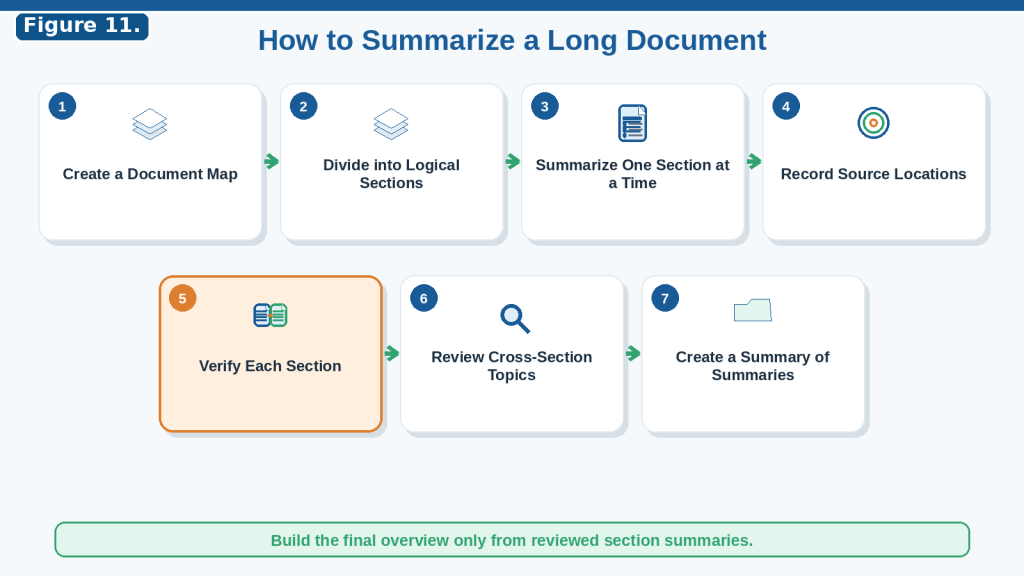
    Figure 11. Long documents are easier to summarize accurately when they are mapped, divided into logical sections, reviewed separately, and combined after verification.

    Figure 11 shows a staged workflow for summarizing a long document. Instead of requesting one immediate summary, the user creates a document map, summarizes each section, checks the results against the source, reviews cross-section topics, and then produces a final summary of summaries.

    How to Summarize Different Types of Documents

    Different documents require different summary instructions. A prompt that works well for meeting notes may not be suitable for a report, study guide, policy, manual, or contract.

    Before writing the prompt, identify:

    · What type of document you have

    · Why you need the summary

    · Which information matters most

    · Whether exact dates, amounts, warnings, or conditions must be preserved

    · Which output format will be easiest to review

    Summarizing a Report

    Reports often contain:

    · A purpose

    · Background information

    · Methods

    · Findings

    · Evidence

    · Recommendations

    · Limitations

    · Conclusions

    A useful report summary should separate findings from recommendations.

    Example prompt:

    Create a section-by-section summary of the attached report. Include the purpose, background, methods, main findings, supporting evidence, recommendations, limitations, and conclusion. Preserve important dates, numbers, and qualifications. Do not add information that is not in the report.

    After receiving the summary, check:

    · Whether the findings are stated accurately

    · Whether recommendations came from the report

    · Whether limitations were preserved

    · Whether statistics match the source

    · Whether conclusions were simplified too much

    Summarizing Meeting Notes

    Meeting notes usually require more attention to decisions, tasks, responsibilities, and deadlines.

    Example prompt:

    Summarize the attached meeting notes. Organize the result under Discussion Topics, Decisions, Action Items, Responsible People, Deadlines, Unresolved Questions, and Next Meeting. Write “Not stated in the document” when a responsibility or deadline is missing. Do not guess.

    A useful action-item table may include:

    TaskResponsible PersonDeadlineStatusSource Section

    Check carefully that ChatGPT did not:

    · Assign a task to the wrong person

    · Combine two separate decisions

    · Invent a deadline

    · Treat a suggestion as an approved decision

    · Omit an unresolved question

    Summarizing an Article

    An article summary should usually identify:

    · The main topic

    · The writer’s central message

    · Important supporting points

    · Examples

    · Conclusions

    · Limitations or opposing views

    Example prompt:

    Summarize the attached article for a complete beginner. Explain the main topic, central message, supporting points, examples, conclusion, and any limitations or opposing views. Do not add outside information.

    When summarizing an opinion article, ask ChatGPT to distinguish between:

    · Facts reported in the article

    · The writer’s opinions

    · Claims that require evidence

    · Conclusions drawn by the writer

    A useful follow-up prompt is:

    Separate the article’s factual statements from the writer’s opinions and interpretations. Do not verify the claims using outside sources unless I ask you to do so.

    Summarizing Study Materials

    Study summaries should help the learner review the material without removing essential explanations.

    They may include:

    · Main concepts

    · Definitions

    · Important facts

    · Examples

    · Processes

    · Formulas

    · Review questions

    · Key terms

    Example prompt:

    Turn the attached study material into beginner-friendly notes. Include the main concepts, definitions, examples, important facts, and step-by-step processes. Add five review questions based only on the document. Mark anything unclear for checking.

    Do not rely on generated study questions alone. Compare the notes with the original material, especially when preparing for:

    · An examination

    · A certification

    · Professional training

    · A school assignment

    · A technical task

    Summarizing Instructions or Manuals

    Instructions and manuals often contain details that should not be shortened carelessly.

    Important information may include:

    · Required tools

    · Preparation steps

    · Numbered procedures

    · Safety warnings

    · Settings

    · Measurements

    · Maintenance instructions

    · Troubleshooting steps

    Example prompt:

    Summarize the attached manual as a beginner-friendly checklist. Preserve the original order of the steps. Include every required tool, preparation step, warning, setting, measurement, and troubleshooting instruction. Do not remove or rewrite warnings in a way that changes their meaning.

    For safety-related instructions, always check the original document before acting.

    A summary should not replace the official manual when operating equipment, handling chemicals, installing electrical items, or performing another potentially dangerous task.

    Summarizing Policies

    Policies may contain:

    · Eligibility rules

    · Responsibilities

    · Restrictions

    · Required documents

    · Deadlines

    · Exceptions

    · Penalties

    · Complaint or appeal procedures

    Example prompt:

    Create a plain-language summary of the attached policy. Organize it under Purpose, Who It Applies To, Requirements, Responsibilities, Restrictions, Exceptions, Deadlines, Penalties, and Contact or Appeal Information. Preserve all conditions and write “Not stated” when information is missing.

    Check the original wording for any rule that affects:

    · Employment

    · Education

    · Benefits

    · Insurance

    · Privacy

    · Eligibility

    · Money

    · Legal rights

    A policy summary is a review aid and should not replace the official policy.

    Summarizing a Contract or Agreement

    Contracts require special care because a short summary can omit a condition that changes the meaning.

    Important areas may include:

    · Names of the parties

    · Services or responsibilities

    · Payment terms

    · Dates

    · Renewal conditions

    · Cancellation terms

    · Warranties

    · Restrictions

    · Penalties

    · Dispute procedures

    · Governing law

    Example prompt:

    Create a plain-language overview of the attached agreement. Separate the parties, responsibilities, payment terms, dates, renewal rules, cancellation terms, restrictions, penalties, and dispute procedures. Preserve important conditions and exceptions. Include the section heading for every major point. Do not provide legal advice or replace the original wording.

    Do not sign, reject, cancel, or change an agreement based only on an AI summary. Review the original and obtain qualified advice when necessary.

    Summarizing a Letter or Notice

    A letter or official notice may require a short action-focused summary.

    Ask ChatGPT to identify:

    · Who sent it

    · Why it was sent

    · What happened

    · What action is required

    · Which documents are needed

    · Important dates

    · Contact information

    · Consequences of not responding

    Example prompt:

    Summarize the attached letter in simple language. Explain who sent it, its purpose, the action required, the deadline, required documents, contact information, and any consequences mentioned. Do not guess missing information.

    Verify the deadline and required action directly from the letter.

    Summarizing a Transcript

    Transcripts may include:

    · Interviews

    · Meetings

    · Lectures

    · Videos

    · Podcasts

    · Customer calls

    · Speeches

    Example prompt:

    Summarize the attached transcript. Organize the result by topic and speaker when the speakers are identified. Include the main ideas, decisions, examples, disagreements, action items, and unanswered questions. Do not assign statements to a speaker unless the transcript identifies them clearly.

    Transcripts may contain:

    · Repeated words

    · Incomplete sentences

    · Speaker-identification errors

    · Misheard names

    · Missing punctuation

    Important quotations and speaker names should be checked against the recording or original transcript.

    Summarizing a Research Paper

    A research-paper summary should usually include:

    · Research question

    · Background

    · Method

    · Participants or data

    · Results

    · Limitations

    · Conclusions

    · Suggested future research

    Example prompt:

    Create a structured summary of the attached research paper. Use the headings Research Question, Background, Method, Data or Participants, Main Results, Limitations, Conclusions, and Future Research. Preserve important measurements, sample sizes, and qualifications. Do not claim that the findings prove more than the paper states.

    Be careful with words such as:

    · Proves

    · Causes

    · Guarantees

    · Always

    · Never

    Many studies identify associations or limited findings rather than universal conclusions.

    Summarizing a Spreadsheet

    Spreadsheets require more than a general text summary.

    Ask ChatGPT to identify:

    · The worksheet used

    · The columns reviewed

    · Date ranges

    · Highest and lowest values

    · Totals

    · Missing values

    · Repeated entries

    · Trends

    · Unusual changes

    Example prompt:

    Review the attached spreadsheet. Identify the worksheet and columns used for each conclusion. Summarize the main trends, highest and lowest values, totals, missing entries, and unusual changes. Show the exact rows or values that support each conclusion. Do not estimate missing numbers.

    Always compare calculated totals and conclusions with the original spreadsheet.

    Summarizing Several Related Documents

    When several documents relate to the same topic, summarize them separately before combining the results.

    Use this workflow:

    1 Summarize Document 1.

    2 Verify its summary.

    3 Summarize Document 2.

    4 Verify its summary.

    5 Repeat for the remaining documents.

    6 Compare the reviewed summaries.

    7 Create a final combined overview.

    Example comparison prompt:

    Compare the reviewed summaries of these documents. Show agreements, differences, conflicting information, missing details, and unique points from each source. Keep each document clearly identified.

    Do not combine sources in a way that hides disagreement.

    Match the Prompt to the Document

    A useful summary prompt changes according to the type of source.

    For example:

    · A report needs findings and limitations.

    · Meeting notes need decisions and action items.

    · Study materials need concepts and definitions.

    · A manual needs ordered steps and warnings.

    · A policy needs conditions and exceptions.

    · A contract needs clauses, dates, responsibilities, and cancellation terms.

    · A spreadsheet needs exact values and source rows.

    Choosing the right summary structure helps ChatGPT focus on the information that matters most.
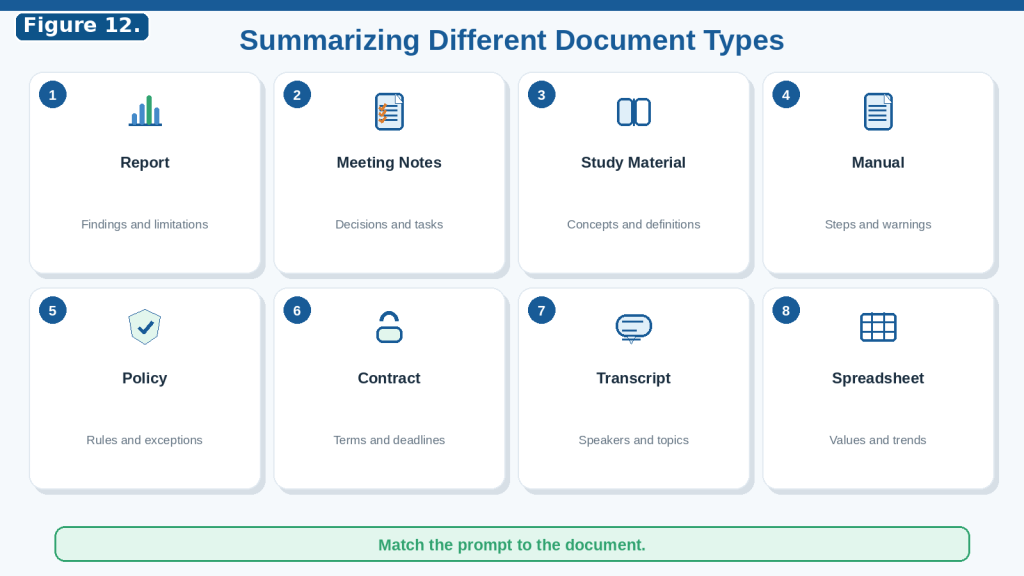
    Figure 12. Different document types require different summary priorities, formats, and verification checks.

    Figure 12 shows that reports, meeting notes, study materials, manuals, policies, contracts, transcripts, and spreadsheets should not all be summarized in the same way. The prompt should focus on the information that is most important for that particular document.

    How to Check and Correct a ChatGPT Document Summary

    A ChatGPT summary should be treated as a draft until you compare it with the original document.

    Even when the summary looks clear and professional, it may contain:

    · Missing information

    · Incorrect dates

    · Changed numbers

    · Confused names

    · Oversimplified conditions

    · Missing warnings

    · Combined rules that should remain separate

    · Statements that are not supported by the document

    A careful review helps you find these problems before you use, save, share, or publish the summary.

    Start with the Document’s Main Purpose

    Read the original document’s title, introduction, and conclusion.

    Then ask:

    · Does the summary explain why the document exists?

    · Does it identify the correct topic?

    · Does it represent the main conclusion accurately?

    · Did it focus on a minor detail instead of the central message?

    For example, a report may discuss several problems but recommend only one main action. The summary should not present every discussion point as an approved recommendation.

    Check Every Name and Role

    Compare all names, job titles, departments, organizations, and responsibilities with the original.

    Look for problems such as:

    · A task assigned to the wrong person

    · Two people combined into one

    · A job title changed

    · An organization name shortened incorrectly

    · A speaker’s opinion presented as an official decision

    When the document does not identify the responsible person, the summary should say:

    Not stated in the document

    It should not guess.

    Check Dates and Deadlines

    Review every date carefully.

    Important dates may include:

    · Application deadlines

    · Meeting dates

    · Payment dates

    · Renewal dates

    · Start dates

    · Completion dates

    · Cancellation periods

    · Review dates

    · Expiry dates

    Check whether the summary explains what each date applies to.

    For example, two deadlines may apply to different groups. The summary should keep them separate.

    A useful checking table is:

    DateWhat It Applies ToSummary Correct?Correction Needed
    March 15Application deadlineYesNone
    April 1Project start dateNoSummary says April 10

    Check Numbers, Amounts, and Measurements

    A single incorrect digit can change the meaning of a document.

    Review:

    · Prices

    · Fees

    · Percentages

    · Quantities

    · Totals

    · Measurements

    · Reference numbers

    · Page numbers

    · Ages

    · Time periods

    · Limits

    Do not assume a number is correct because it looks reasonable.

    When a document says 15%, a summary should not say 50%.

    When a document says 30 days, a summary should not say one month unless that wording preserves the exact meaning.

    Check Conditions and Exceptions

    Conditions explain when a rule applies.

    Exceptions explain when it does not apply.

    These details are often lost in short summaries.

    For example, the document may say:

    A refund is available within 14 days only when the service has not started.

    An unsafe summary might say:

    A refund is available within 14 days.

    The words only when the service has not started are essential.

    Search the original for words such as:

    · Only

    · Unless

    · Except

    · Provided that

    · Subject to

    · Must

    · May

    · Cannot

    · Before

    · After

    · Within

    · Eligible

    · Required

    Confirm that the summary preserves their meaning.

    Check Warnings and Risks

    Warnings should not be shortened so much that they lose their importance.

    Review any information related to:

    · Safety

    · Health

    · Legal obligations

    · Financial loss

    · Privacy

    · Eligibility

    · Penalties

    · Technical damage

    · Employment consequences

    · Insurance coverage

    When the original warning is important, keep the summary close to the source and refer the reader back to the original section.

    Check Whether Important Sections Were Omitted

    Compare the summary headings with the document’s table of contents or main headings.

    Ask:

    · Did every major section receive attention?

    · Were appendices ignored?

    · Were tables excluded?

    · Was the conclusion included?

    · Were final recommendations included?

    · Were limitations included?

    · Were notes or footnotes important?

    A useful follow-up prompt is:

    Compare this summary with the document’s complete list of headings. Identify any major section, appendix, table, warning, or conclusion that is missing from the summary.

    Then confirm the result manually.

    Check for Unsupported Information

    A summary may contain information that sounds logical but does not appear in the source.

    Look for:

    · New recommendations

    · Explanations not found in the document

    · Assumptions about the writer’s intention

    · Outside facts

    · Estimated values

    · Advice that was not requested

    · Conclusions stronger than the source supports

    Use this follow-up prompt:

    Highlight every statement in your summary that is not directly supported by the attached document. Remove unsupported information and identify the source location for each remaining major point.

    ChatGPT may still make mistakes during this review, so check the answer yourself.

    Check Whether Separate Rules Were Combined

    Similar information may apply to different:

    · Groups

    · Products

    · Plans

    · Locations

    · Departments

    · Time periods

    · Eligibility categories

    · Contract sections

    For example:

    · One fee applies to new customers.

    · Another fee applies to existing customers.

    · One deadline applies to online applications.

    · Another applies to mailed applications.

    The summary should not turn them into one general rule.

    Ask ChatGPT:

    Review the summary and keep separate groups, rules, dates, fees, and conditions clearly separated. State which group or section each point applies to.

    Check the Level of Simplification

    Simple language should improve understanding without changing meaning.

    A summary may be too simple when it removes:

    · Essential context

    · Conditions

    · Exceptions

    · Technical distinctions

    · Uncertainty

    · Limitations

    · Safety information

    Compare the simplified sentence with the original paragraph.

    Ask:

    · Does it still mean the same thing?

    · Is anything important missing?

    · Does it sound more certain than the source?

    · Could a beginner misunderstand it?

    When necessary, use:

    Rewrite this section in simple language, but preserve every condition, exception, warning, limitation, date, and number.

    Mark Corrections Clearly

    Do not correct several different problems without keeping a record.

    A simple correction log may include:

    Summary StatementProblemCorrect InformationSource Location
    Payment is due May 1Incorrect datePayment is due May 15Page 4
    Manager approves all expensesToo broadManager approves expenses over the stated limitSection 3

    This helps you:

    · Track what changed

    · Avoid repeating errors

    · Explain corrections to another reviewer

    · Create a reliable final version

    Ask ChatGPT to Revise Only the Incorrect Part

    A full rewrite may introduce new errors.

    When possible, correct one section at a time.

    For example:

    Replace only the Dates and Deadlines section. Use the corrected dates below and keep every deadline connected to the correct group.

    Or:

    Rewrite only the Warnings section. Preserve the original meaning and include the source location for each warning.

    This is usually easier to check than generating the complete summary again.

    Create a Final Reviewed Version

    After all corrections are complete, request a clean final summary.

    Example prompt:

    Create a final summary using only the information we have verified. Organize it under Purpose, Main Points, Dates and Deadlines, Conditions and Exceptions, Warnings, Responsibilities, Action Items, and Information Still Unclear. Do not reintroduce information that was removed or corrected.

    Compare the final version with your correction log before saving it.

    Label the Summary Appropriately

    Do not present an AI-generated summary as though it were the complete original document.

    A useful note is:

    This summary was created with AI assistance and reviewed against the original document. Readers should consult the original source for complete wording, conditions, and official requirements.

    A disclosure may be especially useful when the summary is:

    · Shared with other people

    · Published online

    · Used in training

    · Included in business records

    · Used to support an important decision

    Save the Review Records

    Keep these files together when appropriate:

    · Original document

    · Safe upload copy

    · Original prompt

    · First summary

    · Correction log

    · Final reviewed summary

    · Date of review

    · Name of the reviewer

    · Source references

    This record helps show how the summary was created and checked.

    Final Verification Checklist

    Before using the summary, confirm:

    · The purpose is correct.

    · Main sections are represented.

    · Names and roles are accurate.

    · Dates and deadlines are correct.

    · Numbers and amounts match the source.

    · Conditions and exceptions are preserved.

    · Warnings remain clear.

    · Separate rules are not combined.

    · Unsupported information was removed.

    · Missing information is labelled.

    · Important source locations were checked.

    · The final version matches the correction log.

    · The original document remains available.

    A summary is ready to use only after important information has been checked against the original document.
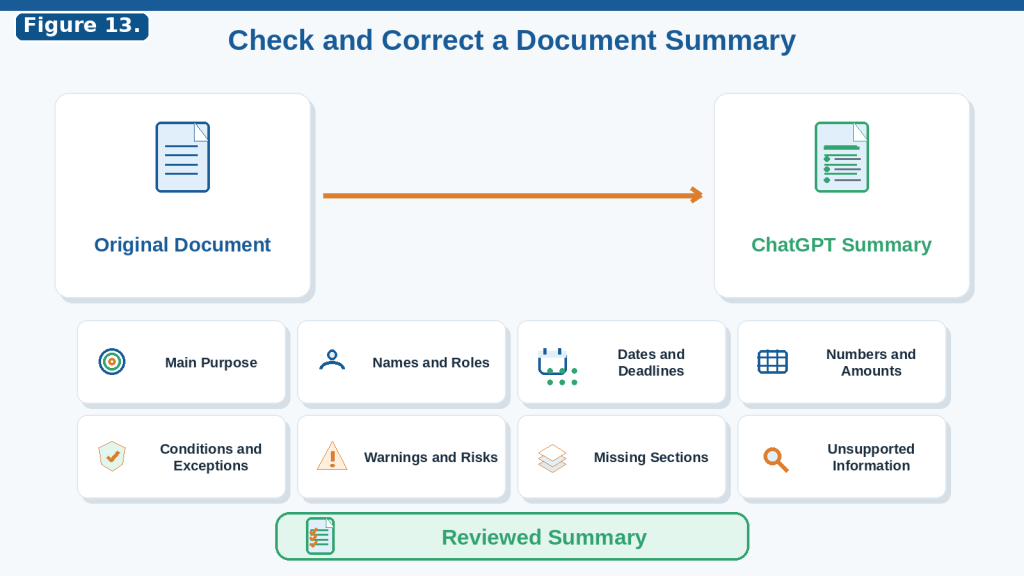
    Figure 13. A reliable summary review checks names, dates, numbers, conditions, warnings, missing sections, and unsupported information against the original document.

    Figure 13 shows the main verification checks that beginners should complete before accepting a ChatGPT summary. The final version should be corrected, compared with the original, and saved with a clear record of the review.

    Benefits of Using ChatGPT to Summarize Documents

    ChatGPT can make long or complicated documents easier to review when it is used carefully.

    The benefits depend on:

    · The quality of the original document

    · Whether the file can be read correctly

    · The clarity of the prompt

    · The type of summary requested

    · Whether the result is checked against the source

    ChatGPT should support your review process rather than replace the original document.

    Saves Time During an Initial Review

    A long document may take considerable time to read from beginning to end.

    A summary can help you identify:

    · The document’s purpose

    · Its main topics

    · Important conclusions

    · Sections that require closer reading

    · Whether the document is relevant to your needs

    For example, a short overview of a 40-page report may help you decide which sections to examine first.

    This does not mean you can ignore the complete document. Important conditions, warnings, or exceptions may not appear in a short summary.

    Makes Difficult Information Easier to Understand

    Documents may contain:

    · Technical language

    · Long sentences

    · Unfamiliar terminology

    · Formal wording

    · Repeated explanations

    · Complicated section structures

    ChatGPT can rewrite important ideas in simpler language.

    For example:

    Explain this section for a complete beginner. Define technical terms, but preserve all dates, numbers, conditions, exceptions, and warnings.

    This can make the material more approachable without intentionally changing its meaning.

    However, simplified explanations must still be compared with the source.

    Organizes Information Clearly

    ChatGPT can reorganize document content into:

    · Headings

    · Bullet points

    · Tables

    · Checklists

    · Timelines

    · Action-item lists

    · Study notes

    · Question-and-answer formats

    A clear structure can make important information easier to find.

    For example, meeting notes can be organized under:

    · Decisions

    · Tasks

    · Responsible people

    · Deadlines

    · Unresolved questions

    This may be easier to review than several pages of unstructured notes.

    Helps Identify Key Points

    A document may contain background details, examples, repetition, and supporting information.

    ChatGPT can help identify:

    · Main arguments

    · Central findings

    · Important requirements

    · Recommendations

    · Risks

    · Warnings

    · Deadlines

    · Responsibilities

    You can control which details receive attention through the prompt.

    For example:

    Focus on eligibility requirements, required documents, deadlines, exceptions, and appeal procedures.

    This is more useful than requesting only a general summary when you have a specific purpose.

    Extracts Dates, Names, Numbers, and Action Items

    ChatGPT can help gather repeated information from different sections.

    For example, you may ask it to create:

    · A list of all deadlines

    · A table of names and responsibilities

    · A timeline of events

    · A list of required documents

    · A record of costs and amounts

    · An action-item checklist

    Example prompt:

    List every deadline in the document. For each one, state what it applies to, who is responsible, and where it appears in the document.

    This can make manual review faster.

    Every extracted date, name, number, and responsibility must still be checked against the source.

    Produces Several Summary Formats

    The same document can be summarized in different ways for different readers.

    For example, ChatGPT may create:

    · A one-paragraph overview for quick review

    · A detailed summary for careful reading

    · A plain-language version for beginners

    · An executive summary for a manager

    · Study notes for a learner

    · An action list for a project team

    · A timeline for events and deadlines

    This flexibility allows one source document to support several legitimate needs.

    Each version should remain faithful to the original.

    Supports Follow-Up Questions

    After receiving a summary, you can ask focused questions about the same document.

    For example:

    Which section explains the cancellation rules?

    What conditions apply to the application deadline?

    Which person is responsible for each task?

    What information is missing or unclear?

    Which conclusion is supported by the table on page 12?

    Follow-up questions can help you examine one issue at a time.

    This is often more useful than requesting a much longer summary immediately.

    Helps Compare Related Documents

    ChatGPT can help compare two or more documents after each one has been summarized and checked separately.

    A comparison may identify:

    · Agreements

    · Differences

    · Conflicting information

    · Changes between versions

    · Missing sections

    · Different deadlines

    · Different responsibilities

    · Unique recommendations

    Example prompt:

    Compare the two reviewed summaries. Show what is the same, what is different, and which source supports each point. Keep conflicting information clearly separated.

    This can be useful for:

    · Updated policies

    · Revised contracts

    · Different reports

    · Product guides

    · Meeting records

    · Research documents

    Do not combine documents before verifying each one individually.

    Supports Learning and Study

    ChatGPT can turn educational documents into:

    · Beginner-friendly notes

    · Definitions

    · Concept summaries

    · Review questions

    · Flashcard-style prompts

    · Checklists

    · Topic outlines

    For example:

    Turn this chapter into study notes containing key concepts, definitions, examples, and five review questions. Use only the information in the document.

    This can support revision, but it should not replace the original material when accuracy is important for an examination, certification, or professional task.

    Helps Readers Who Need Simpler Organization

    Some readers may find long, dense, or poorly organized documents difficult to navigate.

    A structured summary may help by:

    · Dividing long paragraphs

    · Explaining technical terms

    · Grouping related information

    · Highlighting action items

    · Presenting events in order

    · Reducing unnecessary repetition

    This may improve accessibility for some readers, including people reading in a second language or people who benefit from shorter sections.

    A generated summary is not automatically accessible to everyone. Check:

    · Heading structure

    · Reading order

    · Table clarity

    · Colour contrast

    · Link wording

    · Alternative text

    · Plain-language quality

    Accessibility needs vary from person to person.

    Creates a Useful Starting Point for Other Tasks

    After verifying the summary, you may use it as a starting point for:

    · A presentation outline

    · Meeting preparation

    · Study notes

    · A project checklist

    · A plain-language explanation

    · An internal report

    · A list of follow-up questions

    · A website draft

    The summary should be checked before it becomes the basis for another document.

    An error in the first summary may be repeated in every later output.

    Supports Better Record Organization

    Saving the original document, prompts, draft summaries, corrections, and final reviewed version creates an organized record.

    This may help you:

    · Find the source later

    · Understand how the summary was produced

    · Identify corrections

    · Share the review process with another person

    · Compare future versions

    · Avoid overwriting the original

    Use clear filenames and keep the files in the same project folder.

    The Benefits Depend on Careful Use

    ChatGPT is most useful when you:

    1 Prepare a safe document copy.

    2 Write a clear prompt.

    3 Request the right summary format.

    4 Review the first response.

    5 Compare important details with the source.

    6 Correct specific errors.

    7 Save only the reviewed version.

    Without these checks, a fast summary may create confusion instead of saving time.

    The main benefit is not simply making a document shorter. It is helping the reader find, organize, and understand important information more efficiently while keeping the original available for verification.
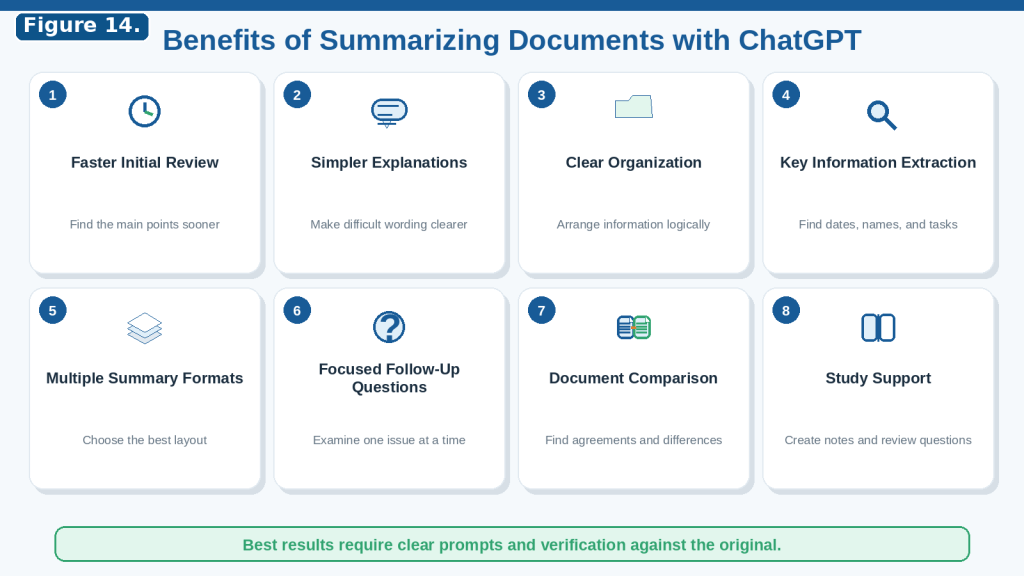
    Figure 14. ChatGPT can support faster review, clearer understanding, better organization, focused extraction, follow-up questions, comparison, and study.

    Figure 14 summarizes the main benefits of using ChatGPT for document review. These benefits are most reliable when the user provides clear instructions, protects private information, checks the summary against the original, and saves a reviewed version.

    Limitations of Using ChatGPT to Summarize Documents

    ChatGPT can help reduce and organize a document, but it cannot guarantee that the summary is complete, accurate, or suitable for every purpose.

    Understanding the limitations helps beginners use document summaries more carefully.

    ChatGPT May Omit Important Details

    A summary is shorter than the original document, so some information must be removed.

    ChatGPT may omit:

    · Conditions

    · Exceptions

    · Examples

    · Definitions

    · Warnings

    · Footnotes

    · Supporting evidence

    · Information in appendices

    · Details that appear only once

    A missing detail may seem minor but could change the meaning of the document.

    For example, a policy may allow an action only under specific conditions. A short summary may mention the permission but leave out the conditions.

    How to Reduce This Limitation: Ask ChatGPT to preserve all conditions, exceptions, warnings, dates, numbers, responsibilities, and deadlines. Compare the summary with the original before using it.

    ChatGPT May Simplify Information Too Much

    Simple language can improve understanding, but excessive simplification may remove important context.

    For example, the original document may say:

    Applications are accepted within 30 days when all required documents have been submitted and eligibility has been confirmed.

    An oversimplified summary might say:

    Applications are accepted within 30 days.

    The shortened version removes two important conditions.

    How to Reduce This Limitation: Use a prompt such as:

    Rewrite this section in simple language, but preserve every condition, exception, warning, limitation, date, and number.

    ChatGPT May Misunderstand the Document

    ChatGPT may misunderstand:

    · The document’s purpose

    · The relationship between two sections

    · Which rule applies to which group

    · Whether a statement is a fact, opinion, or recommendation

    · Whether a decision was approved or only discussed

    · Whether an example is a general rule

    This may happen when the document is long, complicated, poorly organized, or written in unclear language.

    How to Reduce This Limitation: Ask for a section-by-section summary and identify the exact headings, pages, or tables that should be reviewed. Keep separate groups and rules clearly labelled.

    ChatGPT May Combine Separate Information Incorrectly

    Similar information may appear in different sections but apply to different:

    · People

    · Plans

    · Locations

    · Dates

    · Products

    · Departments

    · Eligibility groups

    · Contract clauses

    ChatGPT may incorrectly combine these points into one general statement.

    For example:

    · A 14-day deadline may apply to online applications.

    · A 30-day deadline may apply to mailed applications.

    An incorrect summary might say that every application has a 30-day deadline.

    How to Reduce This Limitation: Ask ChatGPT to keep separate rules, dates, amounts, groups, and conditions clearly separated and to identify which section each point came from.

    ChatGPT May Misread Names, Dates, and Numbers

    ChatGPT may incorrectly reproduce:

    · Names

    · Job titles

    · Dates

    · Prices

    · Percentages

    · Measurements

    · Reference numbers

    · Account identifiers

    · Deadlines

    A single incorrect digit can create a serious problem.

    For example:

    · 15% may become 50%.

    · June 13 may become June 30.

    · 30 days may become 3 days.

    How to Reduce This Limitation: Ask ChatGPT to extract important facts into a table with source locations. Check every name, date, amount, percentage, and deadline against the original.

    ChatGPT May Struggle with Scanned or Image-Based Documents

    A scanned PDF may contain pictures of pages rather than selectable text.

    Problems may include:

    · Blurred words

    · Missing characters

    · Incorrect numbers

    · Unreadable handwriting

    · Cropped pages

    · Shadows

    · Skewed pages

    · Low contrast

    · Confused columns

    ChatGPT cannot summarize text it cannot read correctly.

    How to Reduce This Limitation: Use a clear text-based PDF or DOCX when possible. For scanned pages, improve the scan quality or upload important pages separately as clear images.

    ChatGPT May Miss Information in Tables and Charts

    Tables, charts, diagrams, and other visual elements may contain important information that does not appear in the surrounding text.

    ChatGPT may:

    · Skip a table

    · Read rows in the wrong order

    · Combine columns incorrectly

    · Misread a chart label

    · Miss information shown only by colour

    · Misinterpret a diagram

    How to Reduce This Limitation: Ask ChatGPT to identify every table, chart, and diagram it could not interpret confidently. Upload important visuals separately and compare the explanation with the original.

    ChatGPT May Add Unsupported Information

    ChatGPT may sometimes include information that sounds reasonable but does not appear in the document.

    This may include:

    · Extra explanations

    · Assumptions

    · New recommendations

    · Outside facts

    · Estimated values

    · Advice

    · Stronger conclusions than the source supports

    This is sometimes called a hallucination. In AI, a hallucination is an answer that sounds confident but contains invented or unsupported information.

    How to Reduce This Limitation: Include this instruction:

    Use only information contained in the document. Do not add outside information. Clearly label anything uncertain or missing.

    Then verify every major statement.

    ChatGPT May Sound More Certain Than the Source

    A document may use cautious language such as:

    · May

    · Might

    · Could

    · Appears

    · Suggests

    · Possibly

    · In some cases

    ChatGPT may unintentionally make the statement sound definite.

    For example:

    Original:

    The results suggest that the change may improve performance.

    Unsafe summary:

    The change improves performance.

    The summary changes a cautious finding into a definite claim.

    How to Reduce This Limitation: Ask ChatGPT to preserve uncertainty, qualifications, and limitations exactly as stated in the source.

    ChatGPT May Not Recognize Missing Information

    A document may fail to state:

    · A deadline

    · A responsible person

    · A cost

    · A contact method

    · A required document

    · A next step

    · An exception

    ChatGPT may try to complete the missing information based on context.

    How to Reduce This Limitation: Tell ChatGPT to write Not stated in the document whenever important information is missing.

    Long Documents May Receive Uneven Attention

    In a very long document, some sections may receive more attention than others.

    The summary may describe the introduction clearly but provide less detail about:

    · Middle chapters

    · Appendices

    · Final recommendations

    · Tables

    · Footnotes

    · Supporting documents

    How to Reduce This Limitation: Create a document map, summarize one section at a time, verify each section, and then create a final summary from the reviewed section summaries.

    Different Prompts Can Produce Different Summaries

    The same document may produce different results depending on:

    · The wording of the prompt

    · The requested length

    · The intended audience

    · The selected format

    · The information emphasized

    · The conversation context

    For example, one prompt may focus on deadlines while another focuses on risks.

    Neither summary may be complete by itself.

    How to Reduce This Limitation: Decide your purpose before writing the prompt. Request the most important summary first, review it, and ask for a second format only when needed.

    A Summary Can Lose the Writer’s Tone and Emphasis

    The original document may use:

    · Formal language

    · Cautious wording

    · Strong warnings

    · Emotional emphasis

    · Technical precision

    · Deliberate repetition

    A summary may reduce or change this tone.

    This matters when the wording helps show:

    · Urgency

    · Uncertainty

    · Legal importance

    · Safety importance

    · Professional meaning

    · The writer’s viewpoint

    How to Reduce This Limitation: Ask ChatGPT to preserve the original level of certainty and identify any wording that should be checked directly in the source.

    ChatGPT Cannot Confirm That a Document Is True

    ChatGPT can summarize what a document says, but that does not prove the document is accurate.

    A document may contain:

    · Outdated information

    · Incorrect claims

    · Biased arguments

    · Missing evidence

    · False statistics

    · Misleading conclusions

    · Unverified statements

    A clear summary can still summarize incorrect information accurately.

    How to Reduce This Limitation: Separate summarization from fact-checking. First summarize the document. Then verify important claims using current, reliable, and preferably original sources.

    A Summary Does Not Replace Professional Advice

    An AI summary should not replace qualified advice for documents involving:

    · Legal rights

    · Contracts

    · Medical treatment

    · Financial decisions

    · Taxes

    · Insurance

    · Employment disputes

    · Safety procedures

    · Technical operations

    ChatGPT may help explain the document, but a qualified professional may need to review the original wording and your specific situation.

    How to Reduce This Limitation: Use the summary only for initial understanding. Check the original document and seek appropriate professional advice when the decision could affect health, safety, money, rights, or legal responsibilities.

    Privacy and Permission Risks Remain

    Removing private information reduces risk, but it does not automatically make every document suitable for uploading.

    The document may still be:

    · Confidential

    · Copyright protected

    · Restricted by an employer

    · Covered by a customer agreement

    · Subject to privacy rules

    · Owned by another person or organization

    How to Reduce This Limitation: Confirm that you have permission, remove unnecessary information, check organizational rules, and do not upload a document when confidentiality requirements prohibit it.

    The Summary Still Requires Human Review

    ChatGPT may produce a polished response that appears complete.

    Professional formatting does not prove accuracy.

    A responsible user must still:

    1 Review the summary.

    2 Compare it with the original.

    3 Check important facts.

    4 Correct missing or inaccurate information.

    5 Save only the reviewed version.

    The most important limitation is that ChatGPT cannot take responsibility for deciding whether the summary is safe and accurate enough for your purpose.
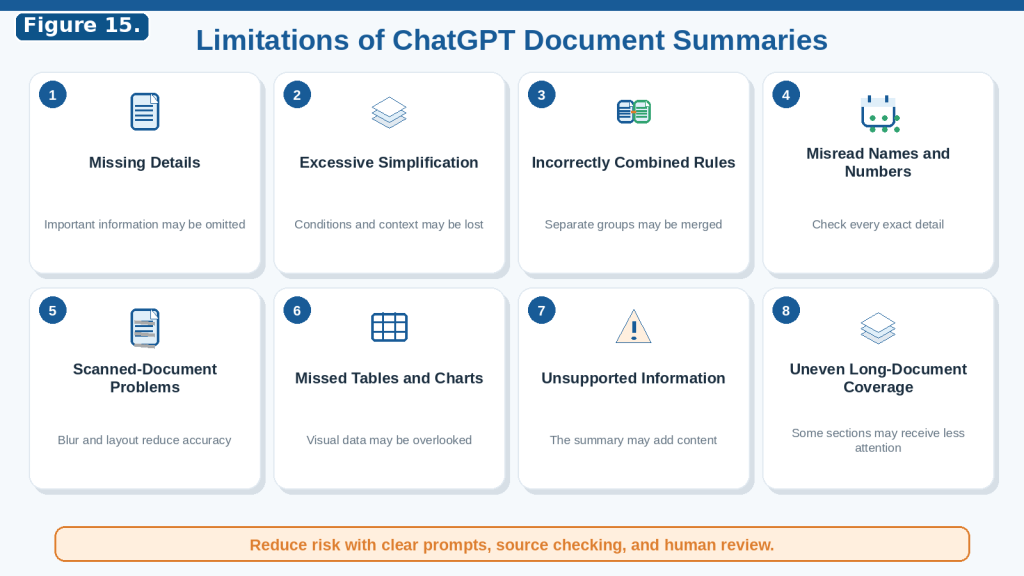
    Figure 15. ChatGPT document summaries may omit details, simplify conditions, misread visual information, add unsupported content, or present uncertain information too confidently.

    Figure 15 highlights the main limitations beginners should understand before relying on a document summary. Each limitation can be reduced through clearer prompts, safer document preparation, focused questions, source references, and careful comparison with the original.

    Common Mistakes When Summarizing Documents with ChatGPT

    Beginners often focus on getting a fast summary and forget to check how the document was prepared, what the prompt requested, and whether the result matches the source.

    The following mistakes can reduce accuracy, create privacy risks, or produce a summary that is unsuitable for its intended purpose.

    Mistake 1: Uploading the Original Confidential Document

    Uploading the original file without reviewing it may expose information that ChatGPT does not need.

    The document may contain:

    · Personal names

    · Addresses

    · Account numbers

    · Signatures

    · Customer information

    · Employee records

    · Private comments

    · Tracked changes

    · Hidden metadata

    · Confidential business information

    Deleting visible text is not always enough because private information may remain in comments, headers, footers, properties, hidden rows, or embedded files.

    How to Avoid This Mistake: Keep the original unchanged. Create a separate safe upload copy, remove unnecessary private information, check hidden content, and confirm that you have permission to use the document.

    Mistake 2: Using Only “Summarize This Document”

    A very short prompt gives ChatGPT little direction.

    It does not explain:

    · Why you need the summary

    · Who will read it

    · Which details matter

    · Which format you prefer

    · How long it should be

    · What information must not be omitted

    The result may be too general or focus on the wrong parts.

    How to Avoid This Mistake: Explain the purpose, audience, required details, output format, desired length, and accuracy rules.

    For example:

    Summarize the attached report for a complete beginner. Include its purpose, main findings, dates, numbers, recommendations, limitations, warnings, and action items. Organize the result under clear headings. Do not add information that is not in the document.

    Mistake 3: Asking for an Extremely Short Summary

    A one-sentence or one-paragraph summary may be useful for a quick overview, but it can remove important context.

    An extremely short summary may leave out:

    · Conditions

    · Exceptions

    · Deadlines

    · Warnings

    · Responsibilities

    · Supporting evidence

    · Limitations

    · Required actions

    How to Avoid This Mistake: Match the requested length to the importance and complexity of the document. Use a detailed or section-by-section summary when important conditions must be preserved.

    Mistake 4: Failing to Explain the Intended Audience

    A summary for a complete beginner should not use the same language as a summary for a technical specialist.

    Without an audience, ChatGPT may produce wording that is:

    · Too technical

    · Too simple

    · Too formal

    · Too detailed

    · Missing necessary explanations

    How to Avoid This Mistake: State who will use the summary.

    For example:

    Explain the document for a complete beginner and define technical terms when they first appear.

    Simpler language should not remove important conditions, warnings, dates, or numbers.

    Mistake 5: Trusting the First Summary Immediately

    A polished summary may appear complete even when it contains mistakes.

    It may:

    · Omit a section

    · Change a date

    · Confuse two names

    · Combine separate rules

    · Simplify a warning

    · Add an unsupported explanation

    · Misread a number

    How to Avoid This Mistake: Treat the first response as a draft. Compare it with the original before copying, sharing, publishing, or acting on it.

    Mistake 6: Checking Only the Main Ideas

    A summary may explain the general topic correctly while still getting important details wrong.

    Beginners may check the overall meaning but forget to verify:

    · Names

    · Roles

    · Dates

    · Deadlines

    · Amounts

    · Percentages

    · Measurements

    · Conditions

    · Exceptions

    · Penalties

    · Required documents

    How to Avoid This Mistake: Use a verification checklist and check each important detail separately.

    Mistake 7: Ignoring Tables, Charts, and Images

    Important information may appear only in:

    · Tables

    · Charts

    · Diagrams

    · Scanned forms

    · Captions

    · Photographs

    · Colour-coded sections

    A text summary may not represent these elements accurately.

    How to Avoid This Mistake: Ask ChatGPT to identify any visual material it could not interpret confidently. Upload important tables, charts, or pages separately when necessary and check them manually.

    Mistake 8: Summarizing a Long Document in One Step

    One broad prompt may not give equal attention to every part of a long document.

    The summary may focus on:

    · The introduction

    · Early chapters

    · Repeated topics

    · Easily recognized sections

    It may give less attention to:

    · Middle chapters

    · Appendices

    · Footnotes

    · Tables

    · Final recommendations

    · Exceptions

    How to Avoid This Mistake: Create a document map, divide the file into logical sections, summarize one section at a time, verify each section, and then create a final summary from the reviewed parts.

    Mistake 9: Combining Too Many Tasks in One Prompt

    A prompt may ask ChatGPT to:

    · Summarize

    · Translate

    · Analyze

    · Fact-check

    · Compare documents

    · Write an email

    · Create a presentation

    · Recommend a decision

    When too many tasks are combined, it becomes difficult to know which part caused an error.

    How to Avoid This Mistake: Complete one task at a time:

    1 Summarize the document.

    2 Verify the summary.

    3 Correct missing information.

    4 Request another format.

    5 Analyze or compare it separately.

    6 Create a final output after verification.

    Mistake 10: Allowing ChatGPT to Guess Missing Information

    A document may not state a deadline, responsible person, amount, or next step.

    ChatGPT may produce a likely answer based on the surrounding context.

    A likely answer is not the same as a documented fact.

    How to Avoid This Mistake: Add this instruction:

    Write “Not stated in the document” whenever important information is missing. Do not guess.

    Mistake 11: Using the Summary Instead of the Original

    A summary is designed to be shorter. It cannot contain every sentence, example, condition, and explanation from the source.

    Relying only on the summary may be unsafe when the document concerns:

    · Contracts

    · Legal rights

    · Medical treatment

    · Financial decisions

    · Insurance

    · Employment

    · Safety

    · Eligibility

    · Technical instructions

    How to Avoid This Mistake: Keep the original document available and return to the exact wording whenever accuracy matters.

    Mistake 12: Presenting the Summary as an Official Document

    An AI-generated summary is not automatically an official version of the source.

    Readers may incorrectly assume that it:

    · Was approved by the document’s author

    · Contains every requirement

    · Replaces the original

    · Has been professionally reviewed

    · Can be used as legal or official evidence

    How to Avoid This Mistake: Label the summary clearly.

    For example:

    This AI-assisted summary is provided for initial review. Consult the original document for complete wording, conditions, and official requirements.

    Mistake 13: Failing to Save the Prompt and Corrections

    Saving only the final summary removes the record of how it was created.

    Without the prompt and correction notes, it may be difficult to understand:

    · What ChatGPT was asked to do

    · Which errors were found

    · What information was corrected

    · Which version is final

    · When the summary was reviewed

    How to Avoid This Mistake: Save the original document, safe copy, prompt, first summary, correction log, reviewed summary, and review date in one organized folder.

    Mistake 14: Assuming the Source Document Is Accurate

    ChatGPT can summarize incorrect or outdated information clearly.

    A professional-looking summary does not prove that the original source is trustworthy.

    How to Avoid This Mistake: Treat summarization and fact-checking as separate tasks. Verify important claims using current, reliable sources when accuracy beyond the document is required.

    Mistake 15: Sharing the Summary Without a Final Review

    A summary may be copied into:

    · An email

    · A report

    · A website

    · A presentation

    · Meeting notes

    · Study material

    · Business records

    An error in the summary may then be repeated in several places.

    How to Avoid This Mistake: Complete a final comparison with the original before sharing or repurposing the summary.

    Common-Mistake Checklist

    Before accepting a summary, confirm that you did not:

    · Upload an unsafe original file

    · Use an unclear prompt

    · Request an overly short result

    · Forget to identify the audience

    · Trust the first response immediately

    · Ignore names, dates, numbers, or conditions

    · Overlook tables and images

    · Summarize a long document in one step

    · Combine too many tasks

    · Allow missing information to be guessed

    · Replace the original with the summary

    · Present the result as an official document

    · Lose the prompt and correction record

    · Assume the original source is accurate

    · Share the summary before final verification

    Avoiding these mistakes makes the summarization process safer, clearer, and easier to review.

    Figure 16. Common document-summarization mistakes include uploading unsafe files, using vague prompts, trusting the first response, ignoring visual information, and failing to verify the result.

    Figure 16 shows the mistakes that most often reduce the reliability of a ChatGPT document summary. Beginners can avoid them by preparing a safe copy, giving clear instructions, reviewing the complete source, correcting specific problems, and saving a verified final version.

    Common Myths About Summarizing Documents with ChatGPT

    ChatGPT can make document review faster and easier, but beginners may misunderstand what it can do.

    The following myths can lead to inaccurate summaries, privacy problems, or overconfidence in the result.

    Myth 1: ChatGPT Reads Every Document Perfectly

    Some users assume that a successful upload means ChatGPT understood every page, paragraph, table, image, and footnote correctly.

    Reality: ChatGPT may miss or misread information, especially when the document contains:

    · Scanned pages

    · Small text

    · Complicated tables

    · Charts and diagrams

    · Handwriting

    · Multiple columns

    · Damaged pages

    · Unusual formatting

    · Important information inside images

    A document can upload successfully even when some content is difficult to interpret.

    Always ask ChatGPT to identify anything it could not read confidently and compare important details with the original.

    Myth 2: A Professional-Looking Summary Must Be Accurate

    ChatGPT can produce a polished summary with clear headings, tables, and confident wording.

    Reality: Good presentation does not prove that the information is correct.

    A professional-looking summary may still contain:

    · Incorrect dates

    · Changed numbers

    · Missing conditions

    · Confused responsibilities

    · Unsupported statements

    · Oversimplified warnings

    Accuracy must be checked against the source, regardless of how polished the response appears.

    Myth 3: A Summary Contains Everything Important

    A summary is shorter than the original, so some information must be removed.

    Reality: ChatGPT may not know which details matter most for your purpose.

    For example:

    · A student may need definitions and examples.

    · A manager may need decisions and deadlines.

    · A customer may need costs and cancellation conditions.

    · A technician may need measurements and warnings.

    Tell ChatGPT what information to prioritize, and check that nothing essential was omitted.

    Myth 4: ChatGPT Can Replace Reading the Original Document

    A summary can help you understand the main ideas quickly.

    Reality: A summary should not automatically replace the complete source.

    The original document may contain:

    · Exact wording

    · Important definitions

    · Exceptions

    · Conditions

    · Footnotes

    · Supporting evidence

    · Official instructions

    · Detailed warnings

    Return to the original whenever the document affects health, safety, money, rights, employment, insurance, eligibility, contracts, or technical work.

    Myth 5: ChatGPT Knows Which Information Is Most Important

    ChatGPT can identify topics that appear central, but it does not know your personal purpose unless you explain it.

    Reality: The same document may require several different summaries.

    For example, meeting notes could be summarized as:

    · A general overview

    · A list of decisions

    · An action-item table

    · A deadline timeline

    · A list of unresolved questions

    Explain your purpose and intended audience in the prompt.

    Myth 6: ChatGPT Will Never Invent Missing Details

    Some users expect ChatGPT to leave every missing field blank automatically.

    Reality: ChatGPT may sometimes infer or supply information that seems likely but is not directly stated in the document.

    For example, it might:

    · Assign a task to the person who discussed it

    · Estimate a missing deadline

    · Treat a suggestion as a decision

    · Add a likely explanation

    · Complete an incomplete sequence

    Use this instruction:

    Write “Not stated in the document” whenever important information is missing. Do not guess.

    Then verify the result.

    Myth 7: A Shorter Summary Is Always Better

    A short summary is easier to read.

    Reality: A summary can become misleading when it is shortened too much.

    Excessive shortening may remove:

    · Conditions

    · Exceptions

    · Context

    · Uncertainty

    · Limitations

    · Warnings

    · Supporting evidence

    Choose the length according to the document’s complexity and your purpose.

    A detailed summary may be more suitable than a short overview when important requirements must be preserved.

    Myth 8: Simple Language Cannot Change the Meaning

    Plain language can make a document easier for beginners to understand.

    Reality: Simplification may change the meaning when important technical distinctions or conditions are removed.

    For example:

    Original:

    Applicants may receive assistance after eligibility has been confirmed and all required documents have been approved.

    Oversimplified summary:

    Applicants will receive assistance.

    The simplified version removes important conditions and changes may into will.

    Ask ChatGPT to simplify the language while preserving qualifications, conditions, exceptions, dates, amounts, and warnings.

    Myth 9: ChatGPT Can Confirm That the Document Is True

    ChatGPT may accurately explain what a document says.

    Reality: Summarizing a claim does not verify that the claim is correct.

    The source document itself may contain:

    · Old information

    · Incorrect statistics

    · Unsupported opinions

    · Misleading conclusions

    · Incomplete evidence

    · Outdated procedures

    Summarization and fact-checking are separate tasks.

    First determine what the document says. Then verify important claims using appropriate reliable sources when necessary.

    Myth 10: Uploading a Document Is Safe Because It Is Only Being Summarized

    A document may appear harmless because the task is simple.

    Reality: The file may still contain private, confidential, restricted, copyrighted, or organizational information.

    The type of task does not remove the need to check:

    · Permission

    · Privacy

    · Confidentiality

    · Workplace rules

    · Customer agreements

    · Ownership

    · Hidden metadata

    Create a safe copy and upload only the information required for the task.

    Myth 11: ChatGPT Understands Every Table and Chart Automatically

    Tables and charts may look clear to a human reader.

    Reality: ChatGPT may misunderstand:

    · Row and column relationships

    · Legends

    · Colour coding

    · Units

    · Footnotes

    · Labels

    · Merged cells

    · Chart scales

    Ask ChatGPT to identify the exact values and source locations used in its conclusions.

    Check important figures yourself.

    Myth 12: One Prompt Is Enough for Every Document

    Some users reuse the same general prompt for reports, contracts, meeting notes, study materials, and spreadsheets.

    Reality: Different documents require different priorities.

    For example:

    · Reports need findings and limitations.

    · Meeting notes need decisions and tasks.

    · Contracts need terms, responsibilities, and cancellation rules.

    · Manuals need ordered steps and warnings.

    · Spreadsheets need exact values and supporting rows.

    Match the prompt to the type of document.

    Myth 13: ChatGPT’s Second Review Guarantees That the First Summary Is Correct

    You can ask ChatGPT to review its own summary.

    Reality: A second AI review can still repeat or introduce errors.

    Self-checking may help identify problems, but it is not the same as independent human verification.

    You should still compare:

    · Names

    · Dates

    · Numbers

    · Conditions

    · Warnings

    · Source references

    with the original document.

    Myth 14: Deleting the Chat Corrects an Unsafe Upload

    Deleting a conversation may remove it from your account according to the service’s applicable retention process.

    Reality: Deletion does not change the fact that an unsuitable file was uploaded.

    Privacy and permission checks must happen before uploading.

    Do not rely on later deletion as a substitute for safe preparation.

    Myth 15: An AI Summary Is an Official Version of the Document

    A summary may be clear enough to share with other people.

    Reality: An AI-generated summary is not automatically:

    · Approved by the author

    · Accepted by an organization

    · Legally authoritative

    · Professionally reviewed

    · Complete

    · Suitable as evidence

    Label shared summaries clearly and direct readers to the original document for complete and official wording.

    A Safer Way to Think About Document Summaries

    A ChatGPT summary is best treated as:

    · A reading aid

    · A first review

    · An organizational tool

    · A way to identify questions

    · A draft that requires checking

    It should not be treated automatically as:

    · Proof

    · An official document

    · Professional advice

    · A complete replacement for the source

    · A guarantee of accuracy

    Understanding these myths helps beginners use document summarization more responsibly and with more realistic expectations.
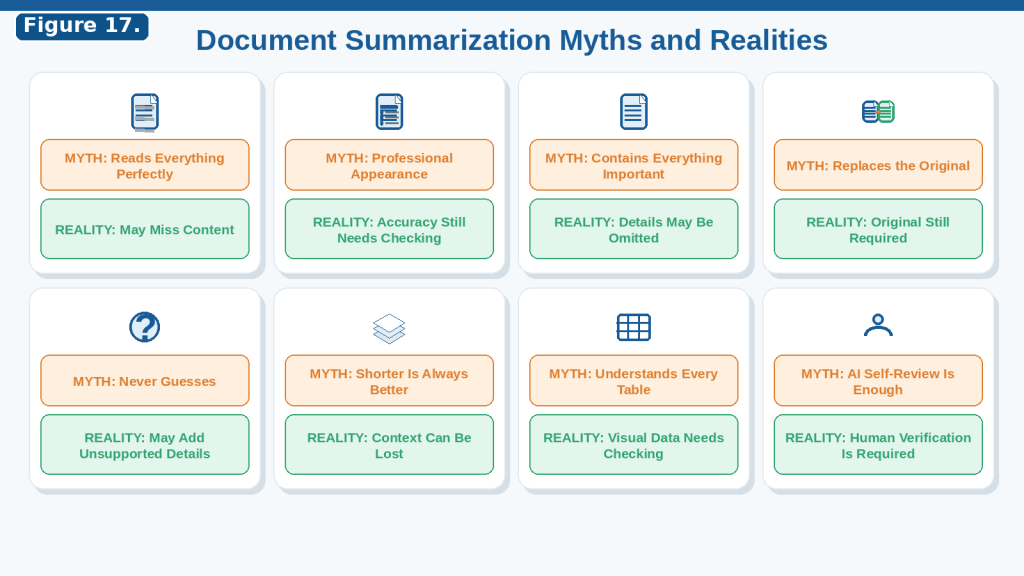
    Figure 17. Common myths about document summarization can create overconfidence in uploads, summaries, simple explanations, tables, and AI self-checking.

    Figure 17 compares common assumptions with the reality of using ChatGPT to summarize documents. The visual reminds beginners that every summary should be prepared safely, checked against the source, and treated as a review aid rather than an official replacement.

    Frequently Asked Questions

    Can ChatGPT summarize an entire document?

    Yes, ChatGPT can summarize many uploaded documents, but the result depends on the document’s length, structure, readability, and file format.

    For a long document, create a document map and summarize one section at a time. This makes it easier to check whether every important section was included.

    Can ChatGPT summarize a PDF?

    ChatGPT can summarize many PDF documents.

    Text-based PDFs usually work better than scanned PDFs because their words can be selected and copied. Scanned pages, charts, tables, handwritten notes, and complicated layouts may require additional checking.

    Can ChatGPT summarize a Word document?

    ChatGPT can work with common Word documents such as DOCX files.

    Before uploading a Word document:

    · Remove private information

    · Review comments and tracked changes

    · Check headers and footers

    · Save a separate safe copy

    · Confirm that you have permission to upload it

    Can ChatGPT summarize a scanned document?

    ChatGPT may be able to read a clear scanned document, but results may be less reliable than with selectable digital text.

    Problems may occur when the scan contains:

    · Blurred text

    · Shadows

    · Cropped edges

    · Small writing

    · Handwriting

    · Skewed pages

    · Complicated tables

    When possible, use a clearer scan or a text-based version.

    Can I paste document text instead of uploading a file?

    Yes. You can copy and paste the relevant text into the message box.

    Pasting may work well for short sections, letters, notes, or individual paragraphs.

    For long documents, divide the text into logical parts and label them clearly, such as:

    · Part 1 of 4

    · Part 2 of 4

    · Part 3 of 4

    · Part 4 of 4

    Do not split the text in the middle of an important paragraph, table, rule, or warning.

    Can ChatGPT summarize only selected pages?

    Yes. Identify the exact pages or section headings in your prompt.

    For example:

    Summarize pages 12–18 only. Preserve all dates, conditions, exceptions, and warnings. Do not use information from the rest of the document.

    Check that the page numbers in your viewer match the numbers printed on the document.

    How long should a document summary be?

    The best length depends on your purpose.

    A short overview may be suitable when you only need the main idea.

    A detailed or section-by-section summary may be better when the document contains:

    · Important conditions

    · Deadlines

    · Warnings

    · Responsibilities

    · Technical information

    · Supporting evidence

    · Exceptions

    Avoid requesting an extremely short summary when important details must be preserved.

    Can ChatGPT summarize a document in simple language?

    Yes. Ask ChatGPT to explain the document for a complete beginner and define technical terms when they first appear.

    For example:

    Explain this document in simple language for a complete beginner. Preserve all important dates, numbers, conditions, exceptions, limitations, and warnings.

    Simple language should improve understanding without changing the meaning.

    Can ChatGPT create study notes from a document?

    Yes. You can ask for:

    · Key concepts

    · Definitions

    · Examples

    · Important facts

    · Review questions

    · Topic outlines

    · Flashcard-style questions

    Example prompt:

    Turn the attached chapter into beginner-friendly study notes. Include key concepts, definitions, examples, important facts, and five review questions. Use only information from the document.

    Compare the study notes with the original material before using them for an examination or professional training.

    Can ChatGPT extract action items from meeting notes?

    Yes. Ask for a structured action-item table.

    For example:

    Create a table with the columns Task, Responsible Person, Deadline, Status, and Source Section. Write “Not stated in the document” when information is missing. Do not guess.

    Check that every task, person, and deadline matches the original meeting notes.

    Can ChatGPT compare two documents?

    Yes. However, summarize and verify each document separately before requesting a comparison.

    Then ask ChatGPT to identify:

    · Agreements

    · Differences

    · Conflicting information

    · Missing sections

    · Changed dates

    · Changed responsibilities

    · Unique points in each document

    Keep the source of every point clearly identified.

    Can ChatGPT fact-check a document while summarizing it?

    Summarization and fact-checking are different tasks.

    A summary explains what the document says. Fact-checking investigates whether the document’s claims are accurate.

    Use this workflow:

    1 Summarize the document.

    2 Verify the summary against the source.

    3 Identify claims that require checking.

    4 Check those claims using current and reliable sources.

    5 Keep the source summary separate from outside research.

    Do not allow outside information to be presented as though it came from the uploaded document.

    Is a ChatGPT summary always accurate?

    No. A summary may contain:

    · Missing information

    · Incorrect dates or numbers

    · Simplified conditions

    · Confused responsibilities

    · Unsupported additions

    · Misread tables

    · Incorrect source locations

    Treat every first summary as a draft and compare it with the original.

    Can a ChatGPT summary replace a contract, policy, manual, or official notice?

    No. A summary can help with initial understanding, but it does not replace the official document.

    Return to the original wording when the document affects:

    · Legal rights

    · Contracts

    · Health

    · Safety

    · Money

    · Insurance

    · Employment

    · Eligibility

    · Technical operation

    Qualified professional advice may also be necessary.

    Is it safe to upload private documents?

    Not every private document is suitable for uploading.

    Before uploading:

    · Confirm that you have permission

    · Create a safe working copy

    · Remove unnecessary personal information

    · Check comments and hidden content

    · Review workplace or organizational rules

    · Upload only the required pages

    · Avoid uploading documents that must remain confidential

    Data controls do not replace permission and privacy checks.

    Should I disclose that AI helped create the summary?

    Disclosure may be appropriate when the summary is:

    · Shared with other people

    · Published online

    · Used in training

    · Included in business records

    · Used to support an important decision

    A useful note is:

    This summary was created with AI assistance and reviewed against the original document. Consult the original source for complete wording and official requirements.

    Should I keep the original document after creating the summary?

    Yes. Keep the original document unchanged and available for reference.

    When appropriate, save:

    · Original document

    · Safe upload copy

    · Prompt

    · First summary

    · Correction log

    · Reviewed summary

    · Review date

    · Source references

    The summary should never become the only remaining copy of important information.

    Key Takeaways

    · ChatGPT can help summarize PDFs, Word documents, presentations, text files, spreadsheets, and document images, but results depend on file quality and structure.

    · Always keep the original document unchanged and create a separate safe copy before uploading.

    · Remove unnecessary private, confidential, financial, medical, customer, employee, or identification information.

    · Confirm that you own the document or have permission to upload and process it.

    · Write a clear prompt that explains the purpose, intended reader, required details, output format, length, and accuracy rules.

    · Match the summary format to the document. Reports, meeting notes, contracts, manuals, study materials, and spreadsheets require different priorities.

    · Ask ChatGPT to write Not stated in the document instead of guessing missing information.

    · Treat the first summary as a draft rather than a final or official document.

    · Compare names, dates, numbers, deadlines, conditions, exceptions, warnings, responsibilities, and action items with the original source.

    · Review tables, charts, diagrams, scanned pages, appendices, captions, and other visual information separately when necessary.

    · For long documents, create a document map and summarize one logical section at a time.

    · Use focused follow-up questions to find missing details, warnings, source locations, responsibilities, and unanswered questions.

    · Keep separate rules, groups, dates, costs, and conditions clearly separated.

    · Simple language should improve understanding without removing important limitations, uncertainty, warnings, or requirements.

    · A summary explains what a document says, but it does not prove that the original document is accurate or current.

    · Document summarization and fact-checking are separate tasks.

    · An AI summary does not replace a contract, policy, manual, medical document, financial document, legal notice, or other official source.

    · Qualified professional advice may be necessary when the document affects health, safety, money, employment, insurance, technical work, or legal rights.

    · Label shared or published AI-assisted summaries clearly when readers could mistake them for complete or official versions.

    · Save the original file, safe upload copy, prompt, first summary, corrections, reviewed summary, source references, and review date when appropriate.

    The safest document-summarization workflow is:

    1. Prepare a safe copy.

    2. Upload only the information you need.

    3. Write a clear and specific prompt.

    4. Review the first summary.

    5. Compare it with the original.

    6. Correct specific errors.

    7. Save and share only the reviewed version.

    Final Tip

    Use ChatGPT to help you find and organize important information, not to replace the original document.

    A reliable routine is:

    1. Keep the original document unchanged.

    2. Create a safe copy for uploading.

    3. Ask for a focused summary.

    4. Check names, dates, numbers, conditions, warnings, and deadlines.

    5. Correct specific problems.

    6. Save only the reviewed version.

    7. Return to the original whenever accuracy matters.

    A summary that takes a few extra minutes to verify is more useful than a fast summary that contains missing or incorrect information.

    Continue Learning

    Continue building your ChatGPT skills with these related AI Mastery guides:

    · ChatGPT Basics for Beginners: Complete Guide (2026) — Review how to use the ChatGPT interface, start conversations, attach files, and write your first prompts.

    · Best ChatGPT Prompts for Beginners (2026) — Learn practical prompt examples that can be adapted for summaries, explanations, lists, tables, and other everyday tasks.

    · Prompt Engineering for Beginners: Complete Guide (2026) — Learn how to make prompts clearer by adding the purpose, audience, format, detail level, and accuracy instructions.

    Sources and References

    ChatGPT features, supported file types, upload limits, privacy controls, storage practices, and plan availability may change. Readers should check current official information when first using document uploads, changing plans, receiving a feature notice, or experiencing an upload problem.

    1. OpenAI Help Center — What Types of Files Are Supported?
    Lists commonly supported document, presentation, spreadsheet, and text formats, including PDF, DOCX, PPTX, TXT, XLSX, XLS, CSV, and TSV. It also explains that native .gdoc files should be exported to a supported format before uploading.

    2. OpenAI Help Center — File Uploads FAQ
    Explains common uses for uploaded files and current upload restrictions. OpenAI currently states a limit of 512 MB per uploaded file and 2 million tokens for text and document files; spreadsheets have different limits.

    3. OpenAI Help Center — File Storage and Library in ChatGPT
    Explains how uploaded and generated files may be saved in ChatGPT’s Library, reused in later conversations, and managed through storage controls. Feature availability and storage allowances may vary.

    4. OpenAI Help Center — Chat and File Retention Policies in ChatGPT
    Describes how chats and files are retained or deleted. It also explains that Temporary Chats are generally deleted automatically from OpenAI’s systems within 30 days, subject to stated exceptions.

    5. OpenAI Help Center — Data Controls FAQ
    Explains how users can manage whether their conversations help improve OpenAI’s models. Turning off Improve the model for everyone keeps new conversations in chat history while preventing them from being used to train ChatGPT.

    6. OpenAI Help Center — How Your Data Is Used to Improve Model Performance
    Explains how content from individual services may be used to improve models according to the user’s settings and describes different default practices for business offerings.

    7. OpenAI Help Center — Are You Able to Handle Images Embedded in Documents and Presentations?
    Explains that images embedded inside ordinary documents and presentations are not currently processed like normal document text. Important screenshots, diagrams, photographs, and charts may need to be uploaded separately.

    8. OpenAI Help Center — Visual Retrieval with PDFs FAQ
    Explains that ChatGPT Enterprise can interpret text and visual elements embedded in uploaded PDFs, including images, diagrams, and graphs. Availability depends on the plan and workspace.

    9. OpenAI Help Center — ChatGPT Image Inputs FAQ
    Explains how to upload images for analysis and lists supported static-image formats, including PNG, JPEG, and non-animated GIF.

    10. OpenAI Help Center — Data Analysis with ChatGPT
    Provides guidance for working with spreadsheets, tables, structured data, PDFs, and text or data files. It also explains that available file types may vary by model, plan, workspace settings, and account features.

    11. OpenAI Help Center — Optimizing File Uploads in ChatGPT Enterprise
    Provides guidance for handling large or complicated files, using focused source materials, dividing lengthy documents into logical sections, and improving results based on file type and structure.

    Accessed: July 28, 2026.

    These references support the article’s technical and platform-related information. They do not replace the original document being summarized or professional legal, medical, financial, safety, or technical advice.

  • How to Create AI Videos with ChatGPT: Beginner Step-by-Step Guide (2026)

    How to Create AI Videos with ChatGPT: Beginner Step-by-Step Guide (2026)

    Estimated reading time: 55–65 minutes
    Last updated: July 28, 2026

    What You’ll Learn

    By the end of this guide, you will know:

    • What AI video generation is and how it works

    • How ChatGPT helps you create better AI videos

    • How to choose a suitable AI video generator to use alongside ChatGPT

    • How to write clearer prompts for more controlled video results

    • How to create videos from text descriptions

    • How to create videos from existing images

    • How to edit AI-generated videos

    • Common mistakes beginners should avoid

    • Tips for improving the presentation of AI-generated videos

    • The current limitations of AI video generation

    • Best practices for using AI-generated videos responsibly

    Before Learning

    These related guides will make this article easier to follow:

    ChatGPT Basics for Beginners (Complete Guide 2026)

    Prompt Engineering for Beginners: Complete Guide (2026)

    AI Image Generation for Beginners: Complete Guide (2026)

    Introduction

    AI video generation has advanced rapidly. Some tasks that once required expensive software, professional cameras, and advanced editing skills can now be completed more quickly with artificial intelligence.

    In this guide, ChatGPT is used as a creative planning assistant rather than as the video generator. It helps you develop ideas, write and improve prompts, plan scenes, and prepare narration. A clear prompt gives a dedicated video generator better direction than a vague request. [2]

    Beginners can create simple visual content for YouTube, social media, websites, presentations, online courses, and business marketing without years of professional video-editing experience.

    In this guide, you will learn how ChatGPT works together with modern AI video tools to create professional-looking videos step by step.

    Current Information Note

    OpenAI discontinued the Sora web and app experiences on April 26, 2026, and states that the Sora API is scheduled to be discontinued on September 24, 2026. This guide therefore uses ChatGPT mainly for planning and prompt writing, while the moving clips are created with a dedicated video generator that is currently available to the reader. Tool features, access, and service names can change, so check the current official information before starting. [1]

    Figure 1. ChatGPT helping a beginner create an AI video using a video generation tool.

    Figure 1 introduces the relationship between ChatGPT and AI video generators. It helps readers understand that ChatGPT can help create and improve prompts, while dedicated AI tools generate the actual moving video.

    What Is AI Video Generation?

    AI video generation is the process of using artificial intelligence to create or modify video content.

    Instead of recording every scene with a camera, you can describe what you want using written instructions called a prompt. The AI then interprets your description and generates a short video based on it.

    For example, you could enter:

    Create a five-second video of a small wooden boat moving across a calm lake at sunrise, with soft mist above the water and gentle camera movement.

    The AI video tool may then create a moving scene that includes the boat, lake, sunrise, mist, and camera motion described in the prompt.

    AI video generators can create content in several ways.

    Text-to-Video

    Text-to-video tools create a video directly from a written description. [3][11]

    You describe:

    • The subject

    • The setting

    • The action

    • The camera movement

    • The lighting

    • The visual style

    The AI uses these instructions to generate the video.

    Image-to-Video

    Image-to-video tools turn a still image into a moving scene. [4]

    For example, you can upload an image of a forest and ask the AI to:

    • Move the tree branches gently

    • Add falling leaves

    • Create drifting fog

    • Make the camera slowly move forward

    The original image becomes the starting point for the video.

    Video-to-Video

    Video-to-video tools modify an existing video.

    They may help you:

    • Change the visual style

    • Replace the background

    • Improve lighting

    • Add visual effects

    • Remove unwanted objects

    • Convert real footage into animation

    AI-Assisted Video Editing

    Some AI tools do not generate an entire video from scratch. Instead, they help edit existing footage.

    They may automatically:

    • Add captions

    • Remove pauses

    • Improve sound quality

    • Resize videos for social media

    • Remove backgrounds

    • Create short clips from longer videos

    The best method depends on whether you are starting with text, an image, or an existing video.

    Figure 2. The four main ways artificial intelligence can create or improve video content.

    Figure 2 shows the main ways AI can create or improve videos. It helps beginners quickly understand the difference between generating a video from text, animating an image, transforming existing footage, and using AI editing tools.

    How ChatGPT Helps You Create AI Videos

    ChatGPT helps you plan and improve many stages of the AI video creation process.

    It does not replace the video generator. Instead, it helps you prepare clear instructions that the video tool can understand.

    Develop the Video Idea

    You can ask ChatGPT to turn a simple idea into a complete video concept.

    For example:

    Help me develop a 15-second promotional video idea for a small bakery. The video should feel warm, friendly, and suitable for social media.

    ChatGPT can suggest:

    • The main subject

    • The sequence of scenes

    • The mood

    • The visual style

    • The camera angles

    • The ending message

    Write a Video Prompt

    ChatGPT can transform a basic request into a detailed AI video prompt.

    A basic request might be:

    Create a video of a café.

    ChatGPT can improve it to:

    Create a realistic eight-second video of a quiet neighbourhood café during the early morning. Warm sunlight enters through large windows while a barista prepares coffee behind the counter. Steam rises gently from a cup in the foreground. Use a slow camera movement toward the counter, warm natural lighting, soft shadows, and a welcoming cinematic style.

    The improved prompt gives the AI video generator clearer direction.

    Create a Scene-by-Scene Plan

    Longer videos usually work better when divided into several short scenes.

    ChatGPT can prepare a simple scene plan such as:

    1. Exterior view of the café

    2. Close-up of coffee beans being poured

    3. Barista preparing coffee

    4. Customer receiving the drink

    5. Final view of the café table

    Each scene can then be generated separately and combined later.

    Write Narration and Dialogue

    ChatGPT can write:

    • Voice-over scripts

    • Character dialogue

    • Introductions

    • Product descriptions

    • Educational explanations

    • Calls to action

    You can also ask it to adjust the language for a particular audience.

    For example:

    Rewrite this video narration using simple language for complete beginners. Keep it under 60 words.

    Improve Camera and Motion Instructions

    AI video prompts often need specific movement instructions.

    ChatGPT can suggest camera movements such as:

    • Slow zoom in

    • Slow zoom out

    • Pan left or right

    • Camera moving forward

    • Camera circling the subject

    • Overhead camera view

    • Close-up shot

    • Wide establishing shot

    It can also describe subject movement, such as a person walking, leaves moving in the wind, or a product slowly rotating.

    Maintain a Consistent Style

    When a video contains several scenes, the visual style should remain consistent.

    ChatGPT can help you repeat important details in every prompt, including:

    • Character appearance

    • Clothing

    • Location

    • Colour scheme

    • Lighting

    • Camera style

    • Mood

    • Aspect ratio

    This reduces sudden visual changes between clips.

    Review and Improve Weak Results

    The first generated video may not look exactly as expected. [5][6]

    You can describe the problem to ChatGPT, such as:

    The person moves too quickly, the camera shakes, and the background changes during the clip. Improve my prompt.

    ChatGPT can rewrite the prompt with clearer instructions, such as slower movement, a fixed background, and stable camera motion.

    Figure 3. The main ways ChatGPT supports the AI video creation process.

    Figure 3 shows that ChatGPT can support the entire planning process, from developing the original idea to improving the final prompt. It also reinforces that the actual video is created by a specialized AI video generator.

    What You Need Before You Begin

    You do not need professional cameras, expensive editing equipment, or advanced technical skills to begin creating AI videos.

    However, you should prepare a few basic items before starting.

    A Clear Video Idea

    Begin with one simple idea.

    Decide what you want the video to show and why you are creating it. For example, your goal might be to create:

    • A short social media video

    • A product demonstration

    • An educational explanation

    • A website introduction

    • A YouTube scene

    • A promotional advertisement

    • An animated story

    • A presentation background

    Avoid trying to include too many ideas in one short video. A focused scene is usually easier for the AI to understand and generate successfully.

    Access to ChatGPT

    You can use ChatGPT to develop your idea, create a storyboard, write narration, and prepare detailed prompts.

    You can begin with a simple request such as:

    Help me plan a ten-second AI video showing a modern home office becoming more organized.

    ChatGPT can then help you define the setting, action, camera movement, lighting, mood, and visual style.

    An AI Video Generator

    You also need an AI video generator that can turn your prompt or image into a video.

    Depending on the available tool, you may be able to:

    • Generate a video from written instructions

    • Animate an uploaded image

    • Add sound effects or dialogue

    • Transform an existing video

    • Extend a short video

    • Create several clips for a longer project

    Video-generation tools, features, access, pricing, and usage limits change frequently. Before beginning a project, check the tool’s supported inputs, clip lengths, aspect ratios, export quality, watermark policy, privacy settings, and commercial-use terms. [8][9][12][13]

    How to Choose an AI Video Generator

    Choose a tool that matches the type of project you want to create. Check whether it provides:

    • Text-to-video, image-to-video, or both

    • Suitable clip lengths and aspect ratios

    • Acceptable resolution and export options

    • Clear watermark and download rules

    • Privacy controls for uploaded images and videos

    • Commercial-use terms that match your project

    • Pricing or credit limits you can manage

    • Availability on your device and in your region

    There is no single best tool for every beginner. Features change quickly, so choose the simplest tool that supports your planned workflow.

    A Reference Image When Needed

    A reference image gives the video generator a visual starting point.

    You may use:

    • An AI-generated image

    • A photograph you own

    • A product image

    • A character design

    • A landscape

    • An illustration

    • A branded background you have permission to use

    Use a clear, high-quality image without unnecessary objects. A confusing starting image can produce confusing movement. [4]

    Do not upload material that you do not have the right or permission to use, especially private photographs of other people.

    A Basic Scene Plan

    Even a short video benefits from a simple plan.

    Write down:

    1. What appears at the beginning

    2. What action takes place

    3. How the camera moves

    4. What appears at the end

    For example:

    1. A closed notebook rests on a clean desk.

    2. The notebook slowly opens.

    3. Handwritten ideas appear across the pages.

    4. The camera moves closer to the finished page.

    This plan can be converted into a detailed prompt before generating the video.

    A Suitable Aspect Ratio

    Choose the video shape according to where it will be published.

    Common choices include:

    16:9 landscape: YouTube, websites, presentations, and television-style videos

    9:16 vertical: YouTube Shorts, Instagram Reels, TikTok, and mobile viewing

    1:1 square: Social media posts and advertisements

    4:5 portrait: Instagram and Facebook feed posts

    Choosing the correct aspect ratio at the beginning can prevent important parts of the video from being cropped later.

    Enough Storage Space

    AI-generated video files can be much larger than images.

    Create an organized folder for:

    • Original prompts

    • Reference images

    • Generated clips

    • Narration files

    • Music and sound effects

    • Edited versions

    • Final exported videos

    Use descriptive filenames instead of names such as video1 or final2.

    For example:

    organized-home-office-scene-01.mp4

    A simple file system makes it easier to revise, replace, and combine clips later.

    Figure 4. The basic items needed before creating an AI video.

    Figure 4 gives beginners a visual checklist of the basic items required before starting an AI video project. Preparing the idea, prompt, format, reference material, and file-storage system in advance can make the creation process easier and more organized.

    How to Write an Effective AI Video Prompt

    A strong AI video prompt gives the generator clear instructions about what should appear, what should move, and how the finished scene should look. [3][10]

    A vague prompt may produce unpredictable motion, unwanted objects, poor framing, or an inconsistent background. A detailed prompt gives the AI a better creative brief.

    Start with the Main Subject

    First, describe the most important person, object, animal, or location in the scene.

    For example:

    A small red bicycle beside a wooden fence.

    You can improve the description by adding useful details:

    A clean vintage red bicycle with a brown leather seat resting beside a weathered wooden fence.

    Avoid adding unnecessary details that do not improve the scene.

    Describe the Setting

    Explain where the scene takes place.

    The setting may include:

    • A modern office

    • A quiet beach

    • A busy city street

    • A family kitchen

    • A forest path

    • A professional studio

    • A futuristic laboratory

    Include the time of day or weather when it affects the appearance.

    For example:

    The bicycle stands beside a wooden fence on a quiet country road during early morning, with light mist over the fields.

    Explain the Action

    A video prompt must describe movement.

    State clearly what the subject should do.

    Examples include:

    • A person slowly walks toward the camera

    • A product rotates on a display stand

    • Steam rises from a cup

    • Leaves move gently in the wind

    • A car drives along a wet road

    • A notebook opens by itself

    • Clouds move across the sky

    Use simple and realistic actions. Too many movements in one short clip may confuse the AI.

    Add Camera Instructions

    Camera direction helps control how the viewer sees the scene.

    Useful camera instructions include:

    • Static camera

    • Slow zoom in

    • Slow zoom out

    • Pan left

    • Pan right

    • Camera moving forward

    • Camera following the subject

    • Close-up shot

    • Medium shot

    • Wide shot

    • Overhead view

    • Low-angle view

    For beginners, slow and simple camera movement usually produces more stable results.

    Describe the Lighting

    Lighting affects the mood and quality of the video.

    You might request:

    • Soft natural daylight

    • Warm golden-hour lighting

    • Bright studio lighting

    • Cool evening light

    • Dramatic side lighting

    • Soft shadows

    • Gentle indoor lighting

    Avoid combining several conflicting lighting styles in one prompt.

    Choose the Visual Style

    State how the video should look.

    Possible styles include:

    • Realistic

    • Cinematic

    • Documentary

    • Professional commercial

    • Hand-drawn animation

    • Watercolour illustration

    • 3D animation

    • Minimalist

    • Futuristic

    • Vintage film

    Keep the style consistent throughout all scenes in the same project.

    Include the Mood

    Mood describes the feeling of the scene.

    Examples include:

    • Calm

    • Welcoming

    • Energetic

    • Inspiring

    • Serious

    • Peaceful

    • Luxurious

    • Playful

    • Mysterious

    The mood should match the lighting, movement, and purpose of the video.

    State the Video Length and Format

    When the tool allows it, include the desired duration and aspect ratio.

    For example:

    Create an eight-second video in 16:9 landscape format.

    You can also specify whether the video is intended for a website, YouTube, or a vertical social media post.

    Add Quality and Stability Instructions

    You may include instructions that reduce common problems.

    Examples include:

    • Smooth natural motion

    • Stable background

    • Consistent character appearance

    • No camera shake

    • No sudden object changes

    • Realistic body movement

    • Clean composition

    • Sharp subject

    • No duplicated objects

    • No visible text

    • No unintended logos or generated text

    Different generators handle exclusion instructions differently. Some accept phrases such as “no visible text,” while others work better with positive wording or a separate negative-prompt control. Follow the current guidance for the selected tool. [3][4]

    These instructions do not guarantee a perfect result, but they give the generator clearer guidance.

    Use a Simple Prompt Formula

    A practical AI video prompt can follow this structure:

    Subject + setting + action + camera movement + lighting + visual style + mood + duration + aspect ratio + quality instructions

    For example:

    Create an eight-second realistic video of a vintage red bicycle resting beside a wooden fence on a quiet country road at sunrise. Light mist moves gently across the fields while nearby grass sways in the breeze. Use a slow camera movement toward the bicycle, soft golden natural lighting, a peaceful cinematic mood, and a 16:9 landscape format. Keep the bicycle and background consistent, with smooth motion, stable framing, no people, no text, no logos, and no duplicated objects.

    This prompt gives the AI clear instructions without making the scene unnecessarily complicated.

    Figure 5. The main parts of an effective AI video prompt.

    Figure 5 breaks an AI video prompt into clear building blocks. Beginners can use this structure as a checklist to make sure they describe the subject, motion, camera, lighting, style, format, and quality requirements before generating a video.

    Step-by-Step: Create an AI Video from Text

    Text-to-video generation begins with a written description. The AI video generator uses that description to create the scene, movement, camera behaviour, lighting, and visual style. [3][6][11]

    The following process helps beginners create a more reliable result.

    Step 1: Choose One Simple Scene

    Start with a scene that contains:

    • One main subject

    • One clear action

    • One location

    • One camera movement

    For example:

    A baker places a fresh loaf of bread on a wooden counter while morning sunlight enters through the window.

    Do not begin with a long story containing several characters, locations, and actions. Short, focused scenes are easier to generate successfully.

    Step 2: Ask ChatGPT to Improve the Idea

    Enter your basic idea into ChatGPT.

    For example:

    Turn this idea into a detailed eight-second AI video prompt: A baker places fresh bread on a wooden counter in the morning.

    ChatGPT can add useful details such as:

    • The baker’s appearance

    • The style of the kitchen

    • The movement of the hands

    • The direction of the camera

    • The lighting

    • The mood

    • The aspect ratio

    • Quality-control instructions

    Review the result and remove any details you do not need.

    Step 3: Check the Prompt for Clarity

    Before using the prompt, confirm that it answers these questions:

    • What is the main subject?

    • Where is the scene happening?

    • What action takes place?

    • How does the camera move?

    • What lighting is used?

    • What visual style is required?

    • How long should the clip be?

    • What aspect ratio is needed?

    • What problems should the AI avoid?

    A clear prompt is easier to improve if the first result is not satisfactory.

    Step 4: Open the AI Video Generator

    Open the video-generation tool available through your account.

    Look for an option such as:

    • Create video

    • Generate video

    • Text-to-video

    • New project

    • Start from prompt

    The exact wording differs from one tool to another.

    Step 5: Paste the Prompt

    Copy the completed prompt from ChatGPT and paste it into the video generator.

    For example:

    Create an eight-second realistic cinematic video of an adult baker placing a freshly baked loaf of bread on a clean wooden counter inside a warm traditional bakery during early morning. Soft sunlight enters through a side window while gentle steam rises from the bread. Use a slow camera movement toward the loaf, natural hand movement, warm golden lighting, soft shadows, and a welcoming atmosphere. Use 16:9 landscape format. Keep the baker, counter, bread, and background consistent. Use smooth motion, stable framing, no visible text, no logos, no duplicated objects, and no sudden scene changes.

    Read the prompt once more before generating the video.

    Step 6: Select the Video Settings

    Choose the available settings that match your project.

    These may include:

    • Video duration

    • Aspect ratio

    • Resolution

    • Number of variations

    • Visual style

    • Motion strength

    • Camera movement

    • Reference image

    • Audio settings

    Do not select the highest motion level automatically. Strong movement may produce unstable or unrealistic results.

    Step 7: Generate the First Version

    Start the generation process.

    When the video appears, watch it several times and examine:

    • Subject consistency

    • Body movement

    • Object movement

    • Background stability

    • Camera motion

    • Lighting

    • Cropping

    • Unwanted objects

    • Sudden visual changes

    Do not judge the clip only by the first frame. Some problems appear later in the video.

    Step 8: Identify the Main Problem

    If the result is weak, identify the most important problem instead of changing everything at once.

    For example:

    • The baker moves too quickly

    • The bread changes shape

    • The camera shakes

    • The background changes

    • The hands look unnatural

    • The scene is too dark

    • The subject is cropped

    • Extra objects appear

    A specific diagnosis makes the next prompt easier to improve.

    Step 9: Ask ChatGPT to Revise the Prompt

    Describe the problem clearly.

    For example:

    Improve this prompt. The baker’s hands move too quickly, the loaf changes shape, and the camera is unstable. Keep the same scene and style.

    ChatGPT may add clearer controls such as:

    • Slow natural hand movement

    • Fixed loaf shape

    • Stable counter and background

    • Static camera or gentle forward movement

    • No object transformation

    • Consistent subject appearance

    Step 10: Generate a New Version

    Paste the revised prompt into the video generator and create another version.

    Compare both clips and keep the stronger one.

    It may take several attempts to produce a usable result. This is normal. AI video generation usually involves testing, reviewing, and refining rather than expecting a finished video from the first prompt. [5][6]

    Step 11: Download and Rename the Video

    After selecting the best result, save the clip using a descriptive filename.

    For example:

    bakery-fresh-bread-scene-01.mp4

    Avoid filenames such as:

    video-final-new-2.mp4

    Descriptive filenames make it easier to organize multiple scenes.

    Figure 6. The step-by-step process for creating an AI video from a text prompt.

    Figure 6 shows that text-to-video creation is an improvement cycle rather than a single action. The user develops the idea, writes the prompt, generates the clip, reviews the result, and revises the instructions until the video becomes more useful and consistent.

    Step-by-Step: Create an AI Video from an Image

    Image-to-video generation starts with a still image. The AI then adds movement to the subject, background, camera, or environment. [4]

    This method is useful when you already have a strong image and want to turn it into a short animated scene.

    Step 1: Choose a Suitable Image

    Select a clear image with:

    • One main subject

    • A simple background

    • Good lighting

    • Enough space around the subject

    • No important objects cut off at the edges

    The starting image should already resemble the scene you want in the video.

    A crowded or confusing image may produce unpredictable movement.

    Step 2: Check the Image Quality

    Use a high-quality image whenever possible.

    Avoid images that are:

    • Blurry

    • Pixelated

    • Heavily compressed

    • Poorly cropped

    • Too dark

    • Filled with tiny details

    • Visually inconsistent

    The AI uses the image as its visual foundation, so weak image quality can lead to weak video quality.

    Step 3: Decide What Should Move

    Choose one or two main movements.

    For example:

    • Hair moving gently in the wind

    • Steam rising from a cup

    • Water flowing in the background

    • Leaves moving on a tree

    • A product slowly rotating

    • A person blinking naturally

    • A curtain moving beside a window

    • The camera slowly moving forward

    Do not ask every object in the image to move at the same time.

    Step 4: Decide What Should Remain Still

    It is equally important to tell the AI what should not change.

    You may request:

    • Keep the face consistent

    • Keep the background stable

    • Keep the product shape unchanged

    • Keep the clothing unchanged

    • Keep the colours consistent

    • Do not add new objects

    • Do not change the camera angle suddenly

    These instructions can reduce unwanted transformations.

    Step 5: Ask ChatGPT to Write the Motion Prompt

    Describe the image and the movement you want.

    For example:

    Write an image-to-video prompt for a still image of a woman sitting beside a window holding a cup of tea. Add only gentle steam from the cup, slight curtain movement, and a slow camera push forward. Keep her face, clothing, hands, and background consistent.

    ChatGPT can turn this into a more complete motion prompt.

    Step 6: Upload the Image

    Open the image-to-video feature in the available AI video tool.

    Choose an option such as:

    • Upload image

    • Animate image

    • Image-to-video

    • Start from image

    • Add reference image

    Select the image from your device.

    Before continuing, confirm that the image is displayed correctly and has not been cropped incorrectly.

    Step 7: Paste the Motion Prompt

    Paste the prompt created with ChatGPT.

    For example:

    Animate this image into a six-second realistic video. Keep the woman seated in the same position beside the window while gentle steam rises from the cup. Add slight natural movement to the curtain and a slow, smooth camera push forward. Maintain the same face, hairstyle, clothing, hands, cup, window, background, lighting, and colour palette. Use calm natural motion, stable framing, no new objects, no facial changes, no hand distortion, no sudden movement, and no text or logos.

    The prompt should focus on motion rather than redescribing the entire image unnecessarily. [4]

    Step 8: Choose the Motion Strength

    Some tools allow you to control how strongly the image moves.

    Use a lower or moderate motion level for:

    • Portraits

    • Product images

    • Interior scenes

    • Close-up shots

    • Images where consistency is important

    Use stronger motion only when the scene genuinely requires it.

    Too much motion can cause faces, hands, products, or backgrounds to change.

    Step 9: Generate the First Version

    Create the video and watch the entire clip.

    Check whether:

    • The main subject remains recognizable

    • The face stays consistent

    • The hands remain natural

    • The background stays stable

    • The requested movement appears

    • Unwanted movement is avoided

    • The camera behaves correctly

    • The image edges remain clean

    Pay close attention to the final seconds because unwanted changes may appear near the end.

    Step 10: Revise the Motion Prompt

    If the result is too active or unstable, simplify the instructions.

    For example:

    Reduce the motion. Keep the woman completely still except for natural blinking. Keep the cup fixed. Only animate the steam and curtain slightly. Use a static camera.

    If the result feels too still, increase one movement at a time.

    For example:

    Keep the subject consistent, but add a slightly stronger forward camera movement and more visible steam.

    Step 11: Generate Another Version

    Create a new version using the revised prompt.

    Compare the clips based on:

    • Stability

    • Natural movement

    • Subject consistency

    • Visual quality

    • Suitability for the intended purpose

    The most dramatic version is not always the best. A subtle, stable clip often looks more professional.

    Step 12: Save the Final Clip

    Download the strongest version and rename it clearly.

    For example:

    woman-tea-window-image-to-video-01.mp4

    Store the original image, prompt, and final video in the same project folder.

    Figure 7. The process for turning a still image into an AI-generated video.

    Figure 7 shows that successful image-to-video creation depends on controlling both movement and stability. The prompt should explain what the AI should animate and what must remain unchanged throughout the clip.

    How to Create a Multi-Scene AI Video

    A longer AI video is often easier to control when it is divided into several short clips. [7]

    Instead of asking the AI to generate an entire story at once, create one scene at a time and combine the clips afterward.

    This approach gives you more control over the subject, camera movement, timing, and visual consistency.

    Step 1: Define the Main Goal

    Decide what the complete video should accomplish.

    For example, the goal might be to:

    • Explain a simple process

    • Promote a product

    • Introduce a business

    • Tell a short story

    • Create a social media advertisement

    • Show a before-and-after transformation

    • Present an educational topic

    Write the goal in one clear sentence.

    For example:

    Create a 30-second promotional video showing how a small bakery prepares fresh bread each morning.

    Step 2: Divide the Video into Short Scenes

    Break the main idea into separate moments.

    A simple bakery video might include:

    1. Exterior view of the bakery at sunrise

    2. Baker mixing the dough

    3. Bread baking inside the oven

    4. Fresh bread placed on the counter

    5. Customer receiving the finished loaf

    Each scene should focus on one clear action.

    Step 3: Choose the Length of Each Scene

    Short clips are often easier to control. [7]

    For a 30-second video, you might create:

    • Five scenes of approximately six seconds each

    • Six scenes of approximately five seconds each

    • Ten scenes of approximately three seconds each

    The exact timing depends on the story and the tool being used.

    Avoid making every scene the same length automatically. An opening scene may need more time than a quick close-up.

    Step 4: Create a Simple Storyboard

    A storyboard is a scene-by-scene plan showing what happens in the video.

    You can ask ChatGPT:

    Create a five-scene storyboard for a 30-second bakery promotional video. Include the subject, action, camera shot, lighting, and approximate duration for each scene.

    A basic storyboard might include:

    Scene 1: Bakery Exterior

    Wide shot

    Early morning

    Warm lights inside the bakery

    Slow camera movement toward the entrance

    Duration: five seconds

    Scene 2: Preparing the Dough

    Close-up of hands mixing dough

    Warm indoor lighting

    Static camera

    Duration: six seconds

    Scene 3: Bread in the Oven

    Close-up through the oven door

    Bread rising and turning golden

    Gentle camera push forward

    Duration: five seconds

    Scene 4: Finished Bread

    Baker places fresh bread on a wooden counter

    Steam rises from the loaf

    Slow camera movement toward the bread

    Duration: seven seconds

    Scene 5: Customer Experience

    Customer receives the loaf and smiles

    Bright, welcoming lighting

    Medium shot

    Duration: seven seconds

    Step 5: Create a Consistency Sheet

    A consistency sheet records important details that should remain the same in every scene.

    Include:

    • Character appearance

    • Clothing

    • Hairstyle

    • Location

    • Interior design

    • Colour palette

    • Lighting style

    • Camera style

    • Product appearance

    • Visual mood

    • Aspect ratio

    For example:

    The baker is an adult man with short dark hair, wearing a white shirt, beige apron, and dark trousers. The bakery has wooden shelves, cream walls, warm golden lighting, and a clean traditional appearance.

    Repeat these details in every relevant prompt.

    Step 6: Write One Prompt for Each Scene

    Do not use one large prompt for the entire video.

    Prepare a separate prompt for every scene.

    For example:

    Scene 1: Create a five-second realistic cinematic video of a small traditional bakery on a quiet street at sunrise. Warm lights glow through the front windows. Use a slow camera movement toward the entrance, soft golden morning light, stable framing, and a welcoming mood. Use 16:9 landscape format. No people, no visible logos, no text, and no sudden camera movement.

    Each prompt should contain only the details required for that scene while preserving the overall visual style.

    Step 7: Generate and Review Each Clip

    Create one scene at a time.

    After each clip is generated, check:

    • Character consistency

    • Clothing

    • Background

    • Product appearance

    • Lighting

    • Camera direction

    • Motion speed

    • Aspect ratio

    • Unwanted objects

    Do not continue automatically if one scene looks significantly different from the others.

    Step 8: Regenerate Weak Scenes

    Some clips may need several attempts.

    If a scene does not match the others, revise the prompt.

    For example:

    Regenerate this scene using the same baker, clothing, bakery interior, warm lighting, and cinematic style as the previous clips. Keep the camera stable and use slower hand movement.

    Focus on the biggest inconsistency first.

    Step 9: Arrange the Clips in Order

    Import the finished clips into a video editor.

    Place them in the correct sequence according to the storyboard.

    Trim unnecessary frames from the beginning or end of each clip.

    The story should remain understandable even before narration or music is added.

    Step 10: Add Transitions Carefully

    Transitions connect one clip to the next.

    Common options include:

    • Straight cut

    • Fade

    • Crossfade

    • Dip to black

    • Gentle zoom transition

    Simple transitions usually look more professional than dramatic effects.

    Use the same transition style throughout the video unless a scene change requires something different.

    Step 11: Add Narration, Music, and Captions

    Once the visual sequence is complete, add supporting audio and text.

    You may include:

    • Voice-over narration

    • Background music

    • Sound effects

    • Captions

    • Short titles

    • A final call to action

    Keep the audio balanced so that music does not overpower the narration.

    Step 12: Review the Complete Video

    Watch the video from beginning to end.

    Check:

    • Does the story make sense?

    • Do the scenes match visually?

    • Is the pacing comfortable?

    • Are the transitions smooth?

    • Is the narration clear?

    • Are captions readable?

    • Is the final message easy to understand?

    • Are there any AI errors that need correction?

    Review the video on both a computer and a mobile device when possible.

    Figure 8. The workflow for creating a multi-scene AI video.

    Figure 8 shows how a longer AI video can be built from several shorter clips. Planning each scene separately and using a consistency sheet gives the creator more control over the final story, pacing, and visual style.

    How to Edit AI-Generated Videos

    The first version of an AI-generated video is rarely the final version.

    Most videos benefit from a few simple edits that improve their appearance, pacing, and overall quality. Small adjustments can make a significant difference without requiring advanced editing skills.

    Step 1: Watch the Entire Video

    Before making any changes, watch the video from beginning to end several times.

    Look for:

    • Sudden changes in the subject

    • Unnatural body movement

    • Flickering backgrounds

    • Camera shake

    • Inconsistent lighting

    • Missing objects

    • Extra unwanted objects

    • Poor framing

    • Distracting transitions

    Take notes so you know exactly what needs to be improved.

    Step 2: Trim Unnecessary Sections

    AI-generated videos often include a few unwanted frames at the beginning or end.

    Trim these sections to create a cleaner result.

    Common examples include:

    • The subject appearing suddenly

    • Camera movement starting too early

    • Objects changing shape near the end

    • A frozen final frame

    A clean beginning and ending make the video feel more professional.

    Step 3: Improve the Pacing

    Every scene should last long enough for viewers to understand what they are seeing.

    If a clip feels rushed:

    • Extend the duration if your tool allows it.

    • Slow the playback slightly.

    • Replace it with a longer version.

    If a scene feels too slow:

    • Shorten the clip.

    • Remove unnecessary pauses.

    • Move to the next scene sooner.

    Aim for a comfortable viewing rhythm.

    Step 4: Correct Visual Problems

    Review each scene carefully.

    Common issues include:

    • Distorted hands or faces

    • Objects changing size

    • Backgrounds shifting unexpectedly

    • Inconsistent shadows

    • Sudden colour changes

    • Duplicate objects

    • Cropped subjects

    If a problem affects only one scene, regenerate that scene instead of the entire video.

    Step 5: Improve the Audio

    If your video includes sound, check that it matches the visuals.

    Review:

    • Voice-over quality

    • Background music volume

    • Sound effects

    • Timing between speech and visuals

    • Unwanted background noise

    The narration should remain easy to hear throughout the video.

    Step 6: Add Captions

    Accurate, synchronized captions make videos easier to understand and improve accessibility. [18][19]

    They also help viewers who:

    • Watch without sound

    • Have hearing difficulties

    • Speak a different first language

    • View the video in noisy environments

    Keep captions:

    • Short

    • Easy to read

    • Correctly spelled

    • Well-timed

    • Consistent in style

    Avoid covering important parts of the video.

    Use a readable font, strong contrast, and text large enough to read on a phone. Avoid rapid flashing effects, and include clear narration or descriptive text when it helps viewers understand the scene. [18][19]

    Step 7: Add Titles and Simple Graphics

    A few simple graphics can improve clarity.

    Examples include:

    • Opening title

    • Section headings

    • Product names

    • Labels

    • Simple arrows

    • Highlight boxes

    • End screen

    Avoid filling the screen with unnecessary text or decorative effects.

    Step 8: Adjust Colour and Brightness

    Some AI-generated clips may appear too dark or too bright.

    Small adjustments can improve:

    • Brightness

    • Contrast

    • Saturation

    • White balance

    • Shadow detail

    Avoid excessive colour correction that makes the scene look unnatural.

    Step 9: Keep the Style Consistent

    If your video contains several scenes, make sure they share the same:

    • Colour palette

    • Lighting

    • Camera style

    • Subject appearance

    • Typography

    • Caption style

    • Transition style

    Consistency makes the finished video feel more polished.

    Step 10: Export the Final Video

    When the edits are complete, export the video using settings appropriate for where it will be published.

    Choose the correct:

    • Resolution

    • Aspect ratio

    • File format

    • Video quality

    Save the finished version with a descriptive filename.

    For example:

    bakery-promo-final-1080p.mp4

    Keep the original project files in case you need to make changes later.

    Step 11: Review Before Publishing

    Watch the exported video one final time.

    Check:

    • Video quality

    • Audio quality

    • Spelling in captions

    • Smooth transitions

    • Consistent appearance

    • Correct aspect ratio

    • No missing scenes

    • No obvious AI mistakes

    If possible, test the video on both a computer and a mobile device.

    A final review helps catch small problems before sharing the video.

    Figure 9. The video editing checklist for AI-generated videos.

    Figure 9 summarizes the essential editing steps after an AI video has been generated. Reviewing, refining, and exporting the video carefully helps produce a polished result that is ready for websites, presentations, or social media.

    Common AI Video Generation Mistakes

    AI video generation is powerful, but beginners often make avoidable mistakes that reduce video quality.

    Understanding these problems early can save time, credits, and frustration.

    Using a Vague Prompt

    A vague prompt might say:

    Create a beautiful video of a city.

    This does not give the AI enough direction.

    The generator does not know:

    • Which city style to use

    • What time of day it is

    • What should move

    • How the camera should behave

    • What mood the video should have

    • Whether the style should be realistic or animated

    A clearer prompt might be:

    Create an eight-second realistic cinematic video of a modern city street at night after light rain. Reflections glow on the pavement while cars move slowly in the background. Use a gentle camera movement forward, cool blue lighting, stable framing, and a calm atmosphere.

    How to Avoid This Mistake

    Include the subject, setting, action, camera movement, lighting, style, mood, duration, and aspect ratio.

    Including Too Many Actions

    A short video cannot always handle several complex movements at once.

    For example:

    A woman walks through a market, picks up fruit, talks to a seller, turns toward the camera, waves, and enters a car.

    This may cause distorted movement, missing actions, or sudden scene changes.

    How to Avoid This Mistake

    Use one main action per clip. Divide longer sequences into separate scenes.

    Changing Too Many Details at Once

    When a generated video has several problems, beginners may completely rewrite the prompt.

    This makes it difficult to identify which change improved or damaged the result.

    How to Avoid This Mistake

    Correct one major problem at a time. For example, first stabilize the camera, then improve the hand movement, and finally adjust the lighting.

    Requesting Fast or Complicated Movement

    Rapid movement can cause:

    • Distorted bodies

    • Changing faces

    • Unstable objects

    • Flickering backgrounds

    • Unnatural motion

    How to Avoid This Mistake

    Use instructions such as:

    • Slow natural movement

    • Gentle camera motion

    • Stable framing

    • One simple action

    • Consistent subject appearance

    Ignoring the Background

    A prompt may describe the main subject clearly but say nothing about the background.

    The AI may then add unwanted people, objects, signs, or changing scenery.

    How to Avoid This Mistake

    Describe the background and state whether it should remain fixed.

    For example:

    Keep the bakery interior, shelves, counter, and lighting unchanged throughout the clip.

    Forgetting Camera Instructions

    Without camera direction, the generator may choose an unsuitable camera angle or movement.

    The result may include:

    • Sudden zooming

    • Camera shake

    • Unwanted rotation

    • Poor framing

    • Cropped subjects

    How to Avoid This Mistake

    Use one clear camera instruction, such as a static camera, slow zoom, gentle pan, or smooth forward movement.

    Using Strong Motion for Portraits

    High motion can cause faces, hands, hair, and clothing to change.

    This is especially common when animating a still portrait.

    How to Avoid This Mistake

    Use low or moderate motion and limit the animation to small actions such as blinking, breathing, slight hair movement, or a gentle camera push.

    Expecting Perfect Text Inside the Video

    AI video generators may create misspelled, distorted, or unreadable signs and labels.

    How to Avoid This Mistake

    Ask for no visible text in the generated scene. Add titles, captions, labels, and product information later in a video editor.

    Using the Wrong Aspect Ratio

    A landscape video may not fit a vertical social media platform. Cropping it later can remove important parts of the scene.

    How to Avoid This Mistake

    Choose the publishing platform before generating the video and select the correct format from the beginning.

    Failing to Review the Entire Clip

    The opening frames may look good while problems appear later.

    Common late-clip problems include:

    • Faces changing

    • Objects disappearing

    • Hands becoming distorted

    • Backgrounds shifting

    • Unwanted objects appearing

    How to Avoid This Mistake

    Watch the complete clip several times, including the final second.

    Regenerating Without Saving Good Versions

    A new version may be worse than the previous one.

    If the earlier clip was not saved, it may be difficult or impossible to recover.

    How to Avoid This Mistake

    Download and rename every promising version before generating another.

    Using Copyrighted or Private Material

    Uploading protected images, private photographs, or branded content without permission can create legal and ethical problems.

    How to Avoid This Mistake

    Use material you created, licensed, purchased with suitable rights, or have clear permission to use.

    Figure 10. Common mistakes beginners make when generating AI videos.

    Figure 10 helps beginners recognize the most common causes of weak AI-generated videos. Clear prompts, simple movement, correct formatting, careful review, and responsible source material can prevent many of these problems.

    Tips for Better AI Video Results

    Good AI videos usually come from careful planning and small improvements rather than one perfect prompt.

    The following tips can help beginners produce more stable, realistic, and professional-looking videos.

    Keep Each Scene Simple

    Use one main subject, one clear action, and one camera movement.

    Simple scenes are easier for the AI to understand and more likely to remain consistent.

    Use Short Clips

    Short clips are easier to control than long continuous videos.

    Generate several short scenes and combine them later instead of asking the AI to create an entire story in one attempt.

    Describe Motion Clearly

    Do not only describe what the scene looks like.

    Explain what should move and how it should move.

    For example:

    The curtain moves gently in the breeze while the camera slowly moves toward the window.

    State What Must Remain Unchanged

    Include stability instructions such as:

    • Keep the face consistent

    • Keep the background fixed

    • Keep the product shape unchanged

    • Keep the clothing and colours consistent

    • Do not add new objects

    This is especially important for image-to-video generation.

    Use Slow, Natural Movement

    Slow movement generally produces better results than rapid action.

    Useful instructions include:

    • Gentle motion

    • Slow camera push

    • Natural walking speed

    • Slight head movement

    • Soft fabric movement

    • Stable framing

    Use One Camera Movement

    Avoid combining zooming, panning, rotating, and tracking in the same short clip.

    Choose the movement that best supports the scene.

    Avoid Text Inside Generated Scenes

    AI-generated text may be misspelled or unreadable.

    Generate the scene without visible text and add captions, titles, signs, and labels later using a video editor.

    Use Reference Images

    A reference image can help define:

    • Character appearance

    • Product design

    • Colour palette

    • Location

    • Clothing

    • Lighting

    • Composition

    Use a clear image with a simple background and enough space around the subject.

    Repeat Important Details

    When creating several clips, repeat the same character, clothing, setting, lighting, and style details in every relevant prompt.

    Do not assume the generator will remember earlier scenes automatically.

    Save Every Promising Version

    Download any clip that contains useful movement, composition, or lighting.

    Even if it is not perfect, it may be valuable for part of the final video.

    Change One Thing at a Time

    When improving a weak result, revise one major problem before changing the entire prompt.

    For example:

    • Stabilize the camera.

    • Slow the subject’s movement.

    • Correct the lighting.

    • Remove unwanted background objects.

    This makes it easier to understand which instruction improved the result.

    Review Frame by Frame

    Watch the full clip slowly.

    Check the beginning, middle, and end for:

    • Object changes

    • Facial distortion

    • Hand problems

    • Background movement

    • Flickering

    • Cropping

    • Lighting changes

    A clip may appear acceptable at normal speed but reveal errors during a closer review.

    Keep Your Prompts Organized

    Save your prompts in a document or spreadsheet.

    Record:

    • Scene number

    • Original prompt

    • Revised prompt

    • Generator settings

    • Filename

    • Problems found

    • Best version

    This helps you reproduce successful results and avoid repeating failed attempts.

    Match the Video to the Platform

    Decide where the video will be published before creating it.

    Use:

    • 16:9 for YouTube, websites, and presentations

    • 9:16 for Shorts, Reels, TikTok, and mobile-first content

    • 1:1 for square social media posts

    • 4:5 for portrait feed posts

    Add the Final Polish in an Editor

    Use a video editor to add:

    • Accurate text

    • Captions

    • Narration

    • Music

    • Sound effects

    • Transitions

    • Branding

    • Colour correction

    AI generation creates the visual foundation. Editing turns the clips into a complete finished video.

    Figure 11. Practical tips for producing better AI-generated videos.

    Figure 11 provides a practical checklist that beginners can follow while planning, generating, reviewing, and editing AI videos. The most reliable results usually come from simple scenes, controlled movement, consistent details, and careful revision.

    Limitations of AI Video Generation

    AI video tools can create impressive results, but they are not perfect. Beginners should understand their limitations before using generated videos for websites, advertising, education, or business projects.

    Inconsistent Characters

    A person’s face, hairstyle, clothing, age, or body shape may change between frames or scenes.

    This problem becomes more noticeable in longer videos or when the subject moves quickly.

    How to Reduce This Limitation

    Use a clear reference image, repeat the character description in every prompt, keep movements simple, and generate short clips instead of one long scene.

    Distorted Hands and Body Movement

    Hands, fingers, arms, legs, and facial expressions may move unnaturally.

    Complex actions such as eating, writing, running, or handling small objects are often more difficult for the AI to generate correctly.

    How to Reduce This Limitation

    Use slow, simple actions and avoid close-up shots of complicated hand movements whenever possible. Review the entire clip carefully before publishing it.

    Objects May Change Shape

    Products, furniture, tools, food, and other objects may change size, colour, position, or shape during the clip.

    For example, a cup may become larger, a chair may disappear, or a product label may change.

    How to Reduce This Limitation

    Ask the AI to keep the object unchanged, use a reference image, reduce motion strength, and keep the camera stable.

    Background Instability

    Walls, windows, signs, furniture, trees, and other background elements may move, flicker, or transform unexpectedly.

    How to Reduce This Limitation

    Describe the background clearly and include instructions such as:

    Keep the background fixed, stable, and unchanged throughout the clip.

    Incorrect or Unreadable Text

    Text shown on signs, screens, packages, or clothing may be misspelled, distorted, or replaced with random symbols.

    How to Reduce This Limitation

    Ask the generator to avoid visible text. Add accurate titles, labels, and captions later using a video editor.

    Limited Control Over Exact Results

    Even a detailed prompt may not produce exactly what you imagined.

    The generator may interpret camera movement, action, lighting, or composition differently.

    How to Reduce This Limitation

    Generate several versions, compare the results, and revise one instruction at a time.

    Short Video Lengths

    Many AI video tools are designed to create short clips rather than complete long-form videos.

    Longer generations may become less consistent as the scene continues.

    How to Reduce This Limitation

    Build longer projects from several short clips and combine them in a video editor.

    Scene-to-Scene Inconsistency

    When several clips are generated separately, the character, setting, lighting, clothing, or visual style may change.

    How to Reduce This Limitation

    Create a consistency sheet and repeat the same important details in every scene prompt.

    Lip-Sync and Speech Problems

    A character’s mouth movement may not match the narration or dialogue correctly.

    Speech may also sound unnatural, poorly timed, or emotionally inconsistent.

    How to Reduce This Limitation

    Create the visual clip first, then use a dedicated narration or lip-sync tool if needed. Review the timing closely before publishing.

    Audio May Need Additional Editing

    Generated music, speech, or sound effects may not match the scene perfectly.

    The audio may be too loud, too quiet, repetitive, or poorly synchronized.

    How to Reduce This Limitation

    Edit audio separately and balance narration, music, and effects in a video editor.

    Product Accuracy Problems

    AI may change important product details such as:

    • Shape

    • Colour

    • Size

    • Packaging

    • Buttons

    • Labels

    • Materials

    This can be a serious problem in advertising.

    How to Reduce This Limitation

    Use real product footage or carefully controlled reference images for important commercial details. Do not use AI-generated product scenes when exact accuracy is required.

    High Generation Costs or Usage Limits

    Video generation may use credits, limited monthly allowances, or paid plans. [13]

    Repeated testing can quickly consume available usage.

    How to Reduce This Limitation

    Plan prompts carefully, begin with low-cost tests when available, save good versions, and avoid regenerating without first identifying the main problem.

    Processing Time

    Video generation may take longer than image generation, especially for higher-quality clips.

    Busy services may also process requests more slowly.

    How to Reduce This Limitation

    Prepare several prompts in advance and organize the project so you can review or edit other scenes while generating clips.

    Copyright and Ownership Concerns

    AI-generated videos may unintentionally resemble protected characters, brands, artwork, or other existing content.

    Copyright protection, ownership, and commercial-use rights may depend on applicable law, the amount of human creative input, the service’s current terms, and the rights attached to the source material. [8][12][13][21][22]

    How to Reduce This Limitation

    Use original material, avoid direct copies of protected content, review the service’s current terms, and keep records of your prompts and source material. For important commercial projects, obtain qualified legal advice.

    Difficulty Creating Complex Stories

    AI video tools may struggle with:

    • Several characters interacting

    • Long conversations

    • Precise action sequences

    • Multiple location changes

    • Detailed cause-and-effect events

    • Consistent storytelling over time

    How to Reduce This Limitation

    Divide complex stories into short, clearly planned scenes and use editing to control the final sequence.

    Human Review Is Still Necessary

    AI cannot reliably decide whether every generated scene is accurate, appropriate, ethical, or suitable for the intended audience.

    How to Reduce This Limitation

    Review every clip manually before publishing. Check visual accuracy, permissions, captions, audio, and possible misleading content.

    Figure 12. The main limitations of AI video generation and how to reduce them.

    Figure 12 shows that AI video generation still requires careful planning, testing, editing, and human review. Understanding these limitations helps beginners choose suitable scenes and avoid relying on AI where exact accuracy is essential.

    How to Use AI-Generated Videos Responsibly

    AI-generated videos can be useful for education, marketing, storytelling, and creative projects. However, they should be created and shared carefully.

    The person publishing the video remains responsible for checking its accuracy, permissions, and possible effect on viewers.

    Important Note

    Copyright, privacy, likeness, disclosure, and commercial-use rules vary by location, platform, and project. This section provides general educational information, not legal advice.

    Review Every Video Before Publishing

    Do not publish an AI-generated video immediately after it is created.

    Watch the entire clip and check for:

    • Distorted faces or bodies

    • Incorrect product details

    • Unwanted text

    • Misleading scenes

    • Offensive content

    • Private information

    • Copyrighted logos or characters

    • Sudden visual changes

    • Inaccurate captions or narration

    Human review is necessary even when the video looks realistic.

    Do Not Mislead Viewers

    AI-generated videos can appear convincing.

    Do not present a fictional event as if it actually happened. Avoid creating videos that falsely show:

    • A real person saying something they never said

    • A public event that did not happen

    • A product performing better than it actually does

    • A location or building that does not exist

    • A customer giving a false testimonial [23]

    • A news event with invented details

    When appropriate, tell viewers that the video was created or modified using AI.

    Protect Real People

    Do not use a person’s image or voice in a deceptive, harmful, or commercial way without the appropriate permission or legal basis. Rules differ by jurisdiction. [16][20]

    Be particularly careful when using images of:

    • Children

    • Family members

    • Customers

    • Employees

    • Public figures

    • Private individuals

    Never use AI video tools to impersonate someone or create false evidence. [16][20]

    Protect Personal Information

    Before uploading a reference image or video, check whether it contains: [9][20]

    • Full names

    • Addresses

    • Phone numbers

    • Email addresses

    • Identification documents

    • Vehicle licence plates

    • Financial information

    • Medical information

    • Private messages

    • Computer passwords or account details

    Crop, blur, or remove private information before uploading the file.

    Respect Copyright

    Use images, video clips, music, sound effects, and other materials that you: [21][22]

    • Created yourself

    • Purchased with suitable rights

    • Licensed correctly

    • Received permission to use

    • Obtained from a legitimate royalty-free source

    Do not assume that material found online is free to reuse. [21][22]

    Avoid Unauthorized Characters, Brands, and Likenesses

    AI tools may generate content that resembles famous characters, company logos, packaging, branded products, or real people.

    Avoid requesting unauthorized copies or deceptive impersonations of:

    • Movie characters

    • Cartoon characters

    • Real-person or celebrity likenesses

    • Company logos

    • Branded packaging

    • Protected artwork

    Create original characters and designs instead.

    Check Product Accuracy

    AI-generated product videos may show incorrect colours, features, dimensions, packaging, or labels.

    Do not use an AI-generated video as the only evidence of how a product looks or works.

    For important commercial content, compare the video with the real product before publishing it.

    Check Educational and Factual Claims

    A visually impressive video can still contain inaccurate information.

    Verify:

    • Names

    • Dates

    • Statistics

    • Procedures

    • Historical events

    • Health information

    • Financial claims

    • Technical explanations

    Use reliable sources before adding factual narration or captions.

    Use Care with Health, Legal, and Financial Content

    AI-generated videos should not be presented as professional advice unless reviewed by a qualified expert.

    Mistakes in these areas may cause serious harm.

    Use clear disclaimers when appropriate, but do not treat a disclaimer as a substitute for qualified review. Avoid guaranteed or unsupported claims.

    Label AI-Generated Content When Appropriate

    Disclosure can help viewers understand how the content was created.

    A simple note may say: [14][15]

    This video was created with the assistance of artificial intelligence.

    You may place the disclosure in:

    • The video caption

    • The description

    • The opening title

    • The closing credits

    • The website page containing the video

    The best location depends on how realistic or sensitive the content is.

    Some platforms provide a specific AI-use or altered-content setting. Use that setting when required; a note in the description may not be enough. [14][15]

    Keep Creation Records

    Save basic information about each project, including:

    • Original prompt

    • Revised prompts

    • Reference images

    • Generated versions

    • Final edited video

    • Creation date

    • Source licences

    • Permission records

    • AI disclosure wording

    These records may help if questions arise later.

    Follow Platform Rules

    Social media platforms, advertising networks, and video services may have rules for AI-generated or altered content. [14][15][16]

    Review the current rules before publishing, especially when the video contains:

    • Realistic people

    • Political subjects

    • News-style content

    • Paid advertising

    • Health claims

    • Financial claims

    • Synthetic voices

    • Sensitive events

    Use Human Judgment

    A video can be technically impressive but still be inappropriate, confusing, or misleading.

    Before publishing, ask:

    • Is the video accurate?

    • Is it respectful?

    • Do I have permission to use the source material?

    • Could viewers misunderstand it?

    • Does it need an AI disclosure?

    • Would I be comfortable explaining how it was created?

    Responsible use protects both the creator and the audience.

    Figure 13. A responsible-use checklist for AI-generated videos.

    Figure 13 gives beginners a practical checklist for reviewing AI-generated videos before publication. It emphasizes accuracy, permission, privacy, disclosure, and human responsibility.

    Practical Uses for AI-Generated Videos

    AI-generated videos can be used in many personal, educational, creative, and business projects.

    The most suitable uses are usually short, clearly planned videos where exact real-world accuracy is not essential.

    Social Media Content

    AI videos can help create short content for platforms such as:

    • YouTube Shorts

    • Instagram Reels

    • TikTok

    • Facebook

    • LinkedIn

    Possible examples include:

    • Motivational scenes

    • Simple educational tips

    • Product introductions

    • Animated quotes

    • Short stories

    • Background videos

    • Before-and-after concepts

    Choose the correct aspect ratio before generating the clip.

    Website Content

    Short AI videos can make a website more engaging. [17]

    They may be used for:

    • Homepage backgrounds

    • Service introductions

    • Tutorial demonstrations

    • Article illustrations

    • Product-category pages

    • About-page introductions

    • Landing pages

    Keep website videos short and compressed so they do not slow down page loading.

    Educational Videos

    Teachers, trainers, bloggers, and course creators can use AI-generated clips to help explain ideas visually.

    Examples include:

    • Historical reconstructions

    • Science demonstrations

    • Animated diagrams

    • Vocabulary examples

    • Process explanations

    • Geography scenes

    • Training scenarios

    Always verify educational details before publishing the video.

    YouTube Videos

    AI-generated clips can support longer YouTube content.

    They may be used as:

    • Opening scenes

    • Background footage

    • Story illustrations

    • Transition clips

    • Visual examples

    • Reconstructed scenes

    • Narration support

    Combine AI clips with original narration, screenshots, diagrams, and real footage to create a more complete video.

    Product Promotion

    AI video can help demonstrate a product concept or create an attractive promotional scene.

    Possible uses include:

    • Product introductions

    • Lifestyle scenes

    • Promotional backgrounds

    • Concept advertisements

    • Packaging presentations

    • Social media teasers

    However, the product must remain visually accurate. Use real footage when exact features, dimensions, colours, or functions must be shown.

    Small-Business Marketing

    Small businesses may use AI-generated video for:

    • Service advertisements

    • Seasonal promotions

    • Event announcements

    • Website introductions

    • Social media campaigns

    • Brand storytelling

    • Customer education

    A bakery, restaurant, repair service, consultant, or online shop could use short AI scenes to support marketing content without filming every visual from scratch.

    Presentations

    AI-generated clips can make presentations more visually interesting.

    They may be useful for:

    • Opening slides

    • Section transitions

    • Concept demonstrations

    • Future scenarios

    • Process illustrations

    • Background motion

    • Project introductions

    Avoid adding distracting movement behind important text.

    Storytelling

    Writers and creative beginners can turn ideas into visual stories.

    AI video can help create:

    • Short fictional scenes

    • Children’s stories

    • Fantasy locations

    • Animated characters

    • Book trailers

    • Poetry videos

    • Visual storyboards

    Create one scene at a time and keep character descriptions consistent.

    Online Courses

    Course creators can use AI-generated video to support lessons.

    Examples include:

    • Lesson introductions

    • Scenario demonstrations

    • Animated examples

    • Visual summaries

    • Background scenes

    • Practice situations

    AI video should support the lesson rather than replace clear teaching.

    Advertising Concepts

    AI video can help businesses test creative ideas before paying for a full production.

    For example, a business can compare:

    • Different settings

    • Different camera angles

    • Different moods

    • Different colour schemes

    • Different product presentations

    • Different story concepts

    These early versions can act as visual prototypes.

    Music and Creative Projects

    AI-generated visuals can support:

    • Original music videos

    • Instrumental tracks

    • Poetry readings

    • Meditation videos

    • Ambient backgrounds

    • Art projects

    • Experimental animation

    Only use music, voices, and images that you have permission to use. [21][22]

    Video Prototypes

    A prototype is an early version used to demonstrate an idea.

    AI video prototypes can help explain:

    • A future advertisement

    • A proposed film scene

    • A website concept

    • A product launch

    • An architectural idea

    • A training scenario

    The prototype can help other people understand the idea before more time or money is invested.

    Figure 14. Common practical uses for AI-generated videos.

    Figure 14 shows the wide range of projects that can benefit from AI-generated video. These tools are especially useful for short visual scenes, educational support, creative storytelling, marketing concepts, and video prototypes.

    Common Myths About AI Video Generation

    AI video generation is often misunderstood. Some people expect perfect results immediately, while others believe the technology can replace every part of professional video production.

    The following myths explain what beginners should realistically expect.

    Myth 1: AI Creates Perfect Videos from One Prompt

    A detailed prompt improves the result, but it does not guarantee perfection.

    AI-generated videos may still contain:

    • Distorted movement

    • Changing faces

    • Unstable backgrounds

    • Incorrect objects

    • Poor timing

    • Unwanted camera motion

    Reality

    Creating a useful AI video often requires several attempts. The prompt may need to be revised, and some scenes may need to be regenerated or edited.

    Myth 2: ChatGPT Creates the Complete Video by Itself

    ChatGPT is used to help plan the idea, write the prompt, create the storyboard, and improve weak instructions.

    A dedicated video-generation tool is responsible for creating the moving video.

    Reality

    ChatGPT and the AI video generator perform different roles. ChatGPT helps with planning and communication, while the generator produces the visual clip.

    Myth 3: Longer Prompts Always Produce Better Videos

    A long prompt is not automatically a good prompt.

    Too many details, actions, camera movements, and style instructions can confuse the generator.

    Reality

    The best prompts are clear, organized, and focused. Include important details, but avoid unnecessary complexity.

    Myth 4: AI Video Requires No Editing

    Even a strong generated clip may contain weak frames, poor pacing, inaccurate text, or audio problems.

    Reality

    Most AI videos benefit from trimming, captions, sound adjustment, colour correction, transitions, and a final review.

    Myth 5: AI Video Can Replace Professional Filming in Every Situation

    AI video is useful for concepts, short scenes, educational examples, creative projects, and prototypes.

    However, it may not be suitable when exact accuracy is essential.

    Examples include:

    • Product demonstrations

    • Legal evidence

    • Medical instructions

    • Customer testimonials

    • Technical procedures

    • News reporting

    Reality

    Real footage is still the safer choice when viewers must see exactly what happened or how something works.

    Myth 6: The AI Remembers Every Character and Setting

    Different clips may produce changes in appearance, clothing, lighting, or background.

    Reality

    You must repeat important details in each prompt and use reference images or consistency sheets when available.

    Myth 7: More Motion Makes a Video More Exciting

    Strong motion may appear dramatic, but it can also create distortion and instability.

    Reality

    Slow, controlled movement often looks more realistic and professional.

    Myth 8: AI Can Generate Accurate Text Inside Videos

    Signs, labels, packaging, and screens may contain misspelled or unreadable text.

    Reality

    Add important text later in a video editor rather than relying on the generator.

    Myth 9: Every Generated Video Can Be Used Commercially

    Usage rights may depend on:

    • The tool

    • The subscription plan

    • The source images

    • The music

    • The voices

    • The reference material

    • The platform rules

    Reality

    Check the current terms and licences before using generated videos for advertising, sales, or paid projects.

    Myth 10: AI-Generated Videos Are Automatically Original

    A generated video may unintentionally resemble existing characters, brands, artwork, or visual styles.

    Reality

    Review the result carefully and avoid prompts that request direct copies of protected material.

    Myth 11: Anyone Can Publish Realistic AI Videos Without Disclosure

    A realistic AI video may mislead viewers, especially when it includes real people, news-style scenes, or sensitive events.

    Reality

    Disclosure may be necessary or appropriate depending on the subject, platform, and purpose of the video. [14][15]

    Myth 12: AI Video Removes the Need for Human Creativity

    AI can generate visuals, but it does not replace the creator’s judgment.

    The human creator still decides:

    • The purpose

    • The story

    • The audience

    • The message

    • The scene order

    • The final quality

    Whether the video should be published.

    Reality

    AI is a creative tool. The quality of the final video still depends heavily on human planning, review, and editing.

    Figure 15. Common myths and realities about AI video generation.

    Figure 15 corrects common misunderstandings about AI video generation. It shows that useful results still depend on clear prompts, careful editing, responsible use, and human creative judgment.

    Frequently Asked Questions

    Can ChatGPT Create the Complete Video Directly?

    No—not in the workflow described in this guide. ChatGPT can help you plan a video, write prompts, create storyboards, prepare narration, and improve weak instructions or results.

    The moving video is generated by a currently available dedicated AI video tool.

    Do I Need Video-Editing Experience?

    No. Beginners can create simple AI videos without advanced editing experience.

    However, learning basic skills such as trimming clips, adding captions, adjusting sound, and arranging scenes will improve the final result.

    Can I Create a Video from a Photograph?

    Yes. Image-to-video tools can animate a still photograph by adding movement to the subject, background, camera, or environment.

    Use a clear image and describe both what should move and what should remain unchanged.

    How Long Should an AI-Generated Clip Be?

    Short clips are usually easier to control.

    A clip of approximately five to ten seconds is often suitable for one simple action. Longer videos can be created by combining several short clips.

    Why Does My Character Change During the Video?

    AI may have difficulty maintaining the same face, clothing, hairstyle, or body shape across several frames.

    Use a reference image, repeat the character details, reduce motion, and create shorter clips.

    Why Do Objects Change Shape?

    The AI synthesizes the video from learned patterns rather than recording a real object.

    Reduce complex movement, use a clear reference image, keep the camera stable, and state that the object must remain unchanged.

    Can AI Video Generators Create Accurate Text?

    They may create visible text, but the result can be misspelled, distorted, or unreadable.

    It is usually better to generate the scene without text and add accurate titles or captions later in a video editor.

    Can I Add Music and Narration?

    Yes. You can add narration, music, sound effects, and captions during the editing stage.

    Use audio that you created, properly licensed, purchased with suitable usage rights, or have permission to use.

    Can I Use AI-Generated Videos on YouTube?

    AI-generated videos may be used on YouTube when they follow the platform’s rules and you have the necessary rights to all video, music, voice, and source materials. [14][16]

    YouTube requires disclosure when AI meaningfully alters or generates realistic content that could be mistaken for real events, places, or actions. Check the current upload settings and policy before publishing. [14]

    Can I Use AI Videos for My Business?

    Yes. AI-generated videos can support advertisements, websites, presentations, social media, educational content, and early product concepts.

    Review the video carefully and do not use inaccurate AI-generated visuals to make false claims about a product or service.

    Are AI-Generated Videos Free?

    Some tools provide limited free access, trials, or credits, while others require a paid plan.

    Video generation often uses more processing resources than image generation, so free limits may be restricted.

    How Many Attempts Does It Take to Get a Good Video?

    There is no fixed number.

    A simple scene may work after one or two attempts, while a difficult scene may require several prompt revisions and regenerated versions.

    Should I Use Text-to-Video or Image-to-Video?

    Use text-to-video when you want the AI to create the entire scene from a written description.

    Use image-to-video when you already have a suitable image and want greater control over the subject, composition, or visual style.

    What Is the Best Aspect Ratio?

    The best format depends on where the video will be published:

    • 16:9 for YouTube, websites, and presentations

    • 9:16 for Shorts, Reels, TikTok, and mobile viewing

    • 1:1 for square social media posts

    • 4:5 for portrait feed posts

    Choose the format before generating the video.

    Can AI Video Replace Real Filming?

    AI video can replace some visual scenes, concept demonstrations, backgrounds, and creative sequences.

    It should not replace real footage when exact accuracy, proof, product details, or genuine human testimony is required.

    Do I Need to Disclose That a Video Was Created with AI?

    Disclosure may be appropriate or required when the video is realistic, contains real people, covers sensitive events, or could mislead viewers.

    Check the rules of the platform where the video will be published, and use its built-in AI-use or altered-content setting when required.

    Key Takeaways

    • ChatGPT helps plan AI videos and write detailed prompts.

    • Dedicated AI video tools generate the actual moving clips.

    • Simple scenes usually produce more reliable results.

    • A strong prompt describes the subject, setting, action, camera, lighting, style, mood, duration, and format.

    • Short clips are easier to control than long videos.

    • Image-to-video prompts should explain what moves and what remains unchanged.

    • Multi-scene videos require a storyboard and consistency sheet.

    • AI-generated videos usually need editing before publication.

    • Generated text, hands, faces, products, and backgrounds may be inaccurate.

    • Human review is necessary before every video is published.

    • Copyright, privacy, disclosure, and platform rules must be considered.

    • AI video works best as a creative tool guided by human planning and judgment.

    Final Tip

    Start with one simple scene.

    Use one subject, one action, and one camera movement. Generate a short clip, review the result carefully, and improve only the most important problem.

    This step-by-step approach is more effective than trying to create a complete professional video with one complicated prompt.

    Figure 16. The complete beginner workflow for creating an AI video.

    Figure 16 summarizes the complete process covered in this guide. It reminds beginners that successful AI video creation is a cycle of planning, generating, reviewing, improving, editing, and publishing responsibly.

    Conclusion

    AI video generation gives beginners a practical way to create some types of moving visual content without professional cameras, actors, or advanced editing equipment.

    ChatGPT can help you develop the idea, plan each scene, write stronger prompts, create narration, and improve weak results. The actual video is then generated using a dedicated AI video tool.

    The best results usually come from keeping each scene simple, using short clips, describing motion clearly, and reviewing every generated version carefully.

    AI video tools are improving quickly, but they can still produce inconsistent characters, distorted movement, changing objects, unstable backgrounds, and incorrect text. For this reason, human review and editing remain essential.

    Start with one simple video idea, generate a short clip, review the result, and improve one problem at a time. With practice, you can use AI video generation for websites, social media, education, presentations, storytelling, and small-business marketing.

    Sources and References

    Citations in square brackets refer to the numbered official sources below. These pages were reviewed on July 28, 2026. Features, access, prices, credits, licences, privacy practices, and platform rules can change. Readers do not need to reread every policy before every publication, but they should check when first using a tool, changing plans or features, receiving a policy-update notice, and periodically for important publishing or commercial projects.

    [1] OpenAI. What to Know About the Sora Discontinuation. Confirms that the Sora web and app experiences ended on April 26, 2026, and gives the scheduled Sora API discontinuation date. Accessed July 28, 2026.

    [2] OpenAI. Prompt Engineering Best Practices for ChatGPT. Recommends clear, specific instructions, sufficient context, and iterative refinement when working with ChatGPT. Accessed July 28, 2026.

    [3] Runway. Text to Video Prompting Guide. Explains that text-to-video prompts should describe both the visible scene and how the elements move, using clear and direct language. Accessed July 28, 2026.

    [4] Runway. Image to Video Prompting Guide. Explains that the starting image defines the composition and appearance, while the text prompt should focus mainly on motion and temporal changes. Accessed July 28, 2026.

    [5] Runway. Introduction to Prompting. Recommends starting simply, reviewing the output, and refining prompts as part of an iterative creative process. Accessed July 28, 2026.

    [6] Runway. Getting Started with Generative Video. Describes a current workflow for selecting a generation mode, prompting, generating, reviewing, and iterating. Accessed July 28, 2026.

    [7] Runway. How to Create Longer Videos and Films. Explains how shorter generated clips can be planned and combined through editing to create longer-form video projects. Accessed July 28, 2026.

    [8] Runway. Usage Rights. Provides Runway-specific ownership and commercial-use information. Other providers may use different terms. Accessed July 28, 2026.

    [9] Runway. Understanding Runway’s Security and Privacy Standards. Provides Runway-specific information about asset privacy, sharing, and security controls. Other tools may use different defaults. Accessed July 28, 2026.

    [10] Adobe. Writing Effective Text Prompts for Video Generation. Provides current official guidance on concise prompts, actions, camera angles, movement, context, and iterative refinement for video generation. Accessed July 28, 2026.

    [11] Adobe. Generate Videos Using Text Prompts. Explains how text prompts and available settings can guide video content, setting, mood, camera angle, and movement. Accessed July 28, 2026.

    [12] Adobe. Adobe Firefly FAQ. Provides current product-specific information about Firefly features, models, data practices, beta status, and commercial use. Accessed July 28, 2026.

    [13] Adobe. Generative Credits FAQ. Explains generative-credit use, plan conditions, and distinctions that may apply to premium video and partner-model features. Accessed July 28, 2026.

    [14] YouTube Help. Disclosing Use of Generative AI Content. Explains when creators must use YouTube’s AI-use disclosure for realistic, meaningfully altered, or synthetically generated content. Accessed July 28, 2026.

    [15] YouTube Help. Understanding “How This Content Was Made” Disclosures on YouTube. Explains how YouTube presents information about AI generation, meaningful alteration, and supported content-provenance signals. Accessed July 28, 2026.

    [16] YouTube Help. Impersonation Policy. Explains that AI disclosure does not permit misleading impersonation and addresses unauthorized use of a person’s voice or likeness. Accessed July 28, 2026.

    [17] WordPress.com Support. Video Block. Explains direct video upload, embedding, poster images, playback settings, and text tracks in the WordPress Video block. Accessed July 28, 2026.

    [18] W3C Web Accessibility Initiative. Captions/Subtitles. Explains the role of accurate synchronized captions for speech and important non-speech audio information. Accessed July 28, 2026.

    [19] W3C Web Accessibility Initiative. Planning Audio and Video Media. Provides planning guidance for captions, transcripts, audio descriptions, and other accessibility needs. Accessed July 28, 2026.

    [20] Office of the Privacy Commissioner of Canada. Consent. Explains meaningful consent for collecting, using, and disclosing personal information in Canada. Accessed July 28, 2026.

    [21] Canadian Intellectual Property Office. A Guide to Copyright. Provides general Canadian copyright information for audiovisual works, photographs, music, sound recordings, and other protected material. Accessed July 28, 2026.

    [22] Creative Commons. The Creative Commons Licences. Explains licence conditions such as attribution, ShareAlike, NonCommercial, and NoDerivatives that may apply to source assets. Accessed July 28, 2026.

    [23] Federal Trade Commission. Consumer Reviews and Testimonials Rule: Questions and Answers. Explains concerns involving false reviews, fake testimonials, AI-generated avatars, and marketing content that may mislead consumers. Accessed July 28, 2026.

    Continue Learning

    Continue building your AI-video skills with these related guides:

    Best AI Video Tools for Beginners: Complete Guide (2026)

    How to Create AI Videos from Text: Beginner Step-by-Step Guide (2026)

    How to Create AI Videos from Images: Beginner Step-by-Step Guide (2026)

    How to Edit AI-Generated Videos: Beginner Step-by-Step Guide (2026)

    How to Add Voice, Music, and Captions to AI Videos: Beginner Step-by-Step Guide (2026)

    These guides continue the learning path from selecting a suitable video tool to creating clips, editing the strongest versions, adding audio and captions, and preparing the final video for publication.

  • How to Create AI Images with ChatGPT: Step-by-Step Beginner Guide (2026)

    How to Create AI Images with ChatGPT: Step-by-Step Beginner Guide (2026)

    Estimated Reading Time: 60 minutes
    Last Updated: July 2026

    What You’ll Learn

    By the end of this guide, you will understand:

    · What AI image generation is.

    · How ChatGPT creates images from written instructions.

    · How to access image-generation tools in ChatGPT.

    · How to write a clear AI image prompt.

    · How to generate your first image step by step.

    · How to improve an image using follow-up instructions.

    · How to change colours, objects, backgrounds, text and visual styles.

    · How to choose the correct image shape and size.

    · How to fix common AI image problems.

    · How to save and organize your generated images.

    · How to prepare images for WordPress and social media.

    · How to use AI-generated images safely and responsibly.

    Introduction

    AI image generation allows you to create pictures by describing what you want in words. Instead of drawing an image yourself or searching through stock-photo websites, you can ask ChatGPT to create an original image based on your instructions.

    You can use ChatGPT to create many types of images, including:

    · Featured images for WordPress articles.

    · Social media graphics.

    · Product images for online stores.

    · Educational illustrations.

    · Business presentation visuals.

    · Cartoon characters.

    · Realistic landscapes.

    · Logo concepts.

    · Simple infographics.

    The written instruction you give to ChatGPT is called an image prompt. A good image prompt explains what should appear in the image and how it should look.

    For example:

    Basic prompt:

    Create an image of a modern home office.

    Improved prompt:

    Create a realistic modern home office with a wooden desk, a laptop, indoor plants, warm natural lighting and a clean white background. Use a professional style and a wide landscape format.

    The improved prompt gives ChatGPT more useful details, making it easier for the AI to create an image that matches your idea.

    You do not need drawing or graphic-design experience to begin. You can start with a simple description, review the generated image and then ask ChatGPT to make specific changes.

    In this guide, you will learn how to create your first AI image, improve the result, correct common problems and prepare the finished image for WordPress, social media or personal projects.

    What Is ChatGPT Image Generation?

    ChatGPT image generation is a feature that creates pictures from written instructions. You describe the image you want, and ChatGPT uses artificial intelligence to produce a new visual based on your description.

    For example, you could write:

    Prompt:

    Create a friendly robot teaching children about artificial intelligence in a bright classroom. Use a colourful cartoon style and a wide landscape format.

    ChatGPT will analyse the prompt and create an image containing the requested subject, setting, style and format.

    You can also continue the conversation and ask ChatGPT to improve or change the image.

    For example:

    · Make the classroom brighter.

    · Change the robot to blue.

    · Add three students.

    · Remove the text from the wall.

    · Use a more realistic style.

    · Change the image to a square format.

    This makes image creation an interactive process. You do not need to describe everything perfectly in your first prompt. You can review the result and give additional instructions until the image is closer to what you need.

    How It Works

    The basic process has four steps:

    1. You describe the image you want.

    2. ChatGPT interprets your instructions.

    3. The AI generates an image.

    4. You review the result and request changes when necessary.

    The quality of the image often depends on the clarity of your prompt. A vague prompt may produce a general result, while a detailed prompt gives the AI more guidance.

    Vague prompt:

    Create a picture of a business meeting.

    Detailed prompt:

    Create a realistic image of four business professionals having a meeting in a modern office. Include a large window, a conference table, laptops and natural daylight. Use a professional style and a wide landscape format.

    The detailed prompt clearly explains the people, setting, objects, lighting, style and image shape.

    How to Access Image Generation in ChatGPT

    You can create an image directly inside a ChatGPT conversation. You may type your image request in the message box, or open More and select Images when that option appears in your interface. ChatGPT can then generate an image based on your written description. (OpenAI Help Center)

    Follow these steps:

    1. Open ChatGPT on your computer, tablet or mobile device.

    2. Sign in to your ChatGPT account.

    3. Start a new conversation.

    4. Click inside the message box.

    5. Describe the image you want ChatGPT to create.

    6. Review your prompt before sending it.

    7. Click the Send button.

    8. Wait while ChatGPT generates the image.

    Your first prompt can be simple.

    Example prompt:

    Create a realistic image of a beginner learning artificial intelligence on a laptop in a bright home office. Use a clean, professional style and a wide landscape format.

    ChatGPT will use your description to create the image. More detailed or complex requests may take longer to complete.

    Using the Images Option

    Some versions of ChatGPT display an Images option inside the More menu.

    To use it:

    1. Select More near the message box.

    2. Select Images.

    3. Enter your image description.

    4. Choose an image shape or aspect ratio when the option is available.

    5. Send the prompt.

    The location and appearance of these controls may differ slightly between the web version and mobile applications.

    Figure 1. Opening the image-generation option in ChatGPT

    This figure shows where the More menu and Images option appear in ChatGPT. Selecting Images opens the image-generation feature, although beginners can also create an image by typing a direct request in the normal message box.

    You Can Also Ask Directly

    You do not always need to open a separate image tool. You can simply type a direct request into a normal ChatGPT conversation.

    For example:

    Prompt:

    Create an educational illustration showing how artificial intelligence helps people write, study, design images and organize information.

    ChatGPT recognizes that you are requesting an image and begins the image-generation process.

    What to Do If the Images Option Is Not Visible

    When you do not see an Images button, try these steps:

    · Start a new conversation.

    · Type a direct image request into the message box.

    · Refresh the browser or reopen the application.

    · Make sure you are signed in.

    · Update the ChatGPT mobile application when an update is available.

    · Check whether image generation is available in the ChatGPT version you are using.

    The simplest method is usually to write:

    Create an image of…

    Then complete the sentence with a clear description of the image you need.

    How to Write Your First AI Image Prompt

    An AI image prompt is the written description you give to ChatGPT. It tells the AI what image to create and how the image should look.

    A clear prompt usually includes:

    · The main subject.

    · The background or location.

    · Important objects or details.

    · The visual style.

    · The colours.

    · The lighting.

    · The mood.

    · The image shape.

    You do not need to include every detail in every prompt. Begin with the most important information and add more details when needed.

    A Simple Image-Prompt Formula

    Use this beginner formula:

    Subject + Setting + Important Details + Style + Lighting + Image Format

    For example:

    Subject: A beginner learning artificial intelligence
    Setting: A modern home office
    Important details: Laptop, notebook, coffee cup and indoor plants
    Style: Realistic and professional
    Lighting: Bright natural light
    Image format: Wide landscape

    The complete prompt becomes:

    Prompt:

    Create a realistic image of a beginner learning artificial intelligence in a modern home office. Include a laptop, notebook, coffee cup and indoor plants. Use bright natural lighting, a clean professional style and a wide landscape format.

    Start with the Main Subject

    The subject is the most important person, animal, object or scene in the image.

    Examples include:

    · A friendly robot.

    · A business owner using a laptop.

    · A family travelling.

    · A modern office.

    · A travel bag.

    · A mountain landscape.

    · A teacher explaining artificial intelligence.

    A vague subject may produce an unclear image.

    Vague prompt:

    Create a technology image.

    Clearer prompt:

    Create an image of a small friendly robot helping a beginner use a laptop.

    Describe the Setting

    The setting explains where the subject appears.

    Possible settings include:

    · A bright classroom.

    · A modern office.

    · A home workspace.

    · A busy city street.

    · A peaceful beach.

    · A professional photography studio.

    · A simple white background.

    For example:

    Prompt:

    Create an image of a small friendly robot helping a beginner use a laptop in a bright modern classroom.

    The setting gives ChatGPT more information about the environment.

    Add Important Details

    Include objects or features that are important to the image.

    For example:

    · A wooden desk.

    · A large window.

    · Indoor plants.

    · A smartphone.

    · A notebook and pen.

    · A blue travel bag.

    · A presentation screen.

    Do not overload the prompt with details that do not affect the final result.

    Choose a Visual Style

    The style controls the overall appearance of the image.

    Common styles include:

    · Realistic photography.

    · Cartoon.

    · Watercolour painting.

    · Digital illustration.

    · Minimalist design.

    · Cinematic style.

    · Three-dimensional design.

    · Professional infographic.

    · Children’s-book illustration.

    For example:

    Prompt:

    Create a digital illustration of a friendly robot teaching a beginner how to use artificial intelligence.

    Changing the style can create a completely different result, even when the subject remains the same.

    Describe the Lighting and Mood

    Lighting affects the atmosphere of an image.

    Examples include:

    · Bright natural lighting.

    · Soft morning light.

    · Warm indoor lighting.

    · Dramatic cinematic lighting.

    · Golden sunset light.

    · Clean studio lighting.

    You can also describe the mood:

    · Friendly.

    · Professional.

    · Peaceful.

    · Exciting.

    · Modern.

    · Playful.

    · Inspiring.

    For example:

    Prompt:

    Create a realistic image of a beginner working on a laptop in a modern home office. Use warm natural lighting and a calm, professional mood.

    Choose the Image Shape

    Tell ChatGPT how the image will be used.

    Common image formats include:

    · Square: Suitable for many social media posts.

    · Wide landscape: Suitable for WordPress featured images, presentations and website banners.

    · Portrait: Suitable for posters, mobile content and vertical social media posts.

    For example:

    Prompt:

    Create a wide landscape image for a WordPress article about learning artificial intelligence.

    Including the format helps ChatGPT arrange the subject and background more appropriately.

    How to Generate Your First AI Image Step by Step

    After writing your prompt, you are ready to generate your first image. ChatGPT can create the image directly inside the conversation and allows you to continue refining it with additional instructions. (OpenAI)

    Step 1: Start a New Conversation

    Open ChatGPT and begin a new conversation. Starting a separate conversation helps keep your image project organized and prevents unrelated messages from affecting the instructions.

    You may give the conversation a clear purpose, such as:

    · WordPress featured image.

    · Social media graphic.

    · Product illustration.

    · Educational diagram.

    · Personal creative project.

    Step 2: Decide What the Image Is For

    Before writing the prompt, decide where you will use the image.

    Ask yourself:

    · Is it for a WordPress article?

    · Is it for Facebook, Instagram or another social platform?

    · Is it for an online store?

    · Is it for a presentation?

    · Is it for personal use?

    The purpose affects the image shape, style and amount of detail you should request.

    For example, a WordPress featured image usually works well in a wide landscape format, while a social media profile image may work better as a square.

    Step 3: Write the First Prompt

    Use the simple prompt formula:

    Subject + Setting + Important Details + Style + Lighting + Image Format

    Example prompt:

    Create a realistic image of a beginner learning how to create AI images with ChatGPT. Show the person sitting at a modern desk with a laptop displaying colourful digital artwork. Include a notebook, a coffee cup and indoor plants. Use bright natural lighting, a clean professional style and a wide landscape format.

    Read the prompt once before sending it. Make sure the most important instructions are included.

    Step 4: Send the Prompt

    Click the Send button after reviewing your prompt.

    ChatGPT will begin creating the image. The process may take a few minutes, depending on the complexity of the request. (OpenAI Help Center)

    Avoid sending the same prompt repeatedly while the image is being generated.

    Figure 2. Entering a complete AI image prompt in ChatGPT

    This figure shows a complete AI image prompt entered in the ChatGPT message box before it is sent. It demonstrates how the subject, setting, important details, style, lighting and image format can be combined into one clear request.

    Step 5: Review the Generated Image

    When the image appears, examine it carefully.

    Check:

    · Is the main subject correct?

    · Does the setting match your request?

    · Are the important objects included?

    · Are the colours suitable?

    · Is the lighting appropriate?

    · Does the image have the correct shape?

    · Is there any unwanted text?

    · Are faces, hands and objects displayed correctly?

    · Is the image suitable for its intended purpose?

    The first result does not need to be perfect. Image generation usually works best as a process of creating, reviewing and improving.

    Step 6: Ask for Specific Changes

    When something needs improvement, describe the exact change you want.

    For example:

    · Make the room brighter.

    · Change the laptop to silver.

    · Remove the coffee cup.

    · Add more space above the subject.

    · Use softer colours.

    · Make the person look more natural.

    · Replace the background with a modern office.

    · Change the image to a wide landscape format.

    · Remove all visible text.

    · Make the design simpler and less crowded.

    ChatGPT can refine an image through follow-up instructions, including changes to composition, size, style and visual details. (OpenAI)

    Try to request one or two important changes at a time. This makes it easier to see whether each correction improved the image.

    Step 7: Review the Revised Image

    After ChatGPT generates the revised version, compare it with the previous result.

    Ask:

    · Did the requested change appear?

    · Is the new version better?

    · Did another part of the image change unexpectedly?

    · Does the image now match its purpose?

    You may continue giving follow-up instructions until the result is satisfactory.

    Step 8: Choose the Best Version

    When several versions are available, choose the one that best meets your needs.

    Do not choose an image only because it looks attractive. Also consider:

    · Whether it supports the article or message.

    · Whether the subject is easy to understand.

    · Whether the layout leaves enough space for website cropping.

    · Whether the image looks professional.

    · Whether important details remain visible on smaller screens.

    A Complete Beginner Example

    First prompt:

    Create an image of a person learning AI.

    This prompt may produce a general result because it does not explain the setting, style or intended use.

    Improved prompt:

    Create a realistic wide landscape image for a beginner-friendly WordPress article about learning artificial intelligence. Show an adult sitting at a clean desk and using ChatGPT on a laptop. Include a notebook, a small plant and soft natural lighting. Use a modern, welcoming and professional style. Do not include any visible text.

    Follow-up instruction:

    Make the room brighter, move the person slightly to the right and leave more open space on the left for a website title.

    The follow-up instruction improves the image without requiring you to rewrite the entire prompt.

    Beginner Tip

    Save your original prompt and your successful follow-up instructions. You can reuse the structure later for similar WordPress images, social media graphics or business projects.

    How to Improve an AI-Generated Image with Follow-Up Prompts

    The first generated image may not match your idea perfectly. You may notice that the colours are incorrect, the background is too busy, an object is missing or the image has the wrong shape.

    You do not need to start again immediately. You can continue the conversation and tell ChatGPT exactly what you want changed.

    These additional instructions are called follow-up prompts.

    Ask for One Clear Change at a Time

    A specific instruction is easier for ChatGPT to follow than a general request.

    Unclear instruction:

    Make the image better.

    Clear instruction:

    Make the background brighter and remove the objects from the desk.

    The clear instruction tells ChatGPT what needs to change.

    Useful follow-up prompts include:

    · Make the lighting brighter.

    · Remove the text from the image.

    · Change the background to white.

    · Add more space around the main subject.

    · Move the person to the right side.

    · Change the shirt colour to blue.

    · Replace the laptop with a tablet.

    · Make the design simpler.

    · Use a more realistic style.

    · Change the image to a wide landscape format.

    Change the Main Subject

    You can ask ChatGPT to change the person, object or main focus of the image.

    For example:

    Follow-up prompt:

    Replace the businessperson with an older beginner learning how to use ChatGPT.

    You could also write:

    · Replace the car with a bicycle.

    · Change the robot into a friendly assistant.

    · Add another person beside the main subject.

    · Remove the person and keep only the workspace.

    · Make the product larger and place it in the centre.

    When changing the main subject, explain which parts of the original image should remain unchanged.

    For example:

    Follow-up prompt:

    Replace the person with an older adult, but keep the same office, desk, lighting and wide landscape format.

    Change the Background

    The background affects how professional and focused the image appears.

    You can ask ChatGPT to:

    · Remove distracting objects.

    · Use a plain white background.

    · Replace the room with a modern office.

    · Add a natural outdoor setting.

    · Blur the background slightly.

    · Make the background brighter.

    · Use a simple studio background.

    · Add more open space around the subject.

    For example:

    Follow-up prompt:

    Replace the busy office background with a clean, modern workspace. Keep the person and laptop unchanged.

    A simple background is often better for WordPress featured images because it keeps attention on the main subject.

    Change Colours

    Colour changes can improve readability, mood and brand consistency.

    You may request:

    · A blue and white colour scheme.

    · Softer colours.

    · Brighter colours.

    · Warm neutral colours.

    · A darker background.

    · Less colour saturation.

    · Colours that match your website.

    For example:

    Follow-up prompt:

    Change the colour scheme to blue, white and light grey. Keep the image professional and suitable for a beginner AI website.

    Avoid asking for too many colour changes at the same time. Start with the main colour scheme and review the result.

    Change the Lighting

    Lighting can make an image feel bright, warm, dramatic or professional.

    Examples of lighting instructions include:

    · Use bright natural daylight.

    · Add soft morning light.

    · Use warm indoor lighting.

    · Make the image brighter.

    · Reduce dark shadows.

    · Use clean studio lighting.

    · Create a soft professional atmosphere.

    For example:

    Follow-up prompt:

    Make the image brighter and use soft natural daylight coming through the window.

    Change the Visual Style

    You can keep the same subject while changing the visual style.

    For example:

    · Realistic photography.

    · Digital illustration.

    · Cartoon.

    · Watercolour painting.

    · Three-dimensional design.

    · Minimalist graphic.

    · Children’s-book illustration.

    · Cinematic style.

    Follow-up prompt:

    Keep the same scene, but change the visual style from realistic photography to a clean digital illustration.

    A realistic style may work well for professional articles, while a cartoon or illustration may be more suitable for educational or children’s content.

    Change the Image Shape

    The image shape should match where you plan to use it.

    You can request:

    · Square format.

    · Wide landscape format.

    · Portrait format.

    · Website banner format.

    · Social media format.

    For example:

    Follow-up prompt:

    Change the image to a wide landscape format suitable for a WordPress featured image. Keep the main subject in the centre and leave enough space around the edges for cropping.

    When changing the shape, some parts of the image may be rearranged. Review the new version carefully to make sure important details remain visible.

    Remove Unwanted Text

    AI-generated images may sometimes contain unnecessary, misspelled or unclear text.

    Use a direct instruction such as:

    Follow-up prompt:

    Remove all visible text, letters, labels and logos from the image. Keep the rest of the design unchanged.

    When you need text in an image, it is often better to add it later using Canva, WordPress or another design tool. This gives you more control over spelling, font size and placement.

    Correct Missing or Incorrect Objects

    Check whether all requested objects are present and accurate.

    You may ask ChatGPT to:

    · Add a missing laptop.

    · Remove an extra object.

    · Correct the number of people.

    · Replace an incorrect object.

    · Make the product larger.

    · Place an object in a different location.

    For example:

    Follow-up prompt:

    Remove the extra coffee cup and add a notebook beside the laptop. Keep everything else unchanged.

    Preserve the Parts You Like

    When requesting a change, explain which parts should stay the same.

    For example:

    Follow-up prompt:

    Keep the person, desk and lighting unchanged. Only replace the background with a modern home office.

    This reduces the chance that ChatGPT will change parts of the image you already like.

    Compare Before and After

    After each revision, compare the new image with the previous version.

    Check:

    · Did ChatGPT make the requested change?

    · Did it accidentally remove something important?

    · Are the colours better?

    · Is the subject still clear?

    · Is the image now suitable for its intended use?

    · Did the image shape remain correct?

    You may need several follow-up prompts before the image is ready.

    Figure 3. Improving an AI-generated image with a follow-up prompt

    This figure compares an original AI-generated image with an improved version. The follow-up prompt brightens the room, simplifies the background, moves the person to the right and creates open space on the left. It demonstrates how specific corrections can improve an image without rewriting the original prompt.

    A Complete Improvement Example

    Original prompt:

    Create a realistic image of a beginner using ChatGPT on a laptop in a home office.

    First follow-up prompt:

    Make the room brighter and add a notebook and indoor plant to the desk.

    Second follow-up prompt:

    Move the person slightly to the right and leave more open space on the left.

    Third follow-up prompt:

    Remove all visible text and change the image to a wide landscape format suitable for a WordPress featured image.

    Each follow-up prompt improves one part of the image while preserving the overall idea.

    Beginner Tip

    Use short, specific instructions and review the result after each change. When too many changes are requested at once, ChatGPT may misunderstand which details are most important.

    How to Edit an Existing Image in ChatGPT

    ChatGPT can edit an image that it created, or you can upload an existing image and ask ChatGPT to change it. You can describe the change in the conversation, or use the selection tool to highlight a specific part of the image. (OpenAI Help Center)

    This is useful when you already have an image but need to:

    · Remove an unwanted object.

    · Replace the background.

    · Change a colour.

    · Add a missing object.

    · Improve the lighting.

    · Change the image shape.

    · Make the background transparent.

    · Adjust the position of the main subject.

    · Convert the image into another visual style.

    Edit an Image Created by ChatGPT

    Follow these steps:

    1. Open the conversation containing the generated image.

    2. Select the image you want to edit.

    3. Describe the change you want in the text box.

    4. Send the instruction.

    5. Review the edited image.

    6. Ask for another correction when necessary.

    For example:

    Editing prompt:

    Change the background to a bright modern office. Keep the person, laptop, desk and lighting unchanged.

    The instruction explains both what should change and what should remain the same.

    Upload and Edit an Existing Image

    You can also upload an image from your computer or mobile device and ask ChatGPT to modify it. (OpenAI Help Center)

    Follow these steps:

    1. Start a new ChatGPT conversation.

    2. Select the attachment button near the message box.

    3. Choose the image from your device.

    4. Wait for the image to finish uploading.

    5. Describe the change you want.

    6. Send the request.

    7. Review the edited version.

    For example:

    Editing prompt:

    Remove the objects behind the product and replace the background with a clean white studio background. Keep the product’s shape, colour and position unchanged.

    Use the Selection Tool

    The image editor may include a selection tool that allows you to highlight the part of the image you want to change. You can select an area and then describe the required edit. (OpenAI Help Center)

    For example, you could highlight:

    · A person you want removed.

    · A product whose colour should change.

    · A section of the background.

    · An incorrect object.

    · An area where a new object should be added.

    Follow these steps:

    1. Open the image in the ChatGPT image editor.

    2. Select Select.

    3. Highlight the area you want to edit.

    4. Describe the required change.

    5. Send the instruction.

    6. Review the result.

    7. Select Save when the image is ready.

    The selected area does not always create a perfectly precise boundary. An edit may sometimes affect nearby parts of the image, so review the complete result carefully. (OpenAI Help Center)

    Figure 4. Selecting a specific area of an image for editing

    Explanation:

    The highlighted area shows the specific part of the image selected for editing. In this example, only the coffee cup is selected, and the follow-up instruction asks ChatGPT to remove it while keeping the person, laptop, notebook, plant, background and lighting unchanged. Selecting a specific area helps ChatGPT understand where the correction should be made, although nearby details may sometimes change and should be reviewed carefully.

    Describe the Location Clearly

    When editing a specific area, explain exactly where it appears.

    Examples include:

    · Remove the coffee cup on the left side of the desk.

    · Change the blue chair in the background to grey.

    · Add a small plant beside the laptop.

    · Remove the text near the upper-right corner.

    · Make the wall behind the person white.

    · Replace the object in the person’s right hand with a smartphone.

    Location words help ChatGPT understand which part of the image should change.

    Useful location words include:

    · Left.

    · Right.

    · Upper-left corner.

    · Upper-right corner.

    · Lower-left corner.

    · Lower-right corner.

    · Centre.

    · Foreground.

    · Background.

    · Beside.

    · Behind.

    · Above.

    · Below.

    Explain What Should Stay the Same

    An editing prompt should not only explain what to change. It should also explain which parts must remain unchanged.

    For example:

    Less precise prompt:

    Change the background.

    Better prompt:

    Replace the background with a bright modern office. Keep the person’s appearance, clothing, position, desk, laptop and lighting exactly the same.

    The second prompt reduces the chance of unwanted changes.

    A useful editing formula is:

    Change this + Location + New result + Keep these parts unchanged

    For example:

    Editing prompt:

    Remove the coffee cup from the right side of the desk and replace it with a small green plant. Keep the person, laptop, notebook, background and lighting unchanged.

    Remove an Object

    Use a direct instruction when removing an unwanted object.

    Example prompt:

    Remove the extra chair from the background. Reconstruct the wall and floor naturally, and keep everything else unchanged.

    Another example:

    Example prompt:

    Remove all visible logos and text from the image. Preserve the colours, layout, people and background.

    After the edit, check whether the empty area looks natural.

    Add an Object

    Explain what the new object is, where it should appear and how large it should be.

    Example prompt:

    Add a small closed notebook beside the laptop on the left side of the desk. Make it look naturally placed and match the lighting of the scene.

    Avoid requesting an object without explaining its location.

    Unclear prompt:

    Add a plant.

    Clear prompt:

    Add a small indoor plant in a white pot on the right side of the desk.

    Replace an Object

    You can ask ChatGPT to replace one object with another.

    Example prompt:

    Replace the tablet on the desk with a silver laptop. Keep the same position, angle, size and lighting.

    Another example:

    Example prompt:

    Replace the red travel bag with a blue foldable travel bag. Keep the background, shadows and camera angle unchanged.

    Change a Colour

    Identify the object and the new colour clearly.

    Example prompt:

    Change the person’s shirt from red to dark blue. Keep the face, pose, background and lighting unchanged.

    Another example:

    Example prompt:

    Change the wall colour to light grey while keeping all furniture and decorations unchanged.

    Replace the Background

    Background editing is useful for product images, featured images and social media graphics.

    Example prompt:

    Replace the current background with a clean white photography-studio background. Keep the product’s shape, colour, size and position unchanged. Add a soft natural shadow beneath the product.

    Another example:

    Example prompt:

    Replace the busy room with a simple modern home office. Keep the person and laptop unchanged.

    Make the Background Transparent

    ChatGPT can follow instructions to create or edit an image with a transparent background. (OpenAI Help Center)

    Use a prompt such as:

    Example prompt:

    Remove the entire background and make it transparent. Keep only the product with clean, smooth edges and no text or shadow outside the product.

    Transparent backgrounds are useful for:

    · Website logos.

    · Product images.

    · Icons.

    · Presentation graphics.

    · Social media designs.

    · Canva projects.

    After saving the image, confirm that the file format supports transparency.

    Change the Visual Style

    You can transform an existing image into another visual style.

    For example:

    Editing prompt:

    Convert this realistic photograph into a clean digital illustration. Preserve the same people, composition, objects and background.

    Other possible style changes include:

    · Cartoon illustration.

    · Watercolour painting.

    · Pencil drawing.

    · Three-dimensional design.

    · Children’s-book illustration.

    · Cinematic photography.

    · Minimalist graphic.

    When changing styles, important details may also change. Check faces, hands, objects and text carefully.

    Change the Aspect Ratio

    The image editor may allow you to select another aspect ratio, or you can include the desired shape in your prompt. (OpenAI Help Center)

    For example:

    Editing prompt:

    Change this image to a wide 16:9 landscape format suitable for a WordPress featured image. Keep the main subject fully visible and leave safe space around the edges for cropping.

    You could also request:

    · Square 1:1 format.

    · Portrait 4:5 format.

    · Vertical 9:16 format.

    · Wide 16:9 format.

    Changing the aspect ratio may cause ChatGPT to extend, crop or rearrange parts of the image.

    Review the edges carefully.

    Review Every Edited Version

    After an edit, check:

    · Was the correct area changed?

    · Did any other part change unexpectedly?

    · Does the edited area look natural?

    · Are faces, hands and objects correct?

    · Is the lighting consistent?

    · Are the shadows realistic?

    · Is the image still the correct shape?

    · Is any unwanted text visible?

    · Does the final image remain suitable for its purpose?

    When the result is not correct, describe the problem specifically.

    For example:

    Correction prompt:

    The background is correct, but the laptop changed. Restore the original silver laptop and keep every other part of the current image unchanged.

    Beginner Tip

    Save the original image before making major edits. This gives you a clean version to return to when an edit changes too many details.

    How to Choose the Right Image Size and Aspect Ratio

    The image shape and dimensions should match where you plan to use the image. An image created for a WordPress article may need a different shape from an image designed for Instagram, a website banner or a presentation.

    The relationship between an image’s width and height is called its aspect ratio.

    For example:

    • 1:1 means the width and height are equal.
    • 16:9 means the image is much wider than it is tall.
    • 4:5 means the image is slightly taller than it is wide.
    • 9:16 means the image is designed for a vertical screen.

    Choosing the correct aspect ratio before generating the image can reduce unnecessary cropping later.

    Square Images

    A square image uses a 1:1 aspect ratio.

    Common square dimensions include:

    • 1024 × 1024 pixels.
    • 1080 × 1080 pixels.

    Square images are useful for:

    • Social media posts.
    • Profile images.
    • Product thumbnails.
    • Icons.
    • Simple educational graphics.
    • Online-store collections.

    Example prompt:

    Create a square 1:1 image of a friendly AI assistant helping a beginner use a laptop. Use a clean digital illustration style, a simple background and bright professional colours.

    Keep the main subject near the centre so it remains visible when the image is displayed as a thumbnail.

    Wide Landscape Images

    A wide landscape image is wider than it is tall.

    A common wide format is 16:9.

    Common dimensions include:

    • 1280 × 720 pixels.
    • 1600 × 900 pixels.
    • 1920 × 1080 pixels.

    Wide images are useful for:

    • WordPress featured images.
    • Blog headers.
    • Website banners.
    • YouTube thumbnails.
    • Presentations.
    • Educational diagrams.

    Example prompt:

    Create a wide 16:9 landscape image for a beginner-friendly WordPress article about creating AI images with ChatGPT. Show an adult using a laptop in a bright modern workspace. Leave safe space around the edges for website cropping. Do not include visible text.

    For WordPress featured images, avoid placing important details too close to the edges. Some themes crop featured images differently on desktop computers, tablets and mobile devices.

    Portrait Images

    Portrait images are taller than they are wide.

    A common portrait format is 4:5.

    Common dimensions include:

    • 1080 × 1350 pixels.
    • 1200 × 1500 pixels.

    Portrait images are useful for:

    • Posters.
    • Pinterest graphics.
    • Mobile-friendly social media posts.
    • Book covers.
    • Educational handouts.
    • Product advertisements.

    Example prompt:

    Create a portrait 4:5 educational image showing a beginner learning how to write an AI image prompt. Include a laptop, notebook and simple prompt examples. Use a clean professional illustration style and leave space at the top for a title.

    Vertical Images

    A vertical image commonly uses a 9:16 aspect ratio.

    Common dimensions include:

    • 1080 × 1920 pixels.
    • 720 × 1280 pixels.

    Vertical images are useful for:

    • Instagram Stories.
    • Facebook Stories.
    • TikTok.
    • YouTube Shorts.
    • Mobile advertisements.
    • Smartphone wallpapers.

    Example prompt:

    Create a vertical 9:16 image of a beginner using ChatGPT to create digital artwork on a smartphone. Use a bright modern style and keep the person and phone centred.

    Vertical images should be simple because they are often viewed quickly on small screens.

    Website Banner Images

    Website banners are usually very wide and relatively short.

    Possible dimensions include:

    • 1600 × 600 pixels.
    • 1920 × 700 pixels.
    • 1920 × 800 pixels.

    Banner images are useful for:

    • Homepage headers.
    • Landing pages.
    • Course pages.
    • Promotional sections.
    • Website category pages.

    Example prompt:

    Create a very wide website banner showing artificial intelligence helping people write, study and create images. Use a clean modern style, a blue and white colour scheme and plenty of open space in the centre for a website heading. Do not include any visible text.

    When requesting a banner, explain where the empty space should appear.

    For example:

    • Leave open space on the left.
    • Leave open space in the centre.
    • Place the main subject on the right.
    • Keep the upper area clear for a heading.

    WordPress Featured Images

    A WordPress featured image should clearly represent the article topic and remain understandable when displayed at different sizes.

    A useful prompt may include:

    • The article topic.
    • Wide landscape format.
    • One clear main subject.
    • A simple background.
    • Open space around the edges.
    • No visible text.
    • A professional and beginner-friendly style.

    Example prompt:

    Create a wide landscape featured image for a WordPress article titled “How to Create AI Images with ChatGPT.” Show an older beginner using ChatGPT on a laptop while colourful digital artwork appears on the screen. Use bright natural lighting, a modern home-office background and a clean professional style. Leave safe space around all edges and do not include visible text.

    Avoid including the complete article title inside the generated image. Adding text later in Canva or another design tool usually gives you greater control over spelling, placement and font size.

    Social Media Images

    Different social media platforms may display images differently. Before creating an image, decide

    whether it will appear as:

    • A square post.
    • A portrait post.
    • A vertical story.
    • A video thumbnail.
    • A profile image.
    •  
    • A page banner.

    When one image will be used on several platforms, create separate versions rather than forcing one design to fit every shape.

    For example, you may create:

    1. A wide version for WordPress.
    2. A square version for Facebook.
    3. A portrait version for Pinterest.
    4. A vertical version for Stories.

    This protects the main subject from being cropped.

    Product Images

    Product images often work best as square images because online stores commonly display products in grids.

    A product image should include:

    • One clear product.
    • A simple background.
    • Consistent lighting.
    • Natural shadows.
    • Enough space around the product.
    • No unrelated objects.
    • Accurate product colours and proportions.

    Example prompt:

    Create a square 1:1 studio product image of a blue foldable travel bag on a clean white background. Show the complete product from a slightly elevated front angle. Use soft professional lighting, a natural shadow and no text, logos or additional objects.

    When the image is intended to represent a real product, compare it carefully with the actual product. AI may change the shape, colour, pockets, handles or materials.

    Presentation Images

    Images for presentations should be clear and easy to understand from a distance.

    Wide landscape images usually work well because presentation slides are commonly horizontal.

    Example prompt:

    Create a wide 16:9 educational illustration explaining how a written prompt becomes an AI-generated image. Show three simple stages: written instruction, AI processing and completed image. Use a clean professional design with large visual elements and no small text.

    Avoid crowded details because presentation images may be viewed on a large screen from several metres away.

    Leave Safe Space Around Important Details

    Safe space is the empty area around the main subject.

    Safe space helps prevent important details from being removed when an image is:

    • Cropped by a WordPress theme.
    • Resized for social media.
    • Displayed on a mobile screen.
    • Used as a website banner.
    • Combined with text in Canva.

    Use instructions such as:

    • Leave generous space around the subject.
    • Keep the subject away from the edges.
    • Place all important objects inside the central area.
    • Leave open space above the subject.
    • Leave open space on the left for text.
    • Keep the face and hands away from the crop area.

    Example prompt:

    Create a wide landscape image of a beginner using ChatGPT on a laptop. Place the person slightly to the right and leave clean open space on the left. Keep all important details away from the outer edges.

    Do Not Stretch an Image

    Stretching an image changes its width or height without maintaining the original proportions. This can make people, objects and text look distorted.

    Instead of stretching an image:

    • Crop it carefully.
    • Resize it proportionally.
    • Generate a new version in the correct aspect ratio.
    • Ask ChatGPT to extend the background.
    • Recreate the image for the intended platform.

    Example editing prompt:

    Extend this image into a wide 16:9 landscape format. Preserve the person’s proportions and original appearance. Add natural background space on both sides instead of stretching the image.

    Check the Image After Resizing

    After resizing or cropping an image, check:

    • Is the main subject still fully visible?
    • Are faces and hands intact?
    • Is any text cut off?
    • Are objects distorted?
    • Is the image still sharp?
    • Is there enough space around the edges?
    • Does the image still communicate the intended message?

    This figure can compare square, landscape, portrait and vertical image formats using simple visual examples.

    Figure 5A. Using a detailed prompt to create an image-aspect-ratio infographic

    Explanation

    This figure shows how a detailed image prompt gives ChatGPT instructions about the layout, aspect ratios, dimensions, labels, colours and intended uses. Providing these details helps the AI create a more organized and informative infographic.

    Figure 5B. Common image aspect ratios for websites and social media

    Explanation

    This figure compares four common image aspect ratios. Square images work well for social media posts and product thumbnails, wide landscape images are suitable for WordPress featured images and presentations, portrait images are useful for posters and taller social media posts, and vertical images are designed for Stories and short-form mobile content. Choosing the correct aspect ratio before generating an image helps prevent unwanted cropping and keeps important details visible.

    Beginner Tip

    Choose the image’s purpose and aspect ratio before writing the prompt. Generating the correct shape from the beginning is usually easier than trying to repair the layout later.

    How to Save and Organize AI-Generated Images

    After creating and editing an image, save it carefully so you can find and reuse it later.

    ChatGPT automatically keeps generated images in the Images area. You can open an image and select Save to download it to your computer or mobile device. You may also use Copy or Share when those options are available. (OpenAI Help Center)

    How to Save an Image from ChatGPT

    Follow these steps:

    1. Select the completed image.
    2. Review the image one final time.
    3. Select Save or the download option.
    4. Choose the folder where you want to store it.
    5. Give the image a clear filename.
    6. Confirm that the image opens correctly after downloading.

    Do not rely only on the ChatGPT conversation. Keep a separate copy of every image you plan to publish.

    Use Clear Image Filenames

    Avoid filenames such as:

    • image1.png
    • picture-final.png
    • download.png
    • new-image-2.png

    These names do not explain what the image contains.

    Use descriptive filenames instead.

    For example:

    Poor filename:

    image1.png

    Better filename:

    how-to-create-ai-images-with-chatgpt.png

    A good filename should:

    • Describe the main subject.
    • Use simple words.
    • Use lowercase letters.
    • Separate words with hyphens.
    • Avoid unnecessary numbers and symbols.
    • Match the article or page topic.

    Example Filenames for This Article

    The figures in this guide could use these filenames:

    • open-chatgpt-image-generation-option.png
    • enter-ai-image-prompt-in-chatgpt.png
    • improve-ai-image-with-follow-up-prompt.png
    • select-image-area-for-editing-chatgpt.png
    • common-image-aspect-ratios.png

    The featured image could use:

    how-to-create-ai-images-with-chatgpt-2026.png

    Clear filenames help you identify images before opening them and can also support better website organization.

    Create a Folder for Each Article

    Keep the images for each WordPress article in a separate folder.

    For example:

    Main folder:

    AI Mastery Articles

    Article folder:

    Article 012 – How to Create AI Images with ChatGPT

    Inside that folder, you could create:

    • Article document.
    • Featured image.
    • Figures.
    • Screenshots.
    • Original images.
    • Edited images.
    • WordPress-ready images.

    This prevents images from different articles from becoming mixed together.

    Keep the Original and Final Versions

    Do not replace the original image immediately after editing it

    .

    Save separate versions, such as:

    • ai-image-original.png
    • ai-image-edited.png
    • ai-image-final.png
    • ai-image-wordpress.webp

    Keeping the original version allows you to return to it when an edit creates an unwanted change.

    Use Version Numbers Carefully

    When you create several versions, add simple version numbers.

    For example:

    • featured-image-v1.png
    • featured-image-v2.png
    • featured-image-v3.png
    • featured-image-final.png

    Avoid unclear names such as:

    • final-final.png
    • final-new.png
    • final-corrected-2.png

    A clear numbering system makes comparison easier.

    Save the Successful Prompt

    Store the prompt used to create each important image.

    You may save it:

    • In the article document.
    • In a separate prompt document.
    • In a spreadsheet.
    • In a notes application.
    • Inside the image folder.

    For example:

    Image filename:

    common-image-aspect-ratios.png

    Prompt used:

    Create a clean educational infographic comparing four common image aspect ratios used for websites and social media.

    Saving the prompt helps you recreate or update the image later.

    Record Follow-Up Instructions

    When an image required several corrections, save the most useful follow-up prompts too.

    For example:

    Original prompt:

    Create a wide landscape image of a beginner creating AI images with ChatGPT.

    Follow-up prompt 1:

    Make the room brighter and simplify the background.

    Follow-up prompt 2:

    Move the person to the right and leave open space on the left.

    Follow-up prompt 3:

    Remove all visible text and keep the image in a 16:9 landscape format.

    This creates a useful record of how the final image was produced.

    Choose the Right File Format

    Common image file formats include:

    • PNG.
    • JPEG or JPG.
    • WebP.

    Each format has different advantages.

    PNG

    PNG is useful for:

    • Images with transparent backgrounds.
    • Logos.
    • Icons.
    • Screenshots.
    • Infographics.
    • Images containing sharp lines or text.

    PNG files may be larger than JPEG or WebP files.

    JPEG or JPG

    JPEG is useful for:

    • Photographs.
    • Realistic images.
    • Blog images.
    • Social media graphics.
    • Images without transparency.

    JPEG files are usually smaller than PNG files, but repeated editing and saving may reduce image quality.

    WebP

    WebP is useful for:

    • WordPress images.
    • Website featured images.
    • Blog figures.
    • Product images.
    • Faster-loading webpages.

    WebP often provides good image quality with a smaller file size.

    For your AI Mastery website, WebP is usually a practical choice for finished WordPress images, while PNG can be kept as the original high-quality version.

    Keep a High-Quality Original

    A useful workflow is:

    1. Save the original generated image as PNG.
    2. Edit or resize the image when necessary.
    3. Create a smaller WebP version for WordPress.
    4. Keep both versions in the article folder.

    For example:

    • common-image-aspect-ratios-original.png
    • common-image-aspect-ratios-wordpress.webp

    This gives you a high-quality backup and a website-ready version.

    Check the Image Before Closing ChatGPT

    Before leaving the conversation, check:

    • Is the correct image saved?
    • Is it the final version?
    • Does it have the correct aspect ratio?
    • Is all visible text spelled correctly?
    • Are there any unwanted objects?
    • Is the image clear when opened at full size?
    • Does the filename describe the image?
    • Did you save the prompt?

    Figure 6A. Using a detailed prompt to create an image-saving workflow

    Explanation:

    This figure shows the detailed prompt used to create an infographic about saving and organizing AI-generated images. It demonstrates how instructions about the workflow, filename, folder structure and visual design guide ChatGPT when generating an educational figure.

    Figure 6B. Saving and organizing an AI-generated image

    Explanation:

    This figure shows a simple three-step image-management process. First, the completed image is saved from ChatGPT. Next, it is given a clear, descriptive filename that identifies the article topic. Finally, the image is stored in the correct article folder together with its original version, edited versions, WordPress-ready copy and saved prompts. Following this system makes images easier to locate, update and reuse later.

    Beginner Tip

    Save the image, prompt and edited versions together. A well-organized image folder can save considerable time when you update an article, replace a figure or reuse a design.

    How to Prepare AI-Generated Images for WordPress

    Before uploading an AI-generated image to WordPress, prepare it carefully. A properly prepared image loads faster, looks clearer and is easier for search engines and visitors to understand.

    The preparation process includes:

    • Choosing the correct image.
    • Cropping it to the right shape.
    • Reducing the file size.
    • Using a descriptive filename.
    • Adding alternative text.
    • Adding a title, caption and description.
    • Checking the image on desktop and mobile screens.

    Choose the Best Version

    Review all generated versions before selecting the final image.

    Choose the version that:

    • Clearly represents the article topic.
    • Has the correct image shape.
    • Looks professional.
    • Contains no spelling errors.
    • Has no unwanted text or objects.
    • Shows faces, hands and products correctly.
    • Leaves enough space around important subjects.
    • Matches the visual style of your website.

    Do not upload every generated version to WordPress. Keep the unused versions in your article folder and upload only the final image.

    Crop the Image Correctly

    Cropping removes unnecessary areas and helps the image fit its intended position.

    Before cropping, decide whether the image will be used as:

    • A featured image.
    • An article figure.
    • A website banner.
    • A thumbnail.
    • A social media image.

    For a wide WordPress featured image, a 16:9 landscape format often works well.

    For example:

    • 1600 × 900 pixels.
    • 1280 × 720 pixels.
    • 1200 × 675 pixels.

    Keep important faces, objects and text away from the edges because WordPress themes may crop images differently on smaller screens.

    Resize Large Images

    Very large images can slow down a webpage.

    You usually do not need to upload an extremely large image when it will appear at a much smaller size inside the article.

    For example, an image measuring 4000 × 3000 pixels may be unnecessarily large for a blog post.

    A practical workflow is:

    1. Keep the large original image in your article folder.
    2. Create a smaller copy for WordPress.
    3. Check that the smaller version still looks clear.
    4. Upload only the website-ready version.

    Do not repeatedly resize the same file because repeated editing may reduce image quality.

    Choose a Suitable File Format

    Common formats for WordPress images include:

    • WebP.
    • JPEG or JPG.
    • PNG.

    WebP is often suitable for:

    • Featured images.
    • Article figures.
    • Product images.
    • Website banners.
    • General blog images.

    JPEG is suitable for:

    • Realistic photographs.
    • Images with many colours.
    • Background images.
    • Social media graphics.

    PNG is suitable for:

    • Screenshots.
    • Infographics.
    • Logos.
    • Images with transparent backgrounds.
    • Graphics containing sharp lines.

    For the AI Mastery website, keep the original image as PNG when necessary and create a smaller WebP copy for WordPress.

    Reduce the File Size

    A smaller file can help the article load more quickly.

    Reduce the file size without making the image blurry.

    Check:

    • Is the image still sharp?
    • Is the text readable?
    • Are the colours accurate?
    • Are faces and objects clear?
    • Are there visible compression marks?
    • Is the file size reasonable for a webpage?

    Infographics may require a slightly larger file because small text and icons must remain readable.

    Use a Descriptive Filename

    Rename the image before uploading it to WordPress.

    Avoid filenames such as:

    • image.png
    • download-1.png
    • final-picture.png
    • chatgpt-image-2026-07-21.png

    Use a filename that describes the image.

    For example:

    prepare-ai-generated-images-for-wordpress.webp

    A good filename should:

    • Use lowercase letters.
    • Separate words with hyphens.
    • Describe the image clearly.
    • Avoid unnecessary numbers.
    • Avoid spaces and unusual symbols.
    • Match the article topic.

    Add Alternative Text

    Alternative text, commonly called alt text, describes the image for people who use screen readers. It may also appear when the image cannot load.

    Alt text should explain the image clearly and naturally.

    Poor alt text:

    AI image.

    Better alt text:

    Beginner preparing an AI-generated image for upload to a WordPress article.

    Do not fill the alt text with repeated keywords.

    Describe what the image shows and how it relates to the article.

    Write an Image Title

    The image title helps you identify the file inside the WordPress Media Library.

    For example:

    Preparing AI-Generated Images for WordPress

    The title can be similar to the filename but should be written normally with spaces and capital letters.

    Add a Caption When Needed

    A caption appears below the image inside the article.

    Captions are especially useful for:

    • Figures.
    • Screenshots.
    • Educational diagrams.
    • Infographics.
    • Before-and-after comparisons.
    • Step-by-step illustrations.

    For example:

    Figure 7: Preparing an AI-generated image for WordPress

    A decorative featured image usually does not require a visible caption.

    Add an Image Description

    The description can provide additional information about the image.

    For example:

    Description:

    Educational infographic showing the steps for preparing an AI-generated image before uploading it to WordPress, including resizing, renaming, adding metadata and previewing the final article.

    The description is mainly useful for media organisation and detailed records.

    Example WordPress Image Metadata

    For an image showing the WordPress preparation process, you could use:

    Filename:

    prepare-ai-generated-images-for-wordpress.webp

    Alt text:

    Beginner preparing an AI-generated image for upload to a WordPress article.

    Title:

    Preparing AI-Generated Images for WordPress

    Caption:

    Figure 7: Preparing an AI-generated image for WordPress

    Description:

    Educational infographic showing how to resize, rename, describe and upload an AI-generated image to WordPress.

    Upload the Image to WordPress

    Follow these steps:

    1. Open the WordPress post editor.
    2. Place the cursor where the image should appear.
    3. Add an Image block.
    4. Select Upload or choose the image from the Media Library.
    5. Select the prepared image file.
    6. Add the alt text.
    7. Confirm the title and caption.
    8. Choose the appropriate image size.
    9. Check the alignment.
    10. Preview the article.

    When adding a figure, place the caption directly below the image and the explanation paragraph directly below the caption.

    Set a Featured Image

    A featured image represents the article on:

    • The blog page.
    • Search results within the website.
    • Related-post sections.
    • Social media previews.
    • Homepage article listings.

    To set it:

    1. Open the post settings.
    2. Find the Featured image section.
    3. Select Set featured image.
    4. Upload or choose the prepared image.
    5. Add the image metadata.
    6. Save the selection.
    7. Preview the post.

    Choose a featured image that clearly represents the article topic even when displayed as a small thumbnail.

    Check the Image Alignment

    Article figures are usually easiest to view when centred.

    Check that:

    • The image is not too small.
    • The image does not extend outside the article area.
    • The caption is directly below it.
    • The caption is centred.
    • The explanation follows the caption.
    • There is enough spacing above and below the figure.

    Avoid placing an image in the middle of a sentence or list.

    Preview the Image on Different Screens

    Before publishing, preview the article on:

    • A desktop computer.
    • A tablet.
    • A mobile phone.

    Check whether:

    • The complete image is visible.
    • The text inside an infographic is readable.
    • The image is not stretched.
    • The subject is not cropped incorrectly.
    • The caption remains connected to the image.
    • The page loads properly.
    • The image supports the surrounding text.

    Check Every Image Before Publishing

    Use this checklist:

    • Is the final version uploaded?
    • Is the filename descriptive?
    • Is the file format suitable?
    • Is the image size appropriate?
    • Is the alt text complete?
    • Is the title correct?
    • Is the caption included when needed?
    • Is the description added?
    • Is the image positioned correctly?
    • Is the explanation below the caption?
    • Does the image look correct on mobile?
    • Are all visible words spelled correctly?

    Figure 7. Preparing an AI-Generated Image for WordPress

    Explanation

    This figure shows the four main steps for preparing an AI-generated image for WordPress. The image is first resized and cropped to the correct shape. It is then given a descriptive filename and converted to a suitable website format. Next, alt text, a title, a caption and a description are added. Finally, the image is uploaded and previewed on desktop and mobile screens to confirm that it displays correctly.

    Beginner Tip

    Prepare the filename, dimensions and image metadata before uploading the file. Completing these steps in advance makes WordPress publishing faster and keeps the Media Library organised.

    Common AI Image Problems and How to Fix Them

    AI-generated images can look impressive, but they are not always perfect. The first version may contain incorrect objects, unusual hands, unreadable text, poor lighting or a composition that does not suit your website.

    The best approach is to identify the exact problem and give ChatGPT a clear correction prompt.

    Incorrect Hands or Fingers

    AI-generated hands may sometimes contain:

    • Extra fingers.
    • Missing fingers.
    • Unnatural positions.
    • Objects held incorrectly.
    • Hands that do not match the person’s pose.

    Use a prompt such as:

    Correction prompt:

    Correct the person’s hands so they look natural and anatomically accurate. Show five fingers on each visible hand. Keep the person’s face, clothing, position, laptop, background and lighting unchanged.

    After the correction, zoom in and check both hands carefully.

    Distorted Faces

    A face may appear uneven, blurred or unnatural.

    Use a specific correction prompt:

    Correction prompt:

    Correct the person’s facial features so the face looks natural, symmetrical and realistic. Keep the same age, expression, hairstyle, clothing, pose and background.

    Check:

    • Eyes.
    • Teeth.
    • Ears.
    • Eyeglasses.
    • Skin texture.
    • Facial expression.

    When several people appear in the image, inspect every face separately.

    Misspelled or Unreadable Text

    AI-generated images may contain:

    • Misspelled words.
    • Random letters.
    • Distorted numbers.
    • Incorrect logos.
    • Inconsistent fonts.

    Use this prompt when text is not necessary:

    Correction prompt:

    Remove all visible text, letters, numbers, labels and logos from the image. Keep the people, objects, colours, background and layout unchanged.

    When text is important, it is usually better to generate the image without text and add the wording later in Canva or another design tool.

    Missing Objects

    Sometimes ChatGPT may leave out an object requested in the prompt.

    For example, you may request a laptop, notebook and coffee cup, but the notebook may be missing.

    Use a correction such as:

    Correction prompt:

    Add a closed notebook beside the laptop on the left side of the desk. Match the size, perspective, shadows and lighting of the existing scene. Keep everything else unchanged.

    Describe:

    • What object is missing.
    • Where it should appear.
    • Its approximate size.
    • Its colour.
    • Which parts should remain unchanged.

    Extra Objects

    ChatGPT may add objects that were not requested.

    For example:

    • An extra laptop.
    • Two coffee cups.
    • An unnecessary chair.
    • Random decorations.
    • Additional people.

    Use a prompt such as:

    Correction prompt:

    Remove the extra laptop from the right side of the desk. Reconstruct the desk surface naturally and keep all other objects unchanged.

    Check the revised image to make sure the removed area looks natural.

    Incorrect Number of People or Objects

    The image may include too many or too few people.

    Use an exact instruction:

    Correction prompt:

    Show exactly three adults sitting around the table. Remove any additional people and keep the office, table, laptops and lighting unchanged.

    Words such as exactly, only and no additional can make the instruction clearer.

    Unwanted Background Details

    A busy background can distract from the main subject.

    You may notice:

    • Too many decorations.
    • Random shelves.
    • Unnecessary signs.
    • Crowded furniture.
    • Objects that compete with the main subject.

    Use this correction:

    Correction prompt:

    Simplify the background by removing unnecessary decorations and furniture. Keep a clean modern office with one plant and one bookshelf. Preserve the person, desk, laptop and lighting.

    A simple background often works better for WordPress featured images.

    Poor Lighting

    An image may appear too dark, too bright or unevenly lit.

    Use a prompt such as:

    Correction prompt:

    Brighten the image using soft natural daylight. Reduce dark shadows on the person’s face and desk. Keep the colours, objects and composition unchanged.

    You can also request:

    • Warm morning light.
    • Soft studio lighting.
    • Bright daylight.
    • Reduced shadows.
    • More balanced exposure.
    • Less glare on screens.

    Incorrect Colours

    The colours may not match your website, product or design plan.

    Use a direct instruction:

    Correction prompt:

    Change the colour scheme to blue, white and light grey. Keep the person’s natural skin tone and preserve the existing composition and lighting.

    When editing a real product image, compare the generated colour with the actual product.

    A Cluttered Composition

    An image may include too many subjects or objects.

    A cluttered image can be difficult to understand when displayed as a small thumbnail.

    Use a prompt such as:

    Correction prompt:

    Simplify the composition. Keep only the person, laptop, notebook and small plant. Remove all other objects and leave more open space around the main subject.

    One clear focal point usually produces a stronger featured image.

    Important Details Too Close to the Edges

    WordPress themes and social media platforms may crop the edges of an image.

    Use this prompt:

    Correction prompt:

    Move the person and all important objects toward the centre. Leave generous empty space around all four edges for safe cropping. Keep the same background, lighting and wide 16:9 format.

    After the edit, check the image on desktop and mobile previews.

    The Wrong Aspect Ratio

    ChatGPT may produce an image shape that does not match your intended use.

    Use a correction such as:

    Correction prompt:

    Recreate this image in a wide 16:9 landscape format at approximately 1600 × 900 pixels. Keep the main subject fully visible and extend the background naturally without stretching the person or objects.

    Do not stretch a square image to make it wide. Generate or extend the image in the correct format instead.

    Blurry or Low-Detail Areas

    Some parts of the image may look soft or unclear.

    Use a prompt such as:

    Correction prompt:

    Improve the clarity and detail of the person, laptop and desk. Keep the image realistic and natural. Do not over-sharpen the background.

    Check the image at full size before uploading it to WordPress.

    Inconsistent Shadows or Reflections

    Added or replaced objects may not match the lighting of the scene.

    Use this correction:

    Correction prompt:

    Correct the shadows and reflections so they match the direction and softness of the existing light. Keep the objects, colours and composition unchanged.

    Natural shadows help edited objects look like part of the original image.

    An Edit Changed Too Much

    Sometimes ChatGPT may correct one problem but change other parts of the image.

    For example, it may remove a coffee cup but also change the person’s clothing or laptop.

    Use a corrective follow-up prompt:

    Correction prompt:

    Restore the original person, clothing, laptop and background. Keep only the requested removal of the coffee cup. Do not change any other part of the image.

    Clearly state which change should remain and which parts should return to the previous version.

    When to Start Again

    Continuing to edit an image is not always the best choice.

    Consider starting again when:

    • The main subject is completely wrong.
    • Several faces or hands are distorted.
    • The composition is too crowded.
    • The image style does not match your purpose.
    • Repeated edits create new problems.
    • The aspect ratio is unsuitable.
    • Important product details are inaccurate.

    A new prompt may produce a cleaner result faster than many corrections.

    A Simple Image-Correction Formula

    Use this formula:

    Identify the problem + Describe the correction + Explain the location + State what must remain unchanged

    For example:

    Correction prompt:

    Remove the second coffee cup from the right side of the desk. Reconstruct the desk surface naturally. Keep the person, laptop, notebook, plant, background, lighting and wide landscape format unchanged.

    This formula helps ChatGPT understand both the requested change and the parts that should be preserved.

    Image-Review Checklist

    Before accepting the final image, check:

    • Are all faces natural?
    • Are hands and fingers correct?
    • Are objects complete?
    • Is the number of people correct?
    • Is all visible text correctly spelled?
    • Is the background simple and appropriate?
    • Are the colours suitable?
    • Is the lighting balanced?
    • Are shadows and reflections natural?
    • Is the image sharp?
    • Is the aspect ratio correct?
    • Are important details away from the edges?
    • Does the image support the article topic?
    • Did any part change unexpectedly?

    Figure 8. Common AI image problems and how to correct them

    Explanation

    This figure compares six common AI image problems with improved versions. It shows how clear correction prompts can fix unnatural hands, unreadable text, extra objects, cluttered backgrounds, poor lighting and unsafe subject placement. Reviewing these details before publishing helps ensure that the final image looks clear, professional and suitable for WordPress.

    Beginner Tip

    Correct one or two problems at a time. Specific follow-up instructions are usually more effective than asking ChatGPT to improve the entire image without explaining what is wrong.

    How to Use AI-Generated Images Responsibly

    AI-generated images can support articles, presentations, social media posts, advertisements and creative projects. However, you should review every image carefully before publishing or sharing it.

    Responsible use means being honest about how the image was created, avoiding harmful or misleading content and checking that the image does not copy protected brands, characters or designs too closely.

    Review Every Image Before Publishing

    Do not publish an AI-generated image without checking it carefully.

    Look for:

    • Incorrect or misleading details.
    • Unnatural faces or hands.
    • Misspelled text.
    • Unwanted logos or brand names.
    • Offensive or inappropriate content.
    • Objects that do not exist in real life.
    • People shown in misleading situations.
    • Product details that do not match the real product.

    Even when an image looks professional, it may contain small errors that are easy to miss.

    Do Not Present Fictional Images as Real Events

    An AI-generated image should not be used to falsely suggest that a real event happened.

    For example, avoid creating an image that appears to show:

    • A real person attending an event they never attended.
    • A company releasing a product that does not exist.
    • A natural disaster in a location where it did not occur.
    • A politician making a statement they never made.
    • A customer using a product when no such photograph exists.

    When an image could be mistaken for a real photograph, clearly explain that it is AI-generated or an illustration.

    Avoid Impersonating Real People

    Do not create images that falsely represent real people, especially when the image could damage their reputation or mislead viewers.

    Be careful when creating images involving:

    • Public figures.
    • Business owners.
    • Employees.
    • Customers.
    • Teachers.
    • Medical professionals.
    • Family members.
    • Children.

    For educational articles, it is usually safer to create fictional people rather than copying the appearance of a real individual.

    Do Not Copy Protected Characters or Brands

    Avoid asking ChatGPT to reproduce:

    • Famous cartoon characters.
    • Movie characters.
    • Company mascots.
    • Product packaging.
    • Registered logos.
    • Distinctive brand designs.
    • Artwork created by another person.

    Instead, describe the general visual idea you need.

    Less suitable prompt:

    Create a character that looks exactly like a famous animated superhero.

    Better prompt:

    Create an original friendly superhero character wearing a blue and silver suit. Use a colourful children’s-book illustration style. Do not copy any existing character, logo or costume.

    This helps create a more original image.

    Check Logos and Brand Names

    AI-generated images may accidentally include symbols or text that resemble real brands.

    Before publishing, check:

    • Clothing.
    • Laptop screens.
    • Product packaging.
    • Store signs.
    • Vehicles.
    • Background posters.
    • Watermarks.
    • Small labels.

    When a logo is not necessary, use this instruction:

    Correction prompt:

    Remove all logos, trademarks, brand names and watermarks. Keep the objects, colours, composition and lighting unchanged.

    Be Careful with Product Images

    AI-generated product images may not match the real product accurately.

    The AI may change:

    • Colour.
    • Shape.
    • Size.
    • Materials.
    • Handles.
    • Buttons.
    • Pockets.
    • Accessories.
    • Packaging.

    Do not use an AI-generated image to make customers believe it is an exact photograph of a real product unless the image accurately represents what they will receive.

    For an online store, use real product photographs whenever exact appearance matters.

    AI-generated images may still be useful for:

    • Background concepts.
    • Lifestyle scenes.
    • Advertising ideas.
    • Mood boards.
    • Early design concepts.
    • Decorative article images.

    Protect Personal Information

    Do not include private information inside an image prompt.

    Avoid entering:

    • Home addresses.
    • Personal telephone numbers.
    • Email addresses.
    • Identification numbers.
    • Banking information.
    • Passwords.
    • Medical records.
    • Private family details.
    • Confidential business documents.

    When editing a screenshot, remove personal information before uploading it.

    Be Careful When Using Images of Children

    Images involving children require additional care.

    Avoid creating images that:

    • Place children in unsafe situations.
    • Show personal identifying information.
    • Present children in inappropriate clothing or settings.
    • Suggest a false real-world event.
    • Copy the appearance of a real child without permission.

    For general educational content, use clearly fictional and age-appropriate illustrations.

    Avoid Harmful or Deceptive Content

    Do not use AI image generation to create:

    • Fraudulent documents.
    • Fake evidence.
    • False news images.
    • Misleading product claims.
    • Medical misinformation.
    • Dangerous instructions.
    • Harassment or humiliation.
    • Violent or hateful material.
    • Images intended to deceive vulnerable people.

    AI-generated images should help explain, educate or create—not mislead or harm.

    Explain When an Image Is AI-Generated

    A disclosure may be helpful when viewers could reasonably believe the image is a real photograph.

    Possible disclosure wording includes:

    • AI-generated illustration.
    • Image created with artificial intelligence.
    • Concept image created using ChatGPT.
    • AI-generated visual for educational purposes.
    • Illustrative image; not a real photograph.

    You may place the disclosure:

    • In the caption.
    • In the image description.
    • In the article text.
    • In the social media post.
    • Near the product or promotional image.

    Keep Records of Important Images

    For important website or business images, save:

    • The original prompt.
    • Follow-up prompts.
    • The original image.
    • The edited version.
    • The final published version.
    • The publication date.
    • The page where the image was used.

    Keeping these records makes it easier to explain how the image was created and update it later.

    Responsible-Use Checklist

    Before publishing an AI-generated image, ask:

    • Does the image accurately support the article?
    • Could viewers mistake it for a real event?
    • Does it contain a real person’s likeness?
    • Are there any visible logos or trademarks?
    • Does it copy a protected character or design?
    • Is the product shown accurately?
    • Does it contain private information?
    • Is it suitable for all intended viewers?
    • Could it mislead or harm someone?
    • Should the image be identified as AI-generated?
    • Have I saved the prompt and final image?

    Figure 9. Responsible Use of AI-Generated Images

    Explanation

    This figure summarizes six important responsibilities when working with AI-generated images. It shows the importance of reviewing every detail, avoiding misleading content, respecting privacy, removing unwanted brands, checking product accuracy and saving the prompts and image versions.

    Following these steps helps ensure that published images are clear, honest and appropriate for their intended audience.

    Beginner Tip

    When an AI-generated image could be mistaken for a real photograph, add a simple disclosure such as “AI-generated illustration.”

    Practical Uses of ChatGPT Image Generation

    ChatGPT image generation can support many personal, educational and business projects. The most useful results come from choosing a clear purpose before writing the prompt.

    WordPress Featured Images

    A featured image represents an article on the homepage, blog page and social media previews.

    You can use ChatGPT to create:

    • Article cover images.
    • Tutorial illustrations.
    • Technology-themed visuals.
    • Category banners.
    • Educational diagrams.

    Example prompt:

    Create a wide 16:9 featured image for a beginner-friendly WordPress article about using artificial intelligence. Show an adult learning on a laptop in a bright modern workspace.

    Use a clean professional style, soft blue accents and no visible text. Leave safe space around the edges for cropping.

    A featured image should remain clear when displayed as a small thumbnail.

    Article Figures and Infographics

    Figures can explain information that may be difficult to understand through text alone.

    You can create:

    • Step-by-step diagrams.
    • Before-and-after comparisons.
    • Process illustrations.
    • Feature comparisons.
    • Checklists.
    • Educational infographics.

    Example prompt:

    Create a clean educational infographic showing the four steps of creating an AI image: write a prompt, generate the image, review the result and request corrections. Use simple icons, arrows and a wide landscape layout.

    Keep infographic wording short so the text remains readable.

    Social Media Graphics

    ChatGPT can create images for:

    • Facebook posts.
    • Instagram posts.
    • Pinterest graphics.
    • LinkedIn updates.
    • Stories.
    • Short-video covers.

    Choose the image shape before generating it.

    Example prompt:

    Create a square 1:1 social media image showing a beginner learning how to create AI images. Use a bright modern illustration style, a simple background and clear space at the top for a short title. Do not include visible text.

    Add the final text later in Canva when exact spelling and placement are important.

    Online-Store Product Backgrounds

    AI image generation can help create:

    • Clean studio backgrounds.
    • Lifestyle settings.
    • Seasonal backgrounds.
    • Advertising concepts.
    • Product-category banners.

    Example prompt:

    Create a realistic lifestyle background for a blue foldable travel bag. Show a bright airport waiting area with soft natural lighting and enough open space for the product. Do not include people, logos or visible text.

    For real products, use an accurate product photograph and edit only the background whenever possible.

    Presentations

    Images can make presentations easier to understand.

    ChatGPT can create:

    • Slide illustrations.
    • Process diagrams.
    • Concept images.
    • Simple visual comparisons.
    • Background graphics.

    Example prompt:

    Create a wide 16:9 educational illustration for a presentation explaining how artificial intelligence converts a written prompt into an image. Show three clear stages connected by arrows: written instruction, AI processing and completed artwork.

    Use large visual elements and no small text.

    Keep presentation images simple because viewers may see them from a distance.

    Educational Materials

    Teachers, parents and students can create:

    • Classroom illustrations.
    • Learning diagrams.
    • Flashcards.
    • Activity-sheet graphics.
    • Historical scene concepts.
    • Science illustrations.

    Example prompt:

    Create a colourful children’s-book illustration showing a friendly robot teaching four students about artificial intelligence in a bright classroom. Use an age-appropriate, welcoming style and do not include visible text.

    Always review educational images for accuracy before using them.

    Business Marketing

    Businesses can use AI-generated images for:

    • Marketing concepts.
    • Website banners.
    • Email graphics.
    • Advertisement drafts.
    • Service illustrations.
    • Promotional campaigns.

    Example prompt:

    Create a professional website banner for a small digital-marketing business. Show a business owner reviewing website analytics on a laptop. Use a modern office setting, blue and white colours, soft natural lighting and open space on the left for a heading.

    AI-generated marketing images should not make false claims about products, customers or results.

    Blog and Newsletter Graphics

    Images can make newsletters and blog posts more attractive.

    You may create:

    • Section illustrations.
    • Header graphics.
    • Topic summaries.
    • Seasonal visuals.
    • Call-to-action images.

    Example prompt:

    Create a clean wide illustration for an email newsletter about beginner AI tools. Show simple icons representing writing, images, video and productivity around a laptop.

    Use a professional blue and light-grey colour scheme and no visible text.

    Logo and Branding Concepts

    ChatGPT can help explore early branding ideas.

    You can create concepts for:

    • Logo shapes.
    • Icons.
    • Colour schemes.
    • Brand symbols.
    • Website mascots.

    Example prompt:

    Create three original logo concepts for a beginner AI education website. Use a simple brain-and-circuit idea, blue and silver colours and a modern minimalist style. Do not copy existing brands or include complicated details.

    AI-generated logo concepts should be checked and redesigned carefully before being used as an official business logo.

    Personal Creative Projects

    You can also create images for:

    • Greeting cards.
    • Invitations.
    • Wallpapers.
    • Family activity sheets.
    • Story illustrations.
    • Hobby projects.

    Example prompt:

    Create a peaceful digital illustration of a family having a picnic beside a lake during sunset. Use warm colours, a friendly atmosphere and a wide landscape format.

    Avoid using the exact appearance of real people unless you have permission and understand how the image will be used.

    Create Several Versions for Different Uses

    One image shape may not work everywhere.

    For the same project, you may create:

    1. A wide version for WordPress.
    2. A square version for social media.
    3. A portrait version for Pinterest.
    4. A vertical version for Stories.

    Example follow-up prompt:

    Create a square version of this image for social media. Keep the same subject, colours and visual style, but rearrange the composition so all important details remain visible.

    Choose Images That Support the Message

    An image should help readers understand the topic.

    Before using an image, ask:

    • Does it match the article or campaign?
    • Is the main subject clear?
    • Is the style suitable for the audience?
    • Is the image shape correct?
    • Does it contain unnecessary details?
    • Could it mislead viewers?
    • Does it look professional at a small size?

    Beginner Tip

    Start with one practical purpose, such as a WordPress featured image or article figure. After learning the basic process, you can use the same prompting method for social media, presentations and business projects.

    Benefits of ChatGPT Image Generation

    ChatGPT image generation gives beginners a simple way to create visual content without needing advanced drawing or graphic-design skills.

    It can help individuals, students, bloggers and small-business owners turn written ideas into images more quickly.

    Easy for Beginners to Use

    You can create an image by describing what you want in everyday language.

    For example:

    Prompt:

    Create a realistic image of a beginner learning artificial intelligence on a laptop in a bright home office.

    You do not need to understand complicated design software before starting.

    You can begin with a simple prompt and improve the image through follow-up instructions.

    Saves Time

    Searching for a suitable stock image can take time.

    You may need to:

    • Visit several websites.
    • Compare many images.
    • Check licence conditions.
    • Crop the selected image.
    • Edit the colours.
    • Remove unwanted objects.
    • Resize it for your website.

    With ChatGPT, you can describe the image you need and generate a customised result in one conversation.

    This can be especially useful when creating several figures for one article.

    Creates Images for a Specific Purpose

    A stock photograph may not match your exact topic.

    ChatGPT allows you to describe:

    • The subject.
    • The setting.
    • The objects.
    • The colours.
    • The lighting.
    • The style.
    • The mood.
    • The aspect ratio.
    • The intended use.

    For example:

    Prompt:

    Create a wide educational infographic showing a beginner writing an AI image prompt, generating an image, reviewing the result and requesting a correction. Use a clean white background, soft blue accents and a professional beginner-friendly style.

    This produces an image designed specifically for the article.

    Supports Fast Revisions

    You can ask ChatGPT to revise an image without beginning a completely new project.

    For example:

    • Make the background brighter.
    • Remove the extra object.
    • Change the colour scheme.
    • Move the person to the right.
    • Add more safe space.
    • Change the format to 16:9.
    • Remove all visible text.
    • Use a more realistic style.

    Follow-up prompts make it easier to test different versions.

    Offers Many Visual Styles

    ChatGPT can create different types of visual content.

    Examples include:

    • Realistic photography.
    • Digital illustration.
    • Cartoon artwork.
    • Watercolour painting.
    • Minimalist graphics.
    • Three-dimensional designs.
    • Educational infographics.
    • Children’s-book illustrations.
    • Product concepts.
    • Presentation visuals.

    This allows you to choose a style that matches your website, audience or project.

    Helps Explain Difficult Ideas

    Some topics are easier to understand with a diagram or visual example.

    ChatGPT can help create:

    • Process diagrams.
    • Before-and-after comparisons.
    • Step-by-step illustrations.
    • Aspect-ratio comparisons.
    • Educational charts.
    • Feature summaries.
    • Visual checklists.

    For example, a figure comparing square, landscape, portrait and vertical formats can help beginners understand aspect ratios more quickly than text alone.

    Supports Consistent Article Design

    You can ask ChatGPT to use the same visual style across several figures.

    For example:

    Consistency instruction:

    Use the same clean white background, soft blue accents, realistic illustrations and beginner-friendly educational style as the other figures in this article.

    Repeating the same design instructions can help the article look more organised and professional.

    However, you should still review every figure because small differences may appear.

    Useful for People with Limited Design Experience

    A beginner may know what an image should communicate but may not know how to draw it or build it in design software.

    ChatGPT can help convert the idea into a visual starting point.

    You can then use Canva or another tool to:

    • Add exact text.
    • Adjust spacing.
    • Add your logo.
    • Match your website colours.
    • Resize the image.
    • Correct small layout problems.

    ChatGPT can create the main visual, while another tool can provide final design control.

    Helps Generate New Ideas

    You can ask ChatGPT to create several visual concepts for the same topic.

    For example:

    Prompt:

    Suggest four different visual concepts for a WordPress featured image about creating AI images with ChatGPT. Do not generate the images yet. Explain the subject, setting, style and layout for each concept.

    After reviewing the ideas, choose the strongest concept and ask ChatGPT to generate it.

    This can help when you are unsure how the article image should look.

    Can Create Several Formats

    The same concept can be adapted for different platforms

    For example:

    • Wide landscape for WordPress.
    • Square for Facebook.
    • Portrait for Pinterest.
    • Vertical for Stories.
    • Banner format for a homepage.

    You can ask ChatGPT to maintain the same subject and visual style while changing the layout.

    Follow-up prompt:

    Create a square version of this design for social media. Keep the same person, colours and visual style, but rearrange the objects so nothing important is cropped.

    Can Reduce Dependence on Stock Images

    Stock-image websites are still useful, especially when you need real photography.

    However, ChatGPT can help when:

    • The exact scene is difficult to find.
    • You need an original educational diagram.
    • You want a specific combination of objects.
    • You need several related visuals.
    • You need a customised background.
    • You want a concept image rather than a real photograph.

    AI-generated images should still be reviewed for accuracy and responsible use.

    Supports Personal and Business Projects

    ChatGPT image generation can support:

    • WordPress websites.
    • Online stores.
    • Social media pages.
    • Presentations.
    • Newsletters.
    • Training materials.
    • School projects.
    • Marketing campaigns.
    • Personal creative work.

    The same prompting skills can be used across many different projects.

    The Main Benefits at a Glance

    The main benefits include:

    • Simple text-based instructions.
    • Faster visual creation.
    • Custom images for specific topics.
    • Easy follow-up revisions.
    • Many available visual styles.
    • Support for different image formats.
    • Useful educational illustrations.
    • Consistent article figures.
    • New creative ideas.
    • Less dependence on stock images.

    Human Review Is Still Necessary

    ChatGPT can assist with image creation, but it should not replace human judgement.

    You must still check:

    • Accuracy.
    • Spelling.
    • Faces and hands.
    • Product details.
    • Logos and trademarks.
    • Privacy.
    • Image quality.
    • Suitability for the audience.
    • Whether the image could mislead viewers.

    Limitations of ChatGPT Image Generation

    ChatGPT image generation can create useful and attractive visuals, but it also has limitations.

    Understanding these limitations helps you set realistic expectations and review every image before publishing it.

    The First Result May Not Match Your Idea

    ChatGPT may interpret your prompt differently from what you intended.

    For example, you may request:

    • A modern home office.
    • One person using a laptop.
    • A blue and white colour scheme.
    • A clean background.

    The generated image may include extra furniture, different colours or an unexpected camera angle.

    How to reduce this limitation

    Write a clearer prompt that explains the subject, setting, important details, style, lighting and image shape.

    You can also use follow-up prompts to correct the result.

    Correction prompt:

    Keep one person using a laptop at a clean desk. Remove unnecessary furniture, use a blue and white colour scheme and keep the background simple.

    Images May Contain Incorrect Hands

    AI-generated hands may show:

    • Extra fingers.
    • Missing fingers.
    • Unnatural positions.
    • Incorrect object placement.
    • Unusual shapes.

    This problem is more likely when several people or complicated hand positions appear in the same image.

    How to reduce this limitation

    Use simple poses and avoid showing too many hands.

    You can also request:

    Correction prompt:

    Correct both hands so they look natural and anatomically accurate. Show five fingers on each visible hand and keep everything else unchanged.

    Faces May Look Unnatural

    Faces may appear:

    • Uneven.
    • Blurred.
    • Emotionless.
    • Asymmetrical.
    • Different from one version to another.

    Small faces in the background may contain more errors than the main subject.

    How to reduce this limitation

    Keep the number of people limited and ask for clear, natural facial features.

    Correction prompt:

    Improve the person’s facial features so the face looks natural, symmetrical and realistic. Keep the same age, expression, hairstyle and pose.

    Text May Be Misspelled

    AI image generators may create:

    • Incorrect words.
    • Random letters.
    • Distorted numbers.
    • Inconsistent fonts.
    • Missing punctuation.

    This can be a serious problem for infographics, signs, product labels and educational figures.

    How to reduce this limitation

    Keep text short and simple.

    When exact wording is important, create the image without text and add the wording later in Canva, PowerPoint or another design tool.

    Correction prompt:

    Remove all visible text from the image. Keep the layout, colours, people and objects unchanged.

    Small Details May Be Incorrect

    The image may contain incorrect:

    • Buttons.
    • Pockets.
    • Handles.
    • Cables.
    • Screens.
    • Furniture.
    • Tools.
    • Product features.

    These errors may not be obvious until you examine the image closely.

    How to reduce this limitation

    Zoom in and inspect every important area.

    When accuracy matters, compare the generated image with a real reference photograph.

    Products May Not Match the Real Item

    ChatGPT may change a product’s:

    • Shape.
    • Colour.
    • Size.
    • Materials.
    • Features.
    • Packaging.
    • Accessories.
    • Logo placement.

    This means an AI-generated product image may not accurately represent what customers will receive.

    How to reduce this limitation

    Use real product photographs when exact product appearance matters.

    Use AI mainly for:

    • Backgrounds.
    • Lifestyle scenes.
    • Advertising concepts.
    • Decorative article images.
    • Early design ideas.

    Edits May Change Unrelated Parts

    When you ask ChatGPT to remove or replace one object, it may also change:

    • The person’s face.
    • Clothing.
    • Background.
    • Lighting.
    • Laptop.
    • Furniture.
    • Image composition.

    How to reduce this limitation

    Explain exactly what should change and what must remain unchanged.

    Correction prompt:

    Remove only the coffee cup from the right side of the desk. Keep the person, face, clothing, laptop, notebook, background, lighting and image format unchanged.

    Always compare the edited version with the original.

    The Same Prompt May Produce Different Results

    Using the same prompt more than once may create different:

    • People.
    • Backgrounds.
    • Colours.
    • Camera angles.
    • Object positions.
    • Lighting.

    This can make it difficult to create a perfectly consistent series of images.

    How to reduce this limitation

    Use the same detailed style instructions in every prompt.

    For example:

    Consistency instruction:

    Use the same adult beginner, blue clothing, bright home office, wooden desk, soft natural lighting and clean professional style as the previous figures.

    You should still expect some differences between images.

    Maintaining the Same Character Can Be Difficult

    A person created in one image may look different in another image.

    Changes may appear in:

    • Face shape.
    • Hair.
    • Age.
    • Clothing.
    • Body size.
    • Skin tone.
    • Eyeglasses.

    How to reduce this limitation

    Continue editing inside the same conversation and clearly describe the features that must remain consistent.

    You can also upload the earlier image as a visual reference when appropriate.

    Complex Prompts May Be Partly Ignored

    A very long prompt containing many instructions may cause ChatGPT to overlook some details.

    For example, the prompt may request:

    • Four people.
    • Several objects.
    • Exact colours.
    • Specific text.
    • A detailed background.
    • A particular visual style.
    • Precise object positions.

    The result may include only some of these requirements.

    How to reduce this limitation

    Begin with the main subject and layout.

    Add smaller details through follow-up prompts.

    A useful process is:

    1. Generate the main scene.
    2. Correct the composition.
    3. Adjust colours and lighting.
    4. Add or remove objects.
    5. Review the final details.

    Image Sizes May Not Be Exact

    You may request a specific size such as 1600 × 900 pixels, but the generated image may use different dimensions.

    The image may still have the correct general shape without matching the exact pixel size.

    How to reduce this limitation

    Request the correct aspect ratio first.

    Then resize the final image using an image editor before uploading it to WordPress.

    Cropping May Remove Important Details

    An image may look correct in ChatGPT but become cropped when used as:

    • A WordPress featured image.
    • A social media thumbnail.
    • A website banner.
    • A mobile preview.

    Important faces, hands or objects near the edges may disappear.

    How to reduce this limitation

    Ask for safe space around important details.

    Correction prompt:

    Move the person and laptop toward the centre and leave generous empty space around all four edges for safe website cropping.

    Generated Images May Look Too Artificial

    Some images may appear:

    • Overly smooth.
    • Too perfect.
    • Plastic.
    • Unnaturally bright.
    • Visually repetitive.
    • Similar to common AI-generated designs.

    How to reduce this limitation

    Ask for natural textures, realistic lighting and small imperfections.

    Example prompt:

    Use realistic photography with natural skin texture, soft daylight, believable shadows and a slightly lived-in home office. Avoid an overly polished or artificial appearance.

    Infographics Can Become Too Crowded

    An infographic with too many sections, icons and words may be difficult to read.

    The problem becomes worse when the image is displayed on a mobile screen.

    How to reduce this limitation

    Keep the design simple.

    Use:

    • Short labels.
    • Large text.
    • Clear spacing.
    • Limited colours.
    • Fewer panels.
    • One main idea per section.

    When necessary, divide one complicated infographic into two simpler figures.

    AI Cannot Confirm Every Fact

    ChatGPT may create a convincing diagram that contains inaccurate information.

    This is especially important for:

    • Medical topics.
    • Legal topics.
    • Financial topics.
    • Scientific diagrams.
    • Historical scenes.
    • Technical instructions.
    • Product comparisons.

    How to reduce this limitation

    Verify all important facts using reliable sources before publishing the image.

    Do not assume that an attractive image is automatically accurate.

    Copyright and Brand Concerns May Arise

    A generated image may accidentally resemble:

    • Existing characters.
    • Company logos.
    • Product packaging.
    • Famous artwork.
    • Brand designs.

    How to reduce this limitation

    Use original descriptions and avoid requesting exact copies of protected characters, brands or artistic works.

    Review the final image for accidental similarities before publishing it.

    AI Images Can Be Misleading

    A realistic AI-generated image may appear to show a real:

    • Event.
    • Person.
    • Location.
    • Product.
    • Customer.
    • News story.

    Viewers may misunderstand the image when it is not clearly identified.

    How to reduce this limitation

    Add a disclosure when necessary.

    For example:

    AI-generated illustration

    or:

    Concept image created using artificial intelligence

    Image Generation May Require Several Attempts

    A strong final image may require:

    • Several prompts.
    • Multiple corrections.
    • Different layouts.
    • Manual editing.
    • Text added later.
    • Resizing and compression.

    This means AI image generation does not always save time on the first attempt.

    How to reduce this limitation

    Save successful prompt templates and correction instructions.

    Reuse them for future articles and similar image projects.

    Human Review Is Always Required

    ChatGPT cannot decide whether every image is:

    • Accurate.
    • Ethical.
    • Appropriate.
    • Legally suitable.
    • Clear for beginners.
    • Consistent with your brand.
    • Ready for publication.

    You remain responsible for the final decision.

    The Main Limitations at a Glance

    The main limitations include:

    • Results may not match the prompt exactly.
    • Hands and faces may contain errors.
    • Text may be misspelled.
    • Product details may be inaccurate.
    • Edits may change unrelated areas.
    • Character consistency can be difficult.
    • Complex instructions may be ignored.
    • Exact image dimensions may differ.
    • Cropping may remove important details.
    • Images may look artificial.
    • Infographics may become crowded.
    • Facts may be incorrect.
    • Copyright or branding concerns may arise.
    • Realistic images may mislead viewers.
    • Several attempts may be necessary.

    Limitation-Review Checklist

    Before accepting an AI-generated image, check:

    • Does the image match the prompt?
    • Are the faces and hands correct?
    • Is all visible text accurate?
    • Are the products and objects realistic?
    • Did the edit change anything unexpectedly?
    • Are the colours and lighting suitable?
    • Is the character consistent?
    • Is the aspect ratio correct?
    • Are important details away from the edges?
    • Is the image clear on mobile?
    • Are all facts accurate?
    • Are any logos or protected characters visible?
    • Could the image mislead viewers?
    • Is a disclosure needed?
    • Has a person reviewed the final image?

    Figure 10. Limitations of ChatGPT Image Generation

    Explanation

    This figure summarizes eight important limitations of AI image generation. Results may not follow every instruction, hands and faces may contain errors, text and product details may be inaccurate, and editing one area may affect another.

    Characters can also change between images, cropping may remove important details and every final image requires careful human review before publication.

    Beginner Tip

    Treat the first generated image as a draft. Review it carefully, correct the most important problems and use another design tool when exact text, sizing or product accuracy is required.

    Common Myths About ChatGPT Image Generation

    Beginners may have unrealistic expectations about AI image generation.

    Understanding the difference between common myths and reality can help you use the tool more effectively.

    Myth 1: ChatGPT Always Creates Exactly What You Request

    Reality

    ChatGPT may interpret parts of your prompt differently from what you intended. It may change colours, add extra objects, leave out details or arrange the scene in an unexpected way.

    Clear prompts and specific follow-up instructions can improve the result, but the first image may still require corrections.

    Myth 2: A Longer Prompt Always Produces a Better Image

    Reality

    A detailed prompt can be helpful, but a very long prompt may contain too many instructions. ChatGPT may overlook some details or create a crowded composition.

    Begin with the most important information:

    • Main subject.
    • Setting.
    • Important objects.
    • Visual style.
    • Lighting.
    • Aspect ratio.

    Add smaller details through follow-up prompts when necessary.

    Myth 3: AI-Generated Images Are Always Accurate

    Reality

    An image may look realistic while containing incorrect information.

    Possible errors include:

    • Unnatural hands.
    • Misspelled text.
    • Incorrect product features.
    • Impossible objects.
    • Inaccurate diagrams.
    • Misleading historical details.

    Always review the image carefully and verify important facts before publishing it.

    Myth 4: AI Images Do Not Need Human Editing

    Reality

    Many generated images require additional work.

    You may need to:

    • Remove unwanted objects.
    • Correct spelling.
    • Adjust the composition.
    • Resize the image.
    • Convert it to WebP.
    • Add accurate text in Canva.
    • Prepare metadata for WordPress.

    ChatGPT can create the main visual, but human review and final preparation remain necessary.

    Myth 5: ChatGPT Can Reproduce the Same Character Perfectly

    Reality

    A fictional person may look different across several generated images.

    The AI may change:

    • Facial features.
    • Hair.
    • Clothing.
    • Age.
    • Eyeglasses.
    • Body shape.
    • Skin tone.

    Continuing inside the same conversation and using a reference image may improve consistency, but perfect consistency is not guaranteed.

    Myth 6: AI-Generated Text Is Always Correct

    Reality

    Text inside generated images may be misspelled, incomplete or distorted.

    This is especially common in:

    • Infographics.
    • Signs.
    • Book covers.
    • Product labels.
    • Laptop screens.
    • Posters.

    When exact wording is important, create the visual without text and add the wording later using Canva, PowerPoint or another design tool.

    Myth 7: AI Images Can Replace All Real Photography

    Reality

    AI-generated images are useful for illustrations, concepts, backgrounds and educational figures, but real photography remains important.

    Use real photographs when accuracy is essential, including:

    • Real products.
    • Properties.
    • Employees.
    • Events.
    • Restaurants.
    • Travel destinations.
    • Before-and-after evidence.

    An AI-generated product image should not mislead customers about what they will receive.

    Myth 8: Every AI-Generated Image Is Automatically Safe to Publish

    Reality

    Generated images may contain unwanted logos, protected characters, misleading details or inappropriate content.

    Before publishing, check:

    • Logos and trademarks.
    • Personal information.
    • Real people’s likenesses.
    • Product accuracy.
    • Possible misleading claims.
    • Suitability for the audience.
    • Whether an AI disclosure is needed.

    You remain responsible for the image you publish.

    Myth 9: AI Image Generation Requires No Creativity

    Reality

    AI can create the image, but you must still decide:

    • What the image should communicate.
    • Which subject is most important.
    • What style suits the audience.
    • Which colours match the website.
    • Where the subject should appear.
    • What should be removed.
    • Which version is strongest.

    Good results require planning, judgement and clear communication.

    Myth 10: One Prompt Is Usually Enough

    Reality

    Strong images often require several stages:

    1. Write the first prompt.
    2. Generate the image.
    3. Review the result.
    4. Identify the main problems.
    5. Request specific corrections.
    6. Resize and prepare the final version.
    7. Check it again before publishing.

    Treat image generation as a process rather than a one-step task.

    Myth 11: More Details Always Make an Image More Professional

    Reality

    Too many objects, colours, labels and decorative elements can make an image confusing.

    A professional image usually has:

    • One clear main subject.
    • A simple background.
    • Consistent colours.
    • Balanced lighting.
    • Enough empty space.
    • A clear purpose.

    Removing unnecessary details can improve the final design.

    Myth 12: AI Can Decide Whether an Image Is Appropriate

    Reality

    ChatGPT cannot fully understand every legal, ethical, cultural or business consequence of an image.

    A person must decide whether the image is:

    • Accurate.
    • Respectful.
    • Suitable for the audience.
    • Consistent with the website.
    • Safe to publish.
    • Clear and not misleading.

    Figure 11. Common myths and realities about ChatGPT image generation

    Explanation

    This figure corrects six common misunderstandings about AI image generation. It explains that the first result may require changes, longer prompts are not always better, generated text can contain errors, real photography remains important, characters may change between images and every final image requires human review before publication.

    Beginner Tip

    Treat ChatGPT as a creative assistant. It can help generate and improve images, but you must provide clear instructions, review the results and make the final publishing decision.

    Frequently Asked Questions About ChatGPT Image Generation

    Can Beginners Create Images with ChatGPT?

    Yes. You do not need drawing or graphic-design experience.

    Describe the image you want using clear everyday language. You can then review the result and ask ChatGPT to make specific changes.

    A beginner can start with a simple prompt such as:

    Prompt:

    Create a realistic image of a person learning artificial intelligence on a laptop in a bright home office. Use a clean professional style and a wide landscape format.

    Do I Need a Special Image Prompt?

    You do not need a complicated prompt, but your instructions should explain the most important details.

    A useful image-prompt formula is:

    Subject + Setting + Important Details + Style + Lighting + Image Format

    For example:

    Prompt:

    Create a digital illustration of a friendly robot helping an adult use a laptop in a modern classroom. Use bright natural lighting, blue and white colours and a wide 16:9 format.

    Can ChatGPT Edit an Image I Already Have?

    Yes. You can upload an existing image and describe the changes you want.

    For example:

    Editing prompt:

    Remove the coffee cup from the right side of the desk. Reconstruct the desk naturally and keep the person, laptop, notebook, background and lighting unchanged.

    Review the edited image carefully because nearby details may also change.

    Can I Change Only One Part of an Image?

    Yes. You can identify the object and its location in your editing prompt. When the image editor includes a selection tool, you may also highlight the area that needs changing.

    For example:

    Editing prompt:

    Change only the blue chair in the background to light grey. Keep every other part of the image unchanged.

    Clear location words such as left, right, foreground, background, above and below can help ChatGPT understand the requested edit.

    Can ChatGPT Remove the Background?

    Yes. You can ask ChatGPT to replace or remove the background.

    For example:

    Prompt:

    Remove the current background and replace it with a clean white studio background. Keep the product’s shape, colour, position and natural shadow unchanged.

    You can also request a transparent background when the image will be used as a logo, icon or product graphic.

    Can ChatGPT Add Text to an Image?

    Yes, but generated text may sometimes be misspelled or distorted.

    For short labels, ChatGPT may produce acceptable results. When exact wording is important, generate the visual without text and add the words later using Canva, PowerPoint or another design tool.

    This gives you greater control over:

    • Spelling.
    • Font.
    • Colour.
    • Size.
    • Alignment.
    • Placement.

    What Image Shape Should I Use for WordPress?

    A wide landscape image usually works well for WordPress featured images and article figures.

    A common format is:

    16:9

    Possible dimensions include:

    • 1600 × 900 pixels.
    • 1280 × 720 pixels.
    • 1200 × 675 pixels.

    Leave enough safe space around important subjects because WordPress themes may crop images differently on desktop and mobile screens.

    What File Format Is Best for WordPress?

    WebP is usually a practical choice for WordPress because it can provide good image quality with a smaller file size.

    PNG is useful for:

    • Infographics.
    • Screenshots.
    • Logos.
    • Transparent backgrounds.
    • Graphics containing sharp text or lines.

    JPEG is suitable for realistic photographs and images containing many colours.

    Keep a high-quality original and create a smaller WebP version for your website.

    Can I Use ChatGPT Images for Social Media?

    Yes. You can create images for:

    • Facebook.
    • Instagram.
    • Pinterest.
    • LinkedIn.
    • Stories.
    • Short-video covers.

    Choose the correct shape before generating the image.

    For example:

    • Square 1:1 for many social posts.
    • Portrait 4:5 for taller posts.
    • Vertical 9:16 for Stories and short videos.
    • Wide 16:9 for video thumbnails and website sharing.

    Can I Use ChatGPT Images for My Online Store?

    AI-generated images can help create:

    • Lifestyle backgrounds.
    • Category banners.
    • Marketing concepts.
    • Promotional graphics.
    • Decorative website images.

    However, use real product photographs when customers need to see the exact product they will receive.

    An AI-generated version may change the colour, material, handles, pockets, dimensions or other product details.

    Can I Create a Transparent Background?

    Yes. Use a clear instruction such as:

    Prompt:

    Remove the entire background and make it transparent. Keep only the product with clean edges. Do not include text, logos or additional objects.

    After saving the result, confirm that the selected file format supports transparency.

    PNG is commonly used for transparent images.

    Why Does the Same Prompt Create Different Images?

    AI image generation can produce different results even when the prompt remains the same.

    The following details may change:

    • The person.
    • Camera angle.
    • Background.
    • Lighting.
    • Colours.
    • Object positions.
    • Facial features.

    Use detailed consistency instructions and continue working inside the same conversation when you want related images.

    How Can I Keep the Same Character in Several Images?

    Describe the character consistently in each prompt.

    For example:

    Consistency instruction:

    Use the same fictional older adult beginner with short grey hair, black eyeglasses, a blue shirt and a friendly expression. Keep the same bright home office, wooden desk and soft natural lighting.

    You may also use an earlier image as a visual reference. Even with these instructions, small differences may still appear.

    Why Does ChatGPT Ignore Part of My Prompt?

    A prompt may contain too many details or conflicting instructions.

    When this happens:

    1. Begin with the main subject and layout.
    2. Generate the first image.
    3. Correct the composition.
    4. Adjust the lighting and colours.
    5. Add or remove smaller objects.
    6. Review the final details.

    Breaking the task into stages is often more effective than putting every instruction into one long prompt.

    How Many Corrections Should I Request at Once?

    Request one or two important changes at a time.

    For example:

    Clear follow-up prompt:

    Make the room brighter and remove the extra chair. Keep everything else unchanged.

    Asking for many changes at once can make it harder to determine which instructions ChatGPT followed correctly.

    What Should I Do When an Edit Makes the Image Worse?

    Return to the earlier version and try a more specific instruction.

    For example:

    Correction prompt:

    Restore the original person, laptop, clothing and background. Keep only the removal of the coffee cup. Do not change anything else.

    Saving the original version before editing gives you a clean image to return to.

    Should I Disclose That an Image Was Created with AI?

    A disclosure is helpful when viewers could mistake the image for a real photograph, real event or real person.

    Possible wording includes:

    • AI-generated illustration.
    • Image created using artificial intelligence.
    • Concept image created with ChatGPT.
    • Illustrative image; not a real photograph.

    Place the disclosure in the caption, description or nearby article text when necessary.

    Can I Publish Every Image ChatGPT Creates?

    No. Review every image before publishing it.

    Check:

    • Faces and hands.
    • Spelling.
    • Logos and trademarks.
    • Product details.
    • Private information.
    • Cropping.
    • Image quality.
    • Accuracy.
    • Suitability for the audience.
    • Whether the image could mislead viewers.

    You are responsible for deciding whether the final image is appropriate to publish.

    Do I Still Need Canva or Another Design Tool?

    ChatGPT can create the main visual, but another design tool can help with final adjustments.

    You may use Canva to:

    • Add exact text.
    • Apply your website colours.
    • Add your logo.
    • Adjust spacing.
    • Resize the image.
    • Create several social media formats.
    • Correct small design problems.

    Using ChatGPT and Canva together can provide both creative speed and better control.

    What Is the Best Advice for a Beginner?

    Start with a simple image and one clear purpose.

    For example:

    • One featured image.
    • One article figure.
    • One social media post.
    • One product background.

    Write a clear prompt, review the result and improve it with specific follow-up instructions. Save the successful prompt so you can reuse its structure later.

    Key Takeaways

    ChatGPT image generation allows beginners to create and edit images by describing what they want in ordinary language.

    The most important lessons from this guide are:

    • Begin with a clear purpose for the image.
    • Describe the subject, setting, important details, style, lighting and aspect ratio.
    • Use a wide 16:9 format for many WordPress featured images and article figures.
    • Review the first result carefully instead of expecting it to be perfect.
    • Use specific follow-up prompts to improve one or two details at a time.
    • Explain what should change and what must remain unchanged.
    • Check faces, hands, text, objects, lighting, colours and cropping.
    • Use real product photographs when exact product accuracy matters.
    • Add important text later in Canva when spelling and placement must be exact.
    • Save the original image, edited versions and successful prompts.
    • Give every file a clear, descriptive filename.
    • Prepare images for WordPress by resizing, compressing and adding metadata.
    • Add alt text that clearly describes what the image shows.
    • Disclose that an image is AI-generated when viewers could mistake it for a real photograph or event.
    • Remove unwanted logos, trademarks and personal information.
    • Review every final image before publishing it.

    A simple image-generation workflow is:

    1. Decide what the image is for.
    2. Choose the correct aspect ratio.
    3. Write a clear prompt.
    4. Generate the first image.
    5. Review the result carefully.
    6. Request specific corrections.
    7. Select the best version.
    8. Resize and prepare the image.
    9. Add the filename and WordPress metadata.
    10. Preview the image before publishing.

    ChatGPT can make image creation faster and more accessible, but human judgement remains essential.

    The strongest results come from combining clear prompts, careful review and responsible publishing.

    Final Tip

    Start with a simple image prompt and improve the result gradually.

    Use this three-step method:

    1. Describe clearly. Explain the subject, setting, style, lighting and image shape.
    2. Review carefully. Check the image for incorrect hands, faces, text, objects, colours and cropping.
    3. Correct specifically. Tell ChatGPT exactly what should change and what must remain unchanged.

    For example:

    Original prompt:

    Create a wide featured image of a beginner creating AI images with ChatGPT in a bright home office.

    Specific follow-up prompt:

    Make the room brighter, remove the extra coffee cup and move the person slightly to the right. Leave more open space on the left and keep the person, laptop, clothing and background style unchanged.

    Clear instructions and careful human review are more important than writing one extremely long prompt.

    Continue Learning

    Continue building your AI image-generation skills with these related beginner guides:

    Your next step is to practise creating one simple image for a real purpose. Start with a WordPress featured image, an article figure or a social media graphic. Save the prompt, review the generated result and improve it using specific follow-up instructions.

  • Prompt Engineering for Beginners: Complete Guide (2026)

    Prompt Engineering for Beginners: Complete Guide (2026)

    Estimated Reading Time: 150 minutes
    Last Updated: July 2026

    What You’ll Learn

    By the end of this guide, you’ll be able to:

    • Understand what prompt engineering means.
    • Learn what an AI prompt is.
    • Understand why clear prompts produce better results.
    • Write effective prompts for ChatGPT and other AI tools.
    • Use a simple prompt formula for everyday tasks.
    • Add context, examples, tone, format, and limits to a prompt.
    • Improve weak prompts step by step.
    • Use follow-up prompts to refine an answer.
    • Recognize common prompt-writing mistakes.
    • Understand the benefits and limitations of prompt engineering.
    • Use AI prompts safely and responsibly.

    Introduction

    Artificial Intelligence tools such as ChatGPT, Google Gemini, Claude, Microsoft Copilot, and AI image generators respond to written instructions from users.

    These instructions are called prompts.

    A prompt may be a simple question, such as:

    What is Artificial Intelligence?

    It may also be a detailed instruction, such as:

    Explain Artificial Intelligence to a complete beginner using simple language, one everyday comparison, and three practical examples. Keep the explanation under 500 words.

    Both prompts ask about the same subject, but the second prompt gives the AI clearer guidance about:

    • Who the answer is for.
    • What language level to use.
    • What examples to include.
    • How the response should be organized.
    • How long the answer should be.

    The process of writing, testing, and improving instructions for an AI system is called prompt engineering.

    The word engineering may sound technical, but beginners do not need programming or advanced computer skills. Prompt engineering simply means learning how to communicate clearly with an AI tool so that it can produce a more useful result.

    People use prompts to ask AI tools to:

    • Answer questions.
    • Explain difficult subjects.
    • Write and improve emails.
    • Summarize documents.
    • Generate ideas.
    • Create study notes.
    • Plan projects.
    • Translate languages.
    • Assist with computer code.
    • Create images.
    • Organize information.

    The quality of an AI response depends partly on the quality of the prompt. A vague instruction may produce a general or unsuitable answer, while a clear prompt can provide the AI with useful direction.

    However, even a well-written prompt does not guarantee a perfect result. AI tools can misunderstand instructions, overlook details, or provide incorrect information.

    Users must still review the response, verify important facts, and decide whether the result is appropriate.

    In this beginner-friendly guide, you will learn what prompt engineering is, how prompts work, how to write clearer instructions, and how to improve AI responses step by step.

    Before reading this guide, you may find it helpful to read

    What Is Artificial Intelligence? A Beginner’s Guide (2026)

    What Is Generative AI? A Beginner’s Guide (2026)

    How ChatGPT Works — Explained Simply,

    What Are Large Language Models? A Beginner’s Guide (2026),

    Best ChatGPT Prompts for Beginners (2026).

    These guides explain the technologies and practical skills that support effective prompting.

    What Is Prompt Engineering?

    Prompt engineering is the process of writing, testing, and improving instructions given to an Artificial Intelligence system.

    The instruction you give to the AI is called a prompt.

    A prompt may be:

    • A question.
    • A command.
    • A request for an explanation.
    • A description of a task.
    • A set of step-by-step instructions.
    • A request to create text, images, code, plans, or ideas.

    For example, this is a basic prompt:

    Write an email.

    The AI understands that you want an email, but it does not know:

    • Who the email is for.
    • Why you are writing.
    • What tone to use.
    • How long the email should be.
    • What information to include.

    A clearer prompt would be:

    Write a polite email to my dentist asking to reschedule my appointment from Monday morning to another day next week. Keep the email under 120 words.

    The second prompt gives the AI more useful direction.

    It explains:

    • Task: Write an email.
    • Recipient: The dentist.
    • Purpose: Reschedule an appointment.
    • Current time: Monday morning.
    • Preferred time: Another day next week.
    • Tone: Polite.
    • Length: Under 120 words.

    Prompt engineering means identifying these useful details and presenting them clearly.

    Prompt Engineering Is Not Only for Experts

    The word engineering may make prompt engineering sound complicated, but beginners can use it without programming knowledge.

    You are already practising prompt engineering whenever you:

    • Add more details to a question.
    • Ask the AI to simplify an answer.
    • Request examples.
    • Change the tone.
    • Set a word limit.
    • Ask for a list or table.
    • Correct a misunderstanding.
    • Request another version.
    • Tell the AI who the answer is for.

    For example, suppose you ask:

    Explain climate change.

    The response may be too broad or technical.

    You could improve the prompt:

    Explain climate change to a 12-year-old using simple language and three everyday examples.

    If the answer is still too difficult, you could follow up:

    Make the explanation shorter and avoid scientific terminology.

    Each change improves the instructions and helps guide the AI toward the result you need.

    Prompt Engineering Is a Process

    A good prompt does not always produce the perfect result immediately. Prompt engineering usually follows a simple cycle:

    1. Write a prompt.
    2. Review the AI’s response.
    3. Identify what is missing or incorrect.
    4. Improve the instructions.
    5. Generate another response.
    6. Repeat until the result is useful.

    For example:

    First prompt:

    Give me business ideas.

    This may produce ideas that are too general.

    Improved prompt:

    Suggest five low-cost online business ideas for a complete beginner in Canada. Explain the startup cost, skills needed, and one advantage of each idea.

    The improved prompt gives the AI clearer instructions about the audience, location, budget, number of ideas, and required format.

    An Everyday Comparison

    Prompt engineering is similar to giving directions to another person.

    Imagine telling a taxi driver:
    Take me somewhere downtown.

    The driver may not know your exact destination.

    A clearer instruction would be:

    Take me to the main entrance of the public library on Dundas Street.

    The clearer instruction reduces uncertainty.

    AI tools work in a similar way. They do not automatically know your exact goal, audience, preferred tone, or format. The more clearly you explain these details, the easier it is for the AI to produce a suitable response.

    Prompt Engineering Works with Many AI Tools

    Prompt engineering is not limited to ChatGPT.

    The same basic skill can be used with:

    • Google Gemini.
    • Claude.
    • Microsoft Copilot.
    • Perplexity.
    • AI image generators.
    • AI video tools.
    • AI writing assistants.
    • AI coding tools.
    • Customer-service chatbots.

    However, different tools may respond differently to the same prompt.

    For example, a text-based AI assistant may write an article, while an AI image generator may create a picture from the same subject.

    A prompt for a text assistant might be:

    Explain how solar panels work to a complete beginner.

    A prompt for an image generator might be:

    Create a simple educational illustration showing sunlight reaching rooftop solar panels and being converted into electricity for a home.

    The goal is similar, but the instructions are adjusted for the type of AI tool being used.

    What Prompt Engineering Does Not Mean

    Prompt engineering does not mean using secret words that force the AI to give perfect answers.

    It does not guarantee:

    • Complete accuracy.
    • Current information.
    • Unbiased results.
    • Correct calculations.
    • Reliable legal, medical, or financial advice.
    • Perfect images.
    • Error-free computer code.

    A well-written prompt can improve the response, but the result still requires human review.

    Prompt engineering works best when the user combines clear instructions with fact-checking, good judgment, and follow-up questions.

    Figure 1. A comparison between a vague prompt and a clear, detailed prompt.

    This comparison shows how additional information can improve an AI response. The vague prompt gives the AI very little direction, while the detailed prompt explains the recipient, purpose, tone, timing, and length. Clear instructions help reduce misunderstanding and make the result more useful.

    What Is an AI Prompt?

    An AI prompt is the instruction, question, or description you give to an Artificial Intelligence tool.

    The prompt tells the AI what you want it to do.

    You may use a prompt to ask the AI to:

    • Answer a question.
    • Explain a difficult subject.
    • Write an email.
    • Summarize information.
    • Generate ideas.
    • Create a plan.
    • Translate text.
    • Improve writing.
    • Write computer code.
    • Create an image.
    • Organize information into a list or table.

    For example:

    Explain machine learning.

    This is an AI prompt because it gives the AI a task.

    However, it provides very little information about the audience, level of detail, examples, or desired format.

    A more useful prompt would be:

    Explain machine learning to a complete beginner using simple language, one everyday comparison, and three practical examples.

    The second prompt gives the AI clearer instructions about how the response should be written.

    A Prompt Can Be a Question

    Many prompts are written as questions.

    For example:

    What is Artificial Intelligence?

    How does a solar panel work?

    What are the main benefits of online learning?

    Questions are useful when you want information or an explanation.

    A more detailed question may produce a more focused response:

    What is Artificial Intelligence? Explain it to a complete beginner using simple language and three examples from everyday life.

    A Prompt Can Be a Command

    A prompt may also tell the AI to complete a task.

    For example:

    Write a thank-you email.

    Summarize this article.

    Create a weekly study plan.

    Translate this paragraph into Arabic.

    Commands work better when they include useful details.

    Compare these prompts:

    Basic command:

    Write a social media post.

    Clearer command:

    Write a friendly Facebook post promoting a beginner’s guide to Artificial Intelligence. Keep it under 100 words and include a simple call to action.

    The clearer prompt explains the platform, topic, tone, length, and purpose.

    A Prompt Can Include Information

    Sometimes the AI needs background information before it can complete the task properly.

    For example:

    I am a complete beginner learning Artificial Intelligence. I have 30 minutes available each day. Create a seven-day study plan that begins with basic concepts and includes one practical activity per day.

    The first two sentences give the AI important context:

    • The user is a beginner.
    • The subject is Artificial Intelligence.
    • The available study time is 30 minutes each day.
    • The plan should cover seven days.
    • Each day should include a practical activity.

    Without this information, the AI may create a plan that is too advanced, too long, or unsuitable.

    A Prompt Can Include Content to Work With

    You may provide text, notes, data, or other content and ask the AI to work with it.

    For example:

    Summarize the following paragraph in three bullet points:

    You would then paste the paragraph below the instruction.

    Other examples include:

    • Rewrite this email in a more professional tone.
    • Turn these notes into an organized outline.
    • Check this paragraph for grammar mistakes.
    • Compare these two product descriptions.
    • Create five questions based on this lesson.
    • Extract the main dates from this text.

    The AI uses both the instruction and the provided material to create the response.

    A Prompt Can Describe the Audience

    Telling the AI who the answer is for can greatly improve the result.

    Possible audiences include:

    • A complete beginner.
    • A 12-year-old student.
    • A business owner.
    • A teacher.
    • A customer.
    • A job applicant.
    • An older adult.
    • A technical expert.
    • A general website reader.

    Compare these prompts:

    Explain cloud computing.

    Explain cloud computing to a retired beginner who has basic computer knowledge. Use simple language and one everyday comparison.

    The second prompt helps the AI choose an appropriate level of vocabulary and detail.

    A Prompt Can Specify the Tone

    Tone describes how the response should sound.

    You may ask for a tone that is:

    • Friendly.
    • Professional.
    • Formal.
    • Polite.
    • Encouraging.
    • Persuasive.
    • Neutral.
    • Conversational.
    • Serious.
    • Enthusiastic.

    For example:

    Write a polite and professional email asking a company for a refund.

    The tone instruction helps the AI avoid language that sounds rude, overly casual, or aggressive.

    A Prompt Can Specify the Format

    You can tell the AI how the answer should be organized.

    Possible formats include:

    • A bulleted list.
    • A numbered list.
    • A table.
    • A short paragraph.
    • A step-by-step guide.
    • A checklist.
    • A comparison.
    • A question-and-answer format.
    • An outline.
    • A template.

    For example:

    Compare ChatGPT and Google Gemini in a simple table with four columns: tool, main use, beginner advantage, and possible limitation.

    The requested format makes the result easier to read and compare.

    A Prompt Can Set a Length

    You may ask the AI to keep the response within a certain length.

    Examples include:

    • Under 100 words.
    • In three paragraphs.
    • In five bullet points.
    • In one sentence.
    • In a 10-step guide.
    • In a short summary.
    • In a detailed explanation.

    For example:

    Summarize the benefits of Artificial Intelligence in five bullet points. Keep each point under 20 words.

    A length instruction helps prevent the answer from becoming too long or too brief.

    A Prompt Can Include Examples

    Examples can show the AI what kind of result you want.

    For example:

    Suggest five article titles for a beginner-friendly Artificial Intelligence website.

    Use a style similar to “What Is Machine Learning? A Beginner’s Guide (2026).”

    The example gives the AI a pattern to follow.

    Examples are especially useful when you want:

    • A particular writing style.
    • A specific layout.
    • Consistent article titles.
    • Similar product descriptions.
    • Matching social media posts.
    • Repeated lesson formats.

    A Prompt Can Set Limits

    A prompt may explain what the AI should avoid.

    For example:

    Explain blockchain to a complete beginner. Avoid technical terminology, mathematical formulas, and programming examples.

    Other limits may include:

    • Do not use jargon.
    • Do not mention brand names.
    • Do not exceed 300 words.
    • Do not include medical advice.
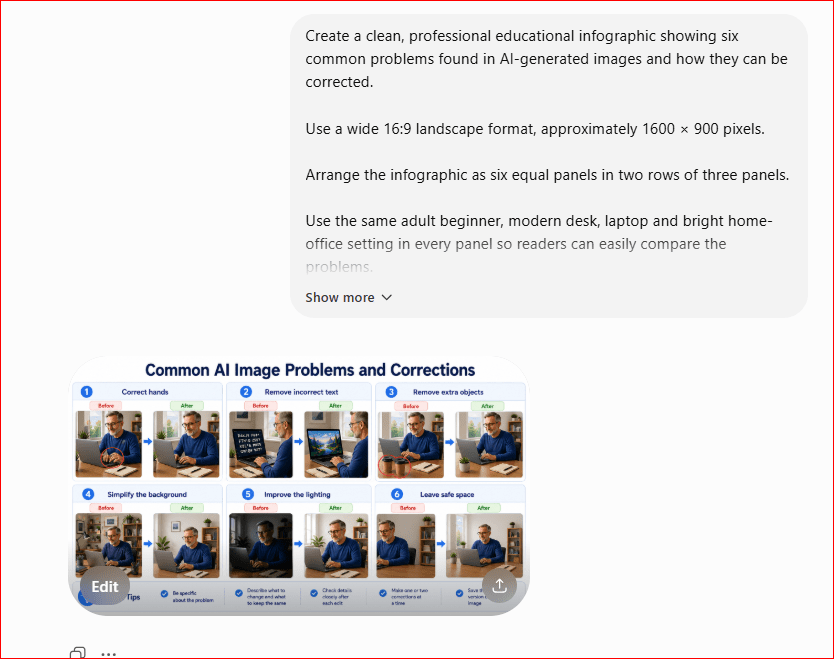
    • Do not use tables.
    • Do not repeat the same idea.
    • Do not invent sources.
    • Do not include private information.

    Limits help guide the AI away from unsuitable content.

    A Prompt Can Ask the AI to Take a Role

    You can ask the AI to respond from a particular professional or practical perspective.

    For example:

    Act as a patient computer teacher. Explain how to create a folder in Windows to a complete beginner.

    Other possible roles include:

    • A tutor.
    • An editor.
    • A career adviser.
    • A marketing assistant.
    • A customer-service representative.
    • A travel planner.
    • A study coach.
    • A technical trainer.

    A role can influence the tone, focus, and type of information provided.

    However, assigning a role does not turn the AI into a licensed professional. Important medical, legal, financial, engineering, or safety advice still requires qualified human review.

    Short Prompts and Detailed Prompts

    A short prompt may work well for a simple task.

    For example:

    Translate “Good morning” into French.

    The task is clear and does not require much additional information.

    A detailed prompt is more useful when the task is complex.

    For example:

    Create a beginner-friendly outline for a 2,000-word article about online privacy. Include an introduction, six main sections, common mistakes, frequently asked questions, key takeaways, and a final safety tip.

    The level of detail should match the task.

    A prompt should not be long simply for the sake of being long. It should include the information necessary to produce a useful response.

    The Main Parts of an Effective Prompt

    A useful prompt may include:

    • Task: What should the AI do?
    • Context: What background information does it need?
    • Audience: Who is the answer for?
    • Tone: How should the response sound?
    • Format: How should the answer be organized?
    • Length: How detailed should it be?
    • Examples: Is there a pattern to follow?
    • Limits: What should the AI avoid?

    For example:

    Write a friendly email to a new website subscriber thanking them for joining AI Mastery. The reader is a complete beginner interested in Artificial Intelligence.

    Keep the email under 150 words, use short paragraphs, and include one link encouraging them to explore the beginner tutorials.

    This prompt includes the task, recipient, audience, tone, length, format, and purpose.

    A Simple Prompt Formula

    Beginners can use this basic structure:

    Task + context + audience + format + tone + limits

    For example:

    Explain prompt engineering to a complete beginner. Use simple language, one everyday comparison, and three practical examples. Organize the answer with short headings and keep it under 600 words.

    You do not need to include every part in every prompt.

    Use only the details that help the AI understand your goal.

    Why Prompts Matter

    AI tools do not automatically know:

    • What result you want.
    • Why you need it.
    • Who will read it.
    • How detailed it should be.
    • What tone you prefer.
    • Which format would be most useful.
    • What information should be avoided.

    The prompt provides this direction.

    A clearer prompt reduces guesswork and increases the chance of receiving a useful response.

    However, the AI may still make mistakes. A good prompt improves the instructions, but it does not remove the need for human review.

    Figure 2. The main parts that can be included in an effective AI prompt.

    This infographic shows that a useful prompt may contain more than a basic question or command. Adding information about the task, context, audience, tone, format, length, examples, and limits gives the AI clearer direction and can improve the final response.

    Why Are Good Prompts Important?

    Good prompts are important because they help the AI understand exactly what you need.

    An AI tool cannot read your mind. It only works with the information you provide.

    When a prompt is vague, the AI must guess:

    • What you are trying to achieve.
    • Who the answer is for.
    • How detailed the response should be.
    • What tone to use.
    • Which format would be most helpful.
    • What information to include or avoid.

    A clear prompt reduces this uncertainty.

    Good Prompts Produce More Relevant Answers

    A relevant answer focuses on the user’s actual goal.

    Consider this prompt:

    Tell me about exercise.

    The AI may discuss many types of exercise, including running, weight training, swimming, stretching, and sports.

    But suppose the user needs gentle exercise ideas for an older beginner.

    A better prompt would be:

    Suggest five gentle indoor exercises for an older beginner. Avoid high-impact movements and explain each exercise in simple language.

    The improved prompt is more likely to produce information that matches the user’s needs.

    Good Prompts Save Time

    A vague prompt often leads to an answer that must be rewritten several times.

    For example:

    Write an advertisement.

    The AI may produce an advertisement for the wrong audience, platform, product, or tone.

    A clearer prompt may be:

    Write a short Facebook advertisement for a beginner-friendly online course about Artificial Intelligence. Target adults with no technical experience. Use a friendly and encouraging tone and keep it under 100 words.

    This prompt gives the AI enough information to create a more suitable first draft.

    A better first draft means fewer corrections and less time spent explaining the task again.

    Good Prompts Improve Clarity

    Clear prompts encourage the AI to organize information in a more understandable way.

    Compare these prompts:

    Explain cybersecurity.

    Explain cybersecurity to a complete beginner. Use short paragraphs, simple language, and three examples of common online threats.

    The second prompt gives specific instructions about vocabulary, structure, and examples.

    This can make the answer easier to understand.

    Good Prompts Help Control the Level of Detail

    AI responses may be too short, too long, too simple, or too technical.

    You can guide the level of detail through the prompt.

    For example:

    Explain neural networks in one paragraph for a complete beginner.

    This requests a brief explanation.

    A more detailed version might be:

    Explain neural networks to a complete beginner in approximately 1,000 words. Include an everyday comparison, a simple step-by-step explanation, three real-world uses, and two limitations.

    The best level of detail depends on the task.

    Good Prompts Improve the Format

    The same information can be presented in many ways.

    For example, you might ask the AI to present information as:

    • A paragraph.
    • A table.
    • A checklist.
    • A numbered guide.
    • A comparison.
    • A timeline.
    • A question-and-answer section.
    • A lesson plan.

    Suppose you ask:

    Explain the differences between ChatGPT, Google Gemini, and Claude.

    The AI may write several long paragraphs.

    A more useful prompt could be:

    Compare ChatGPT, Google Gemini, and Claude in a beginner-friendly table. Include columns for main use, beginner advantage, possible limitation, and best use case.

    The table format makes the information easier to scan and compare.

    Good Prompts Help Maintain a Consistent Tone

    Tone is important in emails, articles, advertisements, customer messages, and educational content.

    For example, this prompt:

    Write a message asking for payment.

    could produce language that sounds too formal, too direct, or unfriendly.

    A better prompt would be:

    Write a polite and professional payment reminder for a customer whose invoice is seven days overdue. Keep the tone respectful and avoid threatening language.

    The tone instructions help the AI create a more appropriate message.

    Good Prompts Support Consistent Content

    Prompt engineering is useful when creating multiple pieces of content that need to follow the same structure.

    For example, a website owner may want every beginner article to include:

    • Estimated reading time.
    • What you’ll learn.
    • An introduction.
    • Main sections.
    • Practical examples.
    • Benefits.
    • Limitations.
    • Common myths.
    • Frequently asked questions.
    • Key takeaways.
    • A final tip.

    A reusable prompt can help maintain this structure across many articles.

    For example:

    Create a beginner-friendly article outline about AI video generation. Follow this structure: estimated reading time, what you’ll learn, introduction, main explanation, practical uses, benefits, limitations, common myths, FAQs, key takeaways, and final tip.

    This helps the AI produce a consistent format.

    Good Prompts Reduce Misunderstandings

    AI tools can misunderstand vague instructions.

    For example:

    Make this better.

    The AI may not know whether “better” means:

    • Shorter.
    • More professional.
    • Easier to understand.
    • More persuasive.
    • More detailed.
    • More formal.
    • More accurate.
    • Better organized.

    A clearer prompt would be:

    Rewrite this paragraph in simpler language for a complete beginner. Keep the meaning the same and reduce it to approximately 100 words.

    The improved instruction explains exactly what kind of change is required.

    Good Prompts Help the AI Use Provided Information

    When working with documents, notes, data, or pasted text, a clear prompt tells the AI what to do with the material.

    For example:

    Review the following article and identify repeated ideas, grammar errors, unclear sentences, and missing headings. Present your findings as a checklist.

    This prompt is more useful than simply writing:

    Check this article.

    The clearer version explains what type of review is needed and how the findings should be presented.

    Good Prompts Can Improve Creativity

    AI can help generate creative ideas, but broad prompts often produce predictable results.

    For example:

    Give me blog ideas.

    A more focused prompt would be:

    Suggest ten beginner-friendly blog article ideas about Artificial Intelligence for adults over 50. Avoid highly technical topics and include one sentence explaining why each idea would be useful.

    The clearer prompt gives the AI a defined audience, subject, difficulty level, number of ideas, and explanation requirement.

    This can lead to more suitable and original suggestions.

    Good Prompts Improve Image Generation

    AI image generators also depend heavily on prompts.

    A basic image prompt might be:

    Create a picture of a robot.

    This may produce many different results.

    A more detailed image prompt could be:

    Create a clean horizontal educational illustration of a friendly home-assistant robot helping an older adult use a laptop. Use a bright modern room, natural lighting, a realistic but approachable style, and a blue-and-purple colour theme. Do not include text, logos, or watermarks.

    The detailed prompt gives the image generator clearer instructions about:

    • Subject.
    • Action.
    • Setting.
    • Style.
    • Lighting.
    • Colour.
    • Image orientation.
    • Elements to avoid.

    This increases the chance of receiving an image that matches the intended use.

    Good Prompts Are Useful for Follow-Up Questions

    Prompt engineering does not end after the first response.

    You can use follow-up prompts to improve the result.

    For example:

    • Make the answer shorter.
    • Add three examples.
    • Explain the second point in simpler language.
    • Turn this into a table.
    • Use a more professional tone.
    • Remove repeated ideas.
    • Rewrite it for a 12-year-old.
    • Add a step-by-step checklist.
    • Correct any factual uncertainty.

    Follow-up prompts allow you to refine the answer without starting the entire task again.

    Good Prompts Do Not Guarantee Perfect Results

    A good prompt improves communication, but it does not guarantee that the AI will always be correct.

    The AI may still:

    • Provide outdated information.
    • Misinterpret the request.
    • Invent facts.
    • Omit important details.
    • Make calculation errors.
    • Produce biased or unsuitable content.
    • Use incorrect sources.
    • Generate poor-quality images.
    • Write code that does not work properly.

    For this reason, users should review important responses carefully.

    Good prompt engineering improves the result, but human judgment remains essential.

    Figure 3. Good prompts can improve relevance, clarity, organization, tone, and efficiency.

    This comparison shows why prompt quality matters. A vague prompt leaves many details unclear, while a strong prompt gives the AI useful direction about the task, audience, tone, format, and limits. Better prompts usually reduce misunderstanding and produce more useful first drafts.

    How Does Prompt Engineering Work?

    Prompt engineering works by giving an AI system clear instructions, reviewing the response, and improving the instructions when necessary.

    The process is usually not completed with one perfect prompt. It often involves several steps:

    1. Decide what result you need.
    2. Write the first prompt.
    3. Review the AI’s response.
    4. Identify problems or missing information.
    5. Add clearer instructions.
    6. Ask the AI to revise the response.
    7. Check the final result carefully.

    This repeated process is sometimes called iteration.

    Iteration means improving something through several attempts.

    Step 1: Decide What You Need

    Before writing a prompt, identify your goal.

    Ask yourself:

    • What task do I want the AI to complete?
    • Who will use or read the result?
    • What information should be included?
    • How should the answer be organized?
    • How long should it be?
    • What tone should it use?
    • What should the AI avoid?

    For example, suppose you need an email asking a company about a delayed delivery.

    Your goal is not simply “write an email.”

    Your actual goal may be:

    • Contact customer service.
    • Explain that the order is late.
    • Ask for an updated delivery date.
    • Remain polite and professional.
    • Keep the email short.
    • Include the order number.

    Understanding the goal makes it easier to write an effective prompt.

    Step 2: Write the First Prompt

    After identifying your goal, write a clear initial prompt.

    For example:

    Write a polite email to customer service asking about a delayed delivery. My order number is 45821, and the expected delivery date was July 10. Ask for an updated delivery date and keep the email under 150 words.

    This prompt gives the AI several useful details:

    • The task.
    • The recipient.
    • The problem.
    • The order number.
    • The expected delivery date.
    • The requested action.
    • The tone.
    • The length.

    The AI uses these instructions to generate a response.

    Step 3: The AI Interprets the Prompt

    When you submit a prompt, the AI analyzes the words and patterns in your instruction.

    It attempts to determine:

    • What task you are requesting.
    • What information is important.
    • What type of response is expected.
    • What writing style or format to use.
    • How the different parts of the prompt relate to one another.

    The AI does not understand the request exactly as a human does. It uses patterns learned from large amounts of training material to predict a suitable response.

    For example, when it reads:

    Write a polite email to customer service…

    it recognizes that the response should probably include:

    • A greeting.
    • A short explanation of the problem.
    • A polite request.
    • A closing.
    • Professional language.

    When the prompt includes an order number and delivery date, the AI can place those details in the email.

    Step 4: The AI Generates a Response

    The AI creates its answer step by step.

    For a writing task, it predicts words and sentences that are likely to satisfy the instructions.

    For an image-generation task, the system interprets the description and creates visual elements that are likely to match the prompt.

    For a coding task, it generates code based on the requested programming language, goal, and conditions.

    The quality of the response depends on several factors, including:

    • The clarity of the prompt.
    • The amount of useful context.
    • The complexity of the task.
    • The capabilities of the AI tool.
    • The information available to the system.
    • Whether the instructions conflict with one another.

    Even a detailed prompt may produce an imperfect response.

    Step 5: Review the Response

    After receiving the answer, do not accept it automatically.

    Check whether the AI followed your instructions.

    Ask:

    • Did it complete the correct task?
    • Did it include all important information?
    • Is the answer suitable for the intended audience?
    • Is the tone appropriate?
    • Is the format correct?
    • Is the answer too long or too short?
    • Are any statements unclear?
    • Are there repeated ideas?
    • Are important facts accurate?
    • Is anything missing?

    For the customer-service email, you might notice that the AI:

    • Forgot to include the order number.
    • Used language that sounds too demanding.
    • Made the email too long.
    • Asked for a refund instead of an updated delivery date.

    These problems can be corrected with a follow-up prompt.

    Step 6: Improve the Prompt

    After reviewing the response, explain what needs to change.

    For example:

    Rewrite the email. Include order number 45821 in the first paragraph. Make the tone more polite, remove the request for a refund, and ask only for the updated delivery date.

    This follow-up instruction is more specific because it responds to problems in the first draft.

    You do not always need to rewrite the entire original prompt. You can tell the AI exactly what to change.

    Other follow-up prompts may include:

    • Make the explanation simpler.
    • Add two practical examples.
    • Remove repeated information.
    • Turn the answer into a numbered list.
    • Keep each paragraph under three sentences.
    • Use a more professional tone.
    • Explain the third point in greater detail.
    • Correct the grammar without changing the meaning.
    • Shorten the response to 200 words.
    • Add a warning about possible limitations.

    Step 7: Generate Another Version

    The AI uses the new instructions to revise the answer.

    You then review the new version.

    Sometimes the second result is satisfactory. At other times, another revision may be required.

    For example:

    First prompt:

    Write a product description for a travel bag.

    First response problem:

    The description is too general and does not mention the important product features.

    Follow-up prompt:

    Rewrite the description for a foldable travel bag. Mention that it is lightweight, water-resistant, easy to store, and suitable for short trips. Use a friendly sales tone and keep it under 120 words.

    Second response problem:

    The description makes an unsupported claim that the bag is completely waterproof.

    Second follow-up prompt:

    Replace “completely waterproof” with “water-resistant.” Do not add features that were not provided.

    The prompt improves as the user identifies and corrects problems.

    The Prompt Engineering Cycle

    Prompt engineering can be understood as a repeating cycle:

    Goal → Prompt → Response → Review → Improvement → New Response

    The cycle continues until the result is accurate, useful, and suitable for the intended purpose.

    This does not mean you should keep revising forever.

    Stop when the response:

    • Meets the main goal.
    • Includes the necessary information.
    • Uses the correct tone and format.
    • Does not contain obvious errors.
    • Is suitable for the intended audience.

    Example: Improving an Explanation

    Suppose a beginner asks:

    Explain blockchain.

    The AI may provide a technical explanation containing terms such as distributed ledger, cryptography, consensus mechanism, and decentralization.

    The user could improve the request:

    Explain blockchain to a complete beginner using simple language and one everyday comparison. Avoid technical terminology.

    The response may now be easier to understand, but it may still be too long.

    The user could follow up:

    Shorten the explanation to four paragraphs and add one example of how blockchain is used.

    This process shows how prompt engineering gradually guides the AI toward the desired result.

    Example: Improving an Article Outline

    First prompt:

    Create an article outline about AI images.

    Possible problem: The outline may be too short or poorly organized.

    Improved prompt:

    Create a detailed outline for a beginner-friendly article titled “AI Image Generation for Beginners: Complete Guide (2026).” Include what readers will learn, an introduction, how AI image generation works, popular tools, prompt-writing tips, practical uses, benefits, limitations, myths, FAQs, key takeaways, and a final tip.

    This version provides the title, audience, year, subject, and required sections.

    If the outline still needs improvement, the user could add:

    Place the sections in a logical learning order. Include suggested H2 and H3 headings and avoid repeating the same topic.

    Example: Improving an Image Prompt

    First prompt:

    Create an image of someone using AI.

    Possible problem: The image generator may create an unsuitable person, setting, style, or image orientation.

    Improved prompt:

    Create a clean horizontal 16:9 educational illustration of an older beginner using an AI assistant on a laptop at home. Show a simple prompt box on the screen and visual ideas appearing beside it. Use natural lighting, a modern blue-and-purple colour theme, and a friendly realistic style. Do not include logos, watermarks, or unreadable text.

    This prompt gives the AI clearer visual instructions.

    The user may still need to refine the result:

    Keep the same scene, but make the laptop screen larger and remove the extra person in the background.

    One Prompt Can Contain Several Instructions

    A detailed prompt may include several instructions at once.

    For example:

    Write a beginner-friendly explanation of online privacy. Use simple language, organize the answer under five short headings, include three everyday examples, add one safety checklist, and keep the response under 800 words.

    The AI must identify and follow each requirement:

    • Topic: Online privacy.
    • Audience: Beginners.
    • Language: Simple.
    • Structure: Five headings.
    • Examples: Three.
    • Additional content: Safety checklist.
    • Length: Under 800 words.

    When a response fails to follow one requirement, remind the AI about that specific instruction.

    For example:

    The explanation is useful, but it does not include the safety checklist. Add a five-point checklist at the end without rewriting the other sections.

    Clear Instructions Should Not Conflict

    A prompt becomes difficult to follow when its instructions contradict each other.

    For example:

    Write a complete and highly detailed guide about machine learning, but keep it under 100 words.

    A complete and highly detailed guide is unlikely to fit within 100 words.

    Another conflicting prompt might be:

    Use technical terminology, but make sure the article contains no technical words.

    To avoid confusion, make sure the instructions work together.

    A clearer version could be:

    Write a 150-word beginner summary of machine learning. Cover only the basic definition, one example, and one limitation.

    Breaking Complex Tasks into Smaller Prompts

    Large tasks may produce better results when divided into smaller steps.

    Instead of asking:

    Write a complete 10,000-word guide about Artificial Intelligence.

    You could work section by section:

    1. Create the article outline.
    2. Review and improve the outline.
    3. Write the introduction.
    4. Write the first main section.
    5. Continue with each section.
    6. Review the full article for repetition.
    7. Check headings and formatting.
    8. Add internal links and metadata.

    This approach gives you more control and makes errors easier to identify.

    It is especially useful for:

    • Long articles.
    • Business plans.
    • Courses.
    • Reports.
    • Website content.
    • Research summaries.
    • Marketing campaigns.
    • Large coding projects.

    Context Can Be Added During the Conversation

    You do not need to include every detail in the first prompt.

    You may add information as the conversation continues.

    For example:

    User:

    Create a weekly meal plan.

    AI response: Produces a general plan.

    User:

    Revise it for a family of six.

    User:

    Avoid seafood and include low-cost ingredients.

    User:

    Present the final version as a seven-day table with breakfast, lunch, and dinner.

    Each follow-up adds context and improves the result.

    However, for important tasks, including the main requirements in the first prompt can save time.

    AI Tools May Respond Differently

    The same prompt may produce different results in different AI tools.

    One tool may provide:

    • A longer explanation.
    • A shorter answer.
    • A different writing style.
    • More examples.
    • A different image composition.
    • Different formatting.
    • Different factual details.

    Results may also vary when the same prompt is submitted more than once.

    Prompt engineering therefore involves testing and reviewing, not simply memorizing one perfect sentence.

    Better Prompts Reduce Guesswork

    The main purpose of prompt engineering is to reduce unnecessary guesswork.

    A prompt such as:

    Help me with my website.

    leaves many questions unanswered.

    The AI does not know whether you need help with:

    • Website design.
    • Article writing.
    • Search engine optimization.
    • Navigation.
    • Images.
    • Speed.
    • Security.
    • Domain settings.
    • Categories.
    • Internal links.

    A clearer prompt would be:

    Review the navigation structure for a beginner-friendly Artificial Intelligence education website. The current menu is Home, Tutorials, AI Tools, AI News, About, and Contact. Suggest any improvements, but keep the menu simple.

    The clearer request gives the AI a defined task and useful background information.

    Human Review Is Part of Prompt Engineering

    Prompt engineering is not only about writing instructions.

    It also includes evaluating the result.

    The user must decide:

    • Whether the answer is accurate.
    • Whether the information is complete.
    • Whether the tone is appropriate.
    • Whether private information has been protected.
    • Whether claims require verification.
    • Whether the content is suitable for publication.
    • Whether the result should be revised or rejected.

    AI can assist with the work, but the user remains responsible for the final decision.

    Figure 4. Prompt engineering is a repeating process of writing, reviewing, and improving instructions.

    This process shows that effective prompting usually involves more than submitting one question. The user defines the goal, writes the prompt, reviews the AI’s response, identifies problems, and adds clearer instructions. The cycle continues until the result is suitable for the intended purpose.

    The Main Elements of an Effective Prompt

    An effective prompt gives the AI enough information to understand the task and produce a useful response.

    A prompt does not need to include every possible detail. It should include the details that are important for the specific task.

    The main elements of an effective prompt are:

    1. The task.
    2. The context.
    3. The audience.
    4. The role.
    5. The tone.
    6. The format.
    7. The length.
    8. Examples.
    9. Limits and restrictions.
    10. Quality requirements.

    1. The Task

    The task explains what you want the AI to do.

    It is usually the most important part of the prompt.

    Common task words include:

    • Explain.
    • Write.
    • Summarize.
    • Compare.
    • Rewrite.
    • Translate.
    • Organize.
    • Suggest.
    • Review.
    • Correct.
    • Create.
    • Calculate.
    • Extract.
    • Classify.
    • Plan.

    For example:

    Explain Artificial Intelligence.

    The task is to explain a subject.

    Another example:

    Create a seven-day study plan.

    The task is to create a plan.

    A clear task should use a specific action word.

    Compare these prompts:

    Unclear task:

    Artificial Intelligence for beginners.

    This describes a subject, but it does not clearly tell the AI what to do.

    Clear task:

    Explain Artificial Intelligence to a complete beginner.

    The second prompt gives the AI a direct instruction.

    Be Specific About the Task

    Some task words are too broad unless they include more details.

    For example:

    Help me with this article.

    The AI does not know whether it should:

    • Correct the grammar.
    • Rewrite the introduction.
    • Check the facts.
    • Improve the headings.
    • Remove repetition.
    • Shorten the article.
    • Add examples.
    • Create a conclusion.

    A clearer prompt would be:

    Review this article and identify repeated ideas, unclear sentences, grammar errors, and missing headings.

    The clearer version explains exactly what type of help is required.

    2. The Context

    Context is the background information the AI needs to understand the situation.

    Context may include:

    • Why you need the result.
    • What has already happened.
    • What information is available.
    • What problem you are trying to solve.
    • What type of project you are working on.
    • What limitations you face.
    • What the AI should know before completing the task.

    For example:

    I am creating a beginner-friendly website about Artificial Intelligence. My readers have little or no technical experience. Suggest ten article ideas for the website.

    The first two sentences provide context.

    They explain:

    • The user is building a website.
    • The website teaches Artificial Intelligence.
    • The readers are beginners.
    • The task is to suggest article ideas.

    Without this context, the AI might suggest advanced technical topics that are unsuitable for the audience.

    Useful Context Versus Unnecessary Context

    Include information that affects the result.

    For example, when asking for travel recommendations, useful context may include:

    • Destination.
    • Dates.
    • Budget.
    • Number of travellers.
    • Ages of children.
    • Transportation preferences.
    • Accessibility needs.

    Unnecessary context may make the prompt longer without improving the answer.

    For example, the colour of your suitcase probably does not matter when asking the AI to create a travel schedule.

    A good prompt includes relevant background information, not every personal detail.

    3. The Audience

    The audience is the person or group who will read, use, or receive the result.

    Audience information helps the AI choose:

    • Vocabulary.
    • Level of detail.
    • Examples.
    • Tone.
    • Structure.
    • Explanations.

    Possible audiences include:

    • Complete beginners.
    • Children.
    • Teenagers.
    • Older adults.
    • Students.
    • Teachers.
    • Business owners.
    • Customers.
    • Job applicants.
    • Technical professionals.
    • General website readers.

    Compare these prompts:

    Without an audience:

    Explain machine learning.

    With an audience:

    Explain machine learning to an adult beginner with no programming experience.

    The second prompt helps the AI avoid unnecessary technical language.

    The Same Topic for Different Audiences

    The same subject may need different explanations depending on the audience.

    For a child:

    Explain cloud computing to a 10-year-old using a school-locker comparison.

    For a business owner:

    Explain cloud computing to a small-business owner. Focus on cost, file access, security, and teamwork.

    For a technical reader:

    Explain cloud computing architecture, including virtualization, service models, and deployment models.

    The topic is the same, but the explanation changes because the audiences are different.

    4. The Role

    A role tells the AI what perspective or type of assistance to provide.

    For example:

    Act as a patient computer tutor.

    Act as an editor reviewing a beginner article.

    Act as a customer-service assistant.

    Act as a study coach.

    A role can influence:

    • Tone.
    • Vocabulary.
    • Priorities.
    • Structure.
    • Type of advice.

    For example:

    Act as a patient computer tutor. Explain how to attach a document to an email using simple step-by-step instructions.

    The role encourages the AI to respond in a teaching style.

    Roles Should Be Used Carefully

    A role is useful when it adds meaningful direction.

    However, a role is not always necessary.

    Compare:

    Act as an expert professional world-class email specialist and write an email.

    This role is exaggerated and does not explain the actual purpose of the email.

    A more useful prompt would be:

    Write a polite email to a customer confirming that their refund has been processed. Use a professional tone and keep it under 120 words.

    Specific instructions are usually more useful than impressive-sounding roles.

    A role also does not make the AI a qualified professional.

    For example:

    Act as a doctor.

    This does not give the AI the qualifications, examination results, or professional responsibility of a real doctor.

    Medical, legal, financial, engineering, and safety-related information should still be checked with an appropriately qualified person.

    5. The Tone

    Tone describes how the response should sound.

    Common tone instructions include:

    • Friendly.
    • Professional.
    • Formal.
    • Informal.
    • Polite.
    • Encouraging.
    • Neutral.
    • Persuasive.
    • Respectful.
    • Serious.
    • Enthusiastic.
    • Calm.
    • Confident.
    • Beginner-friendly.

    For example:

    Write a polite and professional email requesting an update on my application.

    The tone instruction helps the AI avoid language that sounds rude or impatient.

    Match the Tone to the Situation

    Different situations require different tones.

    A customer complaint may require a firm but respectful tone:

    Write a firm but polite complaint about a damaged product. Clearly request a replacement without using threatening language.

    A beginner lesson may require an encouraging tone:

    Explain the topic in a friendly and encouraging tone. Reassure the reader that no programming experience is required.

    A business report may require a neutral tone:

    Summarize the results in a neutral and factual tone. Avoid promotional language.

    Avoid Conflicting Tone Instructions

    Do not combine tones that work against each other.

    For example:

    Write a very formal, highly casual message.

    The AI may not know which style to follow.

    A clearer instruction would be:

    Write a professional but friendly message.

    6. The Format

    Format tells the AI how to organize the response.

    Possible formats include:

    • Paragraphs.
    • Bullet points.
    • Numbered steps.
    • A table.
    • A checklist.
    • A template.
    • An outline.
    • A timeline.
    • A comparison chart.
    • Questions and answers.
    • Headings and subheadings.
    • A script.
    • An email.
    • A social media post.

    For example:

    Create a seven-step checklist for publishing a WordPress article.

    The requested checklist format makes the answer easier to follow.

    Another example:

    Compare three AI writing tools in a table with columns for tool name, main use, beginner advantage, and limitation.

    The table format helps readers compare information quickly.

    Specify the Structure

    For longer content, explain how the response should be organized.

    For example:

    Write a beginner-friendly article with the following sections: introduction, definition, how it works, practical uses, benefits, limitations, FAQs, key takeaways, and final tip.

    This reduces the chance that the AI will omit an important section

    You may also request heading levels:

    Use one H1 title, H2 headings for main sections, and H3 headings for subsections.

    Choose a Format That Matches the Task

    Different tasks benefit from different formats.

    Use:

    • A numbered list for steps that should be followed in order.
    • Bullet points for information that does not require a specific order.
    • A table for comparisons.
    • A checklist for tasks that need to be completed.
    • Short paragraphs for explanations.
    • A template for content that will be reused.
    • A timeline for events arranged by date.

    The clearest format is usually better than the most decorative format.

    7. The Length

    Length instructions tell the AI how much information to provide.

    Examples include:

    • One sentence.
    • One paragraph.
    • Three paragraphs.
    • Five bullet points.
    • Under 100 words.
    • Approximately 500 words.
    • A detailed 2,000-word guide.
    • A ten-step process.

    For example:

    Summarize this article in five bullet points.

    Another example:

    Explain neural networks in approximately 600 words.

    Length instructions are especially useful when creating:

    • Emails.
    • Social media posts.
    • Summaries.
    • Advertisements.
    • Product descriptions.
    • Articles.
    • Presentations.
    • Video scripts.

    Use Realistic Length Requirements

    The requested length should match the task.

    For example:

    Write a complete guide to Artificial Intelligence in 50 words.

    This is unlikely to provide enough detail.

    A more realistic request would be:

    Write a 50-word introduction to Artificial Intelligence.

    Similarly, asking for a short email does not require a 1,000-word response.

    Exact Length Versus Approximate Length

    AI tools may not always follow an exact word count perfectly.

    Instead of saying:

    Write exactly 137 words.

    it may be more practical to say:

    Keep the response between 120 and 150 words.

    You should still check the final word count when the limit is important.

    8. Examples

    Examples show the AI what type of result you want.

    They are especially useful when you need:

    • A specific style.
    • A repeated format.
    • Consistent article titles.
    • Similar product descriptions.
    • Matching email templates.
    • A particular tone.
    • A certain type of explanation.

    For example:

    Suggest five article titles using a style similar to “What Is Artificial Intelligence? A Beginner’s Guide (2026).”

    The example gives the AI a pattern.

    It may produce titles such as:

    • What Is Machine Learning? A Beginner’s Guide (2026)
    • What Is Deep Learning? A Beginner’s Guide (2026)
    • What Is Generative AI? A Beginner’s Guide (2026)

    Give More Than One Example When Necessary

    One example may not always show the full pattern.

    For example:

    Create product titles similar to these:

    • Foldable Travel Bag for Weekend Trips
    • Portable Garment Steamer for Travel
    • Lightweight Packing Cubes for Organized Luggage

    Several examples help the AI identify the common style.

    Do Not Ask the AI to Copy Exactly

    Examples should guide the response, not encourage copying protected or private material.

    A safer instruction is:

    Use a similar level of simplicity and organization, but write original content.

    9. Limits and Restrictions

    Limits explain what the AI should not do.

    Useful limits may include:

    • Avoid technical jargon.
    • Do not exceed 300 words.
    • Do not invent statistics.
    • Do not add information that was not provided.
    • Do not mention competitors.
    • Do not include personal information.
    • Do not use tables.
    • Do not repeat ideas.
    • Do not use aggressive language.
    • Do not provide professional medical advice.
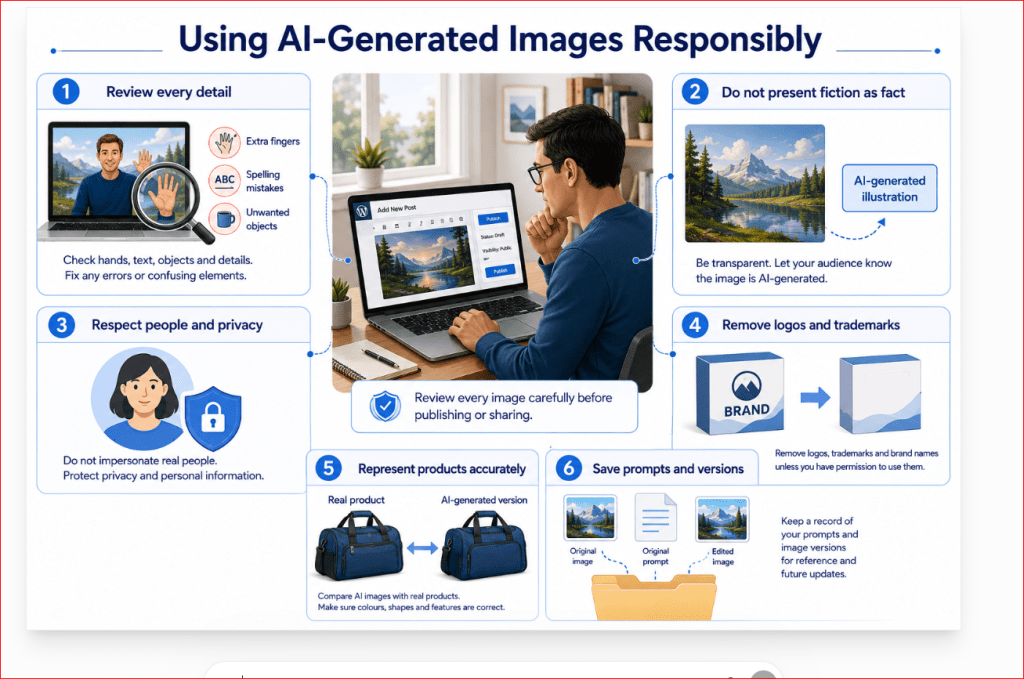
    • Do not include logos or watermarks.
    • Do not change the original meaning.

    For example:

    Rewrite this paragraph in simpler language. Keep the original meaning, do not add new facts, and avoid technical terminology.

    The restrictions help protect the accuracy and purpose of the original text.

    Negative Instructions Should Be Clear

    A negative instruction explains what to avoid.

    For example:

    Create an educational image of a person using an AI assistant. Do not include company logos, watermarks, distorted hands, or unreadable text.

    These instructions are common in AI image generation.

    For writing tasks:

    Explain the topic without using mathematical formulas or programming code.

    Clear negative instructions can reduce unwanted content.

    However, too many restrictions may make the prompt difficult to follow. Include only the limits that matter.

    10. Quality Requirements

    Quality requirements describe what a successful response should achieve.

    They may include:

    • Accuracy.
    • Clarity.
    • Originality.
    • Completeness.
    • Logical organization.
    • Correct grammar.
    • Suitable examples.
    • Consistent terminology.
    • Fact verification.
    • Beginner-friendly language.

    For example:

    Review the article for clarity, grammar, repetition, and logical organization. Preserve the beginner-friendly tone.

    Another example:

    Create a comparison table using only the information I provide. Mark any missing information as “Not provided” instead of guessing.

    This quality requirement reduces the risk of invented details.

    Ask the AI to Identify Uncertainty

    For research-related tasks, you may tell the AI how to handle uncertain information.

    For example:

    Do not guess. Clearly identify any statement that requires verification.

    Or:

    Separate confirmed information from assumptions.

    This does not guarantee accuracy, but it encourages a more careful response.

    Ask for a Final Check

    You can include a final review instruction in the prompt.

    For example:

    Before providing the final answer, check that all seven steps are included, the language is suitable for beginners, and the response stays under 800 words.

    This can help the AI notice missing requirements.

    However, you should still complete your own review.

    Putting the Elements Together

    A complete prompt may combine several elements.

    For example:

    Act as a patient computer tutor. Explain how to create a strong password to an older beginner with basic computer knowledge. Use simple language and a friendly tone. Organize the answer as a six-step numbered guide, include two examples of strong passwords using fictional information, and keep the response under 500 words. Do not include real personal information or recommend reusing the same password.

    This prompt contains:

    • Role: Patient computer tutor.
    • Task: Explain how to create a strong password.
    • Audience: Older beginner.
    • Context: Basic computer knowledge.
    • Tone: Friendly.
    • Format: Six-step numbered guide.
    • Examples: Two fictional examples.
    • Length: Under 500 words.
    • Limits: No real personal information and no password reuse.

    Another Complete Prompt Example

    Write a beginner-friendly article introduction about AI image generation. The article is for adults with no technical experience. Use a clear and encouraging tone, explain the topic in simple language, include one everyday example, and keep the introduction between 300 and 400 words. Do not include technical explanations that belong in later sections.

    This prompt contains:

    • Task: Write an introduction.
    • Topic: AI image generation.
    • Audience: Adults with no technical experience.
    • Tone: Clear and encouraging.
    • Format: Introductory section.
    • Example: One everyday example.
    • Length: 300 to 400 words.
    • Limit: Avoid advanced technical explanation.

    Not Every Prompt Needs Every Element

    A simple task may require only a short instruction.

    For example:

    Translate “Thank you for your help” into French.

    The task is clear.

    A detailed prompt is more useful when:

    • The task is complex.
    • The output will be published.
    • Several requirements must be followed.
    • The intended audience is important.
    • The tone must be controlled.
    • The format must be consistent.
    • Accuracy is especially important.

    The goal is not to make every prompt long.

    The goal is to make every prompt clear enough for the task.

    A Practical Prompt Checklist

    Before submitting an important prompt, check:

    • Did I clearly state the task?
    • Did I provide necessary context?
    • Did I identify the audience?
    • Did I specify the tone?
    • Did I request a useful format?
    • Did I set a realistic length?
    • Did I provide examples when needed?
    • Did I explain what to avoid?
    • Did I describe the required quality?
    • Are any instructions conflicting?

    You do not need to answer every question for every prompt. Use the checklist to identify missing information that could affect the result.

    Figure 5. The main elements that can be combined to create an effective AI prompt.

    An effective prompt usually begins with a clear task and then adds the details needed for that situation. Context, audience, tone, format, examples, limits, and quality requirements help reduce uncertainty and guide the AI toward a more suitable response.

    A Simple Prompt Formula for Beginners

    Beginners do not need to memorize complicated prompt-writing methods.

    A simple formula can make most prompts clearer and more useful:

    Task + Context + Audience + Format + Tone + Limits

    This formula helps you decide what information the AI needs before it begins the task.

    You do not need to include every part in every prompt. Use only the elements that are relevant.

    1. Task

    The task explains what you want the AI to do.

    Begin with a clear action word, such as:

    • Explain.
    • Write.
    • Summarize.
    • Compare.
    • Create.
    • Rewrite.
    • Review.
    • Translate.
    • Organize.
    • Suggest.
    • Plan.

    For example:

    Explain machine learning.

    The task is clear: explain a subject.

    Another example:

    Write a customer-service email.

    The task is to write an email.

    A prompt should clearly tell the AI what action to take.

    2. Context

    Context gives the AI background information about the situation.

    For example:

    I am creating a beginner-friendly website about Artificial Intelligence.

    This helps the AI understand the purpose of the task.

    Other useful context may include:

    • What project you are working on.
    • What has already been completed.
    • Why you need the result.
    • What problem you are trying to solve.
    • What information the AI should use.
    • What restrictions or circumstances affect the task.

    For example:

    I am preparing a weekly study plan for someone who can study for only 30 minutes each day.

    This context helps the AI create a realistic plan.

    3. Audience

    The audience explains who will read or use the result.

    For example:

    The explanation is for a complete beginner with no technical experience.

    Audience information helps the AI choose suitable words, examples, and detail.

    Possible audiences include:

    • Children.
    • Teenagers.
    • Adults.
    • Older beginners.
    • Students.
    • Teachers.
    • Customers.
    • Business owners.
    • Job applicants.
    • Technical professionals.
    • General website readers.

    For example:

    Explain online privacy to an older adult who uses email and social media but has limited technical knowledge.

    This is more useful than simply asking:

    Explain online privacy.

    4. Format

    Format explains how the response should be organized.

    You may request:

    • A short paragraph.
    • Bullet points.
    • Numbered steps.
    • A table.
    • A checklist.
    • An outline.
    • A template.
    • A comparison.
    • Questions and answers.
    • Headings and subheadings.

    For example:

    Present the answer as a seven-step numbered guide.

    Another example:

    Compare the tools in a table with four columns.

    A clear format makes the response easier to read and use.

    5. Tone

    Tone explains how the response should sound.

    You may ask for a tone that is:

    • Friendly.
    • Professional.
    • Polite.
    • Formal.
    • Encouraging.
    • Neutral.
    • Persuasive.
    • Calm.
    • Respectful.
    • Beginner-friendly.

    For example:

    Use a friendly and encouraging tone.

    Tone is especially important when creating:

    • Emails.
    • Customer messages.
    • Articles.
    • Advertisements.
    • Social media posts.
    • Instructions.
    • Complaints.
    • Apologies.

    6. Limits

    Limits explain what the AI should avoid or control.

    Possible limits include:

    • Keep the answer under 300 words.
    • Avoid technical terminology.
    • Do not add facts that were not provided.
    • Do not use tables.
    • Do not repeat information.
    • Do not include brand names.
    • Do not use private information.
    • Do not make medical claims.
    • Do not include logos or watermarks.

    For example:

    Keep the answer under 500 words and avoid technical jargon.

    Limits help prevent the response from becoming unsuitable for the task.

    The Complete Formula

    The formula can be written as:

    Task + Context + Audience + Format + Tone + Limits

    Here is a complete example:

    Explain prompt engineering. I am creating a beginner-friendly Artificial Intelligence website. The explanation is for adults with no technical experience. Organize the answer under five short headings, use a friendly and encouraging tone, and keep it under 700 words. Avoid programming terminology.

    This prompt contains:

    • Task: Explain prompt engineering.
    • Context: The content is for an Artificial Intelligence website.
    • Audience: Adults with no technical experience.
    • Format: Five short headings.
    • Tone: Friendly and encouraging.
    • Limits: Under 700 words and no programming terminology.

    The Formula Does Not Need to Follow One Exact Order

    The elements may appear in a different order.

    For example:

    For a complete beginner, create a five-step guide explaining how to write a strong AI prompt. Use simple language, include one example in each step, and keep the guide under 800 words.

    This prompt contains the same important elements even though they appear in a different sequence.

    The order is less important than clarity.

    Example 1: Writing an Email

    Basic prompt:

    Write an email.

    This prompt does not explain the purpose, recipient, tone, or length.

    Using the formula:

    Write an email to my internet provider asking about a recent increase in my monthly bill. Explain that the price increased without a clear notice. Use a polite and professional tone, keep the email under 150 words, and ask for a written explanation of the new charges.

    The improved prompt includes:

    • Task: Write an email.
    • Context: The monthly bill increased.
    • Recipient: Internet provider.
    • Purpose: Request an explanation.
    • Tone: Polite and professional.
    • Length: Under 150 words.
    • Limit: Ask for an explanation rather than making accusations.

    Example 2: Learning a New Subject

    Basic prompt:

    Teach me about cloud computing.

    Using the formula:

    Explain cloud computing to a complete beginner who uses email and online file storage but has no technical training. Use simple language, one everyday comparison, and three real-world examples. Organize the explanation under short headings and keep it under 800 words.

    The improved prompt gives the AI clear guidance about:

    • The learner’s experience.
    • The required language level.
    • The examples.
    • The structure.
    • The length.

    Example 3: Creating a Study Plan

    Basic prompt:

    Create a study plan.

    Using the formula:

    Create a seven-day study plan for a beginner learning Artificial Intelligence. The learner has 30 minutes available each day. Present the plan as a table with columns for day, topic, learning activity, and practice task. Begin with basic concepts and avoid programming activities.

    This prompt includes:

    • Task: Create a study plan.
    • Context: The subject is Artificial Intelligence.
    • Audience: Beginner.
    • Available time: 30 minutes per day.
    • Format: Table.
    • Length: Seven days.
    • Limit: No programming activities.

    Example 4: Summarizing an Article

    Basic prompt:

    Summarize this.

    Using the formula:

    Summarize the following article for a complete beginner. Present the five most important ideas as bullet points. Keep each point under 25 words, use simple language, and do not add information that is not included in the article.

    The AI now knows:

    • What to do.
    • Who the summary is for.
    • How many points to include.
    • How long each point should be.
    • What language level to use.
    • What information to avoid.

    Example 5: Improving a Paragraph

    Basic prompt:

    Make this better.

    The word “better” is unclear.

    Using the formula:

    Rewrite the following paragraph so it is easier for a complete beginner to understand. Keep the original meaning, shorten long sentences, remove repeated ideas, and use a friendly educational tone. Do not add new facts.

    The improved prompt explains exactly what kind of improvement is required.

    Example 6: Creating a Social Media Post

    Basic prompt:

    Write a Facebook post.

    Using the formula:

    Write a Facebook post promoting a new beginner’s guide to prompt engineering. The audience is adults who are curious about Artificial Intelligence but have little technical experience. Use a friendly and encouraging tone, keep the post under 120 words, and end with a clear invitation to read the guide.

    This gives the AI direction about:

    • Platform.
    • Subject.
    • Audience.
    • Tone.
    • Length.
    • Call to action.

    Example 7: Creating an AI Image

    The same formula can be adapted for image generation.

    Basic prompt:

    Create an image about prompt engineering.

    Using the formula:

    Create a clean horizontal 16:9 educational illustration showing an older beginner typing a detailed prompt into an AI assistant on a laptop. Show a clear flow from written instructions to useful results such as an email, a checklist, and an educational image. Use a modern blue-and-purple colour theme, natural lighting, and a professional beginner-friendly style. Do not include company logos, watermarks, distorted hands, or unreadable text.

    For an image prompt, the main elements may include:

    • Subject.
    • Action.
    • Setting.
    • Style.
    • Colour
    • Lighting.
    • Orientation.
    • Objects to include.
    • Elements to avoid.

    Example 8: Comparing Products or Services

    Basic prompt:

    Compare these tools.

    Using the formula:

    Compare ChatGPT, Google Gemini, and Claude for a complete beginner. Present the comparison in a table with columns for main purpose, beginner advantage, possible limitation, and common use. Use neutral language and avoid declaring one tool the best.

    This prompt controls:

    • The tools being compared.
    • The audience.
    • The format.
    • The comparison criteria.
    • The tone.
    • The restriction against an unsupported overall winner.

    Example 9: Planning a Trip

    Basic prompt:

    Plan a trip to Toronto.

    Using the formula:

    Create a one-day family itinerary for Toronto for two adults and two children. The family will travel by car and wants low-cost indoor and outdoor activities. Organize the plan by morning, afternoon, and evening. Include estimated travel time between locations and avoid activities that require advance reservations.

    The improved prompt provides practical information that affects the result.

    Example 10: Reviewing an Article

    Basic prompt:

    Check my article.

    Using the formula:

    Review the following beginner-friendly article about Artificial Intelligence. Identify grammar errors, repeated ideas, unclear sentences, inconsistent headings, and missing internal links. Present the findings as a checklist and do not rewrite the entire article.

    This prompt tells the AI:

    • What type of review to complete.
    • Which problems to look for.
    • How to present the findings.
    • What not to do.

    A Shorter Four-Part Formula

    For simple everyday tasks, beginners can use a shorter formula:

    Task + Details + Format + Limits

    For example:

    Write a polite appointment-cancellation email. Explain that I am unavailable because of a family commitment. Keep it under 100 words and ask to reschedule for next week.

    This includes:

    • Task: Write an email.
    • Details: Cancellation because of a family commitment.
    • Format: Email.
    • Limits: Under 100 words.
    • Required action: Ask to reschedule.

    The shorter formula is useful when the task does not require detailed context or audience information.

    A One-Sentence Prompt Template

    You can use this reusable template:

    Create [task or result] for [audience or purpose]. Include [important information]. Use [format and tone]. Keep it [length] and avoid [unwanted content].

    Example:

    Create a beginner-friendly explanation of cybersecurity for older adults. Include three common online threats and one safety tip for each. Use short headings and a calm, encouraging tone. Keep it under 900 words and avoid technical jargon.

    A Detailed Prompt Template

    For larger tasks, use this template:

    Task:
    What should the AI do?

    Context:
    What background information does it need?

    Audience:
    Who will read or use the result?

    Required content:
    What information must be included?

    Format:
    How should the response be organized?

    Tone:
    How should it sound?

    Length:
    How detailed should it be?

    Limits:
    What should the AI avoid?

    Quality check:
    What should the AI confirm before providing the final answer?

    For example:

    Task: Create an article outline.
    Context: The article is for an Artificial Intelligence education website.
    Audience: Complete beginners.
    Required content: Definition, how it works, examples, benefits, limitations, myths, FAQs, and key takeaways.
    Format: H1 title, H2 main sections, and H3 subsections.
    Tone: Friendly and educational.
    Length: Detailed enough for a 5,000-word article.
    Limits: Avoid advanced programming topics and repeated sections.
    Quality check: Confirm that all required sections are included and placed in a logical order.

    This structured format is useful when the task contains many requirements.

    Start Simple and Add Details

    You do not always need to write a long prompt immediately.

    You can begin with a simple prompt:

    Create an outline for an article about prompt engineering.

    Then add details:

    Make it suitable for complete beginners.

    Then refine the structure:

    Include practical examples, benefits, limitations, myths, FAQs, and key takeaways.

    Then control the format:

    Use H2 headings for main sections and H3 headings for subsections.

    This step-by-step method is useful when you are still deciding what you need.

    However, when your requirements are already clear, including them in the first prompt can save time.

    Do Not Add Details That Do Not Affect the Result

    A prompt should be clear, not unnecessarily long.

    For example:

    I woke up at 7:00 this morning, drank coffee, checked my email, and then decided that I need a Facebook post about my new AI article.

    Most of this information does not affect the task.

    A clearer prompt would be:

    Write a Facebook post promoting my new beginner-friendly article about Artificial Intelligence.

    Add only the details that help the AI produce the correct result.

    Avoid Overloading the Prompt

    Too many instructions can make a prompt difficult to follow.

    For example:

    Write a short, complete, highly detailed, very simple, advanced, professional, casual, formal, humorous, serious article under 100 words.

    Several instructions conflict with one another.

    A clearer prompt would be:

    Write a 100-word beginner introduction to Artificial Intelligence in a professional but friendly tone.

    When the task is large, divide it into smaller prompts rather than placing dozens of requirements into one instruction.

    Check the Response Against the Formula

    After receiving the AI’s answer, review it using the same elements:

    • Did it complete the correct task?
    • Did it use the context properly?
    • Is it suitable for the audience?
    • Did it follow the requested format?
    • Is the tone appropriate?
    • Did it follow the length requirement?
    • Did it respect the limits?

    For example, suppose the prompt requested:

    Five bullet points, each under 20 words.

    Check that:

    • There are exactly five points.
    • The points are formatted as bullets.
    • Each point stays under the requested length.
    • The content matches the subject.

    Prompt engineering includes checking whether the instructions were followed.

    Save Useful Prompt Templates

    When a prompt works well, save it for future use.

    You may create reusable templates for:

    • Article introductions.
    • Email replies.
    • Product descriptions.
    • Social media posts.
    • Study plans.
    • Image-generation prompts.
    • Article reviews.
    • Comparison tables.
    • Frequently asked questions.
    • WordPress publishing checklists.

    For example:

    Write a beginner-friendly introduction about [TOPIC]. Explain why the topic matters, include one everyday example, use short paragraphs and simple language, and keep the introduction between 300 and 400 words.

    Later, replace [TOPIC] with:

    • Machine learning.
    • Deep learning.
    • Generative AI.
    • Prompt engineering.
    • AI image generation.
    • AI video generation.

    Templates improve consistency and save time.

    A Practical Beginner Method

    Use this five-step method:

    1. State the task clearly.
    2. Add the most important context.
    3. Identify the audience.
    4. Request the desired format and tone.
    5. Add necessary limits.

    Example:

    Create a beginner-friendly checklist explaining how to write a strong AI prompt. The checklist is for adults with no technical experience. Include eight steps, use simple and encouraging language, and keep each step under 30 words.

    This method is simple enough for everyday use but detailed enough to improve many AI responses.

    Figure 6. A simple prompt formula beginners can use for everyday AI tasks.

    This formula helps beginners organize their instructions before submitting a prompt. The task tells the AI what to do, while context, audience, format, tone, and limits provide the additional direction needed to produce a more suitable response.

    How to Write Better AI Prompts Step by Step

    Writing a better AI prompt does not require technical knowledge.

    The main goal is to explain your request clearly enough that the AI can understand:

    • What you want it to do.
    • Why you need the result.
    • Who the result is for.
    • What information must be included.
    • How the response should be organized.
    • What the AI should avoid.

    The following step-by-step method can be used for writing, learning, planning, research, image generation, business tasks, and many other activities.

    Step 1: Identify Your Main Goal

    Before writing the prompt, decide what you actually need.

    A vague goal may produce a vague prompt.

    For example:

    Help me with Artificial Intelligence.

    This does not explain the specific task.

    You may actually need the AI to:

    • Explain an AI concept.
    • Recommend learning topics.
    • Create an article outline.
    • Review an article.
    • Generate an image prompt.
    • Create a study plan.
    • Compare AI tools.
    • Write a social media post.

    A clearer goal would be:

    I need a beginner-friendly explanation of how Artificial Intelligence is used in everyday life.

    Once the goal is clear, the prompt becomes easier to write.

    Ask Yourself Three Questions

    Before submitting the prompt,

    ask:

    1. What result do I need?
    2. Who will use the result?
    3. What will I do with it?

    For example:

    • Result needed: An article outline.
    • Audience: Complete beginners.
    • Purpose: Publish it on an AI education website.

    The prompt could then begin:

    Create a detailed outline for a beginner-friendly article about prompt engineering for an Artificial Intelligence education website.

    This is much clearer than:

    Write something about prompts.

    Step 2: Begin with a Clear Action

    Start the prompt with a direct instruction.

    Useful action words include:

    • Explain.
    • Write.
    • Create.
    • Compare.
    • Summarize.
    • Rewrite.
    • Review.
    • Suggest.
    • Organize.
    • Translate.
    • Extract.
    • Plan.
    • Correct.
    • Simplify.
    • Classify.

    For example:

    Explain how machine learning works.

    Write a polite customer-service email.

    Create a seven-day study plan.

    Compare three AI tools.

    A clear action tells the AI what type of response to generate.

    Avoid Unclear Openings

    Prompts such as these may be too vague:

    • Tell me more.
    • Help me.
    • Make this better.
    • Do something with this.
    • What do you think?
    • Fix it.

    Replace them with more specific instructions.

    Instead of:

    Make this better.

    Write:

    Rewrite this paragraph in simpler language, remove repeated ideas, and keep the original meaning.

    Instead of:

    Help me with my website.

    Write:

    Review the navigation menu for my beginner-friendly AI website and suggest improvements that keep it simple.

    Step 3: Add Important Context

    Context explains the situation surrounding the task.

    The AI may need to know:

    • What project you are working on.
    • What has already been completed.
    • Why you need the result.
    • What information should be used.
    • What problem you are trying to solve.
    • What restrictions affect the task.

    For example:

    I am creating an educational website that teaches Artificial Intelligence to complete beginners.

    This context helps the AI understand that the response should not be highly technical.

    Another example:

    I have already written the introduction and first three sections of the article. Review only the remaining sections for repetition.

    This prevents the AI from reviewing or rewriting the wrong part.

    Include Relevant Context Only

    Useful context affects the answer.

    For a travel plan, useful context may include:

    • Destination.
    • Dates.
    • Budget.
    • Number of travellers.
    • Transportation.
    • Children’s ages.
    • Accessibility requirements.

    For an article, useful context may include:

    • Topic.
    • Audience.
    • Website purpose.
    • Existing structure.
    • Word count.
    • Tone.
    • Publication platform.

    Avoid details that do not affect the task.

    Too much unnecessary information can make the prompt harder to understand.

    Step 4: Identify the Audience

    Tell the AI who will read or use the response.

    The same topic may need very different explanations for different audiences.

    Compare:

    Explain prompt engineering.

    Explain prompt engineering to a complete beginner with no technical experience.

    The second prompt guides the AI toward simpler language.

    Possible audience descriptions include:

    • A complete beginner.
    • A 10-year-old student.
    • An older adult.
    • A small-business owner.
    • A university student.
    • A job applicant.
    • A website visitor.
    • A customer.
    • A technical professional.

    Be Specific When the Audience Matters

    Instead of:

    Write this for beginners.

    You could write:

    Write this for adults over 50 who use email and social media but have little experience with Artificial Intelligence.

    This gives the AI a clearer understanding of the reader’s background.

    However, avoid making assumptions about an audience that are not relevant or supported.

    Step 5: Explain What Must Be Included

    List the important information the AI must include.

    For example:

    Explain prompt engineering and include a definition, one everyday comparison, three examples, two benefits, and two limitations.

    This reduces the chance that the AI will omit an important part.

    For an article outline, you might request:

    • Introduction.
    • Definition.
    • How it works.
    • Practical examples.
    • Benefits.
    • Limitations.
    • Common myths.
    • FAQs.
    • Key takeaways.
    • Final tip.

    For an email, you might request:

    • Recipient.
    • Purpose.
    • Important date.
    • Order number.
    • Requested action.
    • Closing.

    Separate Required Information from Optional Information

    Required information must appear in the result.

    Optional information may be included only when helpful.

    For example:

    Include the appointment date and reference number. You may also add a short polite closing.

    This distinction helps the AI prioritize the most important details.

    Tell the AI how the answer should be organized.

    Step 6: Choose the Best Format

    The format should match the task.

    Use:

    • Numbered steps for a process.
    • Bullet points for separate ideas.
    • A table for comparison.
    • A checklist for completed tasks.
    • Paragraphs for explanations.
    • A template for reusable content.
    • Headings for long articles.
    • A timeline for events arranged by date.

    For example:

    Present the instructions as a numbered seven-step guide.

    Another example:

    Compare the three tools in a table with columns for main use, advantage, limitation, and beginner suitability.

    Specify the Heading Structure for Long Content

    For articles and guides, you may say:

    Use one H1 title, H2 headings for main sections, and H3 headings for subsections.

    You may also provide the exact section order.

    For example:

    Organize the article as follows: introduction, definition, how it works, practical uses, benefits, limitations, FAQs, key takeaways, and final tip.

    This helps maintain consistency across multiple articles.

    Step 7: Choose the Tone

    Tell the AI how the response should sound.

    Possible tones include:

    • Friendly.
    • Professional.
    • Polite.
    • Formal.
    • Encouraging.
    • Neutral.
    • Persuasive.
    • Calm.
    • Respectful.
    • Confident.
    • Beginner-friendly.

    For example:

    Use a friendly and encouraging tone.

    For a complaint:

    Use a firm but respectful tone.

    For a report:

    Use a neutral and factual tone.

    For a lesson:

    Use a patient, beginner-friendly teaching tone.

    Avoid Too Many Tone Instructions

    A prompt may become confusing when it requests several conflicting styles.

    For example:

    Make it highly formal, casual, humorous, serious, and emotional.

    A clearer instruction would be:

    Use a professional but friendly tone.

    Step 8: Set a Realistic Length

    Tell the AI how long or detailed the response should be.

    Examples include:

    • One sentence.
    • Three paragraphs.
    • Five bullet points.
    • Under 150 words.
    • Between 500 and 700 words.
    • A detailed 2,000-word guide.
    • A ten-step checklist.

    For example:

    Keep the email under 120 words.

    Another example:

    Write a detailed explanation between 800 and 1,000 words.

    Match the Length to the Task

    A complete guide may require more space than a short introduction.

    Avoid conflicting requests such as:

    Write a complete and detailed guide in 100 words.

    A better instruction would be:

    Write a 100-word overview that introduces the subject without covering advanced details.

    Check the Final Length Yourself

    AI tools may not always follow exact word limits perfectly.

    When the length matters, verify it before using or publishing the content.

    Step 9: Add Limits and Restrictions

    Explain what the AI should avoid.

    Useful restrictions may include:

    • Avoid technical jargon.
    • Do not invent facts.
    • Do not add information that was not provided.
    • Do not repeat ideas.
    • Do not use aggressive language.
    • Do not include personal information.
    • Do not exceed the word limit.
    • Do not include logos or watermarks.
    • Do not change the original meaning.
    • Do not present assumptions as confirmed facts.

    For example:

    Use only the information I provide. Mark missing details as “Not provided” instead of guessing.

    Another example:

    Rewrite this paragraph without changing the meaning or adding new claims.

    Limits can improve control and reduce unwanted content.

    Do Not Add Too Many Restrictions

    A long list of unnecessary restrictions may confuse the AI.

    Include only the limits that affect the result.

    Step 10: Provide an Example When Helpful

    Examples show the AI the style, format, or pattern you expect.

    For example:

    Suggest five article titles using a style similar to “What Is Machine Learning? A Beginner’s Guide (2026).”

    Or:

    Write three product descriptions using the same structure as this example: product name, main benefit, three features, and short call to action.

    Examples are helpful for:

    • Article titles.
    • Repeated content.
    • Email templates.
    • Product descriptions.
    • Social media posts.
    • Lesson formats.
    • Image styles.
    • Tables.

    Ask for Original Content

    When providing examples, make it clear that the AI should follow the pattern rather than copy the wording.

    For example:

    Use the same level of simplicity and organization, but create original text.

    Step 11: Ask the AI to Handle Uncertainty Carefully

    AI tools may sometimes guess when information is missing.

    You can reduce this by adding instructions such as:

    • Do not guess.
    • Identify missing information.
    • Mark uncertain claims clearly.
    • Separate facts from assumptions.
    • State when verification is required.
    • Use only the provided source material.

    For example:

    Use only the information in the document. Do not invent dates, prices, names, or statistics.

    For research tasks:

    Clearly identify any information that may have changed and requires current verification.

    These instructions do not guarantee perfect accuracy, but they help guide the AI toward a more careful response.

    Step 12: Submit the Prompt and Review the Response

    After submitting the prompt, check whether the AI followed your instructions.

    Review:

    • The task.
    • Context.
    • Audience.
    • Required information.
    • Format.
    • Tone.
    • Length.
    • Restrictions.
    • Accuracy.
    • Completeness.

    Ask yourself:

    • Did the AI answer the correct question?
    • Did it include all required points?
    • Is the language suitable for the audience?
    • Is the format correct?
    • Is anything repeated?
    • Is anything unclear?
    • Are important facts verified?
    • Did it invent unsupported details?

    A strong prompt may still produce an imperfect response.

    Human review remains necessary.

    Step 13: Use Follow-Up Prompts

    A follow-up prompt tells the AI how to improve its first response.

    For example:

    Make the explanation shorter.

    A better follow-up would be:

    Shorten the explanation to approximately 300 words. Keep the definition and examples, but remove repeated background information.

    Other useful follow-up prompts include:

    • Add three practical examples.
    • Explain the second point more simply.
    • Change the answer into a table.
    • Use a more professional tone.
    • Remove repeated ideas.
    • Correct the grammar without changing the meaning.
    • Add a five-point checklist.
    • Replace technical terms with plain language.
    • Keep each paragraph under four sentences.
    • Add a conclusion without rewriting the rest.

    Refer to the Exact Problem

    Instead of:

    Try again.

    Write:

    The response is too technical. Rewrite it for a complete beginner and replace technical terms with everyday language.

    Specific feedback produces better revisions.

    Step 14: Revise One Problem at a Time

    When several changes are needed, you may improve the answer in stages.

    For example:

    1. Correct the structure.
    2. Simplify the language.
    3. Remove repetition.
    4. Add examples.
    5. Check the length.
    6. Review facts.

    This can be easier than giving the AI many corrections in one instruction.

    For a long article, you may review section by section.

    For example:

    Review only the introduction for clarity and repetition. Do not change the other sections.

    Then:

    Review the “How It Works” section and identify any technical terms that need simpler explanations.

    This gives you greater control.

    Step 15: Save the Final Prompt as a Template

    When a prompt works well, save it.

    A reusable prompt template can save time and improve consistency.

    For example:

    Write a beginner-friendly introduction about [TOPIC]. Explain what the topic is, why it matters, and how it appears in everyday life. Use simple language, short paragraphs, one practical example, and a friendly educational tone. Keep it between 300 and 400 words.

    Replace [TOPIC] with a new subject each time.

    You can create templates for:

    • Article introductions.
    • Full article outlines.
    • Email replies.
    • Product descriptions.
    • Social media posts.
    • Study plans.
    • Image-generation prompts.
    • Article reviews.
    • Comparison tables.
    • FAQs.
    • WordPress publishing details.

    A Complete Step-by-Step Example

    Suppose you need a beginner-friendly explanation of cybersecurity.

    First Attempt

    Explain cybersecurity.

    Possible result:

    The AI may provide a broad and technical answer.

    Improved Prompt

    Explain cybersecurity to a complete beginner who uses email, online banking, and social media. Use simple language, three everyday examples, and a friendly tone. Organize the answer under short headings and keep it under 800 words. Avoid technical jargon.

    This version includes:

    • Task.
    • Audience.
    • Context.
    • Examples.
    • Tone.
    • Format.
    • Length.
    • Restriction.

    Follow-Up Prompt

    The explanation is useful, but add a five-point safety checklist at the end. Do not rewrite the other sections.

    This follow-up adds one missing requirement without restarting the task.

    Final Review

    Check that:

    • The explanation is suitable for beginners.
    • The examples are relevant.
    • The checklist contains five points.
    • The language is simple.
    • The answer stays close to the requested length.
    • Any security claims are accurate.

    Example: Writing a Better Email Prompt

    Weak Prompt

    Write a complaint.

    This leaves several questions unanswered.

    Better Prompt

    Write a polite but firm complaint email to an appliance retailer. The refrigerator was delivered with a damaged door on July 15. Include order number 78214, request a replacement, and ask for a response within five business days. Keep the email under 180 words and avoid threatening language.

    This prompt explains:

    • The type of message.
    • Recipient.
    • Problem.
    • Date.
    • Order number.
    • Requested solution.
    • Response deadline.
    • Tone.
    • Length.
    • Restriction.

    Example: Writing a Better Article Prompt

    Weak Prompt

    Write an article about AI.

    Better Prompt

    Create a detailed beginner-friendly article about how Artificial Intelligence is used in everyday life. The readers are adults with no technical experience. Include an introduction, six practical uses, three benefits, three limitations, common myths, five FAQs, key takeaways, and a final tip. Use H2 and H3 headings, simple language, and an encouraging educational tone. Avoid programming details and unsupported statistics.

    The improved prompt provides a clear article structure and audience.

    Example: Writing a Better Image Prompt

    Weak Prompt

    Create a technology image.

    Better Prompt

    Create a clean horizontal 16:9 educational illustration of an older beginner using an AI assistant on a laptop at home. Show a prompt box leading to useful results such as an email, a checklist, and an educational image. Use natural lighting, a modern blue-and-purple colour theme, and a realistic but approachable style. Do not include logos, watermarks, distorted hands, or unreadable text.

    The improved prompt describes:

    • Subject.
    • Action.
    • Setting.
    • Orientation.
    • Visual results.
    • Lighting.
    • Colour.
    • Style.
    • Elements to avoid.

    Example: Reviewing a Long Article

    Weak Prompt

    Check this article.

    Better Prompt

    Review this beginner-friendly article for grammar, repeated ideas, unclear sentences, inconsistent headings, broken figure captions, and missing internal links. Present the findings as a checklist organized by section. Do not rewrite the full article.

    This tells the AI exactly what to inspect and how to present the findings.

    Common Mistakes When Writing Prompts Step by Step

    Even when following a method, beginners may make several common mistakes.

    Giving Too Little Information

    Example:

    Create a plan.

    The AI does not know the subject, length, audience, or purpose.

    Better:

    Create a seven-day beginner study plan for learning basic Artificial Intelligence concepts. Allow 30 minutes per day and include one practical activity each day.

    Giving Too Much Unrelated Information

    A long personal story may distract from the main task.

    Keep relevant details and remove information that does not affect the answer.

    Combining Conflicting Instructions

    Example:

    Write a highly detailed article that is under 100 words.

    Better:

    Write a 100-word introductory overview.

    Asking for Several Different Tasks at Once

    A prompt may become difficult to follow when it asks the AI to:

    • Write an article.
    • Design a website.
    • Create a business plan.
    • Generate images.
    • Write advertisements.

    Break large projects into separate prompts.

    Failing to Review the Response

    A well-written answer may still contain:

    • Incorrect information.
    • Repetition.
    • Missing sections.
    • Poor examples.
    • Unsuitable tone.
    • Formatting problems.

    Always review before publishing or using important content.

    A Beginner Prompt-Writing Checklist

    Before submitting your prompt, check:

    • Is the main goal clear?
    • Did I begin with a specific action?
    • Did I add relevant context?
    • Did I identify the audience?
    • Did I explain what must be included?
    • Did I choose a useful format?
    • Did I specify the tone?
    • Did I set a realistic length?
    • Did I explain what to avoid?
    • Did I provide an example when needed?
    • Are any instructions conflicting?
    • Will I review the final response?

    A prompt does not need to answer every question.

    Use the checklist to identify the details that matter for the task.

    Figure 7. A step-by-step process for writing, reviewing, and improving an AI prompt.

    This process begins with a clear goal and continues through writing, testing, and refining the prompt. Each step gives the AI more useful direction, while the review stage helps the user identify errors, missing information, and areas that require improvement.

    Common Prompting Techniques for Beginners

    Prompting techniques are simple methods that help users give clearer instructions to an AI tool.

    You do not need to use every technique in every prompt. Choose the method that best matches the task.

    Common beginner-friendly techniques include:

    • Direct prompting.
    • Context prompting.
    • Role prompting.
    • Audience prompting.
    • Format prompting.
    • Constraint prompting.
    • Example prompting.
    • Step-by-step prompting.
    • Follow-up prompting.
    • Prompt chaining.
    • Comparison prompting.
    • Review and revision prompting.
    • Source-based prompting.
    • Clarification prompting.
    • Negative prompting.

    1. Direct Prompting

    Direct prompting means clearly telling the AI what you want it to do.

    For example:

    Explain the difference between Artificial Intelligence and machine learning.

    The prompt contains a clear task without unnecessary background information.

    Direct prompting works well for simple tasks such as:

    • Asking a factual question.
    • Requesting a definition.
    • Translating a short sentence.
    • Correcting grammar.
    • Creating a short list.
    • Summarizing a paragraph.
    • Rewriting a sentence.

    Direct Prompt Example

    Basic prompt:

    What is cloud computing?

    Improved direct prompt:

    Explain cloud computing to a complete beginner in one short paragraph and include one everyday example.

    The second prompt remains direct but adds the audience, length, and example requirement.

    When to Use Direct Prompting

    Use direct prompting when:

    • The task is simple.
    • The goal is already clear.
    • Little background information is required.
    • The response does not need a complicated structure.

    A short prompt can be effective when the task itself is straightforward.

    2. Context Prompting

    Context prompting means giving the AI background information before asking it to complete the task.

    For example:

    I am creating a beginner-friendly website about Artificial Intelligence. My readers have no technical experience. Suggest ten article topics that should come after an introduction to AI.

    The context explains:

    • The type of website.
    • The subject.
    • The audience.
    • The position of the articles in the learning sequence.

    This helps the AI suggest more suitable topics.

    Context Prompt Example

    Without context:

    Create a study plan.

    With context:

    I am a complete beginner learning Artificial Intelligence. I can study for 30 minutes each evening and do not want programming lessons yet. Create a seven-day study plan.

    The additional information makes the study plan more realistic.

    Useful Types of Context

    You may provide context about:

    • Your goal.
    • Your project.
    • Your audience.
    • Your available time.
    • Your budget.
    • Your level of experience.
    • Work already completed.
    • Problems encountered.
    • Information the AI should use.
    • Restrictions that affect the task.

    Context is especially useful for planning, writing, reviewing, learning, and business tasks.

    3. Role Prompting

    Role prompting means asking the AI to respond from a particular practical perspective.

    For example:

    Act as a patient computer tutor. Explain how to save a document as a PDF to a complete beginner.

    The role helps guide the tone and focus of the answer.

    Common roles include:

    • Tutor.
    • Editor.
    • Study coach.
    • Customer-service assistant.
    • Marketing assistant.
    • Career adviser.
    • Travel planner.
    • Technical trainer.
    • Proofreader.
    • Interviewer.

    Role Prompt Example

    Act as an editor for a beginner-friendly educational website. Review the following introduction for clarity, repetition, grammar, and suitability for readers with no technical experience.

    This role helps the AI focus on editing rather than rewriting the entire article.

    Use Roles Only When Helpful

    A role should provide useful direction.

    An exaggerated role such as:

    Act as the greatest world-famous expert ever.

    does not explain the task clearly.

    Specific instructions are more important than impressive-sounding roles.

    A better prompt would be:

    Act as a beginner-friendly editor. Identify unclear sentences and technical terms that need simpler explanations.

    4. Audience Prompting

    Audience prompting means telling the AI who will read or use the response.

    For example:

    Explain online banking security to an older adult with basic computer knowledge.

    The audience instruction helps control:

    • Vocabulary.
    • Level of detail.
    • Examples.
    • Tone.
    • Structure.

    Audience Prompt Examples

    For a child:

    Explain Artificial Intelligence to a 10-year-old using a school-related example.

    For a beginner:

    Explain neural networks to an adult with no programming experience.

    For a business owner:

    Explain the benefits and risks of using AI for customer service to a small-business owner.

    For a technical reader:

    Explain the main components of a neural network using technical terminology and mathematical notation.

    The subject may stay the same, but the explanation changes depending on the audience.

    5. Format Prompting

    Format prompting means telling the AI how to organize the response.

    You may request:

    • Bullet points.
    • Numbered steps.
    • A table.
    • A checklist.
    • Short paragraphs.
    • Headings and subheadings.
    • Questions and answers.
    • A template.
    • A timeline.
    • A script.
    • An outline.

    Format Prompt Example

    Compare ChatGPT, Google Gemini, and Claude in a table with columns for main use, beginner advantage, possible limitation, and common task.

    The table format makes comparison easier.

    Another example:

    Explain how to create a strong password as a seven-step numbered guide.

    Numbered steps are suitable because the task involves a process.

    Choosing the Right Format

    Use:

    • A table for comparisons.
    • A numbered list for ordered instructions.
    • Bullet points for separate ideas.
    • A checklist for tasks that need verification.
    • Headings for long explanations.
    • A template for repeated content.
    • A timeline for events arranged by date.

    The format should make the information easier to understand and use.

    6. Constraint Prompting

    Constraint prompting means setting limits or rules for the response.

    For example:

    Explain blockchain in under 300 words. Avoid technical jargon and do not include programming examples.

    The constraints control:

    • Length.
    • Language.
    • Content.
    • Tone.
    • Format.
    • Information to avoid.

    Common Constraints

    You may tell the AI:

    • Keep the answer under 200 words.
    • Use no more than five bullet points.
    • Avoid technical terminology.
    • Do not add information that was not provided.
    • Do not repeat ideas.
    • Use only the supplied source.
    • Do not include brand names.
    • Do not use tables.
    • Keep each paragraph under four sentences.
    • Do not change the original meaning.

    Constraint Prompt Example

    Rewrite the following paragraph in simple language. Keep the original meaning, remove repeated ideas, and do not add new facts.

    The limits help protect the meaning of the original text.

    Avoid Too Many Constraints

    Too many rules can make a prompt difficult to follow.

    For example:

    Write a highly detailed, very short, formal, casual, technical, non-technical article in exactly 75 words.

    Several instructions conflict.

    A clearer version would be:

    Write a 75-word beginner-friendly introduction using a professional but friendly tone.

    7. Example Prompting

    Example prompting means showing the AI a sample of the style, structure, or result you want.

    For example:

    Suggest five article titles using a style similar to “What Is Machine Learning? A Beginner’s Guide (2026).”

    The example gives the AI a pattern to follow.

    One-Shot Prompting

    One-shot prompting means providing one example.

    For example:

    Create a title similar in structure to this example: “What Is Deep Learning? A Beginner’s Guide (2026).” The new topic is AI video generation.

    The AI may produce:

    What Is AI Video Generation? A Beginner’s Guide (2026).

    Few-Shot Prompting

    Few-shot prompting means providing several examples.

    For example:

    Create five new beginner article titles using the same general style as these examples:

    • What Is Artificial Intelligence? A Beginner’s Guide (2026)
    • What Is Machine Learning? A Beginner’s Guide (2026)
    • What Is Generative AI? A Beginner’s Guide (2026)

    Several examples help the AI recognize the common pattern.

    Ask for Original Content

    Examples should guide the AI rather than encourage direct copying.

    You may add:

    Follow the same structure and level of simplicity, but create original wording.

    8. Step-by-Step Prompting

    Step-by-step prompting means asking the AI to divide a task or explanation into clear visible stages.

    For example:

    Explain how to create a WordPress post in ten numbered steps.

    This technique is useful for:

    • Instructions.
    • Tutorials.
    • Study plans.
    • Calculations.
    • Troubleshooting.
    • Business processes.
    • Website publishing.
    • Software tasks.

    Step-by-Step Prompt Example

    Create a beginner-friendly step-by-step guide for publishing an article on WordPress. Begin with opening the dashboard and end with checking the live page.

    The AI can organize the process in a logical order.

    Breaking Down Difficult Topics

    You may also ask:

    Explain neural networks in four stages: input, processing, learning, and output.

    This makes a complex topic easier to follow.

    For calculations or factual work, you may ask the AI to show the main method, assumptions, and final result clearly. You should still verify important calculations independently.

    9. Follow-Up Prompting

    Follow-up prompting means improving the AI’s response through additional instructions.

    For example:

    First prompt:

    Explain cybersecurity.

    Follow-up prompt:

    Rewrite the explanation for a complete beginner and add three everyday examples.

    Another follow-up might be:

    Shorten it to 500 words and add a five-point safety checklist.

    Follow-up prompting allows you to improve the existing answer without starting over.

    Useful Follow-Up Prompts

    • Make this easier to understand.
    • Add two examples.
    • Remove repeated information.
    • Use a more professional tone.
    • Turn the answer into a table.
    • Shorten it to 200 words.
    • Expand the third point.
    • Replace technical terms with plain language.
    • Add a checklist at the end.
    • Correct grammar without changing the meaning.
    • Keep the same content but improve the organization.

    Be Specific About the Problem

    Instead of:

    Try again.

    Write:

    The answer is too technical. Rewrite it for a complete beginner and explain each technical term in simple language.

    Specific feedback helps the AI make a more useful revision.

    10. Prompt Chaining

    Prompt chaining means dividing a large task into several connected prompts.

    Each prompt completes one part of the project.

    For example, when creating a long article:

    1. Ask for the article outline.
    2. Review and improve the outline.
    3. Write the introduction.
    4. Write each main section separately.
    5. Create figures and captions.
    6. Review the full article for repetition.
    7. Add internal links.
    8. Prepare the WordPress metadata.

    Each step builds on the previous one.

    Why Prompt Chaining Helps

    Prompt chaining can:

    • Make large tasks easier to manage.
    • Reduce missing sections.
    • Give the user more control.
    • Make corrections easier.
    • Improve consistency.
    • Prevent the AI from producing an overly long response at once.

    Prompt Chaining Example

    Prompt 1:

    Create a detailed outline for a beginner article about AI image generation.

    Prompt 2:

    Review the outline and remove repeated sections.

    Prompt 3:

    Write the introduction using simple language and one everyday example.

    Prompt 4:

    Continue with the section explaining how AI image generation works.

    This method is especially helpful for articles, reports, courses, business plans, and other long projects.

    11. Comparison Prompting

    Comparison prompting means asking the AI to examine two or more options using specific criteria.

    For example:

    Compare online learning and classroom learning for an adult beginner.

    A stronger comparison prompt would be:

    Compare online learning and classroom learning in a table. Include cost, flexibility, interaction, technology requirements, and suitability for working adults.

    The criteria make the comparison more focused.

    Comparison Prompting Examples

    • Compare two AI tools.
    • Compare two training programs.
    • Compare several products.
    • Compare article titles.
    • Compare business ideas.
    • Compare travel options.
    • Compare different writing styles.

    Ask for a Neutral Comparison

    You may say:

    Use neutral language and do not declare one option the best without explaining the criteria.

    This reduces unsupported conclusions.

    12. Review and Revision Prompting

    Review prompting asks the AI to evaluate existing content.

    For example:

    Review this article for grammar, repetition, unclear sentences, inconsistent headings, and missing links.

    Revision prompting asks the AI to improve the content.

    For example:

    Rewrite the unclear sentences while preserving the original meaning.

    Review Prompt Example

    Review the following beginner article. Present the findings as a checklist under grammar, clarity, repetition, formatting, and missing information. Do not rewrite the full article.

    This prompt separates the review from the rewriting stage.

    Revision Prompt Example

    Revise only the introduction. Shorten long sentences, remove repeated ideas, and keep the beginner-friendly tone.

    Limiting the revision to one section gives the user more control.

    13. Source-Based Prompting

    Source-based prompting means giving the AI specific material and asking it to work only with that information.

    The material may include:

    • An article.
    • A report.
    • Notes.
    • A table.
    • A transcript.
    • A policy.
    • A product description.
    • A contract.
    • A lesson.

    For example:

    Summarize the following article in five bullet points. Use only the information in the article and do not add outside facts.

    This technique is useful when accuracy to the supplied text is important.

    Source-Based Prompt Example

    Using only the document below, identify all dates, names, amounts, and required actions. Present them in a table. Mark missing details as “Not provided.”

    This instruction discourages guessing.

    Check the Source

    The AI can summarize or organize incorrect information if the source itself is wrong.

    Always consider:

    • Who created the source.
    • When it was published.
    • Whether it may be outdated.
    • Whether important information is missing.
    • Whether the source is reliable.

    14. Clarification Prompting

    Clarification prompting means asking the AI to identify missing information before completing the task.

    For example:

    Before creating the travel plan, ask me up to five questions about dates, budget, travellers, transportation, and preferred activities.

    This technique is useful when the task depends on details that have not yet been provided.

    Clarification Prompt Example

    I need help writing a complaint email. Ask me the necessary questions before drafting it.

    The AI may ask about:

    • The company.
    • The product or service.
    • What happened.
    • Important dates.
    • The requested solution.
    • Reference numbers.
    • Preferred tone.

    After receiving the answers, the AI can create a more suitable draft.

    Use Clarification Prompting for Complex Tasks

    It is helpful for:

    • Travel planning.
    • Business plans.
    • Job applications.
    • Customer complaints.
    • Website projects.
    • Study plans.
    • Product recommendations.
    • Long writing tasks.

    15. Negative Prompting

    Negative prompting means explaining what the AI should not include.

    For writing tasks, examples include:

    • Do not use technical jargon.
    • Do not invent facts.
    • Do not repeat information.
    • Do not include aggressive language.
    • Do not change the original meaning.
    • Do not use personal information.
    • Do not include unsupported statistics.

    For example:

    Explain Artificial Intelligence to a complete beginner. Do not use programming terminology, mathematical formulas, or unexplained abbreviations.

    Negative Prompting for Images

    Negative instructions are also common in AI image generation.

    For example:

    Create a clean educational illustration of an older beginner using an AI assistant. Do not include logos, watermarks, distorted hands, extra fingers, or unreadable text.

    These instructions help the AI understand which visual problems to avoid.

    Use Negative Instructions Carefully

    A long list of negative instructions may distract from the main goal.

    Begin by clearly describing what you want, then add only the most important exclusions.

    Combining Prompting Techniques

    Many effective prompts combine several techniques.

    For example:

    Act as a patient computer tutor. Explain how to protect an email account to an older beginner with basic computer knowledge. Present the answer as a seven-step checklist, use a calm and encouraging tone, include one practical example in each step, and keep the answer under 800 words. Avoid technical jargon and do not request real passwords or private information.

    This prompt combines:

    • Role prompting.
    • Audience prompting.
    • Format prompting.
    • Example prompting.
    • Tone prompting.
    • Constraint prompting.
    • Negative prompting.

    You do not need to identify the technique names when writing a prompt. Simply include the instructions that help the AI understand the task.

    Example: Combining Techniques for an Article

    Create a detailed outline for a beginner-friendly article titled “AI Video Generation for Beginners: Complete Guide (2026).” The article is for adults with no technical experience. Include an introduction, how it works, popular uses, benefits, limitations, myths, FAQs, key takeaways, and a final tip. Use H2 headings for main sections and H3 headings for subsections. Avoid advanced programming topics and repeated sections.

    This prompt combines:

    • Direct prompting.
    • Context prompting.
    • Audience prompting.
    • Format prompting.
    • Constraint prompting.
    • Negative prompting.

    Example: Combining Techniques for an Email

    Write a polite but firm email to an internet provider about an unexpected increase in my monthly bill. Ask for a written explanation and a review of the charges. Keep the email under 180 words, include a subject line, and avoid threatening language.

    This prompt combines:

    • Direct prompting.
    • Context prompting.
    • Tone prompting.
    • Format prompting.
    • Constraint prompting.
    • Negative prompting.

    Example: Combining Techniques for an Image

    Create a clean horizontal 16:9 educational illustration showing an older beginner writing a detailed AI prompt on a laptop. Show the prompt leading to three useful results: an email, a checklist, and an educational image. Use natural lighting, a modern blue-and-purple colour theme, and a realistic but approachable style.

    Do not include company logos, watermarks, distorted hands, or unreadable text.

    This prompt combines:

    • Direct prompting.
    • Context prompting.
    • Format and orientation instructions.
    • Style instructions.
    • Negative prompting.

    Choosing the Right Technique

    Choose a technique based on the problem.

    Use:

    • Direct prompting for simple tasks.
    • Context prompting when background information affects the answer.
    • Role prompting when a particular perspective is useful.
    • Audience prompting when the reader’s experience matters.
    • Format prompting when organization is important.
    • Constraint prompting when limits must be followed.
    • Example prompting when you need consistent style.
    • Step-by-step prompting for processes and instructions.
    • Follow-up prompting to improve an existing answer.
    • Prompt chaining for large projects.
    • Comparison prompting when evaluating options.
    • Review prompting for checking existing work.
    • Source-based prompting when the AI should use supplied information.
    • Clarification prompting when important details are missing.
    • Negative prompting when unwanted content must be avoided.

    A Practical Beginner Example

    Suppose you want the AI to write an article introduction.

    A basic prompt might be:

    Write an introduction about prompt engineering.

    A stronger version could be:

    Write a beginner-friendly introduction about prompt engineering for adults with no technical experience. Explain what a prompt is, why clear instructions matter, and how prompt engineering can help with everyday tasks. Use simple language, short paragraphs, and a friendly educational tone. Keep the introduction between 300 and 400 words and avoid advanced programming terminology.

    This stronger prompt uses:

    • Direct prompting.
    • Audience prompting.
    • Context prompting.
    • Format prompting.
    • Tone prompting.
    • Constraint prompting.
    • Negative prompting.

    Do Not Make Prompting More Complicated Than Necessary

    Prompting techniques are tools, not strict rules.

    A simple task may need only one sentence.

    For example:

    Translate “Thank you for your help” into French.

    A complex task may require context, examples, formatting, limits, and several follow-up prompts.

    The best prompt is not always the longest prompt.

    The best prompt is the one that gives the AI enough useful direction for the task.

    Figure 8. Common prompting techniques beginners can use for different AI tasks.

    Different prompting techniques provide different types of guidance. A simple question may need only direct prompting, while a complex project may benefit from context, examples, formatting, limits, follow-up instructions, and several connected prompts.

    Common Prompting Mistakes and How to Avoid Them

    Beginners often expect an AI tool to understand exactly what they want from a very short instruction.

    When the result is unclear, incomplete, or unsuitable, the problem may not be the AI tool alone. The prompt may be missing important information.

    Learning to recognize common prompting mistakes can help you produce better results with fewer revisions.

    Mistake 1: Using a Prompt That Is Too Vague

    A vague prompt gives the AI very little direction.

    For example:

    Write something about Artificial Intelligence.

    The AI does not know:

    • What type of content to create.
    • Who the reader is.
    • How long the response should be.
    • What information to include.
    • What tone or format to use.

    A clearer prompt would be:

    Write a 500-word beginner-friendly introduction to Artificial Intelligence for adults with no technical experience. Use simple language, short paragraphs, and three everyday examples.

    How to Avoid This Mistake

    Include the most important details:

    • Task.
    • Topic.
    • Audience.
    • Format.
    • Tone.
    • Length.
    • Required information.

    You do not need to make every prompt long. You only need to provide enough direction for the task.

    Mistake 2: Using Unclear Words

    Words such as better, good, professional, interesting, and improve may mean different things to different people.

    For example:

    Make this article better.

    The AI does not know whether you want it to:

    • Correct grammar.
    • Shorten the article.
    • Add examples.
    • Change the tone.
    • Improve the headings.
    • Remove repeated ideas.
    • Simplify the language.

    A clearer prompt would be:

    Review this article for grammar, repetition, unclear sentences, and inconsistent headings. Present the problems as a checklist without rewriting the full article.

    How to Avoid This Mistake

    Explain exactly what kind of improvement you need.

    Instead of:

    Make this more professional.

    Write:

    Rewrite this email using polite and professional language. Remove casual expressions, keep the message under 150 words, and preserve the original meaning.

    Mistake 3: Leaving Out the Audience

    The AI may use language that is too advanced or too basic when it does not know who the response is for.

    For example:

    Explain neural networks.

    The AI may produce a technical explanation containing programming and mathematical terminology.

    A better prompt would be:

    Explain neural networks to a complete beginner with no programming experience. Use simple language and one everyday comparison.

    How to Avoid This Mistake

    Identify the audience when it affects:

    • Vocabulary.
    • Examples.
    • Detail.
    • Tone.
    • Structure.

    Possible audience descriptions include:

    • Complete beginner.
    • Child.
    • Older adult.
    • Student.
    • Business owner.
    • Customer.
    • Technical professional.

    Mistake 4: Providing Too Little Context

    The AI may not understand the purpose of the task when important background information is missing.

    For example:

    Create ten article ideas.

    The AI does not know the website topic, audience, or articles already published.

    A clearer prompt would be:

    I am creating a beginner-friendly website about Artificial Intelligence. I have already published articles about AI, machine learning, deep learning, generative AI, ChatGPT, large language models, and AI image generation. Suggest ten logical next article topics for complete beginners.

    How to Avoid This Mistake

    Provide context that changes the result.

    Useful context may include:

    • The project.
    • Work already completed.
    • Your goal.
    • Available resources.
    • Restrictions.
    • The intended use of the answer.

    Mistake 5: Providing Too Much Unnecessary Information

    Too much unrelated information can make the main task harder to identify.

    For example:

    I woke up early, had breakfast, checked my email, and then thought about my website. I have been interested in technology for a long time. Please write a Facebook post about my new AI article.

    Most of the background information does not affect the task.

    A clearer prompt would be:

    Write a Facebook post promoting my new beginner-friendly article about prompt engineering. Keep it under 120 words and end with an invitation to read the guide.

    How to Avoid This Mistake

    Ask whether each detail changes the answer.

    Remove information that does not affect:

    • The task.
    • Audience.
    • Format.
    • Tone.
    • Content.
    • Limitations.

    Mistake 6: Combining Too Many Tasks in One Prompt

    A prompt may become difficult to follow when it contains several unrelated tasks.

    For example:

    Write an article, create a business plan, design a logo, prepare a social media campaign, and recommend a website theme.

    The AI may:

    • Skip tasks.
    • Provide shallow answers.
    • Confuse the requirements.
    • Mix unrelated information.

    How to Avoid This Mistake

    Break the project into separate prompts.

    For example:

    1. Create the article outline.
    2. Write the article section by section.
    3. Prepare the featured-image prompt.
    4. Create the WordPress metadata.
    5. Write the social media promotion.

    This method is called prompt chaining.

    Mistake 7: Giving Conflicting Instructions

    Conflicting instructions make it difficult for the AI to know which requirement to follow.

    For example:

    Write a complete, highly detailed guide in under 100 words.

    A detailed guide will usually require more than 100 words.

    Another example:

    Use a formal, casual, humorous, and serious tone.

    These tone requirements may conflict.

    How to Avoid This Mistake

    Check whether all instructions can be followed together.

    Replace:

    Write a complete guide under 100 words.

    With:

    Write a 100-word introductory overview of the topic.

    Replace:

    Use a formal and casual tone.

    With:

    Use a professional but friendly tone.

    Mistake 8: Requesting an Unrealistic Length

    A very short word limit may not allow the AI to cover all required information.

    For example:

    Explain machine learning, deep learning, neural networks, training data, benefits, limitations, and real-world examples in 100 words.

    The response may become rushed or incomplete.

    How to Avoid This Mistake

    Match the length to the task.

    Use:

    • 50 to 100 words for a brief introduction.
    • 150 to 300 words for a short explanation.
    • 500 to 1,000 words for a detailed section.
    • Several thousand words for a complete guide.

    These are general examples, not strict rules.

    The required length depends on the subject and audience.

    Mistake 9: Failing to Specify the Format

    The AI may organize the response in a way that is difficult to use.

    For example:

    Compare ChatGPT, Gemini, and Claude.

    The AI may write several long paragraphs.

    A better prompt would be:

    Compare ChatGPT, Google Gemini, and Claude in a table with columns for main use, beginner advantage, possible limitation, and common task.

    How to Avoid This Mistake

    Choose a format that matches the task:

    • Numbered steps for instructions.
    • Bullet points for separate ideas.
    • A table for comparisons.
    • A checklist for review tasks.
    • Headings for long explanations.
    • A template for repeated content.

    Mistake 10: Asking the AI to Guess Missing Information

    The AI may invent details when important information is missing.

    For example:

    Write a complaint email about my damaged appliance.

    The AI may guess:

    • The purchase date.
    • Product model.
    • Store name.
    • Order number.
    • Type of damage.
    • Requested solution.

    How to Avoid This Mistake

    Provide the necessary information or ask the AI to request clarification.

    For example:

    Before writing the complaint email, ask me for the store name, product, purchase date, damage, order number, and requested solution.

    You may also write:

    Do not invent missing details. Use placeholders such as [ORDER NUMBER] when information is not provided.

    Mistake 11: Assuming a Role Guarantees Expertise

    A user may write:

    Act as a doctor and diagnose my symptoms.

    Assigning a role does not make the AI a licensed medical professional.

    The same applies to:

    • Lawyers.
    • Financial advisers.
    • Engineers.
    • Accountants.
    • Therapists.
    • Safety inspectors.

    How to Avoid This Mistake

    Use roles for style and organization, not as a replacement for professional qualifications.

    For example:

    Explain these general questions I may discuss with my doctor. Do not diagnose a condition or recommend changing medication.

    Important decisions should be reviewed by a qualified professional.

    Mistake 12: Using Exaggerated Role Instructions

    Prompts sometimes include phrases such as:

    Act as the world’s greatest expert.

    Use your maximum intelligence.

    Become the best writer in history.

    These phrases may sound impressive, but they do not clearly explain the task.

    How to Avoid This Mistake

    Use a practical role and specific instructions.

    Instead of:

    Act as the greatest editor ever.

    Write:

    Act as a beginner-friendly editor. Review the article for grammar, repetition, unclear sentences, and inconsistent headings.

    Specific requirements are more useful than exaggerated descriptions.

    Mistake 13: Providing Too Many Negative Instructions

    Negative instructions explain what the AI should avoid.

    They can be useful, but a very long list may distract from the main goal.

    For example:

    Do not use long sentences, do not use short sentences, do not use technical words, do not oversimplify, do not use examples, do not avoid examples, and do not make the article too long or too short.

    These instructions are confusing and contradictory.

    How to Avoid This Mistake

    First explain what you want.

    Then add only the most important restrictions.

    For example:

    Write a 500-word beginner explanation using simple language and three practical examples. Avoid unexplained technical terminology and repeated ideas.

    Mistake 14: Expecting the First Response to Be Perfect

    Even a strong prompt may not produce a perfect result immediately.

    The AI may:

    • Miss a requirement.
    • Use the wrong tone.
    • Repeat information.
    • Misunderstand a detail.
    • Produce an unsuitable example.
    • Make a factual mistake.

    How to Avoid This Mistake

    Treat prompting as a process.

    Use follow-up instructions such as:

    • Add the missing example.
    • Simplify the third paragraph.
    • Remove repeated information.
    • Change the response into a table.
    • Correct the tone without changing the meaning.
    • Revise only the conclusion.

    Prompt engineering includes reviewing and improving the response.

    Mistake 15: Using “Try Again” Without Explaining the Problem

    The instruction:

    Try again.

    does not explain why the first response was unsuitable.

    The AI may produce a similar answer.

    How to Avoid This Mistake

    Identify the exact problem.

    For example:

    The response is too technical. Rewrite it for a complete beginner, explain all abbreviations, and include one everyday comparison.

    Or:

    The email sounds too aggressive. Rewrite it in a firm but respectful tone and remove threatening language.

    Specific feedback produces better revisions.

    Mistake 16: Asking for Too Many Revisions at Once

    A long correction prompt may include dozens of changes.

    The AI may follow some instructions but overlook others.

    For example:

    Shorten the article, add examples, change the tone, fix grammar, reorganize all headings, add internal links, create image prompts, update the title, and prepare metadata.

    How to Avoid This Mistake

    Revise in stages:

    1. Correct the structure.
    2. Remove repetition.
    3. Simplify the language.
    4. Check grammar.
    5. Add examples.
    6. Add links and metadata.

    For long content, review one section at a time.

    Mistake 17: Failing to Provide the Source Material

    A user may ask:

    Summarize the report.

    But the report has not been pasted, uploaded, or linked.

    The AI cannot accurately summarize material it has not received.

    How to Avoid This Mistake

    Provide the source and state how it should be used.

    For example:

    Summarize the attached report in ten bullet points. Use only information from the report and identify any recommendations separately.

    When working with a long source, explain which pages or sections matter most.

    Mistake 18: Not Telling the AI to Stay Within the Source

    When the task is based on a document, the AI may add outside information unless instructed otherwise.

    For example:

    Summarize this policy.

    The response may include general background that is not in the policy.

    How to Avoid This Mistake

    Write:

    Summarize the policy using only the information in the document. Do not add outside facts, and mark unclear points as “Requires clarification.”

    This is especially important for:

    • Contracts.
    • Policies.
    • Financial records.
    • Research reports.
    • Government documents.
    • Product specifications.

    Mistake 19: Asking for Current Information Without Requesting Verification

    Information about prices, laws, software, public officials, product features, and schedules may change.

    An AI response based on older information may be inaccurate.

    How to Avoid This Mistake

    Ask for current verification.

    For example:

    Check the current WordPress.com plan features and use official WordPress sources.

    Or:

    Verify the current price and availability before comparing the products.

    You should still inspect the source and publication date.

    Mistake 20: Trusting Confident Language as Proof

    AI responses may sound confident even when the information is uncertain or incorrect.

    Clear writing is not proof of accuracy.

    How to Avoid This Mistake

    Ask for:

    • Sources.
    • Dates.
    • Assumptions.
    • Uncertain points.
    • Information requiring verification.

    For example:

    Separate confirmed facts from assumptions and identify which claims require current verification.

    For important decisions, check reliable original sources.

    Mistake 21: Sharing Sensitive Personal Information

    Users sometimes include unnecessary private information in prompts.

    Examples include:

    • Passwords.
    • Banking information.
    • Credit-card numbers.
    • Identification numbers.
    • Medical records.
    • Private addresses.
    • Confidential business information.
    • Children’s personal details.

    How to Avoid This Mistake

    Remove or replace sensitive information.

    Use placeholders such as:

    • [FULL NAME]
    • [ACCOUNT NUMBER]
    • [ADDRESS]
    • [ORDER NUMBER]
    • [PHONE NUMBER]

    For example:

    Write a letter using the following placeholders: [NAME], [ACCOUNT NUMBER], and [DATE].

    Share only the information necessary for the task.

    Mistake 22: Asking for Facts Without Checking Them

    An AI may provide incorrect:

    • Dates.
    • Prices.
    • Names.
    • Statistics.
    • Quotes.
    • Legal rules.
    • Product specifications.
    • Medical information.

    How to Avoid This Mistake

    Verify important facts before publishing or acting on them.

    For example:

    Identify every factual claim in this article that should be checked before publication.

    You may also request:

    Do not invent statistics, quotations, or sources.

    Mistake 23: Asking the AI to Create Sources

    A prompt such as:

    Add five research sources even if you cannot find them.

    encourages unreliable information.

    The AI may generate references that look real but do not exist.

    How to Avoid This Mistake

    Write:

    Use only verifiable sources. Do not create titles, authors, quotations, or links.

    Check each source independently before publication.

    Mistake 24: Failing to Check Calculations

    AI tools can make arithmetic and reasoning errors.

    A well-organized answer may still contain an incorrect total.

    How to Avoid This Mistake

    Ask the AI to state:

    • The values used.
    • The formula or method.
    • The units.
    • The final result.

    Then verify important calculations with a calculator, spreadsheet, or qualified person.

    A useful prompt might be:

    Show the calculation clearly, state all assumptions, and check that the units are consistent.

    Mistake 25: Using the Wrong Prompt for the AI Tool

    Different AI tools are designed for different tasks.

    A text assistant may be suitable for writing, while an image generator requires visual descriptions.

    For example, a text prompt might be:

    Explain the parts of an effective prompt.

    An image prompt might be:

    Create an educational infographic showing task, context, audience, tone, format, and limits arranged around a central prompt box.

    How to Avoid This Mistake

    Match the prompt to the tool.

    For image generation, include:

    • Subject.
    • Action.
    • Setting.
    • Style.
    • Orientation.
    • Lighting.
    • Colour.
    • Elements to avoid.

    For writing, include:

    • Task.
    • Audience.
    • Tone.
    • Format.
    • Length.
    • Required content.

    Mistake 26: Making the Prompt Longer Than Necessary

    A long prompt is not automatically a good prompt.

    Repeating the same instruction several times may make the request harder to follow.

    For example:

    Make it simple, very simple, extremely simple, easy, very easy, and not difficult.

    A clearer instruction would be:

    Use simple language suitable for a complete beginner.

    How to Avoid This Mistake

    Remove repeated instructions.

    Keep the prompt focused on details that affect the result.

    Mistake 27: Using Too Many Technical Prompting Terms

    Beginners may feel they need to use technical phrases such as:

    • Zero-shot prompting.
    • Few-shot prompting.
    • Chain prompting.
    • Persona prompting.
    • Context windows.
    • Token optimization.

    These terms can be useful, but they are not required for everyday prompting.

    How to Avoid This Mistake

    Use plain instructions.

    For example:

    Show me three examples before creating the final version.

    Or:

    Break the task into five steps and complete one step at a time.

    Clear communication matters more than technical terminology.

    Mistake 28: Not Saving Successful Prompts

    A useful prompt may be forgotten after the task is completed.

    The user then has to recreate it later.

    How to Avoid This Mistake

    Save successful prompts as templates.

    Create folders for:

    • Article writing.
    • Email drafting.
    • Image generation.
    • Social media posts.
    • Article reviews.
    • Study plans.
    • WordPress publishing.
    • Product descriptions.

    Replace changing details with placeholders.

    For example:

    Write a beginner-friendly introduction about [TOPIC]. Use simple language, one everyday example, short paragraphs, and a friendly educational tone. Keep it between [WORD COUNT] words.

    Mistake 29: Failing to Compare the Result with the Original Goal

    A response may be well written but still fail to solve the actual problem.

    For example, the goal may be to create a short customer email, but the AI produces a long article explaining customer service.

    How to Avoid This Mistake

    After receiving the response, return to the original goal.

    Ask:

    • Did it complete the correct task?
    • Is it suitable for the audience?
    • Can I use it in the intended situation?
    • Did it follow the requested format?
    • Is anything important missing?

    The goal is not simply to receive a polished answer. The goal is to receive a useful answer.

    Mistake 30: Publishing Without a Final Review

    AI-generated content should not be copied directly into a website without checking it.

    Possible problems include:

    • Incorrect facts.
    • Repeated paragraphs.
    • Broken headings.
    • Missing links.
    • Unclear captions.
    • Unnatural wording.
    • Private information.
    • Unsupported claims.
    • Formatting mistakes.
    • Instructions accidentally left inside the article.

    How to Avoid This Mistake

    Before publishing, check:

    • Title.
    • Headings.
    • Grammar.
    • Repetition.
    • Facts.
    • Links.
    • Images.
    • Captions.
    • Category.
    • Tags.
    • Excerpt.
    • Reading time.
    • Mobile appearance.

    Remove any internal working instructions such as:

    • “Say continue.”
    • “Insert image here.”
    • “Rewrite later.”
    • “Add link.”
    • “Check this fact.”

    A Weak Prompt and a Better Prompt

    Weak Prompt

    Write about AI prompts.

    Problems:

    • The task is broad.
    • The audience is missing.
    • The format is missing.
    • The length is missing.
    • The required topics are missing.
    • The tone is missing.

    Better Prompt

    Write a beginner-friendly explanation of AI prompts for adults with no technical experience. Define what a prompt is, explain why clear instructions matter, include three practical examples, and add a five-point checklist. Use simple language, short headings, and a friendly educational tone. Keep the response between 800 and 1,000 words and avoid programming terminology.

    The improved prompt gives the AI clear direction without being unnecessarily complicated.

    A Prompt-Correction Checklist

    When an AI response is unsatisfactory, ask:

    • Was my task clear?
    • Did I provide enough context?
    • Did I identify the audience?
    • Did I request the correct format?
    • Did I specify the tone?
    • Was the length realistic?
    • Did I explain what must be included?
    • Did I include conflicting instructions?
    • Did I ask the AI not to guess?
    • Did I provide the necessary source material?
    • Did I review the answer carefully?
    • Can I correct one specific problem with a follow-up prompt?

    Figure 9. Common prompting mistakes and the simple corrections that can improve AI responses.

    Most prompting problems can be corrected by making the task clearer, adding relevant context, identifying the audience, choosing a useful format, removing conflicting instructions, and reviewing the final response carefully.

    Practical Uses of Prompt Engineering

    Prompt engineering can be used for many everyday, educational, creative, and professional tasks.

    The purpose is not to make every request complicated. It is to give the AI enough direction to produce a response that is more relevant, organized, and useful.

    People commonly use prompt engineering for:

    • Learning new subjects.
    • Writing and improving content.
    • Drafting emails and letters.
    • Summarizing documents.
    • Generating ideas.
    • Planning projects.
    • Creating study materials.
    • Organizing information.
    • Comparing options.
    • Preparing job applications.
    • Creating marketing content.
    • Planning travel.
    • Generating images.
    • Assisting with computer code.
    • Reviewing work before publication.

    The following examples show how prompt engineering can be applied to practical situations.

    1. Learning New Subjects

    AI tools can explain difficult topics at different levels.

    A basic prompt might be:

    Explain machine learning.

    A stronger prompt would be:

    Explain machine learning to a complete beginner with no programming experience. Use simple language, one everyday comparison, and three examples from daily life. Keep the explanation under 700 words.

    The improved prompt helps control:

    • Difficulty level.
    • Vocabulary.
    • Examples.
    • Length.
    • Audience suitability.

    Asking for a Learning Sequence

    Prompt engineering can also help organize a subject into a logical learning order.

    For example:

    Create a four-week beginner learning plan for Artificial Intelligence. Allow 30 minutes per day, begin with basic concepts, and avoid programming during the first two weeks. Present the plan in a table with columns for day, topic, activity, and practice task.

    This prompt provides:

    • Subject.
    • Duration.
    • Available time.
    • Experience level.
    • Topic restrictions.
    • Required format.

    Asking for Simpler Explanations

    When an explanation is too technical, use a follow-up prompt:

    Rewrite the explanation using simpler words. Define every technical term and include one everyday example for each main idea.

    You may also ask:

    • Explain this as if I am 12 years old.
    • Use an everyday comparison.
    • Avoid mathematical formulas.
    • Explain one idea at a time.
    • Add a short summary after each section.
    • Create five review questions.

    Prompt engineering allows the learner to adjust the explanation to match their needs.

    2. Creating Study Materials

    AI can assist with study notes, questions, flashcards, quizzes, and summaries.

    For example:

    Using the lesson below, create ten beginner-friendly review questions. Include seven multiple-choice questions and three short-answer questions. Provide the answers in a separate section.

    This prompt explains:

    • The source material.
    • Number of questions.
    • Question types.
    • Difficulty level.
    • Answer format.

    Creating Flashcards

    Example:

    Create 15 flashcards from the following lesson about Artificial Intelligence. Put the term on the front and a simple definition on the back. Keep each definition under 30 words.

    Creating a Quiz

    Example:

    Create a ten-question beginner quiz about machine learning. Use four answer options for each question, identify the correct answer, and provide a one-sentence explanation.

    Creating Study Notes

    Example:

    Turn the following article into organized study notes. Use H2 headings, short bullet points, definitions of important terms, and a five-point summary at the end. Use only information from the article.

    These prompts help convert long material into formats that are easier to review.

    3. Writing Emails

    Email writing is one of the most practical uses of prompt engineering.

    A basic prompt might be:

    Write an email.

    A stronger prompt would be:

    Write a polite email to my doctor’s office asking to reschedule my appointment from Monday morning to another day next week. Include a clear subject line, keep the message under 120 words, and avoid giving unnecessary medical details.

    The improved prompt controls:

    • Recipient.
    • Purpose.
    • Date.
    • Requested action.
    • Tone.
    • Length.
    • Privacy.

    Common Email Uses

    Prompt engineering can help write:

    • Appointment requests.
    • Customer complaints.
    • Refund requests.
    • Payment reminders.
    • Thank-you messages.
    • Follow-up emails.
    • Job application emails.
    • Meeting confirmations.
    • Delivery inquiries.
    • Subscription cancellations.

    Example: Customer Complaint

    Write a polite but firm complaint email to an appliance retailer. The refrigerator was delivered with a damaged door on July 15. Include order number [ORDER NUMBER], request a replacement, and ask for a reply within five business days. Keep the email under 180 words and avoid threatening language.

    Example: Follow-Up Email

    Write a professional follow-up email asking for an update on a job application submitted one week ago. Keep the message brief, respectful, and under 120 words.

    The prompt can be adjusted until the email sounds appropriate for the situation.

    4. Improving Existing Writing

    AI can help improve grammar, clarity, tone, structure, and readability.

    A vague prompt might be:

    Make this better.

    A clearer prompt would be:

    Rewrite the following paragraph in simpler language for a complete beginner. Shorten long sentences, remove repeated ideas, preserve the original meaning, and do not add new facts.

    This tells the AI exactly what kind of improvement is needed.

    Common Writing Improvements

    You may ask the AI to:

    • Correct grammar.
    • Simplify vocabulary.
    • Shorten sentences.
    • Improve organization.
    • Remove repetition.
    • Change the tone.
    • Add headings.
    • Improve transitions.
    • Correct spelling.
    • Preserve the original meaning.

    Example: Professional Tone

    Rewrite this email in a polite and professional tone. Remove emotional wording, keep the main request, and limit the message to 150 words.

    Example: Beginner-Friendly Language

    Rewrite this technical explanation for adults with no computer training. Replace technical terms with plain language and add one everyday example.

    Example: Shortening Text

    Reduce the following article introduction from 500 words to approximately 300 words. Keep the definition, main example, and purpose of the article. Remove repeated background information.

    Specific revision instructions give the user more control over the final result.

    5. Summarizing Documents

    AI can summarize articles, reports, notes, transcripts, policies, and other documents.

    A basic prompt might be:

    Summarize this.

    A stronger prompt would be:

    Summarize the following report in ten bullet points. Focus on the main findings, important dates, financial amounts, required actions, and deadlines. Use only information from the report and do not add outside facts.

    This prompt explains what information matters most.

    Different Summary Formats

    You may request:

    • A one-paragraph summary.
    • Five key points.
    • A table.
    • A timeline.
    • An executive summary.
    •  
    • A beginner explanation.
    • A list of actions.
    • Questions and answers.

    Example: Meeting Notes

    Summarize the meeting notes below. Organize the result under decisions, assigned tasks, responsible people, and deadlines. Mark any missing deadline as “Not provided.”

    Example: Long Article

    Summarize this article for a complete beginner. Include the definition, main argument, three examples, two limitations, and a five-point takeaway list. Do not include information that is not in the article.

    Review the Summary

    The AI may leave out important details or misunderstand the source.

    Always compare the summary with the original document before using it for important decisions.

    6. Generating Ideas

    AI can help generate ideas for articles, products, lessons, businesses, videos, social media posts, and projects.

    A basic prompt might be:

    Give me ideas.

    A stronger prompt would be:

    Suggest ten beginner-friendly article ideas for an Artificial Intelligence education website. The audience is adults with no technical experience. Avoid advanced programming topics and include one sentence explaining the purpose of each article.

    The improved prompt controls:

    • Number of ideas.
    • Subject.
    • Audience.
    • Difficulty level.
    • Topics to avoid.
    • Explanation requirement.

    Article Ideas

    Example:

    Suggest 15 article ideas that should logically follow a beginner guide to prompt engineering. Organize them under AI prompting, ChatGPT, AI image generation, and productivity.

    Business Ideas

    Example:

    Suggest five low-cost online business ideas for a beginner. For each idea, include estimated startup requirements, skills needed, possible customers, and one major limitation. Avoid businesses that require inventory.

    Video Ideas

    Example:

    Suggest ten short educational video ideas about Artificial Intelligence for beginners. Each idea should be suitable for a video under three minutes and include a suggested title and learning objective.

    AI-generated ideas should be reviewed for practicality, originality, and suitability.

    7. Creating Article Outlines

    Prompt engineering is useful for organizing long articles before writing them.

    For example:

    Create a detailed outline for a beginner-friendly article titled “AI Video Generation for Beginners: Complete Guide (2026).” Include an introduction, definition, how it works, popular tools, practical uses, benefits, limitations, myths, FAQs, key takeaways, and final tip. Use H2 headings for main sections and H3 headings for subsections.

    This prompt gives the AI:

    • Article title.
    • Audience.
    • Required sections.
    • Heading structure.
    • Learning order.

    Improving the Outline

    A follow-up prompt might be:

    Review the outline and remove repeated sections. Place the topics in a logical learning order and identify any important beginner topic that is missing.

    Another follow-up might be:

    Add suggested figure placements and one image concept for each major section.

    Creating the outline first reduces the chance of missing important sections later.

    8. Writing Articles Section by Section

    Long articles often work better when divided into smaller prompts.

    For example:

    1. Create the outline.
    2. Write the introduction.
    3. Write the definition section.
    4. Explain how the technology works.
    5. Add practical uses.
    6. Write the benefits and limitations.
    7. Add myths and FAQs.
    8. Write the key takeaways.
    9. Review the complete article.
    10. Prepare the publishing information.

    A section prompt might be:

    Write the “What Is Prompt Engineering?” section for a complete beginner. Include a clear definition, one everyday comparison, two examples, and one warning about AI accuracy. Use H3 subheadings and keep the section between 800 and 1,000 words.

    This approach gives the user more control over:

    • Length.
    • Structure.
    • Examples.
    • Repetition.
    • Heading levels.
    • Writing style.

    It also makes corrections easier because only one section needs to be revised at a time.

    9. Reviewing Articles Before Publication

    AI can help identify problems before content is published.

    For example:

    Review the following article for grammar errors, repeated ideas, unclear sentences, inconsistent headings, missing figure captions, broken internal links, and accidental writing instructions. Present the findings as a checklist organized by section. Do not rewrite the full article.

    This prompt tells the AI what to inspect.

    Publishing Review Checklist

    You may ask the AI to check:

    • Title.
    • Reading time.
    • Last updated date.
    • H1, H2, and H3 headings.
    • Grammar.
    • Spelling.
    • Repetition.
    • Factual claims.
    • Internal links.
    • Figure captions.
    • Alt text.
    • Category.
    • Tags.
    • Excerpt.
    • Meta description.
    • Mobile readability.

    Removing Working Instructions

    A useful prompt might be:

    Identify any internal drafting instructions that should be removed before publication, including phrases such as “Say continue,” “Insert image here,” “Check this fact,” or “Add link later.”

    The final human review remains essential.

    10. Creating Website Content

    Prompt engineering can assist with website pages such as:

    • Home.
    • About.
    • Contact.
    • Tutorials.
    • Services.
    • Frequently Asked Questions.
    • Privacy explanations.
    • Newsletter introductions.
    • Calls to action.

    Example: About Page

    Write a beginner-friendly About page for an educational website called AI Mastery. Explain that the website helps adults learn Artificial Intelligence in simple language. Use a welcoming but professional tone, include the website’s purpose and topics covered, and keep the page under 700 words. Do not make unsupported claims about qualifications.

    Example: Homepage Introduction

    Write a 150-word homepage introduction for an Artificial Intelligence education website. The audience is complete beginners. Explain what visitors can learn, use short paragraphs, and end with an invitation to explore the tutorials.

    Example: Contact Page

    Write a short Contact page explaining how readers can send questions, corrections, or topic suggestions. Use a friendly and professional tone and do not promise immediate replies.

    Clear prompts help website pages follow the same voice and purpose.

    11. Creating Social Media Content

    AI can help create posts for Facebook, LinkedIn, Instagram, and other platforms.

    A basic prompt might be:

    Write a social media post.

    A stronger prompt would be:

    Write a Facebook post promoting a new beginner’s guide to prompt engineering. The audience is adults interested in learning Artificial Intelligence. Use a friendly and encouraging tone, keep it under 120 words, mention one benefit of the guide, and end with a clear invitation to read the article.

    Creating Several Versions

    You may ask:

    Create three versions of the post: one informative, one encouraging, and one question-based. Keep each version under 100 words.

    Platform-Specific Prompts

    For Linked In:

    Write a professional Linked In post announcing a new beginner guide to AI image generation. Keep it under 180 words, include three key learning points, and avoid exaggerated claims.

    For Instagram:

    Write a short Instagram caption promoting a beginner AI tutorial. Use simple language, include a clear call to action, and suggest five relevant hashtags.

    Review platform rules and audience expectations before publishing.

    12. Creating Marketing Content

    Prompt engineering can assist with:

    • Product descriptions.
    • Advertisements.
    • Landing-page copy.
    • Email campaigns.
    • Promotional headlines.
    • Calls to action.
    • Customer personas.
    • Content calendars.

    Product Description Example

    Write a 120-word product description for a lightweight foldable travel bag. Mention that it is easy to store, suitable for short trips, and water-resistant. Use a friendly sales tone, include three bullet-point features, and do not describe it as fully waterproof.

    This prompt protects against an unsupported product claim.

    Advertisement Example

    Write a short Facebook advertisement for a beginner-friendly online course about Artificial Intelligence. Target adults with no technical experience. Use a positive but realistic tone, keep it under 100 words, and avoid guarantees about employment or income.

    Landing-Page Example

    Write a landing-page headline, subheading, three benefit statements, and one call-to-action button for a beginner prompt-writing course. Use simple language and avoid exaggerated promises.

    Marketing content must still be checked for accuracy, advertising rules, and truthful claims.

    13. Assisting with Customer Service

    AI can help prepare customer-service replies.

    For example:

    Write a polite reply to a customer whose delivery is three days late. Apologize for the delay, explain that the order is being checked, and promise only that an update will be provided within two business days. Keep the reply under 140 words.

    This prompt controls what the message may promise.

    Common Customer-Service Tasks

    • Answering basic questions.
    • Acknowledging complaints.
    • Explaining delays.
    • Requesting additional information.
    • Confirming refunds.
    • Providing return instructions.
    • Following up after service.

    Avoid Inventing Information

    A useful restriction is:

    Do not invent a refund date, delivery date, tracking number, or company policy. Use placeholders where information is missing.

    Customer messages should be reviewed before sending, especially when they involve money, policies, or legal obligations.

    14. Preparing Job Applications

    Prompt engineering can help with:

    • Resumes.
    • Cover letters.
    • Interview questions.
    • Professional summaries.
    • Follow-up emails.
    • Skills descriptions.
    • Job comparison.

    Cover Letter Example

    Write a one-page cover letter for a beginner bookkeeping position. Use the experience and skills provided below. Match the job posting without inventing qualifications. Use a professional tone and include three reasons the applicant is suitable.

    Résumé Review Example

    Review the résumé below for unclear wording, repeated information, weak action verbs, and formatting inconsistencies. Do not add experience or qualifications that are not provided.

    Interview Preparation Example

    Create ten interview questions for an entry-level bookkeeping position. Provide a short explanation of what each question is testing and one sample answer based only on the experience I provide.

    Never allow the AI to invent jobs, education, certifications, achievements, or dates.

    15. Planning Projects

    AI can help divide a large goal into smaller tasks.

    For example:

    Create an eight-week plan for launching a beginner-friendly Artificial Intelligence website. Include weekly goals for website structure, article writing, images, publishing, internal links, quality review, and basic promotion. Present the plan as a table and assume ten hours of work per week.

    This prompt provides:

    • Goal.
    • Duration.
    • Main activities.
    • Available time.
    • Required format.

    Breaking a Project into Tasks

    You may ask:

    Divide the project into tasks that can each be completed in under two hours. Arrange them in the correct order and identify dependencies.

    Creating a Checklist

    Example:

    Create a per-publication checklist for WordPress articles. Include content, formatting, images, links, SEO details, categories, tags, and mobile review.

    AI can help organize a project, but the user must confirm that the schedule is realistic.

    16. Planning Daily and Weekly Tasks

    Prompt engineering can help organize personal or work activities.

    For example:

    Create a weekly schedule for writing one beginner AI article. Allow two hours each morning from Monday to Friday. Include research, outline, drafting, images, editing, WordPress upload, and final review.

    Prioritizing Tasks

    Example:

    Organize the following tasks by urgency and importance. Explain the reason for each priority and create a realistic two-day schedule.

    Creating a Routine

    Example:

    Create a simple daily learning routine for someone studying Artificial Intelligence for 30 minutes. Include 15 minutes of reading, 10 minutes of practice, and 5 minutes of review.

    A schedule created by AI should be adjusted to match real commitments and energy levels.

    17. Comparing Products, Services, or Options

    AI can organize comparisons when the user provides clear criteria.

    For example:

    Compare three online bookkeeping programs in a table. Include program length, delivery format, tuition, admission requirements, certification, and possible limitations. Use current official information and mark unavailable details as “Not confirmed.”

    The quality of the comparison depends on:

    • Accurate source information.
    • Current data.
    • Clear criteria.
    • Neutral language.

    Avoid Asking for the “Best” Without Criteria

    Instead of:

    Which program is best?

    Ask:

    Compare the programs for an adult learner who requires online study, a duration under one year, and low tuition. Explain which option best matches each criterion.

    A recommendation should be connected to the user’s actual needs.

    18. Travel Planning

    Prompt engineering can help create itineraries, packing lists, travel questions, and budget categories.

    For example:

    Create a three-day family itinerary for Toronto for two adults and two children. Include low-cost indoor and outdoor activities, arrange each day by morning, afternoon, and evening, and avoid activities requiring advance reservations.

    Packing List Example

    Create a seven-day summer travel packing list for a family with two adults and two children. Organize it under clothing, documents, electronics, toiletries, medicine, and children’s items.

    Travel Comparison Example

    Compare travelling by car and train between two cities. Include estimated time, comfort, luggage, parking, transfers, and suitability for a family.

    Travel information such as schedules, prices, entry requirements, and closures must be checked using current official sources.

    19. Organizing Information

    AI can turn unstructured notes into an organized format.

    For example:

    Organize the notes below into a table with columns for date, person, issue, action required, deadline, and status. Do not guess missing information.

    This can be useful for:

    • Meeting notes.
    • Expenses.
    • Project tasks.
    • Contact records.
    • Article plans.
    • Research notes.
    • Application requirements.
    • Maintenance records.

    Extracting Specific Details

    Example:

    Extract all names, dates, amounts, reference numbers, and required actions from the text below. Present them in separate sections and quote only short identifying phrases.

    The user should compare the extracted information with the original source.

    20. Translation and Language Assistance

    AI can assist with translation, rewriting, and language practice.

    For example:

    Translate the following English email into Arabic. Preserve the polite professional tone, keep names and reference numbers unchanged, and do not shorten the message.

    Simplifying English

    Example:

    Rewrite the following paragraph in clear everyday English for a reader whose first language is not English. Keep the original meaning and avoid idioms.

    Language Practice

    Example:

    Create a beginner English conversation between a customer and a bank employee. Include ten short exchanges and explain five important vocabulary words.

    Important legal, medical, immigration, and financial translations may require a qualified translator.

    21. Generating AI Images

    Prompt engineering is especially important in image generation.

    A basic prompt might be:

    Create an image of AI.

    A stronger prompt would be:

    Create a clean horizontal 16:9 educational illustration showing an older beginner typing a prompt into an AI assistant on a laptop. Show useful results appearing beside the screen, including an email, a checklist, and an educational image. Use natural lighting, a modern blue-and-purple colour theme, and a realistic but approachable style. Do not include logos, watermarks, distorted hands, or unreadable text.

    This prompt describes:

    • Subject.
    • Action.
    • Setting.
    • Orientation.
    • Visual elements.
    • Lighting.
    • Colour.
    • Style.
    • Elements to avoid.

    Refining an Image

    Follow-up prompts might include:

    • Make the laptop screen larger.
    • Remove the extra person.
    • Use a simpler background.
    • Change the image to a horizontal format.
    • Make the colours softer.
    • Leave empty space for a title.
    • Remove unreadable text.
    • Keep the subject but change the setting.

    AI images should be reviewed for accuracy, quality, suitability, and usage rights.

    22. Assisting with Computer Code

    AI can help explain, write, review, or troubleshoot code.

    For example:

    Explain what the following HTML code does to a complete beginner. Describe each section in simple language and do not assume programming experience.

    Another example:

    Review the following Python code for syntax errors and explain each correction. Do not change the intended output.

    Code-Generation Prompt

    Create a simple HTML contact form with fields for name, email, subject, and message. Include basic labels and comments explaining each section.

    AI-generated code may contain errors, security problems, or outdated methods.

    Always test code in a safe environment before using it on a live website or system.

    23. Creating Checklists and Templates

    Prompt engineering can turn repeated tasks into reusable checklists.

    For example:

    Create a WordPress article publishing checklist for a beginner. Include title, headings, featured image, alt text, captions, internal links, category, tags, excerpt, preview, mobile check, and final update.

    Email Template

    Create a reusable template for requesting an appointment change. Include placeholders for name, original date, preferred dates, and contact information.

    Article Template

    Create a reusable structure for beginner AI articles. Include title, reading time, what readers will learn, introduction, main explanation, examples, benefits, limitations, myths, FAQs, key takeaways, final tip, and continuing-learning links.

    Templates help maintain consistency and reduce repeated work.

    24. Brainstorming and Decision Support

    AI can help list options, questions, advantages, risks, and decision criteria.

    For example:

    Help me evaluate whether to add a new category to my website. List the potential benefits, disadvantages, number of articles needed, navigation impact, and questions I should answer before deciding.

    Decision Matrix Prompt

    Create a simple decision table comparing three website themes. Use the criteria readability, mobile design, customization, speed, beginner suitability, and cost. Do not choose a winner until the criteria are compared.

    AI can organize a decision, but it should not replace the user’s judgment.

    25. Accessibility and Readability

    Prompt engineering can help make content easier to understand.

    For example:

    Review this article for readability. Identify long paragraphs, long sentences, unexplained terms, unclear headings, and sections that may be difficult for a complete beginner.

    Alt Text Example

    Write concise alt text for an educational image showing an older adult using a laptop while an AI assistant turns a written prompt into an email and checklist. Keep the alt text under 125 characters.

    Plain-Language Rewrite

    Rewrite this policy explanation in plain language. Use short sentences, common words, headings, and bullet points. Preserve all important requirements.

    Accessibility work should also be checked against current standards and real user needs.

    26. Preparing Frequently Asked Questions

    AI can help create an FAQ section based on a subject or source.

    For example:

    Create eight beginner-friendly FAQs about prompt engineering. Include questions about what prompts are, whether programming is required, prompt length, follow-up prompts, accuracy, privacy, image prompts, and common mistakes. Keep each answer between 80 and 120 words.

    Source-Based FAQs

    Using only the article below, create six FAQs that answer the most likely beginner questions. Do not introduce topics that are not covered in the article.

    FAQs should add value rather than repeat the same paragraphs from the main article.

    27. Creating Presentation or Video Content

    AI can help prepare:

    • Slide outlines.
    • Speaking notes.
    • Video scripts.
    • Lesson plans.
    • Demonstration steps.
    • Short educational explanations.

    Video Script Example

    Write a three-minute beginner video script explaining what an AI prompt is. Include a short introduction, one weak prompt, one improved prompt, three practical tips, and a closing summary. Use simple spoken language.

    Presentation Outline Example

    Create a ten-slide presentation outline about prompt engineering for beginners. Include a title slide, definition, prompt elements, weak-versus-strong example, practical uses, mistakes, safety, checklist, and final takeaway.

    The final content should be adjusted for the actual speaking time and audience.

    28. Research Assistance

    AI can help develop research questions, organize sources, summarize provided material, and identify areas requiring verification.

    For example:

    Create a research checklist for an article about AI image generation. Include current tools, pricing, copyright questions, privacy, commercial use, accuracy, and accessibility. Separate stable background information from details that require current verification.

    Source Comparison Example

    Compare the claims in the two provided sources. Identify where they agree, where they differ, and which statements require additional evidence.

    AI should not be asked to invent sources or quotations.

    For current or important research, verify the information using reliable primary sources.

    29. Personal Administration

    AI can help draft and organize everyday administrative tasks.

    Examples include:

    • Appointment requests.
    • Subscription-cancellation letters.
    • Service complaints.
    • Document checklists.
    • Moving checklists.
    • Home-maintenance schedules.
    • Questions for service providers.
    • Budget categories.

    Service Inquiry Example

    Write a polite email asking a heating company to confirm the service date, work included, total price, warranty, and payment terms. Use placeholders for personal information and keep the message under 180 words.

    Document Checklist Example

    Create a checklist of documents I should gather before meeting an accountant about self-employment income and expenses. Organize the checklist by income, expenses, banking, taxes, and business registration.

    Important financial, legal, tax, and medical matters still require qualified advice.

    30. Building Reusable Workflows

    One of the most valuable uses of prompt engineering is creating a repeatable process.

    For example, an article workflow may include:

    1. Choose the topic.
    2. Create the outline.
    3. Write each section.
    4. Create figure prompts.
    5. Review the article.
    6. Remove repetition.
    7. Verify facts.
    8. Add internal links.
    9. Prepare metadata.
    10. Upload to WordPress.
    11. Preview on desktop and mobile.
    12. Publish and check the live page.

    A reusable prompt might be:

    Continue my beginner AI article workflow. Follow the established structure, write one section at a time, use H2 and H3 headings, include practical examples and figure prompts, and wait for my instruction before continuing.

    Saving workflows helps keep future projects organized and consistent.

    Prompt Engineering Supports Human Work

    Prompt engineering can help people begin tasks, organize ideas, create drafts, and improve existing work.

    However, AI should be treated as an assistant rather than an automatic final decision-maker.

    Human review is especially important when the content involves:

    • Health.
    • Law.
    • Finance.
    • Taxes.
    • Safety.
    • Employment.
    • Contracts.
    • Current prices.
    • Government rules.
    • Personal information.
    • Public publication.

    The user remains responsible for checking the result and deciding whether it is suitable.

    A Practical Use Checklist

    Before using AI for a task, ask:

    • What result do I need?
    • What information should I provide?
    • Who is the result for?
    • What format would be most useful?
    • What must be included?
    • What should the AI avoid?
    • Does the information require current verification?
    • Does the result contain private information?
    • Will a qualified professional need to review it?
    • Have I checked the final response carefully?

    Prompt engineering becomes more useful when the task, context, audience, and review process are clear.

    Figure 10. Prompt engineering can support learning, writing, planning, creativity, organization, and everyday tasks.

    Prompt engineering is a practical communication skill that can be applied across many AI tools and situations. Clear instructions help the AI understand the user’s goal, while human review ensures that the final result is accurate, appropriate, and useful.

    Benefits of Prompt Engineering

    Prompt engineering helps users communicate more clearly with Artificial Intelligence tools.

    A well-written prompt can improve the usefulness of an AI response by explaining the task, audience, context, format, tone, and limits.

    Prompt engineering does not guarantee a perfect answer, but it can reduce confusion and make the AI more helpful for learning, writing, planning, creativity, and everyday work.

    1. Produces More Relevant Responses

    A clear prompt helps the AI focus on the user’s actual goal.

    For example:

    Explain exercise.

    This may produce a broad answer covering many types of exercise.

    A more relevant prompt would be:

    Suggest five gentle indoor exercises for an older beginner. Avoid high-impact movements and explain each exercise in simple language.

    The second prompt gives the AI information about:

    • The user.
    • The environment.
    • The type of exercise.
    • The difficulty level.
    • Movements to avoid.
    • The required explanation style.

    The response is more likely to match the user’s needs.

    2. Reduces Misunderstandings

    AI tools cannot automatically know what the user is thinking.

    A vague instruction may be interpreted in several ways.

    For example:

    Make this shorter.

    The AI may not know:

    • Which section to shorten.
    • What information must remain.
    • What word count is required.
    • Whether the tone should change.
    • Whether examples should be removed.

    A clearer prompt would be:

    Reduce the introduction from approximately 500 words to 300 words. Keep the definition and main example, but remove repeated background information.

    This instruction reduces uncertainty and gives the AI a specific editing goal.

    3. Saves Time

    A weak prompt may produce an unsuitable first draft that requires many corrections.

    A stronger prompt can reduce the number of revisions.

    For example:

    Write a customer email.

    This may produce the wrong type of message.

    A better prompt would be:

    Write a polite email to a customer confirming that their refund has been processed. Include the refund amount, explain that bank processing may take five to ten business days, and keep the message under 150 words.

    The AI now has enough information to create a more useful draft.

    Saving time does not mean accepting the response without checking it. The user should still review the final result.

    4. Improves Clarity

    Prompt engineering can encourage the AI to explain difficult information more clearly.

    For example:

    Explain neural networks.

    This may result in a technical answer.

    A clearer prompt would be:

    Explain neural networks to a complete beginner using simple language, one everyday comparison, and three practical examples. Define every technical term.

    The instructions help control:

    • Vocabulary.
    • Difficulty.
    • Examples.
    • Explanation style.

    This can make complex subjects easier to understand.

    5. Helps Control the Level of Detail

    Different users need different levels of information.

    A student preparing for an exam may need a detailed explanation, while a website visitor may need only a short overview.

    Prompt engineering allows the user to request the appropriate level.

    For a short response:

    Explain cloud computing in one paragraph for a complete beginner.

    For a detailed response:

    Explain cloud computing in approximately 1,000 words. Include an everyday comparison, service types, practical uses, benefits, limitations, and three examples.

    The user can decide whether the answer should be brief, moderate, or detailed.

    6. Improves Organization

    A prompt can tell the AI how to structure the response.

    For example:

    Explain online privacy.

    The answer may be written as several long paragraphs.

    A more organized prompt would be:

    Explain online privacy using five short headings: what it means, why it matters, common risks, practical safety steps, and key takeaways.

    The requested structure makes the information easier to scan and understand.

    Prompt engineering can also request:

    • Tables.
    • Checklists.
    • Numbered steps.
    • Bullet points.
    • Timelines.
    • Templates.
    • Questions and answers.
    • Headings and subheadings.

    The best format depends on the task.

    7. Supports Different Audiences

    The same information may need to be presented differently for different readers.

    For example, Artificial Intelligence may be explained to:

    • A child.
    • A complete beginner.
    • An older adult.
    • A business owner.
    • A student.
    • A technical professional.

    A prompt can identify the audience.

    For example:

    Explain Artificial Intelligence to a 12-year-old using a school-related example.

    Another version might be:

    Explain Artificial Intelligence to a small-business owner. Focus on customer service, marketing, productivity, and possible risks.

    Prompt engineering helps the AI adjust the vocabulary, examples, and detail to suit the reader.

    8. Helps Maintain the Right Tone

    Tone affects how a message sounds.

    A poorly chosen tone can make an email appear rude, overly casual, aggressive, or unprofessional.

    For example:

    Write a payment reminder.

    A better prompt would be:

    Write a polite and professional payment reminder for a customer whose invoice is seven days overdue. Keep the tone respectful and avoid threatening language.

    The tone instructions help produce a message that is more appropriate for the situation.

    Prompt engineering can request tones such as:

    • Friendly.
    • Professional.
    • Formal.
    • Polite.
    • Encouraging.
    • Neutral.
    • Persuasive.
    • Calm.
    • Respectful.
    • Firm but courteous.

    9. Improves Consistency

    Prompt engineering is useful when creating repeated content.

    For example, a website may use the same article structure for every beginner guide.

    A reusable prompt may request:

    • Estimated reading time.
    • What readers will learn.
    • Introduction.
    • Main explanation.
    • Practical uses.
    • Benefits.
    • Limitations.
    • Common myths.
    • FAQs.
    • Key takeaways.
    • Final tip.
    • Continue Learning links.

    Using the same prompt template helps maintain a consistent structure across many articles.

    Consistency is especially useful for:

    • Website articles.
    • Product descriptions.
    • Email templates.
    • Social media posts.
    • Lesson plans.
    • Customer-service replies.
    • Reports.
    • Business documents.

    10. Supports Better Learning

    Prompt engineering allows learners to control how a subject is explained.

    A learner can ask the AI to:

    • Use simple language.
    • Explain one idea at a time.
    • Provide examples.
    • Create quizzes.
    • Generate flashcards.
    • Build study plans.
    • Ask review questions.
    • Compare related concepts.
    • Repeat difficult explanations in a different way.

    For example:

    Teach me the basics of machine learning over seven days. Allow 30 minutes each day, include one lesson and one practice activity, and avoid programming.

    This prompt turns a broad subject into a manageable learning plan.

    11. Encourages Active Learning

    Instead of only asking the AI for answers, users can ask it to create activities.

    For example:

    Ask me five beginner questions about Artificial Intelligence one at a time. After each answer, explain what I understood correctly and what I should improve.

    This makes the learner participate rather than simply read.

    Other active-learning prompts may include:

    • Test me with multiple-choice questions.
    • Give me a practical exercise.
    • Ask me to explain the concept in my own words.
    • Create a short case study.
    • Give me a problem to solve.
    • Review my answer and provide feedback.

    Prompt engineering can therefore support practice, reflection, and understanding.

    12. Improves Writing Assistance

    AI tools can assist with:

    • Grammar.
    • Clarity.
    • Tone.
    • Organization.
    • Shortening.
    • Expanding.
    • Simplifying.
    • Rewriting.
    • Summarizing.
    • Proofreading.

    The prompt should explain what kind of improvement is required.

    For example:

    Review this paragraph for grammar and clarity. Shorten long sentences, remove repetition, and preserve the original meaning. Do not add new facts.

    This gives the user more control than simply asking:

    Make this better.

    13. Supports Creativity

    Prompt engineering can help generate ideas for:

    • Articles.
    • Videos.
    • Lessons.
    • Businesses.
    • Products.
    • Social media posts.
    • Images.
    • Stories.
    • Marketing campaigns.
    • Website sections.

    For example:

    Suggest ten beginner-friendly article ideas about Artificial Intelligence for adults over 50. Avoid advanced programming topics and explain the purpose of each idea.

    The audience and restrictions help produce more suitable suggestions.

    AI-generated ideas should still be checked for originality, usefulness, and practicality.

    14. Improves AI Image Generation

    AI image tools depend heavily on written descriptions.

    A vague image prompt may produce unpredictable results.

    For example:

    Create an AI image.

    A more useful prompt would be:

    Create a clean horizontal 16:9 educational illustration showing an older beginner typing a detailed prompt into an AI assistant on a laptop. Show useful results appearing beside the screen, including an email, a checklist, and an educational image. Use natural lighting, a blue-and-purple colour theme, and a realistic but approachable style. Do not include logos, watermarks, distorted hands, or unreadable text.

    The detailed prompt controls:

    • Subject.
    • Action.
    • Setting.
    • Orientation.
    • Style.
    • Colour.
    • Lighting.
    • Objects.
    • Elements to avoid.

    This increases the chance of receiving an image that matches the intended purpose.

    15. Helps Break Large Tasks into Smaller Steps

    Large tasks may be difficult for both the user and the AI.

    Prompt engineering can divide the work into manageable stages.

    For example, a long article may be created through:

    1. Topic selection.
    2. Outline creation.
    3. Introduction.
    4. Main sections.
    5. Examples.
    6. Figures.
    7. Benefits and limitations.
    8. FAQs.
    9. Final review.
    10. Publishing details.

    This method gives the user more control and makes errors easier to identify.

    It also reduces the risk that the AI will skip important sections.

    16. Supports Prompt Chaining

    Prompt chaining allows one task to build on another.

    For example:

    Prompt 1:

    Create an outline for an article about prompt engineering.

    Prompt 2:

    Review the outline and remove repeated topics.

    Prompt 3:

    Write the introduction for complete beginners.

    Prompt 4:

    Continue with the definition section.

    Prompt 5:

    Review the full article for repetition and missing headings.

    Each prompt completes one stage of the project.

    Prompt chaining is especially useful for:

    • Articles.
    • Reports.
    • Courses.
    • Business plans.
    • Research projects.
    • Website development.
    • Marketing campaigns.
    • Coding projects.

    17. Makes Revisions Easier

    A user can ask the AI to change one part of a response without rewriting everything.

    For example:

    Keep the article unchanged, but rewrite the second paragraph in simpler language.

    Or:

    Add a five-point checklist after the conclusion without changing the earlier sections.

    This targeted approach can save time and reduce accidental changes.

    It is especially helpful when the user is satisfied with most of the content.

    18. Helps Users Compare Options

    Prompt engineering can organize comparisons using clear criteria.

    For example:

    Compare online learning and classroom learning in a table. Include cost, flexibility, interaction, technology requirements, and suitability for working adults.

    The criteria make the comparison more focused.

    Other comparisons may include:

    • AI tools.
    • Training programs.
    • Products.
    • Services.
    • Travel options.
    • Business ideas.
    • Website themes.

    The user should provide meaningful criteria rather than asking only:

    Which one is best?

    19. Supports Better Decision-Making

    AI can help organize information needed for a decision.

    For example:

    Create a decision table comparing three website themes. Use readability, mobile design, customization, speed, cost, and beginner suitability as the criteria.

    The AI can help identify:

    • Advantages.
    • Disadvantages.
    • Risks.
    • Costs.
    • Missing information.
    • Questions to ask.
    • Criteria to compare.

    However, the AI should support the decision rather than make the final choice automatically.

    20. Helps Identify Missing Information

    A prompt can ask the AI to point out what is missing.

    For example:

    Review this business idea and identify the information still needed about customers, costs, competition, pricing, and marketing.

    Another example:

    Before writing the complaint email, ask me for the product, purchase date, order number, problem, and requested solution.

    This can prevent the AI from guessing important details.

    21. Reduces Unsupported Guessing

    Users can instruct the AI not to invent missing information.

    For example:

    Use only the information I provide. Mark any missing amount, date, or name as “Not provided.”

    This is useful when working with:

    • Contracts.
    • Reports.
    • Policies.
    • Financial records.
    • Applications.
    • Product specifications.
    • Meeting notes.

    The instruction does not guarantee that the AI will never make a mistake, but it encourages more careful handling of the source.

    22. Improves Document Summaries

    Prompt engineering helps the user specify what should be included in a summary.

    For example:

    Summarize this report in ten bullet points. Focus on dates, financial amounts, decisions, deadlines, and required actions. Use only information from the report.

    This is more useful than:

    Summarize this.

    The user can also request:

    • A timeline.
    • A table.
    • A one-paragraph overview.
    • Key findings.
    • Action items.
    • Risks.
    • Questions requiring clarification.

    23. Supports Safer Use of Personal Information

    Prompts can include privacy instructions.

    For example:

    Write the letter using placeholders for the name, address, account number, and phone number. Do not include real personal information.

    Users can replace private details with:

    • [NAME]
    • [ADDRESS]
    • [ACCOUNT NUMBER]
    • [PHONE NUMBER]
    • [ORDER NUMBER]
    • [DATE]

    This helps reduce unnecessary sharing of sensitive information.

    Users should still avoid entering confidential information unless it is necessary and appropriate.

    24. Helps Control What the AI Should Avoid

    Prompt engineering allows users to add restrictions.

    For example:

    Explain online banking safety to a complete beginner. Avoid technical jargon, do not request account information, and do not suggest sharing passwords.

    For images:

    Do not include logos, watermarks, distorted hands, extra fingers, or unreadable text.

    For writing:

    Do not add facts that were not provided.

    For marketing:

    Do not make guarantees about income or results.

    Limits help guide the AI away from unsuitable output.

    25. Improves Accessibility and Readability

    Prompt engineering can help make content easier to understand.

    For example:

    Rewrite this article in plain language. Use short sentences, common words, descriptive headings, and bullet points. Explain all abbreviations.

    It can also assist with:

    • Alt text.
    • Short paragraphs.
    • Clear headings.
    • Simplified explanations.
    • Reading-level adjustments.
    • Descriptions of charts and images.

    Accessibility should still be checked by people and against current standards.

    26. Supports Reusable Templates

    A successful prompt can be saved and reused.

    For example:

    Write a beginner-friendly introduction about [TOPIC]. Explain what it is, why it matters, and one everyday example. Use simple language and short paragraphs. Keep the introduction between 300 and 400 words.

    The user can replace [TOPIC] with:

    • Artificial Intelligence.
    • Machine learning.
    • Deep learning.
    • Generative AI.
    • Prompt engineering.
    • AI image generation.

    Reusable prompts help maintain consistency and reduce repeated work.

    27. Builds Better AI Communication Skills

    Prompt engineering teaches users to think clearly about:

    • Their goal.
    • The information required.
    • The intended audience.
    • The preferred format.
    • The desired tone.
    • The limitations.
    • The quality of the final result.

    These communication skills can be useful beyond Artificial Intelligence.

    They can also improve:

    • Emails.
    • Instructions.
    • Project planning.
    • Customer communication.
    • Teaching.
    • Teamwork.
    • Problem-solving.

    Clear thinking often leads to clearer prompts.

    28. Gives the User More Control

    Without detailed instructions, the AI makes more decisions about the response.

    It may choose:

    • The length.
    • Format.
    • Tone.
    • Examples.
    • Level of detail.
    • Organization.

    Prompt engineering allows the user to control more of these choices.

    For example:

    Write a 600-word beginner explanation using five H3 headings, one everyday comparison, three examples, and a final checklist. Use a friendly educational tone and avoid technical jargon.

    The prompt gives the user greater influence over the final result.

    However, the AI may still fail to follow some requirements, so review remains necessary.

    29. Encourages Human Review

    Good prompt engineering includes checking the AI’s response.

    The user should review:

    • Accuracy.
    • Completeness.
    • Relevance.
    • Tone.
    • Structure.
    • Grammar.
    • Sources.
    • Privacy.
    • Suitability.
    • Possible bias.

    Prompt engineering is not only about asking better questions.

    It also includes judging whether the answer is good enough to use.

    30. Makes AI More Practical for Everyday Users

    Prompt engineering allows people without programming knowledge to use AI for practical tasks.

    A beginner can use clear prompts to:

    • Learn a subject.
    • Write an email.
    • Create a checklist.
    • Plan a project.
    • Summarize a document.
    • Generate ideas.
    • Organize notes.
    • Create an image.
    • Prepare a study plan.
    • Review an article.

    This makes AI tools more accessible to people with different backgrounds and skill levels.

    The Main Benefits at a Glance

    Prompt engineering can help users:

    • Receive more relevant answers.
    • Reduce misunderstandings.
    • Save time.
    • Improve clarity.
    • Control length and detail.
    • Choose the right format.
    • Match the response to an audience.
    • Maintain the correct tone.
    • Create consistent content.
    • Break large tasks into smaller steps.
    • Improve revisions.
    • Reduce unsupported guessing.
    • Protect private information.
    • Build reusable workflows.
    • Review AI output more carefully.

    Prompt Engineering Still Requires Human Judgment

    The benefits of prompt engineering are important, but they do not remove the limitations of AI.

    Even a strong prompt may produce:

    • Incorrect facts.
    • Outdated information.
    • Missing details.
    • Repeated ideas.
    • Biased content.
    • Poor recommendations.
    • Incorrect calculations.
    • Unusable code.
    • Unsuitable images.
    • Invented sources.

    Prompt engineering can improve the instructions, but it cannot guarantee a perfect result.

    The user must still:

    • Review the response.
    • Verify important facts.
    • Protect personal information.
    • Check current sources.
    • Test code.
    • Confirm calculations.
    • Consult qualified professionals when necessary.

    Figure 11. Prompt engineering can improve clarity, relevance, organization, consistency, efficiency, and user control.

    Prompt engineering helps users give AI tools clearer direction and receive more useful first drafts. Its greatest benefit is not automatic perfection, but greater control over the task, audience, format, tone, and review process.

    Limitations of Prompt Engineering

    Prompt engineering can improve the quality of an AI response, but it cannot remove every weakness of Artificial Intelligence.

    A detailed prompt may help the AI understand the task, audience, tone, format, and limits. However, the final response may still contain mistakes, omissions, outdated information, or unsuitable content.

    Understanding these limitations helps users apply prompt engineering realistically and responsibly.

    1. Good Prompts Do Not Guarantee Correct Answers

    A well-written prompt can improve clarity, but it cannot guarantee factual accuracy.

    An AI tool may still provide:

    • Incorrect dates.
    • Wrong names.
    • False statistics.
    • Inaccurate explanations.
    • Incorrect calculations.
    • Invented quotations.
    • Unsupported recommendations.
    • Sources that do not exist.

    For example:

    Explain the current tax rules for a self-employed person in Canada and include all applicable deductions.

    Even when the prompt is clear, tax rules may be complex or recently changed. The AI may overlook an exception or use outdated information.

    How to Reduce This Limitation

    For important topics:

    • Ask for current verification.
    • Use official sources.
    • Check publication dates.
    • Confirm calculations independently.
    • Consult a qualified professional when necessary.
    • Do not rely on the AI response as the only source.

    A better prompt might be:

    Explain the general tax categories that may apply to a self-employed person in Canada. Clearly identify which details require confirmation from the Canada Revenue Agency or a qualified tax professional.

    The revised prompt encourages caution, but verification is still required.

    2. AI Can Invent Information

    AI tools sometimes produce information that sounds believable but is not supported by evidence.

    This may include invented:

    • Sources.
    • Authors.
    • Book titles.
    • Research studies.
    • Quotations.
    • Statistics.
    • Court cases.
    • Product features.
    • Policies.
    • Links.

    This problem is sometimes called an AI hallucination.

    The word does not mean that the AI sees or hears something. It means the system generates information that appears reasonable but may be false.

    For example, a user might ask:

    Provide five academic studies supporting this claim.

    The AI may create study titles or author names that look realistic.

    How to Reduce This Limitation

    Use instructions such as:

    • Do not invent sources.
    • Include only sources that can be verified.
    • Clearly identify uncertainty.
    • State when a reliable source cannot be found.
    • Use only the documents I provide.
    • Do not create quotations.

    Example:

    Use only the sources included below. Do not add studies, quotations, authors, or links that are not present in the provided material.

    This can reduce the risk, but the user should still verify every source.

    3. AI Information May Be Outdated

    Some AI tools may not automatically know the latest:

    • Laws.
    • Prices.
    • Software features.
    • Government programs.
    • Product specifications.
    • Company policies.
    • Travel requirements.
    • Public officials.
    • Schedules.
    • Subscription plans.

    A clear prompt does not automatically make the information current.

    For example:

    Compare the current WordPress.com plans and recommend the best one for a beginner website.

    The AI must use up-to-date official information. Otherwise, it may describe features or prices that have changed.

    How to Reduce This Limitation

    Ask the AI to:

    • Check current information.
    • Use official sources.
    • Include the date checked.
    • Identify details that may change.
    • Separate stable information from current information.

    Example:

    Check the current WordPress.com plan features using official WordPress sources. Include the date verified and identify any features or prices that may change.

    Even after this, the user should inspect the official page before purchasing.

    4. AI May Misunderstand a Clear Prompt

    A prompt may appear clear to the user, but the AI may interpret one part differently.

    For example:

    Create a short article about AI safety for beginners.

    The word short may mean:

    • 300 words.
    • 500 words.
    • 1,000 words.
    • A brief overview.

    The word beginners may also refer to different experience levels.

    How to Reduce This Limitation

    Replace general words with measurable instructions.

    Instead of:

    Write a short article.

    Use:

    Write an article between 600 and 800 words.

    Instead of:

    Make it beginner-friendly.

    Use:

    Write for adults with no technical or programming experience. Define all technical terms and include one everyday example.

    Specific instructions reduce misunderstanding but do not eliminate it completely.

    5. AI May Ignore Part of a Long Prompt

    A prompt containing many requirements may be difficult for the AI to follow completely.

    For example, a user may request:

    • Ten sections.
    • Five examples.
    • Three tables.
    • A specific tone.
    • A word limit.
    • Several restrictions.
    • Exact formatting.
    • Internal links.
    • Image prompts.
    • Metadata.

    The AI may complete most requirements but overlook one or two.

    It may:

    • Forget a section.
    • Use the wrong heading level.
    • Exceed the word limit.
    • Leave out an example.
    • Ignore a restriction.
    • Repeat information.

    How to Reduce This Limitation

    Break large tasks into smaller stages.

    For example:

    1. Create the outline.
    2. Review the outline.
    3. Write one section.
    4. Add examples.
    5. Create figures.
    6. Review the complete article.
    7. Prepare metadata.

    Before providing the final response, check that all eight requirements have been followed.

    However, human review remains necessary.

    6. Longer Prompts Are Not Always Better

    Adding more information can improve a prompt, but unnecessary detail may make the task harder to understand.

    A very long prompt may contain:

    • Repeated instructions.
    • Irrelevant background.
    • Conflicting requirements.
    • Too many examples.
    • Too many restrictions.
    • Several unrelated tasks.

    For example:

    Write a simple, detailed, short, complete, technical, non-technical article that is formal, casual, serious, and humorous.

    This prompt contains several conflicts.

    How to Reduce This Limitation

    Include only the details that affect the result.

    A clearer version would be:

    Write a 700-word beginner article using a professional but friendly tone. Use simple language and avoid programming terminology.

    The goal is not to make the prompt as long as possible.

    The goal is to make it clear enough for the task.

    7. Different AI Tools May Respond Differently

    The same prompt may produce different results in:

    • ChatGPT.
    • Google Gemini.
    • Claude.
    • Microsoft Copilot.
    • Perplexity.
    • AI image generators.
    • AI coding assistants.

    One tool may provide a detailed answer, while another may produce a shorter response.

    The tools may also differ in:

    • Writing style.
    • Available information.
    • Source access.
    • Image quality.
    • Formatting.
    • Safety rules.
    • File handling.
    • Current-data access.

    How to Reduce This Limitation

    Adjust the prompt for the specific tool.

    For example, a text AI prompt might say:

    Explain the parts of an effective prompt using short headings and examples.

    An image-generation prompt might say:

    Create an infographic showing task, context, audience, tone, format, and limits arranged around a central prompt box.

    The subject is similar, but the instructions match the tool.

    8. The Same Prompt Can Produce Different Results

    Submitting the same prompt more than once may produce different wording, examples, organization, or images.

    This can happen because AI generation is not always completely predictable.

    For example, the same image prompt may produce:

    • Different people.
    • Different backgrounds.
    • Different colours.
    • Different object placement.
    • Different facial expressions.
    • Different image quality.

    The same writing prompt may produce:

    • Different examples.
    • Different headings.
    • Different sentence structures.
    • Different levels of detail.

    How to Reduce This Limitation

    When consistency matters:

    • Save the successful output.
    • Save the successful prompt.
    • Provide a sample to follow.
    • Specify the required structure.
    • Ask the AI to preserve approved sections.
    • Request changes only to one specific area.

    Example:

    Keep the approved title, headings, examples, and tone. Rewrite only the final paragraph.

    This reduces unnecessary changes.

    9. AI May Lose Important Context

    During a long conversation, the AI may misunderstand, overlook, or forget earlier instructions.

    For example, the user may have previously explained:

    • The article audience.
    • The website structure.
    • The preferred spelling.
    • The heading format.
    • The file-naming system.
    • The tone.
    • The publication workflow.

    Later responses may not follow every earlier detail.

    How to Reduce This Limitation

    Restate important instructions when beginning a new task.

    For example:

    Continue the beginner AI article. Use Canadian spelling, H2 headings for main sections, H3 headings for subsections, short paragraphs, practical examples, and one figure prompt at the end.

    For long projects, save a reusable project instruction containing:

    • Audience.
    • Tone.
    • Article structure.
    • Formatting rules.
    • Categories.
    • Internal-link rules.
    • Publishing workflow.

    This helps maintain consistency across different sessions.

    10. Prompt Engineering Requires Time and Practice

    Writing, testing, reviewing, and improving prompts can take time.

    A user may need several attempts before receiving a suitable result.

    The process may involve:

    • Rewriting the task.
    • Adding context.
    • Removing conflicts.
    • Adjusting the tone.
    • Correcting the format.
    • Asking for missing information.
    • Reviewing facts.
    • Comparing versions.

    For a simple task, this may take only a few minutes.

    For a long article, business plan, research project, or coding task, it may take much longer.

    How to Reduce This Limitation

    Save successful prompt templates.

    Examples include templates for:

    • Article sections.
    • Email replies.
    • Image prompts.
    • Study plans.
    • Product descriptions.
    • Article reviews.
    • WordPress metadata.
    • Social media posts.

    Templates reduce repeated work, but they still need to be adjusted for each new task.

    11. Prompt Engineering Cannot Replace Subject Knowledge

    A person may write a clear prompt without understanding the topic.

    The AI may produce an answer that appears professional, but the user may not recognize:

    • Incorrect facts.
    • Missing information.
    • Weak reasoning.
    • Unsafe advice.
    • Poor examples.
    • Unsupported claims.

    For example, a beginner may request computer code and receive a polished-looking result.

    Without testing or programming knowledge, the user may not know whether the code is secure or functional.

    How to Reduce This Limitation

    Use AI to assist learning rather than replace understanding.

    Ask the AI to:

    • Explain important terms.
    • State assumptions.
    • Identify uncertainties.
    • Show the method.
    • Provide a checklist for verification.
    • Suggest questions for a professional.

    For important work, ask someone with appropriate knowledge to review the result.

    12. AI Cannot Replace Qualified Professionals

    Prompt engineering does not turn an AI system into a licensed:

    • Doctor.
    • Lawyer.
    • Accountant.
    • Financial adviser.
    • Engineer.
    • Therapist.
    • Pharmacist.
    • Building inspector.
    • Immigration consultant.

    For example:

    Act as a doctor and diagnose my symptoms.

    The role instruction does not give the AI access to a physical examination, medical history, laboratory results, or professional responsibility.

    How to Reduce This Limitation

    Use prompts for general educational support.

    For example:

    Explain general questions I may discuss with my doctor. Do not diagnose a condition or recommend changing medication.

    For legal or financial matters:

    Explain the general concepts and identify which questions should be confirmed with a qualified professional.

    AI may help the user prepare, but it should not replace professional judgment.

    13. AI Can Reflect Bias

    AI systems learn patterns from large collections of human-created information.

    That information may contain:

    • Cultural bias.
    • Social stereotypes.
    • Historical inequality.
    • Incomplete representation.
    • One-sided viewpoints.
    • Outdated assumptions.

    As a result, AI responses may favour certain perspectives or overlook others.

    A strong prompt may reduce some bias, but it cannot guarantee complete neutrality.

    How to Reduce This Limitation

    Ask the AI to:

    • Present several viewpoints.
    • Avoid stereotypes.
    • Use neutral language.
    • Identify assumptions.
    • Explain limitations in the available information.
    • Separate facts from opinions.

    Example:

    Present the main arguments from different perspectives. Use neutral language and clearly identify areas where reliable sources disagree.

    The user should still review the result carefully.

    14. AI May Produce Repetitive Content

    Long AI-generated articles may repeat:

    • Definitions.
    • Examples.
    • Benefits.
    • Warnings.
    • Explanations.
    • Conclusions.

    The repeated ideas may use slightly different wording, making them harder to notice.

    Prompt engineering can reduce repetition, but large documents still require editing.

    How to Reduce This Limitation

    Use prompts such as:

    Review the full article and identify repeated ideas by section. Do not rewrite the article yet.

    Then:

    Remove the repeated explanations while preserving the clearest version of each idea.

    For long articles, review each section and the complete document separately.

    15. AI May Produce Unnatural Writing

    An AI response may be grammatically correct but still sound:

    • Repetitive.
    • Overly formal.
    • Generic.
    • Mechanical.
    • Too enthusiastic.
    • Too promotional.
    • Emotionally inappropriate.
    • Unlike the user’s normal voice.

    For example, marketing content may contain exaggerated phrases such as:

    • Revolutionary.
    • Life-changing.
    • Unmatched.
    • Guaranteed success.
    • The ultimate solution.

    How to Reduce This Limitation

    Describe the desired style clearly.

    For example:

    Use clear, natural language. Avoid exaggerated claims, promotional clichés, and overly enthusiastic expressions.

    You may also provide a sample of your preferred writing style.

    Human editing is often needed to make the content sound natural.

    16. AI May Not Follow Exact Word Counts

    A prompt may request exactly 500 words, but the AI may produce slightly more or less.

    The same problem may occur with:

    • Number of bullet points.
    • Sentence length.
    • Character limits.
    • Table columns.
    • Required examples.
    • Paragraph counts.

    How to Reduce This Limitation

    Use a range instead of an exact count when possible.

    For example:

    Keep the response between 450 and 550 words.

    For strict limits, check the result using:

    • A word counter.
    • TextMaker.
    • WordPress.
    • A spreadsheet.
    • A character-counting tool.

    Do not assume that the AI followed the exact number.

    17. AI May Produce Incorrect Calculations

    A clear prompt does not guarantee correct arithmetic or reasoning.

    The AI may make mistakes involving:

    • Percentages.
    • Taxes.
    • Interest.
    • Currency conversion.
    • Totals.
    • Dates.
    • Unit conversion.
    • Financial projections.
    • Statistical results.

    How to Reduce This Limitation

    Ask the AI to show:

    • Values used.
    • Formula.
    • Units.
    • Assumptions.
    • Intermediate steps.
    • Final result.

    Then verify the calculation with a calculator, spreadsheet, or qualified person.

    For example:

    Show the formula and values used. Check that all units are consistent and clearly identify any assumptions.

    18. AI-Generated Code May Be Unsafe or Incorrect

    AI can help write computer code, but the result may contain:

    • Syntax errors.
    • Security weaknesses.
    • Outdated methods.
    • Missing validation.
    • Incorrect dependencies.
    • Poor performance.
    • Compatibility problems.
    • Hidden assumptions.

    A detailed coding prompt can improve the result, but it cannot guarantee safe code.

    How to Reduce This Limitation

    Ask the AI to:

    • Explain the code.
    • Identify dependencies.
    • Add error handling.
    • Check security concerns.
    • Include testing instructions.
    • State the software version.
    • Avoid changing live systems.

    Test the code in a safe environment before using it on a live website or business system.

    19. AI Image Prompts Do Not Guarantee Perfect Images

    A detailed image prompt may still produce:

    • Distorted hands.
    • Extra fingers.
    • Unnatural faces.
    • Incorrect objects.
    • Unreadable text.
    • Strange shadows.
    • Missing details.
    • Incorrect proportions.
    • Unwanted logos.
    • Poor composition.

    AI image generators may also interpret visual descriptions differently.

    How to Reduce This Limitation

    Specify:

    • Subject.
    • Action.
    • Setting.
    • Orientation.
    • Style.
    • Lighting.
    • Colour.
    • Main objects.
    • Elements to avoid.

    Then refine the image with follow-up instructions.

    For example:

    Keep the same scene, but remove the extra person, enlarge the laptop screen, and simplify the background.

    Every final image should be reviewed before publication.

    20. Negative Prompts May Not Always Work

    A user may write:

    Do not include text, logos, watermarks, extra fingers, or distorted hands.

    The image generator may still include one of these problems.

    Similarly, a writing tool may ignore instructions such as:

    • Do not repeat ideas.
    • Do not use technical terms.
    • Do not exceed 300 words.
    • Do not add outside facts.

    How to Reduce This Limitation

    State clearly what you want before listing what to avoid.

    For example:

    Create a clean educational illustration with one person using a laptop in a simple home office. Do not include additional people, logos, watermarks, or text.

    Review the result and request a revision when necessary.

    21. Prompt Engineering Cannot Guarantee Originality

    AI-generated content may resemble common wording, familiar article structures, or existing ideas.

    The AI may produce:

    • Generic titles.
    • Common phrases.
    • Predictable examples.
    • Similar descriptions.
    • Repeated marketing language.

    A prompt asking for originality does not guarantee that every sentence is unique.

    How to Reduce This Limitation

    Ask for:

    • Original examples.
    • A specific audience.
    • A distinctive angle.
    • A practical local context.
    • Several alternative versions.

    Example:

    Create five original beginner article titles that focus on practical household uses of AI. Avoid common phrases such as “ultimate guide” and “revolutionary.”

    The user should still review the content for similarity and suitability.

    22. Copyright and Ownership Questions Can Be Complex

    Prompt engineering may involve:

    • Summarizing copyrighted material.
    • Rewriting articles.
    • Creating images in a particular style.
    • Reproducing brand elements.
    • Using protected characters.
    • Generating commercial content.

    A clear prompt does not automatically resolve copyright, trademark, or ownership concerns.

    How to Reduce This Limitation

    Use original material and avoid requesting exact copies.

    For example:

    Create an original educational illustration with a clean modern appearance. Do not copy a specific artist, logo, protected character, or brand design.

    For commercial use, check:

    • The AI tool’s current licence.
    • Usage rights.
    • Platform policies.
    • Applicable laws.
    • Source permissions.

    When necessary, obtain professional legal advice.
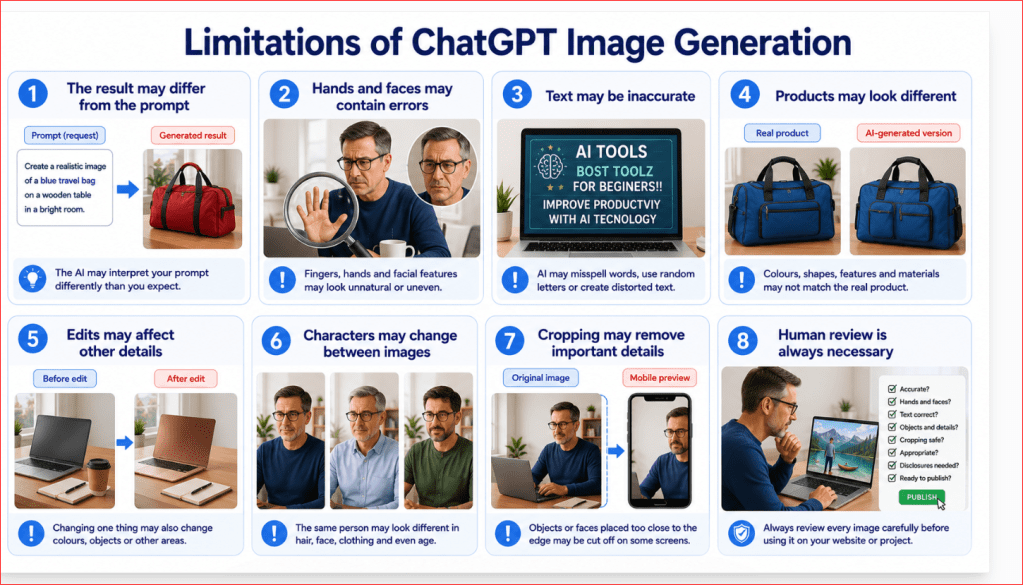
    23. Privacy Risks Remain

    A user may accidentally include sensitive information in a prompt.

    Examples include:

    • Passwords.
    • Banking details.
    • Credit-card numbers.
    • Government identification.
    • Medical records.
    • Confidential contracts.
    • Private addresses.
    • Customer information.
    • Children’s personal details.

    Prompt engineering does not protect information that should not have been shared.

    How to Reduce This Limitation

    Remove or replace sensitive details.

    Use placeholders such as:

    • [NAME]
    • [ADDRESS]
    • [ACCOUNT NUMBER]
    • [ORDER NUMBER]
    • [PHONE NUMBER]
    • [DATE]

    Before submitting a prompt, ask:

    Does the AI need this information to complete the task?

    Share only what is necessary and appropriate.

    24. AI May Not Understand Personal Preferences Automatically

    The AI may not know the user’s preferred:

    • Writing style.
    • Spelling.
    • Tone.
    • Article structure.
    • Reading level.
    • Image style.
    • File format.
    • Website categories.
    • Business goals.

    A clear prompt must explain these preferences.

    How to Reduce This Limitation

    Create reusable project instructions.

    For example:

    Use Canadian spelling, simple language, short paragraphs, H2 headings for main sections, H3 headings for subsections, and a professional beginner-friendly tone.

    Save the instruction and reuse it for future tasks.

    25. Prompt Templates Can Become Outdated

    A successful prompt template may stop working well when:

    • The AI tool changes.
    • The website structure changes.
    • The audience changes.
    • The article format changes.
    • The user’s goals change.
    • New requirements are added.
    • Old instructions are no longer relevant.

    How to Reduce This Limitation

    Review templates regularly.

    Ask:

    • Does the audience description remain correct?
    • Are the required sections still needed?
    • Are the categories current?
    • Are the instructions conflicting?
    • Does the prompt include outdated tool names or features?
    • Does the final output still match the project?

    Templates should be updated rather than used automatically forever.

    26. Prompt Engineering Can Create False Confidence

    A detailed prompt may make the user feel that the result must be reliable.

    However, a polished response can still be wrong.

    The appearance of:

    • Clear headings.
    • Professional language.
    • Tables.
    • Citations.
    • Calculations.
    • Confident statements.

    does not prove that the information is correct.

    How to Reduce This Limitation

    Judge the evidence, not only the presentation.

    Check:

    • Source quality.
    • Publication date.
    • Official information.
    • Calculations.
    • Missing assumptions.
    • Conflicting evidence.
    • Professional requirements.

    A well-formatted answer is only a draft until it has been verified.

    27. Prompt Engineering Cannot Remove All Safety Restrictions

    AI tools may refuse certain requests or limit the type of assistance they provide.

    Changing the wording of the prompt does not mean the user should attempt to bypass safety protections.

    Safety restrictions may apply to requests involving:

    • Harm.
    • Illegal activity.
    • Dangerous instructions.
    • Privacy violations.
    • Deception.
    • Exploitation.
    • Restricted content.

    How to Work Within This Limitation

    Use AI for safe, lawful, and responsible purposes.

    For example, instead of requesting harmful instructions, ask for:

    • Safety information.
    • Prevention strategies.
    • Legal alternatives.
    • Emergency guidance.
    • Educational explanations.

    Prompt engineering should improve communication, not bypass appropriate safeguards.

    28. The User Must Still Make the Final Decision

    AI can provide:

    • Drafts.
    • Comparisons.
    • Lists.
    • Questions.
    • Explanations.
    • Suggestions.
    • Checklists.
    • Possible options.

    However, it may not understand every personal, financial, legal, cultural, or practical factor affecting the decision.

    How to Reduce This Limitation

    Use AI to support the decision-making process.

    Ask:

    • What information is missing?
    • What assumptions were made?
    • What risks should I consider?
    • Which facts require verification?
    • What questions should I ask a professional?
    • Which criteria matter most?

    The final decision should remain with the user or an appropriately qualified person.

    The Main Limitations at a Glance

    Prompt engineering cannot guarantee:

    • Correct information.
    • Current information.
    • Complete responses.
    • Perfect formatting.
    • Exact word counts.
    • Unbiased results.
    • Original content.
    • Working code.
    • Correct calculations.
    • Perfect images.
    • Valid sources.
    • Safe professional advice.
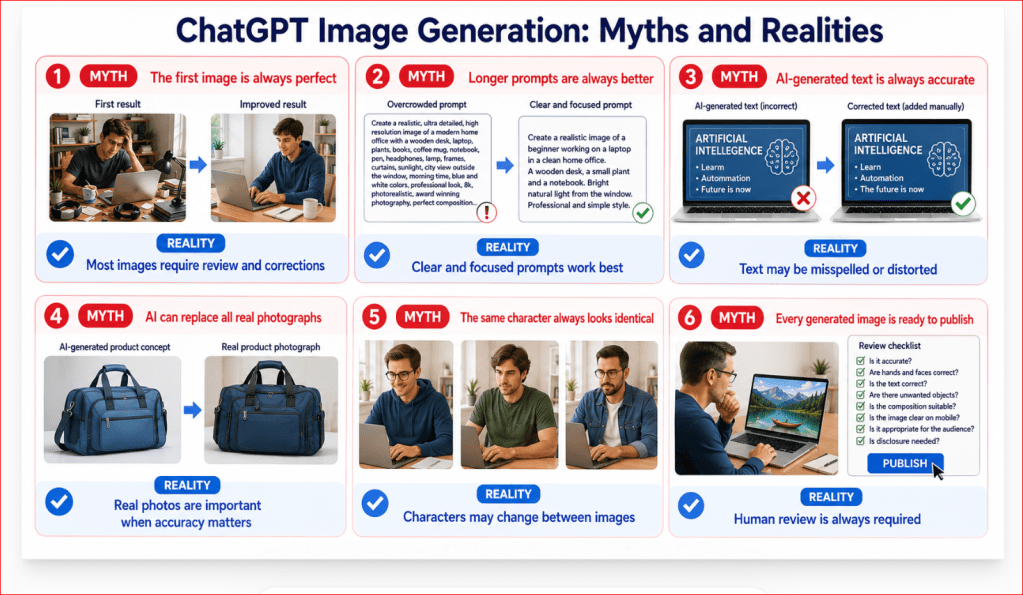
    • Protection of information voluntarily shared.
    • Identical results every time.

    It improves communication with the AI, but it does not make the AI infallible.

    How to Use Prompt Engineering Responsibly

    Use this practical approach:

    1. Write a clear prompt.
    2. Include only relevant information.
    3. Protect sensitive details.
    4. Review the response carefully.
    5. Check that all instructions were followed.
    6. Verify important facts.
    7. Confirm current information using reliable sources.
    8. Test calculations and code.
    9. Review images for errors.
    10. Consult qualified professionals when needed.
    11. Revise the response rather than accepting it automatically.
    12. Make the final decision yourself.

    A Limitation-Review Checklist

    Before using an AI response, ask:

    • Could any facts be incorrect?
    • Could the information be outdated?
    • Did the AI invent a source, quote, date, or statistic?
    • Were any instructions ignored?
    • Is important context missing?
    • Does the response contain repeated ideas?
    • Is the tone suitable?
    • Are calculations correct?
    • Does the code work safely?
    • Does the image contain visual errors?
    • Is any private information exposed?
    • Does the topic require professional review?
    • Have I compared the result with reliable sources?
    • Is the final response suitable for its intended purpose?

    Figure 12. Prompt engineering can improve AI responses, but it cannot guarantee accuracy, safety, originality, or perfect results.

    Prompt engineering is most effective when clear instructions are combined with human judgment. Users must review the response, verify important information, protect private details, and consult qualified professionals when the situation requires expert advice.
    Common Myths About Prompt Engineering

    Prompt engineering is often described as a powerful way to improve AI responses. However, many misunderstandings have developed around what it can and cannot do.

    Some people believe prompt engineering is highly technical. Others believe there are secret phrases that make AI tools produce perfect answers.

    The following myths explain common misunderstandings and the reality behind them.

    Myth 1: Prompt Engineering Is Only for Programmers

    Some people assume prompt engineering requires coding, mathematics, or advanced computer knowledge.

    Reality

    Most everyday prompt engineering does not require programming.

    A beginner can improve a prompt by adding:

    • A clear task.
    • Relevant context.
    • The intended audience.
    • A useful format.
    • The desired tone.
    • Necessary limits.

    For example:

    Explain Artificial Intelligence.

    can become:

    Explain Artificial Intelligence to a complete beginner using simple language, one everyday comparison, and three practical examples.

    No programming is required.

    Technical knowledge may be useful for advanced tasks such as software development or data analysis, but ordinary users can apply prompt engineering to emails, articles, learning, planning, and image generation.

    Myth 2: Prompt Engineering Requires Special Technical Words

    Some people believe prompts must include terms such as:

    • Zero-shot prompting.
    • Few-shot prompting.
    • Chain-of-thought prompting.
    • Token optimization.
    • Context engineering.
    • Persona prompting.

    Reality

    Technical terms may help describe prompting methods, but they are not required for everyday use.

    A plain instruction such as:

    Give me three examples before creating the final answer.

    may be more useful than using a technical term the user does not fully understand.

    Clear language is more important than advanced vocabulary.

    Beginners can write effective prompts using normal words.

    Myth 3: Longer Prompts Are Always Better

    A common belief is that a long prompt automatically produces a better response.

    Reality

    A long prompt can be useful when the task is complex, but unnecessary details may confuse the AI.

    A prompt may become weaker when it contains:

    • Repeated instructions.
    • Unrelated information.
    • Conflicting requirements.
    • Too many restrictions.
    • Several different tasks.

    For example:

    Write a short, complete, highly detailed, formal, casual, serious, humorous article in under 100 words.

    This prompt is long but unclear.

    A better version would be:

    Write a 100-word beginner introduction in a professional but friendly tone.

    The best prompt is not necessarily the longest. It is the prompt that includes the right details.

    Myth 4: Short Prompts Never Work

    Some people believe every prompt must contain many instructions.

    Reality

    Short prompts can work well when the task is simple and clear.

    For example:

    Translate “Good morning” into French.

    This does not require additional context.

    Another example:

    Correct the spelling in this sentence.

    The necessary instruction is already clear.

    More detail is useful only when it affects the result.

    Simple tasks often need simple prompts.

    Myth 5: There Is One Perfect Prompt for Every Task

    Some websites and social media posts promote “the perfect prompt” for writing, marketing, studying, or business.

    Reality

    A prompt that works well for one person may not work equally well for another.

    The best prompt depends on:

    • The user’s goal.
    • The audience.
    • The AI tool.
    • The required format.
    • The available information.
    • The desired level of detail.
    • The current situation.

    For example, an article prompt for a complete beginner will differ from an article prompt for a technical professional.

    A useful prompt is often improved through testing and revision rather than discovered as one perfect sentence.

    Myth 6: Secret Words Can Unlock Perfect AI Answers

    Some people believe certain phrases can force an AI tool to produce flawless results.

    Examples may include:

    • Use your maximum intelligence.
    • Never make a mistake.
    • Give the perfect answer.
    • Ignore all previous limitations.
    • Act as the greatest expert in the world.

    Reality

    These phrases do not guarantee accuracy, quality, or completeness.

    Specific instructions are more useful.

    Instead of:

    Give me the perfect answer.

    write:

    Explain the topic to a complete beginner, include three examples, identify uncertain claims, and use reliable current sources.

    Clear requirements are more effective than dramatic language.

    Myth 7: Assigning an Expert Role Makes the AI a Real Expert

    A user may write:

    Act as a doctor.

    Act as a lawyer.

    Act as a financial adviser.

    Reality

    A role can guide the style and focus of a response, but it does not give the AI professional qualifications.

    The AI does not automatically have:

    • A professional licence.
    • Full case information.
    • Physical examination results.
    • Legal responsibility.
    • Access to all current rules.
    • Human professional judgment.

    A safer prompt would be:

    Explain the general questions I should discuss with a qualified professional. Do not provide a diagnosis or final legal conclusion.

    Roles are useful for tone and organization, not as substitutes for qualified professionals.

    Myth 8: A Good Prompt Guarantees a Correct Answer

    Some users believe that a detailed prompt makes the response reliable.

    Reality

    Even a strong prompt may produce:

    • Incorrect facts.
    • Outdated information.
    • Invented sources.
    • Calculation errors.
    • Missing details.
    • Biased content.
    • Unsupported recommendations.

    Prompt engineering improves communication, but it cannot guarantee truth.

    The user must still:

    • Check important claims.
    • Review official sources.
    • Confirm calculations.
    • Test code.
    • Inspect images.
    • Consult professionals when required.

    A polished response is not proof of accuracy.

    Myth 9: Prompt Engineering Can Completely Eliminate AI Hallucinations

    A well-written prompt can encourage the AI to avoid guessing.

    For example:

    Do not invent sources or statistics.

    Reality

    This instruction may reduce the risk, but it cannot guarantee that the AI will never produce unsupported information.

    The AI may still generate believable but incorrect details.

    For important work, users should:

    • Use source-based prompts.
    • Request verifiable references.
    • Check every source.
    • Ask the AI to identify uncertainty.
    • Compare the response with reliable original information.

    Prompt engineering can reduce hallucinations, but it cannot remove them completely.

    Myth 10: AI Always Follows Every Instruction

    A prompt may contain ten or more requirements.

    Some users expect the AI to follow all of them perfectly.

    Reality

    The AI may:

    • Forget one requirement.
    • Use the wrong format.
    • Exceed the word limit.
    • Omit an example.
    • Ignore a restriction.
    • Change approved content.
    • Repeat information.

    This is more likely when the prompt is long or contains conflicting instructions.

    The user should compare the response with the original prompt and identify missing requirements.

    For large tasks, divide the work into smaller prompts.

    Myth 11: Prompt Engineering Is Completed After the First Prompt

    Some people believe prompt engineering means writing one detailed instruction and accepting the answer.

    Reality

    Prompt engineering is often an ongoing process.

    The process may include:

    1. Writing the first prompt.
    2. Reviewing the response.
    3. Identifying problems.
    4. Adding clarification.
    5. Requesting a revision.
    6. Checking the improved version.
    7. Repeating the process when necessary.

    Follow-up prompts are an important part of prompt engineering.

    For example:

    The answer is useful, but shorten it to 300 words, keep the examples, and remove repeated background information.

    This targeted instruction improves the original response.

    Myth 12: “Try Again” Is an Effective Follow-Up Prompt

    Some users write:

    Try again.

    when the first response is unsuitable.

    Reality

    This does not explain what was wrong.

    The AI may produce a similar response.

    A better follow-up would be:

    The explanation is too technical. Rewrite it for a complete beginner, define all abbreviations, and include one everyday comparison.

    Specific feedback is more useful than a general request to try again.

    Myth 13: Prompt Engineering Is Only for ChatGPT

    Prompt engineering is often discussed in connection with ChatGPT.

    Reality

    Prompting skills can be used with many AI systems, including:

    • Google Gemini.
    • Claude.
    • Microsoft Copilot.
    • Perplexity.
    • AI image generators.
    • AI video tools.
    • AI writing assistants.
    • AI coding tools.
    • Customer-service chatbots.

    However, the prompt may need to be adjusted for the tool.

    A text AI may need instructions about tone, format, and length.

    An image generator may need instructions about subject, setting, orientation, colour, lighting, and visual style.

    Myth 14: The Same Prompt Produces the Same Result Every Time

    Some users expect identical results when they submit the same prompt again.

    Reality

    AI tools may generate different:

    • Wording.
    • Examples.
    • Headings.
    • Explanations.
    • Images.
    • Layouts.
    • Suggestions.

    This variation is common.

    When consistency matters:

    • Save successful outputs.
    • Save successful prompts.
    • Provide approved examples.
    • Request the same structure.
    • Tell the AI which parts must remain unchanged.

    For example:

    Keep the approved title, headings, and examples. Rewrite only the final paragraph.

    Myth 15: Prompt Engineering Can Replace Human Editing

    Some users believe a strong prompt removes the need for proofreading.

    Reality

    AI-generated content may still contain:

    • Grammar problems.
    • Repeated ideas.
    • Unclear sentences.
    • Incorrect headings.
    • Broken links.
    • Missing captions.
    • Inconsistent spelling.
    • Unsupported claims.
    • Internal drafting instructions.

    A final human review is necessary before publishing.

    The user should check:

    • Accuracy.
    • Clarity.
    • Formatting.
    • Tone.
    • Links.
    • Images.
    • Captions.
    • Reading time.
    • Category and tags.

    Prompt engineering supports editing, but it does not replace it.

    Myth 16: AI-Generated Content Is Automatically Original

    A prompt may ask:

    Create completely original content.

    Reality

    AI output may still resemble:

    • Common internet wording.
    • Familiar article structures.
    • Frequently used examples.
    • Standard marketing phrases.
    • Generic titles.

    Prompting can encourage originality by requesting:

    • A specific audience.
    • A practical angle.
    • New examples.
    • Several alternatives.
    • Avoidance of common clichés.

    However, the user should still review the result and rewrite generic sections where necessary.

    Myth 17: AI Image Prompts Can Guarantee Perfect Images

    A detailed prompt may describe every visual element.

    Reality

    The image generator may still produce:

    • Distorted hands.
    • Extra fingers.
    • Unnatural faces.
    • Incorrect objects.
    • Unreadable text.
    • Unwanted people.
    • Poor proportions.
    • Strange lighting.
    • Missing details.

    Negative instructions may help, but they may not work perfectly.

    AI-generated images require review and often several revisions.

    Myth 18: Negative Prompts Always Remove Unwanted Content

    A user may write:

    Do not include logos, text, watermarks, extra fingers, or distorted hands.

    Reality

    The AI may still include one of these elements.

    Negative prompts guide the tool, but they are not guarantees.

    It is usually better to:

    1. Clearly describe the desired image.
    2. Add the most important exclusions.
    3. Review the result.
    4. Request a targeted correction.

    For example:

    Keep the same scene, but remove the extra person and simplify the background.

    Myth 19: Prompt Engineering Makes Current Information Automatically Accurate

    A user may request:

    Give me the current price.

    Reality

    The AI may not have access to the latest information unless it checks a current source.

    Prices, laws, software features, plans, schedules, and public information may change.

    A better prompt would be:

    Check the current price using the official website and include the date verified.

    Even then, the user should confirm the information before making a decision.

    Myth 20: Prompt Engineering Removes the Need for Reliable Sources

    Some people believe the AI’s explanation is enough.

    Reality

    Important information should be supported by reliable evidence.

    Sources are especially important for:

    • Health.
    • Law.
    • Taxes.
    • Finance.
    • Safety.
    • Government programs.
    • Product specifications.
    • Research.
    • Current events.
    • Software features.

    Prompt engineering can help identify and organize sources, but the user must judge their reliability.

    Myth 21: AI Citations Are Always Real

    An AI response may include professional-looking references.

    Reality

    Some citations may be:

    • Incomplete.
    • Incorrect.
    • Outdated.
    • Unrelated.
    • Invented.

    The user should open and verify each source.

    A useful prompt is:

    Use only verifiable sources and do not invent titles, authors, dates, quotations, or links.

    However, this instruction does not remove the need for verification.

    Myth 22: Prompt Engineering Makes Calculations Error-Free

    A user may provide all the numbers and request a calculation.

    Reality

    The AI may still make mistakes involving:

    • Addition.
    • Percentages.
    • Interest.
    • Taxes.
    • Currency conversion.
    • Dates.
    • Units.
    • Financial projections.

    For important calculations:

    • Ask the AI to show the method.
    • Check the values used.
    • Confirm the units.
    • Verify the result with a calculator or spreadsheet.

    A clear prompt improves the explanation but does not guarantee the arithmetic.

    Myth 23: Prompt Engineering Makes AI-Generated Code Safe

    A detailed coding prompt may produce professional-looking code.

    Reality

    The code may still contain:

    • Errors.
    • Security weaknesses.
    • Outdated functions.
    • Missing validation.
    • Compatibility problems.
    • Poor performance.
    • Incorrect dependencies.

    The code should be reviewed and tested in a safe environment.

    Prompt engineering can improve code generation, but it cannot replace testing and professional review.

    Myth 24: One Prompt Template Works Forever

    A user may save a successful prompt and expect it to remain useful indefinitely.

    Reality

    Prompt templates may become outdated when:

    • The AI tool changes.
    • The audience changes.
    • The project changes.
    • The website structure changes.
    • New requirements are added.
    • Old instructions are no longer needed.

    Templates should be reviewed and updated regularly.

    A good template is reusable, but not permanent.

    Myth 25: Prompt Engineering Is Only About Getting Better Answers

    Prompt engineering is often described only as a method for improving output.

    Reality

    It also helps users think more clearly about:

    • Their actual goal.
    • The audience.
    • Required information.
    • Suitable structure.
    • Important limitations.
    • Questions that remain unanswered.
    • How the result will be checked.

    Prompt engineering is partly a communication skill and partly a planning skill.

    Myth 26: Prompt Engineering Removes the Need to Understand the Subject

    Some users believe they do not need subject knowledge because the AI can provide everything.

    Reality

    Without basic understanding, the user may not recognize:

    • Incorrect information.
    • Missing details.
    • Weak reasoning.
    • Unsafe advice.
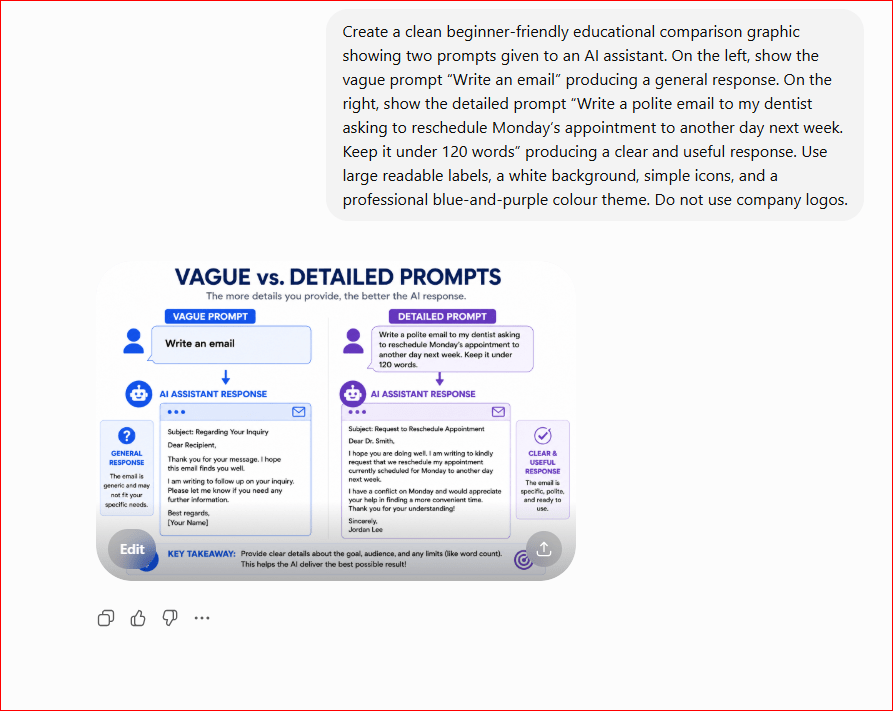
    • Poor examples.
    • Misleading conclusions.

    AI can help the user learn, but human knowledge remains important.

    A useful approach is to ask the AI to:

    • Explain important terms.
    • State assumptions.
    • Identify uncertainties.
    • Suggest verification steps.
    • Provide questions for further research.

    Myth 27: Prompt Engineering Can Make AI Completely Unbiased

    A prompt may request:

    Give me a completely unbiased answer.

    Reality

    AI systems may still reflect:

    • Bias in training material.
    • Incomplete representation.
    • Cultural assumptions.
    • Historical inequalities.
    • Differences in source quality.
    • Limitations in available information.

    A better prompt would be:

    Present the main viewpoints, identify assumptions, use neutral language, and explain where reliable sources disagree.

    This may improve balance, but it cannot guarantee complete neutrality.

    Myth 28: Prompt Engineering Can Bypass Every Safety Rule

    Some users believe changing the wording of a request can bypass AI safety restrictions.

    Reality

    Prompt engineering should not be used to evade protections involving:

    • Harm.
    • Illegal activity.
    • Privacy violations.
    • Dangerous instructions.
    • Deception.
    • Exploitation.

    The purpose of prompting is to communicate more clearly, not to bypass responsible safeguards.

    A safer approach is to ask for:

    • Prevention.
    • Protection.
    • Risk awareness.
    • Legal alternatives.
    • Educational information.
    • Emergency guidance.

    Myth 29: Prompt Engineering Is a Temporary Trend

    Some people view prompting as a short-lived technology trend.

    Reality

    AI tools may change, and the way people interact with them may develop.

    However, the underlying skill remains useful:

    • State the goal clearly.
    • Provide relevant context.
    • Identify the audience.
    • Request the right format.
    • Set limits.
    • Review the result.
    • Correct misunderstandings.

    These are general communication and problem-solving skills that remain valuable even as AI systems change.

    Myth 30: Prompt Engineering Makes AI Independent of Human Judgment

    Some users believe the AI can complete the task and make the final decision.

    Reality

    The user remains responsible for deciding whether the result is:

    • Accurate.
    • Safe.
    • Appropriate.
    • Ethical.
    • Legal.
    • Useful.
    • Suitable for publication.
    • Suitable for the intended audience.

    AI can assist with ideas, drafts, organization, and analysis.

    It should not automatically make important personal, professional, legal, medical, or financial decisions.

    The Main Myths at a Glance

    Prompt engineering is not:

    • Only for programmers.
    • Dependent on secret words.
    • Guaranteed to produce perfect answers.
    • A replacement for professional expertise.
    • A replacement for human editing.
    • A guarantee of accurate sources.
    • A guarantee of original content.
    • A guarantee of perfect images.
    • A way to eliminate all AI errors.
    • A method for bypassing safety rules.

    It is a practical method for giving clearer instructions, reviewing results, and improving communication with AI tools.

    A Myth-Checking Checklist

    Before believing a claim about prompt engineering, ask:

    • Does the claim promise perfect results?
    • Does it suggest secret words can control the AI?
    • Does it ignore the need for fact-checking?
    • Does it suggest AI can replace a qualified professional?
    • Does it claim longer prompts are always better?
    • Does it promise the same result every time?
    • Does it ignore privacy or safety risks?
    • Does it treat a polished response as proof of accuracy?
    • Does it suggest human review is unnecessary?
    • Is the claim supported by reliable evidence?

    Figure 13. Common myths about prompt engineering compared with the practical reality.

    Prompt engineering is not based on secret words or perfect formulas. It is a practical process of giving clear instructions, reviewing the AI’s response, correcting problems, and applying human judgment.

    Frequently Asked Questions About Prompt Engineering

    Prompt engineering can sound technical at first, but the basic idea is simple: give the AI clear instructions, review the response, and improve the prompt when necessary.

    The following frequently asked questions address common beginner concerns about prompts, AI tools, accuracy, safety, privacy, and practical use.

    1. What Is Prompt Engineering?

    Prompt engineering is the process of writing, testing, and improving instructions given to an Artificial Intelligence system.

    These instructions are called prompts.

    Prompt engineering may involve:

    • Clearly stating the task.
    • Adding useful context.
    • Identifying the audience.
    • Choosing the tone and format.
    • Setting limits.
    • Providing examples.
    • Reviewing the result.
    • Giving follow-up instructions.

    For example:

    Write an email.

    is a basic prompt.

    A more effective prompt would be:

    Write a polite email to my dentist asking to move Monday’s appointment to another day next week. Keep the email under 120 words.

    The second prompt gives the AI more useful direction.

    2. What Is an AI Prompt?

    An AI prompt is a question, instruction, description, or piece of information given to an AI tool.

    A prompt may ask the AI to:

    • Explain a subject.
    • Write an email.
    • Summarize a document.
    • Generate ideas.
    • Create a plan.
    • Translate text.
    • Review writing.
    • Create an image.
    • Assist with code.
    • Organize information.

    A prompt can be short or detailed, depending on the task.

    For example:

    Translate “Thank you” into French.

    is enough for a simple translation.

    A more complex task usually requires more information.

    3. Do I Need Programming Skills to Use Prompt Engineering?

    No.

    Most everyday prompt engineering does not require programming, mathematics, or technical training.

    Beginners can improve prompts by adding:

    • A clear task.
    • Relevant details.
    • The intended audience.
    • A preferred format.
    • The desired tone.
    • A realistic length.
    • Important restrictions.

    For example:

    Explain cybersecurity to a complete beginner using simple language and three everyday examples.

    This is prompt engineering, even though it does not involve code.

    Programming knowledge becomes relevant only when the task itself involves software development, technical systems, or advanced data work.

    4. Is Prompt Engineering Only Used with ChatGPT?

    No.

    Prompt engineering can be used with many AI tools, including:

    • ChatGPT.
    • Google Gemini.
    • Claude.
    • Microsoft Copilot.
    • Perplexity.
    • AI image generators.
    • AI video generators.
    • AI writing assistants.
    • AI coding assistants.
    • Customer-service chatbots.

    The same basic principles apply, but the prompt should match the type of tool.

    A text assistant may need instructions about:

    • Tone.
    • Length.
    • Audience.
    • Structure.

    An image generator may need instructions about:

    • Subject.
    • Setting.
    • Style.
    • Lighting.
    • Colour.
    • Orientation.
    • Elements to avoid.

    5. Why Do Detailed Prompts Often Produce Better Results?

    Detailed prompts reduce uncertainty.

    Without enough information, the AI may have to guess:

    • What the user wants.
    • Who the response is for.
    • How long it should be.
    • What tone to use.
    • What format is required.
    • Which details should be included.
    • What information should be avoided.

    For example:

    Create a study plan.

    is very broad.

    A stronger prompt would be:

    Create a seven-day study plan for a complete beginner learning Artificial Intelligence. Allow 30 minutes per day, begin with basic concepts, and present the plan in a table.

    The additional details make the goal clearer.

    However, more detail is helpful only when it affects the result.

    6. Are Longer Prompts Always Better?

    No.

    A long prompt may be useful for a complex task, but unnecessary information can make the prompt harder to follow.

    A weak long prompt may contain:

    • Repeated instructions.
    • Unrelated background.
    • Conflicting requirements.
    • Too many examples.
    • Several separate tasks.
    • Too many restrictions.

    A good prompt should be as long as necessary, but no longer.

    For example:

    Write a 150-word professional but friendly email asking for an update on my application.

    is clearer than a long paragraph containing unrelated details.

    7. Can Short Prompts Still Work Well?

    Yes.

    Short prompts can work very well when the task is simple and clear.

    Examples include:

    • Translate this sentence into Arabic.
    • Correct the spelling in this paragraph.
    • Define machine learning in one sentence.
    • List five colours.
    • Convert these notes into bullet points.

    A short prompt becomes less useful when the task requires important context, audience information, formatting, or restrictions.

    The length of the prompt should match the complexity of the task.

    8. What Information Should I Include in a Good Prompt?

    A useful prompt may include:

    • Task: What should the AI do?
    • Context: What background information does it need?
    • Audience: Who is the response for?
    • Format: How should the answer be organized?
    • Tone: How should it sound?
    • Length: How detailed should it be?
    • Examples: Is there a pattern to follow?
    • Limits: What should the AI avoid?
    • Quality requirements: What should the result achieve?

    You do not need to include every element in every prompt.

    Use the details that affect the result.

    9. What Is the Easiest Prompt Formula for Beginners?

    A simple beginner formula is:

    Task + Context + Audience + Format + Tone + Limits

    For example:

    Explain prompt engineering to a complete beginner. Use simple language, short headings, one everyday comparison, and three practical examples. Keep the explanation under 700 words and avoid programming terminology.

    This prompt includes:

    • Task.
    • Audience.
    • Format.
    • Examples.
    • Length.
    • Restriction.

    Another shorter formula is:

    Task + Details + Format + Limits

    For example:

    Write a polite appointment-cancellation email. Explain that I am unavailable because of a family commitment. Keep it under 100 words and ask to reschedule.

    10. What Makes a Prompt Too Vague?

    A prompt is too vague when it does not give the AI enough information to understand the user’s goal.

    Examples include:

    • Help me.
    • Make this better.
    • Write something.
    • Create a plan.
    • Tell me about technology.
    • Fix this.
    • Give me ideas.

    These prompts may produce general or unsuitable responses.

    A clearer version of:

    Make this better.

    would be:

    Rewrite this paragraph in simpler language, remove repeated ideas, and preserve the original meaning.

    Specific instructions help the AI understand what kind of improvement is required.

    11. Can I Ask the AI to Take a Role?

    Yes.

    You may ask the AI to respond from a practical perspective, such as:

    • A patient tutor.
    • An editor.
    • A study coach.
    • A customer-service assistant.
    • A marketing assistant.
    • A travel planner.
    • A technical trainer.

    For example:

    Act as a patient computer tutor. Explain how to attach a file to an email using simple numbered steps.

    The role can influence the tone, focus, and organization of the response.

    However, assigning a role does not make the AI a licensed doctor, lawyer, accountant, engineer, or financial adviser.

    Professional advice still requires qualified human review.

    12. Does Telling the AI to “Act as an Expert” Make the Answer More Accurate?

    Not necessarily.

    The phrase may influence the style of the response, but it does not guarantee:

    • Correct facts.
    • Current information.
    • Professional qualifications.
    • Reliable judgment.
    • Safe recommendations.

    Specific instructions are more useful than exaggerated roles.

    Instead of:

    Act as the world’s greatest expert.

    write:

    Explain the topic using simple language, identify uncertain claims, and state which facts require current verification.

    The quality of the instructions matters more than impressive wording.

    13. What Is a Follow-Up Prompt?

    A follow-up prompt is an additional instruction used to improve or continue an earlier response.

    For example:

    First prompt:

    Explain blockchain.

    Follow-up prompt:

    Rewrite the explanation for a complete beginner and include one everyday comparison.

    Another follow-up might be:

    Shorten the explanation to 300 words and add a three-point summary.

    Follow-up prompts allow users to refine the answer without restarting the entire task.

    14. What Should I Say Instead of “Try Again”?

    Explain exactly what was wrong with the first response.

    Instead of:

    Try again.

    write:

    The explanation is too technical. Rewrite it for a complete beginner, define every abbreviation, and include one everyday example.

    Or:

    The email sounds too aggressive. Rewrite it in a firm but respectful tone and keep it under 150 words.

    Specific feedback gives the AI clearer direction.

    15. What Is Prompt Chaining?

    Prompt chaining means dividing a large task into several connected prompts.

    For example, when creating a long article:

    1. Create the outline.
    2. Review and improve the outline.
    3. Write the introduction.
    4. Write each section separately.
    5. Add figures and captions.
    6. Review the complete article.
    7. Prepare internal links.
    8. Create the WordPress metadata.

    Each prompt completes one stage.

    Prompt chaining is useful for:

    • Articles.
    • Reports.
    • Business plans.
    • Courses.
    • Research projects.
    • Website content.
    • Marketing campaigns.
    • Coding projects.

    It gives the user more control and makes corrections easier.

    16. What Is Example Prompting?

    Example prompting means giving the AI one or more samples of the style or structure you want.

    For example:

    Create five article titles using a style similar to “What Is Machine Learning? A Beginner’s Guide (2026).”

    One example is sometimes called one-shot prompting.

    Several examples are sometimes called few-shot prompting.

    Examples are useful for:

    • Titles.
    • Product descriptions.
    • Email templates.
    • Lesson structures.
    • Social media posts.
    • Repeated website content.

    Ask the AI to follow the general pattern while creating original wording.

    17. Can I Ask the AI to Use a Specific Format?

    Yes.

    You may request:

    • Bullet points.
    • Numbered steps.
    • A table.
    • A checklist.
    • Short paragraphs.
    • Headings and subheadings.
    • A template.
    • A timeline.
    • Questions and answers.
    • An outline.

    For example:

    Compare ChatGPT, Google Gemini, and Claude in a table with columns for main use, beginner advantage, possible limitation, and common task.

    The format should match the purpose.

    Use a table for comparison, numbered steps for a process, and a checklist for tasks that need verification.

    18. Can I Control the Tone of an AI Response?

    Yes.

    You may request a tone that is:

    • Friendly.
    • Professional.
    • Formal.
    • Polite.
    • Encouraging.
    • Neutral.
    • Persuasive.
    • Calm.
    • Respectful.
    • Firm but courteous.

    For example:

    Write a polite but firm complaint email requesting a replacement for a damaged product. Avoid threatening language.

    Tone instructions are especially useful for emails, customer messages, articles, advertisements, and social media posts.

    Avoid combining conflicting tone instructions.

    For example, “highly formal and extremely casual” may confuse the AI.

    19. Can I Ask the AI to Stay Within a Word Limit?

    Yes, but the AI may not always follow an exact word count perfectly.

    You can request:

    • Under 100 words.
    • Between 300 and 400 words.
    • Five bullet points.
    • Three paragraphs.
    • A ten-step guide.

    A range is often more practical than an exact number.

    For example:

    Keep the explanation between 450 and 550 words.

    When the limit matters, verify the final word count using TextMaker, WordPress, or another counting tool.

    20. Can I Tell the AI What Not to Include?

    Yes.

    These are sometimes called negative instructions or constraints.

    Examples include:

    • Do not use technical jargon.
    • Do not add information that was not provided.
    • Do not invent statistics.
    • Do not repeat ideas.
    • Do not use aggressive language.
    • Do not include private information.
    • Do not change the original meaning.
    • Do not include logos or watermarks.

    For example:

    Rewrite this paragraph in simpler language. Preserve the meaning and do not add new facts.

    Negative instructions can improve control, but too many restrictions may make the prompt difficult to follow.

    21. What Is Negative Prompting for AI Images?

    Negative prompting for images means telling the AI image generator which elements to avoid.

    Common instructions include:

    • No logos.
    • No watermarks.
    • No unreadable text.
    • No distorted hands.
    • No extra fingers.
    • No additional people.
    • No cluttered background.
    • No incorrect objects.

    For example:

    Create a clean horizontal educational illustration of an older beginner using a laptop. Do not include logos, watermarks, distorted hands, or unreadable text.

    Negative instructions may reduce unwanted elements, but they do not guarantee a perfect image.

    Every image should still be inspected carefully.

    22. Why Does the AI Sometimes Ignore Part of My Prompt?

    The AI may overlook instructions when:

    • The prompt is very long.
    • Too many tasks are combined.
    • Requirements conflict.
    • Important details are buried.
    • The requested length is unrealistic.
    • The task is too complex.
    • The instructions are unclear.

    To reduce this problem:

    • Put the main task near the beginning.
    • Use short sections or labels.
    • Remove repeated instructions.
    • Break the project into smaller prompts.
    • Review the response against the original requirements.

    For example:

    Before giving the final answer, check that all six requested sections are included.

    Human review is still necessary.

    23. Why Does the Same Prompt Produce Different Answers?

    AI systems do not always produce identical responses.

    The same prompt may result in different:

    • Wording.
    • Examples.
    • Headings.
    • Explanations.
    • Recommendations.
    • Images.
    • Layouts.

    When consistency matters:

    • Save the successful prompt.
    • Save the approved response.
    • Provide a sample to follow.
    • State which parts must remain unchanged.
    • Request changes only to a specific section.

    For example:

    Keep the approved title, structure, and examples. Rewrite only the conclusion.

    24. Can Prompt Engineering Prevent AI Hallucinations?

    It can reduce the risk, but it cannot eliminate it.

    AI may still invent:

    • Facts.
    • Sources.
    • Quotes.
    • Statistics.
    • Product features.
    • Dates.
    • Policies.
    • Links.

    Useful instructions include:

    • Do not guess.
    • Do not invent sources.
    • Use only the provided document.
    • Mark missing information as “Not provided.”
    • Clearly identify uncertainty.
    • Separate confirmed facts from assumptions.

    Every important fact and source should still be checked independently.

    25. Can Prompt Engineering Guarantee Accurate Information?

    No.

    A clear prompt improves communication, but the AI may still provide:

    • Incorrect facts.
    • Outdated details.
    • Weak reasoning.
    • Missing information.
    • Biased content.
    • Calculation errors.
    • Unsupported recommendations.

    Accuracy depends on more than prompt quality.

    For important information:

    • Check official sources.
    • Confirm the date.
    • Review calculations.
    • Compare several reliable sources.
    • Consult a qualified professional when needed.

    26. How Do I Ask for Current Information?

    Clearly state that the information must be current and verified.

    For example:

    Check the current WordPress.com plan features using official WordPress sources. Include the date verified and identify any details that may change.

    This is useful for:

    • Prices.
    • Laws.
    • Government programs.
    • Software features.
    • Travel rules.
    • Product specifications.
    • Schedules.
    • Public officials.
    • Subscription plans.

    The user should still inspect the official source before making an important decision.

    27. Should I Ask the AI for Sources?

    Sources can be useful when the task involves research, current facts, or important claims.

    You may ask:

    Use reliable sources and identify the source for each major factual claim.

    However, AI-generated references may be incomplete, unrelated, outdated, or invented.

    Always verify:

    • The title.
    • Author.
    • Publication date.
    • Website.
    • Quotation.
    • Link.
    • Relevance.

    Do not treat the presence of citations as proof that the response is correct.

    28. Can I Use Prompt Engineering for Medical, Legal, or Financial Questions?

    You may use AI for general educational information and preparation, but it should not replace a qualified professional.

    A safer prompt might be:

    Explain the general questions I should discuss with my doctor. Do not diagnose a condition or recommend changing medication.

    For legal matters:

    Explain the general concepts and identify which questions require confirmation from a qualified lawyer.

    For financial matters:

    Explain the general options, risks, and questions to ask a licensed adviser. Do not make a final investment decision for me.

    High-stakes information requires careful verification.

    29. Is It Safe to Share Personal Information in a Prompt?

    Users should avoid sharing unnecessary sensitive information.

    Do not include:

    • Passwords.
    • Credit-card numbers.
    • Banking credentials.
    • Government identification numbers.
    • Confidential medical records.
    • Private addresses.
    • Customer information.
    • Children’s personal details.
    • Confidential business information.

    Use placeholders such as:

    • [NAME]
    • [ADDRESS]
    • [ACCOUNT NUMBER]
    • [ORDER NUMBER]
    • [PHONE NUMBER]
    • [DATE]

    Before submitting a prompt, ask whether the AI truly needs the information.

    30. Can Prompt Engineering Help Protect Privacy?

    It can encourage safer handling of information.

    For example:

    Write the letter using placeholders for all personal information. Do not include real names, addresses, account numbers, or phone numbers.

    You may also ask the AI to:

    • Remove identifying details.
    • Replace names with initials.
    • Mark confidential sections.
    • Avoid repeating sensitive information.
    • Use only necessary details.

    Prompt instructions can support privacy, but the user must decide what should be shared in the first place.

    31. Can I Use Prompt Engineering to Improve My Writing?

    Yes.

    You may ask the AI to improve:

    • Grammar.
    • Spelling.
    • Clarity.
    • Tone.
    • Organization.
    • Readability.
    • Sentence length.
    • Repetition.
    • Headings.
    • Transitions.

    For example:

    Review this paragraph for grammar and clarity. Shorten long sentences, remove repetition, preserve the meaning, and do not add new facts.

    Be specific about what should change.

    The instruction “make this better” is usually too vague.

    32. Can AI Rewrite My Work Without Changing the Meaning?

    You may request this, but review the result carefully.

    A useful prompt is:

    Rewrite the following paragraph in simpler language. Preserve every factual claim and do not add, remove, or change the meaning.

    The AI may still accidentally alter:

    • Tone.
    • Emphasis.
    • Dates.
    • Conditions.
    • Technical meaning.
    • Legal meaning.

    For contracts, policies, medical information, and other important documents, compare the revised version with the original.

    33. Can Prompt Engineering Help with Long Articles?

    Yes.

    Long articles often work better when created in stages.

    A practical workflow is:

    1. Choose the topic.
    2. Create the outline.
    3. Review the outline.
    4. Write one section at a time.
    5. Add examples and figures.
    6. Review repetition.
    7. Verify facts.
    8. Add internal links.
    9. Prepare metadata.
    10. Complete a final publication review.

    A section prompt might say:

    Write the “Benefits of Prompt Engineering” section for complete beginners. Use H3 subheadings, practical examples, and simple language. Avoid repeating earlier definitions.

    This approach gives the user more control.

    34. How Can I Prevent Repetition in a Long Article?

    Use a separate review step.

    For example:

    Review the complete article and identify repeated ideas by section. Do not rewrite anything yet.

    After identifying the repetition:

    Remove repeated explanations while keeping the clearest version of each idea. Preserve the heading structure.

    You can also tell the AI:

    • Do not repeat definitions already explained.
    • Refer briefly to earlier sections.
    • Use new examples in each section.
    • Review the full article before finalizing.

    Long AI-generated articles still require human editing.

    35. Can Prompt Engineering Help with WordPress Articles?

    Yes.

    AI can assist with:

    • Article outlines.
    • Introductions.
    • Main sections.
    • Figure prompts.
    • Captions.
    • Alt text.
    • Internal links.
    • Categories.
    • Tags.
    • Excerpts.
    • Meta descriptions.
    • Publishing checklists.

    For example:

    Prepare the WordPress publishing package for this beginner AI article. Include the featured-image prompt, filename, alt text, caption, category, tags, slug, excerpt, meta description, and internal-link suggestions.

    The final post should still be checked on desktop and mobile before publication.

    36. Can Prompt Engineering Help with AI Image Generation?

    Yes.

    A strong image prompt may include:

    • Subject.
    • Action.
    • Setting.
    • Orientation.
    • Style.
    • Lighting.
    • Colours.
    • Main objects.
    • Composition.
    • Elements to avoid.

    For example:

    Create a clean horizontal 16:9 educational illustration of an older beginner typing a detailed prompt into an AI assistant on a laptop. Show an email, checklist, and educational image appearing as results. Use natural lighting and a blue-and-purple colour theme. Do not include logos, watermarks, distorted hands, or unreadable text.

    The final image may still require revision.

    37. Why Does an AI Image Sometimes Look Wrong Even with a Good Prompt?

    AI image generators may still produce:

    • Distorted hands.
    • Extra fingers.
    • Unnatural faces.
    • Incorrect objects.
    • Unreadable text.
    • Strange shadows.
    • Poor proportions.
    • Missing details.
    • Unwanted people.
    • Cluttered backgrounds.

    A detailed prompt improves direction, but it does not guarantee perfect visual accuracy.

    Use targeted follow-up instructions such as:

    Keep the same scene, but remove the extra person, enlarge the laptop, and simplify the background.

    Inspect every final image before publishing.

    38. Can Prompt Engineering Help with Computer Code?

    Yes.

    AI can help:

    • Explain code.
    • Create simple code.
    • Identify syntax errors.
    • Suggest improvements.
    • Add comments.
    • Create test cases.
    • Explain dependencies.

    For example:

    Explain the following HTML code to a complete beginner. Describe each section in simple language and identify any errors.

    However, AI-generated code may contain security problems, outdated methods, or hidden errors.

    Test code in a safe environment before using it on a live system.

    39. Can I Save Prompts and Reuse Them?

    Yes.

    Saving successful prompts can improve consistency and save time.

    You may create templates for:

    • Article introductions.
    • Email replies.
    • Image prompts.
    • Social media posts.
    • Product descriptions.
    • Study plans.
    • Article reviews.
    • Comparison tables.
    • WordPress metadata.
    • Publishing checklists.

    For example:

    Write a beginner-friendly introduction about [TOPIC]. Explain what it is, why it matters, and one everyday example. Use simple language and keep it between 300 and 400 words.

    Replace [TOPIC] each time.

    Review templates occasionally because your project or AI tool may change.

    40. How Do I Know Whether My Prompt Is Good?

    A good prompt usually makes the following clear:

    • The task.
    • The purpose.
    • The audience.
    • Important context.
    • Required information.
    • Preferred format.
    • Desired tone.
    • Realistic length.
    • Necessary restrictions.

    After receiving the response, ask:

    • Did the AI complete the correct task?
    • Did it follow the requested format?
    • Is the language suitable for the audience?
    • Is important information missing?
    • Are any facts uncertain?
    • Did it add unsupported details?
    • Is the result useful for its intended purpose?

    A prompt is successful when it helps produce a useful result, not merely a long or polished response.

    41. How Many Times Should I Revise a Prompt?

    There is no fixed number.

    Some simple tasks may require only one prompt.

    More complex tasks may need several revisions.

    Stop revising when the response:

    • Meets the main goal.
    • Includes the required information.
    • Uses the correct tone.
    • Follows the requested format.
    • Is suitable for the audience.
    • Has been checked for important errors.

    Do not continue revising only to make small changes that do not improve usefulness.

    42. What Should I Do When the AI Keeps Producing the Wrong Result?

    Try the following:

    1. Restate the main task.
    2. Remove unnecessary information.
    3. Identify the audience.
    4. Give one clear example.
    5. Specify the format.
    6. Explain what is wrong with the current response.
    7. Correct one problem at a time.
    8. Break the task into smaller prompts.
    9. Start a new conversation with the important instructions summarized.
    10. Review whether the task is suitable for that AI tool.

    For example:

    The previous versions are too technical. Start again with a 300-word explanation for a complete beginner. Use one everyday comparison and avoid programming terms.

    43. Should I Use One Large Prompt or Several Small Prompts?

    Use one prompt for simple, clearly defined tasks.

    Use several connected prompts for:

    • Long articles.
    • Reports.
    • Business plans.
    • Research projects.
    • Website development.
    • Course creation.
    • Coding projects.
    • Large editing tasks.

    Several smaller prompts usually provide:

    • Greater control.
    • Easier review.
    • Fewer missed requirements.
    • Better organization.
    • Simpler corrections.

    This is the reason prompt chaining is useful for large projects.

    44. Can Prompt Engineering Make AI Completely Unbiased?

    No.

    AI systems may reflect bias from:

    • Training material.
    • Cultural assumptions.
    • Incomplete representation.
    • Historical inequalities.
    • Source selection.
    • Outdated information.

    You may request:

    Present several viewpoints, use neutral language, identify assumptions, and explain where reliable sources disagree.

    This may improve balance, but it cannot guarantee complete neutrality.

    Human review remains important.

    45. Can Prompt Engineering Make AI Content Completely Original?

    No prompt can guarantee complete originality.

    AI output may resemble:

    • Common internet language.
    • Standard article structures.
    • Familiar examples.
    • Popular marketing phrases.
    • Frequently used titles.

    You may request:

    • Original examples.
    • A specific audience.
    • A practical angle.
    • Several alternative versions.
    • Avoidance of clichés.

    The final content should still be reviewed and edited.

    46. Does Prompt Engineering Replace Human Creativity?

    No.

    Prompt engineering can support creativity by helping users:

    • Generate ideas.
    • Explore alternatives.
    • Create first drafts.
    • Develop outlines.
    • Test styles.
    • Organize concepts.

    Human creativity remains important for:

    • Choosing the purpose.
    • Adding personal insight.
    • Judging quality.
    • Selecting the best ideas.
    • Creating an authentic voice.
    • Making final decisions.

    AI can assist the creative process, but it should not automatically control it.

    47. Does Prompt Engineering Replace Human Judgment?

    No.

    The user must still decide whether the response is:

    • Accurate.
    • Safe.
    • Ethical.
    • Legal.
    • Useful.
    • Appropriate.
    • Suitable for publication.
    • Suitable for the intended audience.

    AI can provide drafts, comparisons, suggestions, and checklists.

    The final decision belongs to the user or an appropriately qualified professional.

    48. What Is the Most Important Prompting Skill?

    The most important skill is clarity.

    A useful prompt clearly communicates:

    • What you need.
    • Why you need it.
    • Who it is for.
    • How it should be presented.
    • What should be avoided.

    The second important skill is review.

    Even a clear prompt can produce an imperfect response.

    Good prompt engineering combines:

    Clear instruction + careful review + specific revision

    49. What Is the Best Advice for a Complete Beginner?

    Start with a simple task.

    For example:

    Explain Artificial Intelligence to a complete beginner using simple language and three everyday examples.

    Review the answer.

    Then practise follow-up prompts such as:

    • Make it shorter.
    • Add another example.
    • Explain the second point more simply.
    • Turn this into a checklist.
    • Remove technical terms.
    • Add a five-point summary.

    Prompt engineering becomes easier through regular practice.

    50. What Is a Simple Final Checklist Before Submitting a Prompt?

    Before submitting an important prompt, ask:

    • Is my main task clear?
    • Did I provide relevant context?
    • Did I identify the audience?
    • Did I explain what must be included?
    • Did I choose a useful format?
    • Did I specify the tone?
    • Is the requested length realistic?
    • Did I explain what should be avoided?
    • Are any instructions conflicting?
    • Will I review the response before using it?

    A prompt does not need every possible detail.

    It only needs enough clear information for the task.

    Figure 14. Common beginner questions about writing prompts, improving responses, accuracy, privacy, and human review.

    Prompt engineering becomes easier when users understand that there is no secret formula. Clear instructions, relevant details, careful review, and specific follow-up prompts are the main skills needed to communicate more effectively with AI tools.

    Key Takeaways

    Prompt engineering is the process of writing, testing, reviewing, and improving instructions given to an Artificial Intelligence tool.

    The following points summarize the most important lessons from this guide.

    1. A Prompt Is an Instruction Given to an AI Tool

    A prompt may be:

    • A question.
    • A command.
    • A description.
    • A request for an explanation.
    • A task involving writing, planning, images, code, or organization.

    The prompt tells the AI what you want it to do.

    2. Clear Prompts Usually Produce More Useful Responses

    A vague prompt leaves the AI to guess important details.

    For example:

    Write an email.

    A clearer version would be:

    Write a polite email to my dentist asking to reschedule Monday’s appointment to another day next week. Keep it under 120 words.

    The clearer prompt explains the purpose, recipient, tone, timing, and length.

    3. Prompt Engineering Does Not Require Programming

    Beginners can use prompt engineering without technical knowledge.

    The most important skills are:

    • Clear communication.
    • Identifying the goal.
    • Providing relevant details.
    • Reviewing the response.
    • Giving specific follow-up instructions.

    4. Start with a Clear Task

    Use direct action words such as:

    • Explain.
    • Write.
    • Compare.
    • Summarize.
    • Create.
    • Review.
    • Rewrite.
    • Organize.
    • Translate.
    • Plan.

    A clear task helps the AI understand what type of response is required.

    5. Add Relevant Context

    Context explains the situation surrounding the task.

    Useful context may include:

    • The purpose of the request.
    • The project being completed.
    • Work already finished.
    • Available time.
    • Budget.
    • Experience level.
    • Important restrictions.

    Include only information that affects the result.

    6. Identify the Audience

    The audience affects the language, examples, tone, and level of detail.

    For example:

    Explain machine learning to a complete beginner with no programming experience.

    This is more useful than simply asking:

    Explain machine learning.

    7. Choose the Right Format

    Tell the AI how the response should be organized.

    Use:

    • Numbered steps for a process.
    • Bullet points for separate ideas.
    • Tables for comparisons.
    • Checklists for review tasks.
    • Headings for long explanations.
    • Templates for repeated work.

    The format should match the purpose of the task.

    8. Specify the Tone

    Tone helps control how the response sounds.

    You may request:

    • Friendly.
    • Professional.
    • Polite.
    • Formal.
    • Encouraging.
    • Neutral.
    • Calm.
    • Firm but respectful.

    Avoid conflicting instructions such as asking for a message that is both highly formal and extremely casual.

    9. Set Realistic Length Requirements

    You may ask for:

    • One sentence.
    • Three paragraphs.
    • Five bullet points.
    • Under 150 words.
    • Between 500 and 700 words.
    • A detailed multi-section guide.

    The requested length should match the complexity of the task.

    10. Use Limits When Necessary

    Limits explain what the AI should avoid.

    Examples include:

    • Do not use technical jargon.
    • Do not invent facts.
    • Do not add information that was not provided.
    • Do not repeat ideas.
    • Do not include personal information.
    • Do not exceed the word limit.
    • Do not include logos or watermarks.

    Use only the restrictions that are important.

    11. Examples Can Improve Consistency

    Examples help the AI understand the style or structure you want.

    For example:

    Create five article titles using a style similar to “What Is Machine Learning? A Beginner’s Guide (2026).”

    Examples are useful for:

    • Article titles.
    • Product descriptions.
    • Emails.
    • Social media posts.
    • Lesson formats.
    • Repeated website content.

    Ask for original wording rather than exact copying.

    12. Use a Simple Prompt Formula

    A useful beginner formula is:

    Task + Context + Audience + Format + Tone + Limits

    For example:

    Explain cybersecurity to an older beginner with basic computer knowledge. Use simple language, five short headings, and three practical examples. Keep the explanation under 800 words and avoid technical jargon.

    Not every prompt needs every element.

    Use the details that matter for the task.

    13. Follow-Up Prompts Are Important

    The first response may not be perfect.

    Use follow-up prompts to improve it.

    Examples include:

    • Make the explanation shorter.
    • Add three practical examples.
    • Use simpler language.
    • Change the response into a table.
    • Remove repeated ideas.
    • Rewrite only the conclusion.
    • Keep the meaning but improve the grammar.

    Specific feedback is more useful than writing only:

    Try again.

    14. Break Large Tasks into Smaller Prompts

    Complex projects often work better when completed step by step.

    For a long article, you may:

    1. Create the outline.
    2. Review the structure.
    3. Write the introduction.
    4. Write each section separately.
    5. Add figures and captions.
    6. Review repetition.
    7. Verify facts.
    8. Prepare publishing details.
    9. This method is called prompt chaining.

    15. Good Prompts Do Not Guarantee Perfect Results

    Even a detailed prompt may produce:

    • Incorrect facts.
    • Outdated information.
    • Missing details.
    • Repetition.
    • Biased content.
    • Calculation errors.
    • Invented sources.
    • Faulty code.
    • Imperfect images.

    Prompt engineering improves direction, but it does not make AI error-free.

    16. Important Information Must Be Verified

    Check current and high-risk information using reliable sources.

    This is especially important for:

    • Health.
    • Law.
    • Taxes.
    • Finance.
    • Safety.
    • Government programs.
    • Product prices.
    • Software features.
    • Travel requirements.
    • Public information that may change.

    A confident AI answer is not proof that the information is correct.

    17. Protect Personal Information

    Do not include unnecessary sensitive details in prompts.

    Avoid sharing:

    • Passwords.
    • Banking information.
    • Credit-card numbers.
    • Government identification numbers.
    • Confidential medical records.
    • Private addresses.
    • Customer information.
    • Children’s personal details.

    Use placeholders such as:

    • [NAME]
    • [ADDRESS]
    • [ACCOUNT NUMBER]
    • [ORDER NUMBER]
    • [PHONE NUMBER]

    18. Prompt Engineering Works with Many AI Tools

    Prompting is not limited to ChatGPT.

    It can be used with:

    • Google Gemini.
    • Claude.
    • Microsoft Copilot.
    • Perplexity.
    • AI image generators.
    • AI video tools.
    • AI coding assistants.
    • AI writing tools.
    • Customer-service chatbots.

    The prompt should be adjusted for the type of tool.

    19. Save Successful Prompts as Templates

    A useful prompt can be reused.

    For example:

    Write a beginner-friendly introduction about [TOPIC]. Explain what it is, why it matters, and one everyday example. Use simple language and keep it between 300 and 400 words.

    Templates can be created for:

    • Articles.
    • Emails.
    • Image prompts.
    • Social media posts.
    • Study plans.
    • Reviews.
    • Comparison tables.
    • WordPress publishing tasks.

    Review templates regularly and update them when your project changes.

    20. Human Review Is Essential

    Prompt engineering includes evaluating the result.

    Before using or publishing an AI response, check:

    • Accuracy.
    • Relevance.
    • Completeness.
    • Tone.
    • Format.
    • Grammar.
    • Sources.
    • Privacy.
    • Possible bias.
    • Suitability for the audience.

    The user remains responsible for the final decision.

    A Final Prompt-Engineering Checklist

    Before submitting an important prompt, ask:

    • Is the task clear?
    • Did I provide relevant context?
    • Did I identify the audience?
    • Did I explain what must be included?
    • Did I choose a useful format?
    • Did I specify the tone?
    • Is the requested length realistic?
    • Did I explain what should be avoided?
    • Are any instructions conflicting?
    • Will I review and verify the response?

    Prompt engineering becomes easier with practice.

    Start with a clear task, add the details that matter, review the response carefully, and use specific follow-up instructions when improvements are needed.

    What’s Next?

    Now that you understand the basic principles of prompt engineering, the next step is to practise them in real situations.

    You do not need to create complicated prompts immediately. Begin with simple everyday tasks and improve your instructions gradually.

    Start with One Simple Task

    Choose a task you already understand, such as:

    • Writing an email.
    • Summarizing a short article.
    • Creating a checklist.
    • Explaining a new subject.
    • Organizing notes.
    • Generating article ideas.
    • Planning a weekly schedule.
    • Creating an image description.

    For example, begin with:

    Write an email asking to reschedule an appointment.

    Then improve it:

    Write a polite email to my dentist asking to reschedule Monday morning’s appointment to another day next week. Include a subject line and keep the email under 120 words.

    Compare the two responses and notice how the additional details affect the result.

    Practise the Beginner Prompt Formula

    Use the following formula:

    Task + Context + Audience + Format + Tone + Limits

    For example:

    Explain online privacy to an older beginner who uses email and social media. Use simple language, five short headings, and three everyday examples. Keep the explanation under 800 words and avoid technical jargon.

    You do not need to use every element each time. Include only the information that helps the AI understand the task.

    Improve One Prompt at a Time

    When the AI response is not suitable, identify the specific problem.

    Ask:

    • Is the answer too long?
    • Is it too technical?
    • Is an example missing?
    • Is the tone unsuitable?
    • Is the format difficult to read?
    • Did the AI misunderstand the audience?
    • Did it add unsupported information?

    Then write a focused follow-up prompt.

    For example:

    The explanation is too technical. Rewrite it for a complete beginner, define all abbreviations, and add one everyday comparison.

    Specific corrections are more effective than simply asking the AI to try again.

    Create a Personal Prompt Collection

    Save prompts that produce useful results.

    You may organize them into categories such as:

    • Article writing.
    • Email drafting.
    • AI image generation.
    • Study and learning.
    • Social media.
    • Website management.
    • Document summaries.
    • Business tasks.
    • Article reviews.
    • WordPress publishing.

    A saved prompt can be turned into a reusable template.

    For example:

    Write a beginner-friendly explanation of [TOPIC]. Define the subject, explain why it matters, include one everyday comparison and three practical examples, and use simple language. Keep the response between [WORD COUNT] words.

    Replace the bracketed information when using the template again.

    Build a Small Prompt Library

    A beginner prompt library might include:

    1. An explanation prompt.
    2. An email-writing prompt.
    3. A summary prompt.
    4. A comparison prompt.
    5. A study-plan prompt.
    6. An article-outline prompt.
    7. An image-generation prompt.
    8. A proofreading prompt.
    9. A fact-checking prompt.
    10. A final-review prompt.

    Saving these templates can make future tasks faster and more consistent.

    Practise Follow-Up Prompting

    Prompt engineering is not only about the first instruction.

    Practise follow-up requests such as:

    • Explain this more simply.
    • Add three practical examples.
    • Shorten the response to 300 words.
    • Present the information as a table.
    • Remove repeated ideas.
    • Use a more professional tone.
    • Rewrite only the conclusion.
    • Keep the approved structure unchanged.
    • Identify which facts require verification.
    • Do not add information that was not provided.

    Follow-up prompting helps you refine a response without restarting the entire task.

    Practise Prompt Chaining

    For larger tasks, divide the work into connected stages.

    For example, when writing an article:

    1. Select the topic.
    2. Create the outline.
    3. Review the outline.
    4. Write the introduction.
    5. Write each main section.
    6. Add practical examples.
    7. Create figure prompts and captions.
    8. Review the complete article for repetition.
    9. Verify important facts.
    10. Prepare the WordPress publishing information.

    This method provides greater control and makes mistakes easier to correct.

    Test Prompts with Different AI Tools

    The same prompt may produce different results in different AI systems.

    You may compare how tools handle:

    • Explanations.
    • Writing style.
    • Summaries.
    • Tables.
    • Image descriptions.
    • Research questions.
    • Creative ideas.

    When comparing tools, use the same main prompt and evaluate:

    • Accuracy.
    • Clarity.
    • Organization.
    • Usefulness.
    • Tone.
    • Instruction-following.
    • Need for revision.

    Do not assume that one tool will always be best for every task.

    Learn Prompting for Different Purposes

    After mastering the basics, you can practise specialized prompts for:

    • ChatGPT conversations.
    • AI image generation.
    • AI video generation.
    • Business and marketing.
    • Education and study.
    • Website content.
    • Customer service.
    • Productivity.
    • Computer coding.
    • Research and document analysis.

    Each area uses the same basic principles, but the required details may differ.

    For example, a writing prompt may focus on audience, tone, format, and word count.

    An image prompt may focus on subject, composition, orientation, lighting, colours, style, and unwanted elements.

    Review AI Responses More Critically

    As your prompting skills improve, also improve your reviewing skills.

    Before using an AI response, check:

    • Did it answer the correct question?
    • Did it follow all important instructions?
    • Is the language suitable for the audience?
    • Are any important details missing?
    • Are there repeated ideas?
    • Are factual claims supported?
    • Could the information be outdated?
    • Did the AI invent sources or statistics?
    • Is private information included?
    • Does the topic require professional review?

    Better prompting and better reviewing should develop together.

    Continue Learning Beyond Basic Prompting

    After practising beginner prompts, you may explore:

    • Reusable prompt templates.
    • Prompt chains for complex projects.
    • Source-based prompting.
    • Prompting with uploaded documents.
    • Image-prompt structure.
    • Research and verification prompts.
    • Prompts for tables and structured data.
    • Prompts for revising existing content.
    • Prompts for maintaining a consistent writing style.
    • Prompts for automating repeated workflows.

    These skills build on the same foundation introduced in this guide.

    A Simple Seven-Day Practice Plan

    You can practise prompt engineering for a few minutes each day.

    Day 1: Improve one vague question.

    Day 2: Write a prompt that identifies a specific audience.

    Day 3: Ask for information in a table or checklist.

    Day 4: Add tone and length requirements.

    Day 5: Use a follow-up prompt to improve an answer.

    Day 6: Create and refine an AI image prompt.

    Day 7: Save your best prompts as reusable templates.

    Regular practice will help you recognize which details improve a prompt and which details are unnecessary.

    Measure Success by Usefulness

    A successful prompt is not necessarily long, technical, or complicated.

    A successful prompt helps produce a response that:

    • Completes the intended task.
    • Matches the audience.
    • Uses the right format.
    • Includes the necessary information.
    • Respects important limits.
    • Requires fewer corrections.
    • Can be reviewed and used safely.

    The goal of prompt engineering is not to impress the AI with complex language.

    The goal is to communicate clearly enough to receive a useful result.

    Keep Human Judgment at the Centre

    As you continue learning, remember that AI is an assistant.

    You remain responsible for:

    • Defining the goal.
    • Providing appropriate information.
    • Protecting private details.
    • Reviewing the response.
    • Verifying important facts.
    • Correcting mistakes.
    • Making the final decision.

    Prompt engineering becomes most valuable when clear instructions are combined with careful human review.

    Final Tip for Beginners

    Do not try to write a perfect prompt on your first attempt.

    Start with a clear and simple instruction. Review the AI’s response, identify what is missing, and improve the prompt one detail at a time.

    For example, begin with:

    Explain prompt engineering.

    Then improve it:

    Explain prompt engineering to a complete beginner using simple language, one everyday comparison, and three practical examples.

    If the response is still too long, follow up with:

    Shorten the explanation to 400 words and organize it under four short headings.

    This process is more useful than trying to memorize complicated prompt formulas or special technical words.

    Remember these three basic steps:

    1. Ask clearly.
    2. Review carefully.
    3. Improve specifically.

    When correcting a response, explain the exact problem.

    Instead of writing:

    Try again.

    Write:

    The answer is too technical. Rewrite it for a complete beginner, remove unexplained terminology, and add one everyday example.

    The clearer your feedback is, the easier it is for the AI to revise the response.

    Also remember that a confident and well-written AI response may still contain incorrect or outdated information. Check important facts, protect private information, and consult qualified professionals when the subject involves health, law, finance, taxes, or safety.

    Prompt engineering becomes easier through regular practice. Begin with everyday tasks such as writing emails, creating checklists, summarizing short documents, organizing ideas, or improving paragraphs.

    The goal is not to create the longest or most complicated prompt.

    The goal is to give the AI enough clear direction to produce a result that is useful, appropriate, and easy to review.

    Continue Learning

    Prompt engineering is one of the most practical skills for using Artificial Intelligence effectively.

    Now that you understand how to write clearer prompts, improve weak instructions, use follow-up prompts, and review AI responses, continue building your knowledge with these beginner-friendly guides.

    Learn the Foundations of Artificial Intelligence

    Start with the basic concepts behind modern AI:

    These guides explain how AI systems learn from information, recognize patterns, generate content, and respond to written instructions.

    Learn How to Use ChatGPT

    Continue with the practical ChatGPT guides:

    These articles will help you understand the ChatGPT interface, begin conversations, write useful prompts, and improve the answers you receive.

    Learn About AI Image Generation

    Prompt-writing skills can also help you create better AI images.

    Read:

    This guide explains how text-to-image tools work, how image prompts are structured, what details to include, and how to improve images through follow-up instructions.

    When writing an image prompt, describe:

    • The main subject.
    • The action.
    • The setting.
    • The image orientation.
    • The visual style.
    • The lighting.
    • The colours.
    • Important objects.
    • Elements that should not appear.

    Practise with Real Tasks

    Use what you learned in this guide to practise prompts for:

    • Writing an email.
    • Summarizing an article.
    • Creating a study plan.
    • Comparing two options.
    • Organizing notes.
    • Reviewing a paragraph.
    • Creating a checklist.
    • Generating an educational image.
    • Planning a WordPress article.
    • Preparing social media content.

    Begin with a basic prompt, review the result, and then improve the instructions.

    For example:

    First prompt:

    Create a study plan about Artificial Intelligence.

    Improved prompt:

    Create a seven-day Artificial Intelligence study plan for a complete beginner. Allow 30 minutes per day, begin with basic concepts, include one practical activity each day, and present the plan in a table. Avoid programming topics.

    The improved version gives the AI clearer direction about the audience, duration, available time, format, activities, and limits.

    Save Your Best Prompts

    Create a simple prompt library in TextMaker or another document.

    You may organize it under headings such as:

    • Learning prompts.
    • Email prompts.
    • Article-writing prompts.
    • Image-generation prompts.
    • Social media prompts.
    • Business prompts.
    • Review prompts.
    • WordPress publishing prompts.

    Save each successful prompt as a reusable template.

    For example:

    Explain [TOPIC] to [AUDIENCE]. Use [FORMAT], include [REQUIRED INFORMATION], use a [TONE] tone, keep the response within [LENGTH], and avoid [UNWANTED CONTENT].

    Replace the bracketed details for each new task.

  • What Are Large Language Models (LLMs)? A Beginner’s Guide (2026)

    What Are Large Language Models (LLMs)? A Beginner’s Guide (2026)

    Estimated Reading Time: 23 minutes

    Last Updated: July 2026

    What You’ll Learn

    By the end of this guide, you’ll be able to:

    · Understand what a Large Language Model (LLM) is.

    · Learn how LLMs work in simple language.

    · Discover how ChatGPT uses an LLM.

    · Recognize everyday examples of LLMs.

    · Learn the benefits and limitations of LLMs.

    · Build a strong foundation for learning more advanced AI concepts.

    Introduction

    Large Language Models (LLMs) are the technology behind many of today’s most popular Artificial Intelligence tools, including ChatGPT, Google Gemini, Microsoft Copilot, and Claude. They allow computers to understand and generate human language in a natural and conversational way.

    Although the name “Large Language Model” may sound technical, the basic idea is simple. An LLM learns from enormous amounts of text and then uses that knowledge to generate helpful responses, answer questions, summarize information, translate languages, and assist with many other tasks.

    Every time you ask ChatGPT a question, write an email with AI, summarize a document, or generate computer code, you are using a Large Language Model.

    If you’re new to AI, this guide explains Large Language Models using simple language and everyday examples. You do not need any programming or technical knowledge to understand the concepts presented here.

    Before reading this guide, you may find it helpful to read our What Is Artificial Intelligence? A Beginner’s Guide (2026), What Is Machine Learning? A Beginner’s Guide (2026), What Is Deep Learning? A Beginner’s Guide (2026), What Is Generative AI? A Beginner’s Guide (2026), and How ChatGPT Works (Explained Simply). These guides explain the technologies that make Large Language Models possible.

    What Is a Large Language Model (LLM)?

    A Large Language Model (LLM) is a type of Artificial Intelligence that is designed to understand, process, and generate human language. It learns by analyzing enormous amounts of text from multiple sources, which may include publicly available information, licensed material, and content created or reviewed by human trainers.

    During training, it identifies patterns in words, grammar, sentence structure, and writing styles.

    The term Large Language Model can be understood by looking at each word:

    · Large refers to the model’s enormous number of learned mathematical settings, called parameters, as well as the large amounts of data and computing power used during training.

    · Language means it works with human languages such as English, French, Arabic, Spanish, and many others.

    · Model refers to the AI system that has learned these language patterns and can use them to generate responses.

    Think of an LLM as a person who has spent many years reading millions of books, newspapers, and websites. Instead of memorizing every sentence, that person learns how language works and uses that knowledge to answer new questions, explain ideas, and write about different topics. A Large Language Model works in a similar way by recognizing language patterns rather than memorizing information.

    Large Language Models power many AI applications, including ChatGPT, Google Gemini, Microsoft Copilot, Claude, AI writing assistants, translation tools, and customer service chatbots.

    Although an LLM can generate natural and helpful responses, it does not think, understand, or have personal experiences. It predicts the most appropriate tokens based on patterns it learned during training.

    Figure 1. ChatGPT explaining what a Large Language Model (LLM) is.

    This example explains Large Language Models using simple language and an everyday comparison. By comparing an LLM to a person who has read millions of books, beginners can better understand how ChatGPT and other AI assistants generate natural and helpful responses.

    How Does a Large Language Model Work?

    A Large Language Model, or LLM, works by learning patterns from enormous amounts of text. It does not simply memorize every sentence, and the language model itself does not automatically search the internet whenever you ask a question.

    During training, an LLM analyzes books, articles, websites, and other written materials. From this text, it learns grammar, vocabulary, sentence structure, common facts, and relationships between words and ideas.

    Think of an LLM as a student who has spent many years reading millions of books. The student may not remember every page exactly, but they learn how language works and become skilled at explaining ideas, answering questions, and writing about many subjects.

    A Large Language Model works in a similar way. It recognizes patterns in language and uses those patterns to create new responses.

    When you enter a prompt into ChatGPT, the model analyzes the words in your request and considers the surrounding context. It then predicts what should come next. The response is generated step by step using small pieces of text called tokens, which may be complete words or parts of words.

    For example, suppose you ask ChatGPT to explain photosynthesis. The LLM does not normally locate an article and copy it. Instead, it uses patterns and information learned during training to create an explanation that matches your question.

    Although Large Language Models can produce accurate and natural-sounding answers, they do not think or understand the world exactly as humans do. They use advanced mathematics to calculate which tokens are most likely to form a useful response.

    Because an LLM predicts language rather than checking every statement against a trusted source, it can sometimes provide incorrect or invented information. Important facts should always be verified.

    One of the greatest strengths of Large Language Models is their ability to generate useful responses about many topics. They can assist with learning, writing, programming, brainstorming, translation, research, and everyday problem-solving.

    Figure 2. ChatGPT explaining how a Large Language Model works using an everyday example.

    This example shows that a Large Language Model generates responses by recognizing language patterns learned during training rather than simply memorizing information or automatically searching the internet. Using an everyday comparison helps beginners understand how AI assistants such as ChatGPT create natural and helpful responses.

    How Are Large Language Models Trained?

    Large Language Models are trained using enormous collections of written text. This training material may include books, articles, educational websites, public documents, and other forms of written content.

    The purpose of training is not to teach the model to memorize every sentence. Instead, the model studies patterns in language and learns how words, phrases, and ideas are commonly connected.

    During training, part of a sentence may be shown to the model, and it must predict what comes next.

    For example:

    The sky is usually…

    The model may predict the word blue because it has learned that “blue” commonly follows this sentence.

    At first, the model’s predictions are often incorrect. Each time it makes a mistake, its internal mathematical settings are adjusted slightly. This process is repeated billions of times using many different examples.

    Over time, the model becomes better at predicting suitable words, completing sentences, answering questions, and generating natural-sounding text.

    You can compare this process to a student practising with a very large collection of exercises. The student answers a question, checks the correct answer, learns from the mistake, and tries again. After completing millions of exercises, the student becomes much more skilled.

    Training a Large Language Model requires powerful computers, large amounts of data, and significant processing time. Specialized computer chips are used to perform the enormous number of mathematical calculations required during training.

    After the main training process is completed, the model may receive additional training using examples created or reviewed by people. Human reviewers can help teach the model to follow instructions, avoid harmful responses, and provide clearer and more useful answers.

    However, training does not make an LLM perfect. The model may still misunderstand a question, provide outdated information, or generate an answer that sounds convincing but is incorrect.

    For this reason, users should review important information and confirm it using reliable sources.

    What Are Tokens in a Large Language Model?

    Large Language Models do not read and write text exactly the way humans do. Instead, they break text into smaller pieces called tokens.

    A token may be:

    · A complete word.

    · Part of a word.

    · A punctuation mark.

    · A number.

    · A short group of characters.

    For example, the sentence:

    ChatGPT can explain artificial intelligence.

    may be divided into several tokens. Common words may appear as complete tokens, while longer or less common words may be separated into smaller parts.

    You can think of tokens as puzzle pieces. Before a Large Language Model can understand and respond to your prompt, it divides the text into smaller pieces that it can process. The model then examines how those pieces relate to one another.

    When ChatGPT generates an answer, it predicts one token at a time. After producing one token, it uses that token and the previous text to predict what should come next. This process continues very quickly until the full response is completed.

    For example, suppose the model begins the sentence:

    Artificial intelligence can help people…

    It may predict that the next token should relate to writing, learning, working, researching, or solving problems. The exact choice depends on the prompt and the surrounding context.

    Tokens are also important because Large Language Models have limits on how much text they can process at one time. This limit is called the context window. It includes your prompt, previous messages in the conversation, and the response being generated.

    A larger context window allows the model to work with longer documents, remember more of the current conversation, and connect information from different parts of the text.

    However, the context window is not the same as permanent human memory. Information may be lost when a conversation becomes too long or when the model is used in a new conversation.

    Understanding tokens helps explain why:

    · Very long prompts may need to be divided into smaller sections.

    · Long documents may require several steps to analyze.

    · A model may sometimes forget details from earlier parts of a lengthy conversation.

    · Different words can use different numbers of tokens.

    Although tokens may sound technical, the basic idea is simple: a Large Language Model breaks language into small pieces, studies the relationships between those pieces, and predicts which piece should come next.

    Figure 3. ChatGPT explaining tokens using a simple sentence and an everyday comparison.

    This example shows how a Large Language Model breaks text into smaller pieces called tokens before processing it. A token may be a complete word, part of a word, a number, or punctuation. Comparing tokens to puzzle pieces helps beginners understand how an LLM processes prompts and generates responses one small piece at a time.

    What Can Large Language Models Do?

    Large Language Models can perform many tasks that involve reading, writing, organizing, and explaining information. Their ability to recognize language patterns allows them to respond to many different types of prompts.

    Here are some common uses of Large Language Models:

    Answer Questions

    LLMs can answer questions about history, science, technology, business, education, and many other topics. They can also explain difficult ideas in simpler language.

    Write and Improve Text

    Large Language Models can help create:

    · Emails.

    · Articles.

    · Reports.

    · Social media posts.

    · Product descriptions.

    · Stories.

    · Summaries.

    They can also correct grammar, improve sentence structure, and change the tone of writing.

    Summarize Information

    An LLM can shorten a long passage, article, or document and identify the most important points. This can save time when reviewing large amounts of information.

    Translate Languages

    Large Language Models can translate text between many languages. They can also explain the meaning of words, phrases, and expressions.

    Help with Programming

    LLMs can explain computer code, suggest improvements, identify possible errors, and help users write simple programs. However, generated code should always be tested before it is used.

    Support Learning

    Students and beginners can use LLMs to:

    · Explain difficult subjects.

    · Create practice questions.

    · Prepare study notes.

    · Compare ideas.

    · Learn step by step.

    · Receive examples and simple explanations.

    Generate Ideas

    Large Language Models can help with brainstorming. For example, they can suggest business names, article topics, marketing ideas, lesson plans, recipes, or project concepts.

    Organize Information

    An LLM can turn unorganized notes into lists, tables, outlines, schedules, or structured plans. This makes information easier to understand and use.

    Assist with Everyday Tasks

    People can use Large Language Models to prepare shopping lists, plan trips, draft messages, compare options, create routines, or understand instructions.

    Although Large Language Models are powerful, they should be viewed as assistants rather than perfect authorities. They can make mistakes, misunderstand instructions, or provide outdated information.

    For important decisions involving health, law, finance, safety, or major purchases, users should verify the information using trusted sources or qualified professionals.

    Figure 4. ChatGPT explaining the common tasks Large Language Models can perform.

    This example shows how Large Language Models can assist with many language-based tasks, including answering questions, writing, summarizing, translation, learning, brainstorming, organization, and programming. These practical examples help beginners understand how LLM-powered tools can support everyday activities.

    Examples of Popular Large Language Models and AI Assistants

    Many companies and research organizations have developed Large Language Models. These models may work differently, but they all use language patterns to understand prompts and generate responses.

    Here are several well-known examples:

    ChatGPT

    ChatGPT is an AI assistant created by OpenAI. It can answer questions, explain ideas, write content, summarize information, assist with programming, and help users complete everyday tasks.

    ChatGPT is the application people interact with, while the underlying GPT models provide its language-processing abilities.

    Google Gemini

    Gemini is a family of AI models developed by Google. It can help users write, learn, summarize information, generate ideas, analyze content, and work with different types of information.

    Gemini is also available through several Google products and services.

    Claude

    Claude is an AI assistant developed by Anthropic. It is designed to help with writing, analysis, explanations, document review, brainstorming, and other language-related tasks.

    Claude is often used for working with long documents and detailed written instructions.

    Meta Llama

    Llama is a family of Large Language Models developed by Meta. Unlike some AI models that are mainly accessed through one chatbot, Llama models can be used by developers and organizations to build their own AI applications.

    Mistral

    Mistral is a family of AI models developed by Mistral AI. These models can be used for writing, answering questions, summarizing information, programming, and developing AI-powered tools.

    Microsoft Copilot

    Microsoft Copilot is an AI assistant available in several Microsoft products. It can help users write documents, summarize information, create presentations, work with spreadsheets, and complete other productivity tasks.

    Copilot is an AI application rather than one single Large Language Model. It uses AI models behind the scenes to understand requests and generate responses.

    Are All Large Language Models the Same?

    No. Large Language Models can differ in several ways, including:

    · The amount and type of data used for training.

    · The size of the model.

    · The languages it supports.

    · The length of text it can process.

    · Its ability to work with images, audio, documents, or computer code.

    · Its safety rules and response style.

    · Whether it is publicly available or privately controlled.

    Some models are designed for general-purpose tasks, while others are created for specialized areas such as programming, medicine, science, customer service, or business research.

    The best model depends on the task. One model may be better for writing, while another may be more suitable for analyzing long documents or helping with computer code.

    Regardless of which model is used, users should remember that all Large Language Models can make mistakes. Important information should always be reviewed and verified.

    Benefits of Large Language Models

    Large Language Models offer many benefits because they can understand and generate natural-sounding language. They help people complete tasks more quickly, organize information, improve communication, and learn about many different subjects.

    Some of the main benefits of Large Language Models include:

    Save Time

    LLMs can complete many language-based tasks in seconds. They can draft emails, summarize documents, create outlines, answer questions, and organize notes much faster than doing everything manually.

    Make Difficult Topics Easier to Understand

    A Large Language Model can explain complicated subjects using simple language, everyday examples, or step-by-step instructions.

    For example, a student can ask an LLM to explain a scientific topic as if they were 12 years old.

    Improve Writing

    LLMs can help improve:

    · Grammar

    · Spelling

    · Sentence structure

    · Clarity

    · Tone

    · Organization

    They can also rewrite text to make it more professional, friendly, persuasive, or easier to understand.

    Support Learning

    Large Language Models can act as learning assistants. They can explain lessons, create practice questions, provide examples, summarize chapters, and help students study at their own pace.

    Increase Productivity

    Businesses and individuals can use LLMs to reduce repetitive work. They can assist with reports, customer messages, meeting notes, research summaries, marketing ideas, and content creation.

    Generate Ideas

    An LLM can help people brainstorm ideas for:

    · Articles

    · Business names

    · Presentations

    · Marketing campaigns

    · Stories

    · Lessons

    · Projects

    · Social media posts

    This can be useful when someone is unsure how to begin.

    Support Multiple Languages

    Many Large Language Models can understand and generate text in several languages. They can translate messages, explain unfamiliar words, and help people communicate across language barriers.

    Important translations should still be reviewed by a qualified translator.

    Help with Programming

    LLMs can explain computer code, suggest improvements, identify possible errors, and help users create simple programs.

    However, AI-generated code should always be tested before it is used.

    Improve Accessibility

    Large Language Models can simplify difficult text, summarize long documents, change the reading level, and help users organize their thoughts.

    This can make information easier to access for beginners, language learners, and people who need writing assistance.

    Assist with Many Different Tasks

    One of the greatest benefits of an LLM is its flexibility. The same model may help with education, writing, translation, programming, planning, research, and everyday problem-solving.

    Although Large Language Models provide many benefits, they work best when combined with human knowledge, careful review, and good judgment.

    Limitations of Large Language Models

    Large Language Models are powerful, but they are not perfect. Understanding their limitations helps people use them more safely and avoid relying on incorrect information.

    Some of the main limitations of Large Language Models include:

    They Can Generate Incorrect Information

    An LLM may provide an answer that sounds confident and convincing even when the information is incorrect. This type of mistake is sometimes called an AI hallucination.

    The model generates likely language patterns, but it does not guarantee that every statement is true.

    Their Information May Be Outdated

    A Large Language Model may not know about recent events, updated laws, current prices, new products, or the latest research unless it has access to current information.

    Time-sensitive information should always be verified.

    They Do Not Understand Like Humans

    LLMs can produce natural-sounding responses, but they do not think, feel, or understand the world in the same way humans do.

    They generate answers using mathematical calculations and patterns learned during training.

    They Can Misunderstand Unclear Prompts

    A short, vague, or incomplete prompt may produce an answer that does not match what the user needs.

    For example:

    Unclear prompt:
    Tell me about computers.

    Clearer prompt:
    Explain how a laptop works to a complete beginner using simple language.

    Clear instructions usually produce better results.

    They May Reflect Bias

    Training information may contain stereotypes, errors, unfair assumptions, or unbalanced viewpoints. An LLM may sometimes repeat these patterns in its responses.

    Developers try to reduce bias, but it cannot always be completely removed.

    They Have Context Limits

    Large Language Models can process only a limited amount of text at one time. This limit is called the context window.

    In a long conversation or document, the model may forget earlier details, overlook important information, or provide inconsistent answers.

    They Cannot Always Verify Sources

    An LLM may mention a study, quotation, book, or website that does not exist or does not support the information provided.

    Users should verify references before using them in articles, reports, assignments, or important decisions.

    Privacy Can Be a Concern

    Users should avoid entering sensitive or confidential information into an AI assistant.

    This includes:

    · Passwords

    · Banking information

    · Medical records

    · Government identification numbers

    · Confidential business documents

    · Private customer information

    Only share information that is safe and appropriate for the AI service being used.

    They Should Not Replace Professionals

    Large Language Models can provide general information, but they should not replace qualified doctors, lawyers, accountants, financial advisers, engineers, or other professionals.

    Important health, legal, financial, and safety decisions require expert advice.
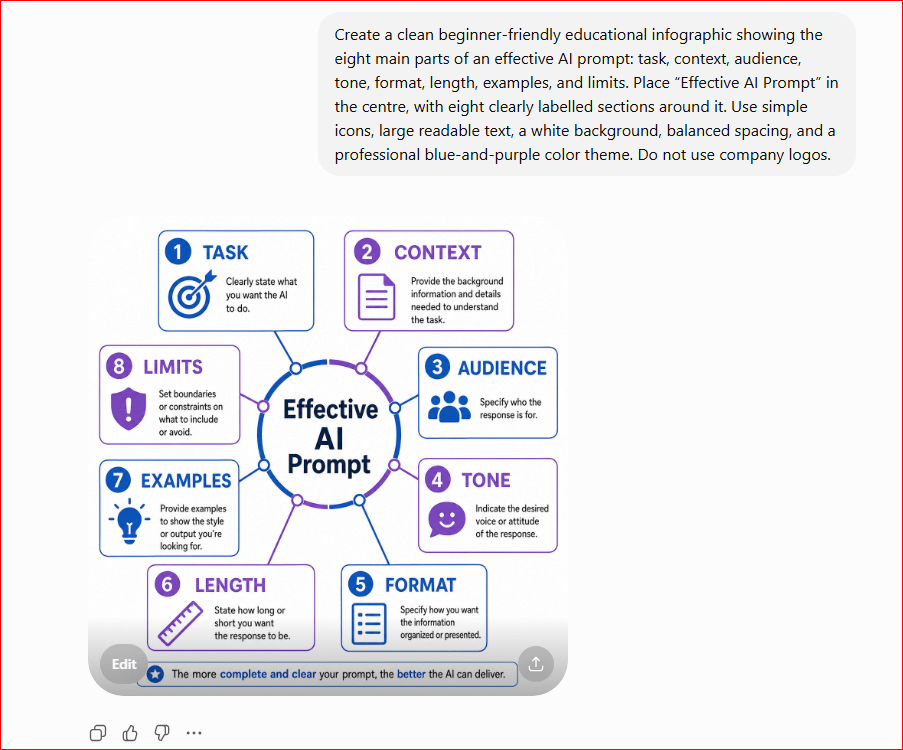
    They Depend on Human Review

    An LLM works best as an assistant. People still need to check facts, correct mistakes, review the final result, and decide whether the information is appropriate.

    The safest approach is to use Large Language Models to support human judgment rather than replace it.

    Common Myths About Large Language Models

    Large Language Models are becoming more common, but many people still misunderstand what they can and cannot do. Learning the facts helps beginners use LLMs more safely and effectively.

    Myth 1: Large Language Models Think Like Humans

    Reality: Large Language Models do not think, feel, or understand information in the same way humans do.

    They generate responses by recognizing language patterns and predicting which words or tokens are most likely to come next.

    Myth 2: Large Language Models Know Everything

    Reality: No Large Language Model knows everything.

    Its knowledge depends on the information used during training, later updates, and any additional tools it can access. It may not know recent news, private information, local details, or highly specialized facts.

    Myth 3: Every LLM Answer Is Correct

    Reality: An LLM can produce an answer that sounds professional and convincing while still containing incorrect information.

    Important facts should always be checked using reliable sources.

    Myth 4: LLMs Search the Internet for Every Answer

    Reality: A Large Language Model does not automatically search the internet whenever it receives a question.

    It normally generates an answer using patterns learned during training. Some AI assistants can also use web-search tools when those features are available.

    Myth 5: Large Language Models Simply Copy Websites

    Reality: LLMs generally create new responses using patterns learned from large amounts of text rather than copying one webpage word for word.

    However, generated content should still be reviewed for accuracy, originality, and proper source use.

    Myth 6: LLMs Remember Everything Forever

    Reality: Large Language Models do not automatically remember every conversation permanently.

    They can use information available in the current conversation, but they may lose earlier details when a conversation becomes very long. Some AI services offer optional memory features, depending on the platform and user settings.

    Myth 7: Better Writing Means Better Facts

    Reality: A clear and polished response is not always accurate.

    An LLM can use excellent grammar while providing incomplete, outdated, or incorrect information. Users should evaluate the facts, not only the writing style.

    Myth 8: Large Language Models Will Replace Every Job

    Reality: LLMs may automate some tasks and change how certain jobs are performed, but they cannot replace every worker.

    Many jobs require human judgment, responsibility, physical skills, creativity, trust, emotional understanding, and real-world experience.

    Large Language Models are usually most useful as tools that assist people rather than completely replace them.

    Myth 9: Only Technology Experts Can Use LLMs

    Reality: Most AI assistants powered by Large Language Models are designed for ordinary users.

    Students, teachers, writers, business owners, retirees, programmers, and complete beginners can use them by typing questions and instructions in everyday language.

    Myth 10: Longer Prompts Always Produce Better Answers

    Reality: A longer prompt is not automatically better.

    The most effective prompts are clear, specific, and relevant. Too many unnecessary details can confuse the model, while a short but precise prompt may produce an excellent response.

    Understanding these myths helps beginners develop realistic expectations about Large Language Models. LLMs are powerful tools, but they work best when combined with human knowledge, careful review, and responsible use.

    Frequently Asked Questions About Large Language Models

    What Does LLM Stand For?

    LLM stands for Large Language Model. It is a type of Artificial Intelligence designed to understand and generate human language.

    The word Large refers to the enormous amount of information and mathematical settings used to train the model. Language means it works with written or spoken language, and Model refers to the trained AI system.

    Is ChatGPT a Large Language Model?

    ChatGPT is an AI assistant that is powered by Large Language Models developed by OpenAI.

    The LLM is the technology that processes language and generates responses, while ChatGPT is the application people use to interact with that technology.

    How Does a Large Language Model Learn?

    A Large Language Model learns by analyzing enormous amounts of text during training. It studies patterns in words, sentences, grammar, facts, writing styles, and relationships between ideas.

    It does not learn exactly like a human student. Instead, its mathematical settings are repeatedly adjusted so it becomes better at predicting suitable words and generating useful responses.

    Does an LLM Understand What It Writes?

    Not in the same way a human does.

    An LLM can produce explanations that sound thoughtful and intelligent, but it does not have human awareness, emotions, personal experience, or true understanding. It generates responses by recognizing patterns and predicting which tokens should come next.

    Does an LLM Search the Internet for Every Answer?

    No. A Large Language Model does not automatically search the internet whenever it receives a question.

    It normally generates responses using patterns learned during training. Some AI assistants can also use web-search tools when those features are available and activated.

    Are Large Language Models Always Accurate?

    No. LLMs can generate incorrect, incomplete, biased, or outdated information.

    They may also create convincing details that are not true. Important information should always be checked using reliable sources.

    What Can Large Language Models Be Used For?

    Large Language Models can help with:

    · Answering questions

    · Writing and editing

    · Summarizing documents

    · Translating languages

    · Explaining difficult subjects

    · Generating ideas

    · Organizing information

    · Assisting with computer code

    Their usefulness depends greatly on the quality and clarity of the prompt.

    Do I Need Programming Skills to Use an LLM?

    No. Most LLM-powered assistants are designed for ordinary users.

    You can communicate with them by typing questions or instructions in everyday language. Programming knowledge is only necessary when building applications or working with advanced AI systems.

    Are Large Language Models Safe to Use?

    Large Language Models can be useful when used responsibly, but users should protect their privacy and verify important answers.

    Avoid entering passwords, banking information, confidential business records, government identification numbers, or sensitive personal information into an AI assistant.

    Will Large Language Models Replace Humans?

    Large Language Models may automate some tasks, but they cannot replace human judgment, responsibility, experience, creativity, and emotional understanding.

    They are most effective when used as tools that assist people rather than make every decision for them.

    Key Takeaways

    Remember these important points:

    · A Large Language Model, or LLM, is an Artificial Intelligence system designed to understand and generate human language.

    · LLMs learn by analyzing enormous amounts of text and recognizing patterns in words, sentences, and ideas.

    · They generate responses by predicting one token at a time.

    · Tokens may be complete words, parts of words, numbers, or punctuation marks.

    · Large Language Models can answer questions, write content, summarize documents, translate languages, support learning, and assist with computer code.

    · Popular LLM-powered tools include ChatGPT, Google Gemini, Claude, Microsoft Copilot, Meta Llama, and Mistral.

    · LLMs can save time, improve productivity, support creativity, and make difficult information easier to understand.

    · Large Language Models can still generate incorrect, biased, incomplete, or outdated information.

    · They do not think, feel, or understand the world in the same way humans do.

    · Important information should always be checked using reliable sources.

    · LLMs work best as helpful assistants rather than replacements for human judgment.

    · Writing clear and specific prompts usually produces better answers.

    What’s Next?

    Congratulations! You have completed this beginner’s guide to Large Language Models.

    You now understand what an LLM is, how it learns from large amounts of text, how it uses tokens to generate responses, and the different tasks it can perform.

    You have also learned about popular Large Language Models, their benefits, their limitations, and the importance of checking AI-generated information before relying on it.

    Large Language Models are the technology behind many modern AI assistants, including ChatGPT, Google Gemini, Claude, and Microsoft Copilot. Understanding how LLMs work gives you a stronger foundation for using these tools safely and effectively.

    With this knowledge, you are ready to explore more practical AI topics, including prompt writing, AI image generation, productivity tools, and other beginner-friendly AI applications.

    Final Tip for Beginners

    Large Language Models work best when you give them clear and specific instructions. Instead of asking a very general question, explain exactly what you want, who the answer is for, and how you would like the response presented.

    For example, instead of writing:

    Explain Large Language Models.

    Try:

    Explain Large Language Models to a complete beginner using simple language, one everyday comparison, and three practical examples.

    The second prompt gives the LLM more direction and usually produces a clearer and more useful response.

    Do not accept every AI-generated answer automatically. Ask follow-up questions, request simpler explanations, compare important information with reliable sources, and correct anything that appears inaccurate.

    Like any new skill, using Large Language Models becomes easier with practice. Keep experimenting with different prompts and use human judgment to decide whether the final response is accurate, useful, and appropriate.

    Continue Learning

    Ready to continue your AI journey?

    Explore these beginner-friendly guides to strengthen your understanding of Artificial Intelligence and learn how to use AI tools more effectively:

    · Create a ChatGPT Account — Step-by-Step Beginner Guide 2026

    · ChatGPT Basics for Beginners — Complete Guide 2026

    · What Is Artificial Intelligence? A Beginner’s Guide 2026

    · What Is Machine Learning? A Beginner’s Guide 2026

    · What Is Deep Learning? A Beginner’s Guide 2026

    · What Is Generative AI? A Beginner’s Guide 2026

    · How ChatGPT Works — Explained Simply

    · Best ChatGPT Prompts for Beginners 2026

    · AI Image Generation for Beginners

    · Prompt Engineering for Beginners

    New beginner-friendly AI tutorials will be added regularly. Check back for more practical examples, step-by-step guides, and simple explanations of important AI concepts.

    Thank you for reading. Keep exploring, keep practicing, and enjoy learning how Large Language Models are changing the way people communicate, learn, work, and create.

  • How ChatGPT Works (Explained Simply)

    How ChatGPT Works (Explained Simply)

    Estimated Reading Time: 13 minutes

    Last Updated: July 2026

    What You’ll Learn

    By the end of this guide, you’ll be able to:

    · Understand how ChatGPT works in simple language.

    · Learn how ChatGPT generates answers.

    · Understand what prompts are and why they matter.

    · Learn what Large Language Models (LLMs) are.

    · Discover the benefits and limitations of ChatGPT.

    · Understand why ChatGPT sometimes makes mistakes.

    · Learn how to get better answers from ChatGPT.

    Introduction

    ChatGPT is one of the world’s most popular Artificial Intelligence (AI) tools. Millions of people use it every day to answer questions, write emails, summarize documents, generate ideas, translate languages, learn new skills, and solve problems.

    Although ChatGPT may seem intelligent, it does not think or understand information like humans do. Instead, it uses advanced Artificial Intelligence, Deep Learning, and a Large Language Model (LLM) to predict the most appropriate response based on the prompt you provide.

    The quality of ChatGPT’s answers depends largely on the instructions you give it. A clear, detailed prompt usually produces a more accurate and useful response than a short or unclear request.

    If you’re new to ChatGPT, this guide explains how it works using simple language and everyday examples. You do not need any programming or technical knowledge to understand the concepts presented in this article.

    Before reading this guide, you may find it helpful to read our What Is Artificial Intelligence? A Beginner’s Guide (2026), What Is Machine Learning? A Beginner’s Guide (2026), What Is Deep Learning? A Beginner’s Guide (2026), and What Is Generative AI? A Beginner’s Guide (2026). These articles explain the technologies that make ChatGPT possible.

    What Is ChatGPT?

    ChatGPT is an Artificial Intelligence (AI) chatbot developed by OpenAI that can understand and generate human-like text. It allows people to have natural conversations with a computer by asking questions or giving instructions in everyday language.

    ChatGPT is powered by a type of Generative AI called a Large Language Model (LLM). The models that power ChatGPT are developed using large amounts of information from several sources, including publicly available information, data accessed through partnerships, and information provided or generated by users, human trainers, and researchers. During training, the model learns patterns in language, grammar, sentence structure, facts, and writing styles, enabling it to generate useful and natural-sounding responses.

    ChatGPT can perform many different tasks, including:

    · Answering questions.

    · Explaining difficult topics in simple language.

    · Writing emails, letters, and articles.

    · Summarizing documents.

    · Translating between languages.

    · Helping with homework and studying.

    · Generating computer code.

    · Brainstorming ideas for business, marketing, and creative projects.

    One of the reasons ChatGPT has become so popular is that it can understand conversational language. Instead of using complicated computer commands, you simply type your question or request, and ChatGPT responds in a way that is easy to understand.

    Although ChatGPT often provides accurate and helpful answers, it is not perfect. It can occasionally make mistakes, misunderstand a question, or provide outdated information. For this reason, important information should always be verified using reliable sources.

    Figure 1. ChatGPT explaining what ChatGPT is in simple language.

    This example introduces ChatGPT in clear, beginner-friendly language. By showing the different tasks ChatGPT can perform, readers can better understand why it has become one of the most widely used Artificial Intelligence tools in the world.

    How Does ChatGPT Generate Answers?

    When you enter a prompt, ChatGPT analyzes your request and its context, then predicts which token is most likely to come next. It repeats this process one token at a time until it creates a complete response. A token may be a complete word, part of a word, a number, or punctuation mark.

    Think of ChatGPT as a person who has read millions of books, articles, and websites. Rather than memorizing every sentence, that person learns how language works, recognizes patterns, and uses that knowledge to answer new questions. ChatGPT works in a similar way by using what it learned during training to generate new responses.

    When you enter a prompt, ChatGPT analyzes the words, identifies the context of your request, and predicts which words are most likely to come next. It repeats this process one token at a time until it creates a complete response. A token may be a complete word, part of a word, a number, or punctuation mark.

    For example, if you ask ChatGPT to write a professional email, it does not copy an existing email from the internet. Instead, it generates a new email based on the writing patterns and language it learned during training.

    The quality of ChatGPT’s answers depends largely on the quality of your prompt. A clear, detailed prompt usually produces a more accurate, helpful, and relevant response than a short or unclear request.


    Although ChatGPT can perform reasoning and problem-solving tasks, it does not think, understand, feel, or experience the world in the same way humans do. It generates responses using mathematical models and patterns learned from large amounts of information.

    Figure 2. ChatGPT explaining how it generates answers using an everyday example.

    This example shows that ChatGPT generates responses by recognizing language patterns it learned during training rather than searching the internet or thinking like a human. Using a simple everyday comparison helps beginners understand how ChatGPT creates useful and natural-sounding answers.

    What Is a Large Language Model (LLM)?

    A Large Language Model (LLM) is a type of Artificial Intelligence designed to understand and generate human language. It learns by analyzing large amounts of text from multiple sources, which may include publicly available information, licensed material, and content created or reviewed by human trainers. During training, it recognizes patterns in language, grammar, sentence structure, and writing styles.

    The word “Large” refers to the huge amount of data used during training. The word “Language” means the model works with human languages such as English, French, Arabic, Spanish, and many others. The word “Model” refers to the AI system that has learned these language patterns.

    Think of a Large Language Model as a very experienced librarian who has read millions of books. When someone asks a question, the librarian does not remember every sentence from every book. Instead, the librarian uses years of reading experience to provide a helpful answer. A Large Language Model works in a similar way by recognizing language patterns and generating new responses based on what it learned during training.

    ChatGPT is powered by a Large Language Model. This enables it to answer questions, explain concepts, write articles, summarize documents, translate languages, generate computer code, and assist with many other tasks using natural language.

    Although a Large Language Model can generate impressive responses, it does not think, understand, or have personal experiences. It predicts the most appropriate words based on patterns it learned from large amounts of text.

    Figure 3. ChatGPT explaining what a Large Language Model (LLM) is.

    This example explains the meaning of a Large Language Model in simple language. By comparing an LLM to an experienced librarian, beginners can understand how ChatGPT generates helpful responses using patterns learned from a vast amount of text rather than memorizing or thinking like a human.

    Why Are Prompts So Important?

    A prompt is the instruction, question, or request you give to ChatGPT. Every conversation begins with a prompt, and the quality of your prompt has a major impact on the quality of the response you receive.

    Think of ChatGPT as a helpful assistant. If you ask, “Tell me about dogs,” you may receive a general answer. However, if you ask, “Explain how to care for a Labrador puppy for a first-time owner using simple language,” ChatGPT has much more information to work with and can provide a more detailed and useful response.

    Good prompts are usually:

    · Clear – Explain exactly what you want.

    · Specific – Include important details or requirements.

    · Complete – Mention the topic, audience, format, or length if needed.

    · Polite and natural – Write as if you are asking a knowledgeable person for help.

    For example, compare these two prompts:

    Basic Prompt

    Explain Artificial Intelligence.

    Better Prompt

    Explain Artificial Intelligence to a 12-year-old using simple language. Include three everyday examples, avoid technical jargon, and keep the explanation under 300 words.

    The second prompt gives ChatGPT clear instructions about the audience, writing style, examples, and length. As a result, the response is usually much more useful.

    Learning how to write effective prompts is one of the most valuable skills when using ChatGPT. With practice, you will receive more accurate, detailed, and personalized answers for learning, work, and everyday tasks.

    Figure 4. ChatGPT explaining why good prompts produce better answers.

    This example shows how clear and detailed prompts help ChatGPT generate more accurate and useful responses. By learning to write better prompts, beginners can improve the quality of the answers they receive and make better use of AI tools.

    Benefits of Using ChatGPT

    ChatGPT has become one of the most popular Artificial Intelligence tools because it helps people complete many everyday tasks quickly and efficiently. Whether you are a student, teacher, business owner, programmer, or simply curious about AI, ChatGPT can save time and improve productivity.

    Some of the main benefits of using ChatGPT include:

    · Answers questions on a wide variety of topics using simple, easy-to-understand language.

    · Supports learning by explaining difficult concepts, providing examples, and helping with homework or research.

    · Improves writing by creating emails, letters, reports, articles, and social media posts.

    · Generates ideas for business, marketing, creative writing, presentations, and projects.

    · Summarizes information by turning long documents into shorter, easier-to-read summaries.

    · Helps programmers write, explain, and improve computer code.

    · Translates languages and assists with grammar, spelling, and writing style.

    · Available 24/7, providing instant assistance whenever you need it.

    · Saves time by completing repetitive tasks in just a few seconds.

    · Encourages creativity by helping users brainstorm ideas and explore new approaches to solving problems.

    One of the greatest strengths of ChatGPT is its versatility. A single tool can help with education, business, writing, programming, travel planning, customer service, and many other everyday activities. By adapting its responses to different situations, ChatGPT has become a valuable assistant for millions of people around the world.

    Although ChatGPT is a powerful tool, it works best when combined with human knowledge and critical thinking. Reviewing its responses and verifying important information helps ensure that the final result is accurate and reliable.

    Figure 5. ChatGPT explaining the benefits of using ChatGPT.

    This example shows how ChatGPT can help people learn, write, solve problems, and complete everyday tasks more efficiently. By understanding its many practical uses, beginners can make better use of ChatGPT in their personal, educational, and professional lives.

    Limitations of ChatGPT

    Although ChatGPT is a powerful and helpful AI tool, it is not perfect. Like all Artificial Intelligence systems, it has limitations and can sometimes make mistakes. Understanding these limitations helps people use ChatGPT more effectively and responsibly.

    Some of the main limitations of ChatGPT include:

    · Can generate incorrect information, even when the response sounds confident and convincing.

    · May misunderstand unclear prompts, resulting in answers that do not match the user’s request.

    · Does not understand or experience the world in the same way humans do; it relies on learned patterns and may lack human common sense.

    · May provide outdated information if it does not have access to the latest data.

    · Can reflect bias if similar patterns existed in the data used during training.

    · Cannot replace professional advice in areas such as healthcare, law, finance, or engineering.

    · Requires clear prompts to produce the most accurate and useful responses.

    · May occasionally create fictional details, especially when asked about information it is uncertain about.

    · Cannot verify every fact automatically, so important information should always be checked using reliable sources.

    Although ChatGPT can answer a wide variety of questions and assist with many tasks, users should think critically about its responses. Reviewing AI-generated content, checking important facts, and applying human judgment are essential for making informed decisions.

    The best way to use ChatGPT is as a helpful assistant rather than as a replacement for human knowledge or expertise. When used responsibly, it can save time, improve productivity, and support learning while still allowing people to make the final decisions.

    Figure 6. ChatGPT explaining the limitations of ChatGPT.

    This example shows that although ChatGPT is a powerful AI assistant, it also has important limitations. Understanding these challenges helps beginners use ChatGPT more responsibly by writing better prompts, verifying important information, and recognizing that human judgment remains essential.

    Common Myths About ChatGPT

    As ChatGPT has become more popular, many misconceptions have also spread. Understanding what ChatGPT can and cannot do will help you use it more effectively and responsibly.

    Myth 1: ChatGPT thinks like a human.

    Reality: ChatGPT does not think, understand, or have emotions. It generates responses by recognizing patterns in language learned during training.

    Myth 2: ChatGPT is always correct.

    Reality: ChatGPT can make mistakes and sometimes provide incorrect or outdated information. Important facts should always be verified using reliable sources.

    Myth 3: ChatGPT searches the internet every time it answers a question.

    Reality: ChatGPT does not automatically search the internet whenever you ask a question. It generates responses using patterns learned during training. Some versions of ChatGPT can access the web when specific browsing features are enabled, but this depends on the version and settings being used.

    Myth 4: ChatGPT will replace all human jobs.

    Reality: ChatGPT is designed to assist people, not replace them. It can automate repetitive tasks, but human creativity, critical thinking, decision-making, and professional expertise remain essential.

    Myth 5: Only programmers can use ChatGPT.

    Reality: ChatGPT is designed for everyone. Students, teachers, business owners, writers, healthcare professionals, and beginners can all use ChatGPT by typing questions or instructions in everyday language.

    Myth 6: ChatGPT remembers everything forever.

    Reality: ChatGPT does not automatically remember every conversation. Depending on your settings and the version you are using, it may not retain information between chats unless memory features are available and enabled.

    Understanding these myths helps beginners develop realistic expectations about ChatGPT. Although it is one of the most advanced AI tools available today, it works best when combined with human knowledge, careful thinking, and responsible use.

    Frequently Asked Questions

    What is ChatGPT?

    ChatGPT is an Artificial Intelligence chatbot developed by OpenAI that understands and generates human-like text. It can answer questions, explain concepts, write content, summarize information, translate languages, and assist with many everyday tasks.

    How does ChatGPT generate answers?

    ChatGPT generates answers by recognizing patterns in language that it learned during training. It predicts the most appropriate response based on the prompt you provide rather than thinking like a human.

    Does ChatGPT search the internet for every answer?

    No. ChatGPT does not automatically search the internet whenever you ask a question. Some versions can access the web when browsing features are available and enabled, but many responses are generated from patterns learned during training.

    Can ChatGPT make mistakes?

    Yes. ChatGPT can sometimes generate incorrect, incomplete, or outdated information. Important facts should always be verified using reliable sources.

    How can I get better answers from ChatGPT?

    Write clear and detailed prompts. Including the topic, audience, desired format, writing style, and any special instructions usually results in more accurate and useful responses.

    Key Takeaways

    Remember these important points:

    · ChatGPT is an AI chatbot that understands and generates human-like text.

    · It is powered by a Large Language Model (LLM).

    · ChatGPT generates responses by recognizing language patterns learned during training.

    · The quality of your prompt greatly affects the quality of the response.

    · ChatGPT can help with learning, writing, coding, brainstorming, and many everyday tasks.

    · Although powerful, ChatGPT can make mistakes and should not replace human judgment.

    · Verifying important information is always a good practice.

    What’s Next?

    Congratulations! You have completed this beginner’s guide to ChatGPT.

    You now understand what ChatGPT is, how it works, what a Large Language Model is, why prompts are important, and both the benefits and limitations of using ChatGPT.

    With this knowledge, you are ready to use ChatGPT more effectively for learning, writing, research, business, creativity, and everyday problem-solving.

    Final Tip for Beginners

    The secret to getting the best results from ChatGPT is simple: ask better questions. The more specific and detailed your prompt is, the more useful the response is likely to be. Don’t be afraid to experiment with different prompts, ask follow-up questions, and refine your requests until you get the information you need.

    Continue Learning

    Ready to continue your AI journey?

    Explore our beginner-friendly tutorials to deepen your understanding of Artificial Intelligence and learn how to use AI tools more effectively.

    Continue Your AI Journey

    Explore these beginner-friendly guides to continue building your AI skills:

    · Create a ChatGPT Account (Step-by-Step Beginner Guide 2026)

    · ChatGPT Basics for Beginners (Complete Guide 2026)

    · Best ChatGPT Prompts for Beginners (2026)

    · What Is Artificial Intelligence? A Beginner’s Guide (2026)

    · What Is Machine Learning? A Beginner’s Guide (2026)

    · What Is Deep Learning? A Beginner’s Guide (2026)

    · What Is Generative AI? A Beginner’s Guide (2026)

    · What Are Large Language Models (LLMs)? A Beginner’s Guide (2026)

    · AI Image Generation for Beginners

    New beginner-friendly AI tutorials will be added regularly, so be sure to check back for more guides, practical examples, and step-by-step AI tutorials.

    Thank you for reading. Keep exploring, keep practicing, and enjoy discovering how ChatGPT can help you learn, create, and solve problems more effectively.

  • What Is Generative AI? A Beginner’s Guide (2026)

    What Is Generative AI? A Beginner’s Guide (2026)

    Estimated Reading Time: 14 minutes

    Last Updated: July 2026

    What You’ll Learn

    By the end of this guide, you’ll be able to:

    · Understand what Generative AI is.

    · Learn how Generative AI works in simple language.

    · Recognize everyday examples of Generative AI.

    · Discover the most popular Generative AI tools.

    · Learn the benefits and limitations of Generative AI.

    · Understand the difference between Generative AI and traditional AI.

    · Build a strong foundation for using Generative AI safely and effectively.

    Introduction

    Generative AI is one of the fastest-growing areas of Artificial Intelligence (AI). Unlike traditional AI systems that analyze data or make predictions, Generative AI can create entirely new content, including text, images, music, videos, computer code, and more.

    Today, millions of people use Generative AI every day to write emails, create artwork, generate ideas, summarize documents, translate languages, and solve problems. Popular tools such as ChatGPT, Google Gemini, Microsoft Copilot, Claude, and image generators have made this technology accessible to beginners as well as professionals.

    Although Generative AI may seem complex, the basic idea is surprisingly simple. It learns from large amounts of existing data and uses that knowledge to generate new content that is similar in style and structure but not simply copied from the original information.

    If you’re new to Generative AI, this guide is the perfect place to start. It explains the key concepts in simple language, uses real-world examples, and shows how Generative AI is changing the way people learn, work, and create.

    Before learning about Generative AI, you may find it helpful to read our What Is Artificial Intelligence? A Beginner’s Guide (2026), What Is Machine Learning? A Beginner’s Guide (2026), and What Is Deep Learning? A Beginner’s Guide (2026). These guides explain the technologies that make Generative AI possible.

     What Is Generative AI?

    Generative AI is a type of Artificial Intelligence that can create new content instead of simply analyzing existing information. It can generate text, images, music, videos, computer code, and other types of digital content based on the information it has learned during training.

    Unlike traditional AI systems, which are mainly designed to classify data, recognize patterns, or make predictions, Generative AI generates new content in response to a user’s request. For example, it can write articles, answer questions, create artwork, summarize documents, translate languages, or generate computer programs.

    Generative AI learns by studying enormous amounts of data from multiple sources, which may include publicly available information, licensed material, and content created or reviewed by human trainers.

    During training, it identifies patterns, relationships, and structures within the data. When you give it a prompt, it uses those learned patterns to generate new content that is relevant to your request.

    Many of today’s most popular AI tools use Generative AI. Examples include ChatGPT for writing and answering questions, Google Gemini for conversation and productivity, Microsoft Copilot for work-related tasks, DALL·E for creating images, and Suno for generating music.

    Although Generative AI can produce impressive results, it does not think, understand, or have feelings like humans. Instead, it predicts the most appropriate response based on patterns it learned during training.

    One of the biggest advantages of Generative AI is its ability to help people create content quickly. It can save time, improve productivity, and support creativity in education, business, software development, marketing, and many other fields.

    Figure 1. ChatGPT explaining Generative AI in simple language.

    This example shows how ChatGPT explains Generative AI using clear language and practical examples. By showing that Generative AI can create text, images, music, and other content, beginners can easily understand how this technology differs from traditional Artificial Intelligence.

    How Does Generative AI Work?

    Generative AI works by learning from enormous amounts of existing information instead of following only a fixed set of instructions. During training, it analyzes books, articles, websites, images, videos, music, and other types of data to recognize patterns and relationships. Once it has learned those patterns, it can generate new content based on a user’s prompt.

    Think of Generative AI as a student who has read millions of books and seen millions of examples. Instead of memorizing every sentence, the student learns writing styles, grammar, facts, and patterns. When asked a new question, the student uses that knowledge to create a new answer instead of copying a page from a book.

    For example, when you ask ChatGPT a question, it does not always search the internet like a traditional search engine. Depending on your question and the tools available, it may generate a response using patterns learned during training or search the web for current information. It analyzes your prompt, considers the context and instructions, and generates a response that matches your request.

    Generative AI works in a similar way when creating images, music, or computer code. It does not simply copy existing content. Instead, it combines the patterns it has learned to create something new that matches the instructions you provide.

    Although Generative AI can produce impressive results, it does not think, understand, or have emotions like humans. It uses mathematical calculations and learned patterns to generate content that appears natural and useful.

    One of the greatest strengths of Generative AI is its ability to create content in just a few seconds. Whether writing an article, creating an image, summarizing a document, or generating computer code, it can complete tasks much faster than traditional methods.

    Figure 2. ChatGPT explaining how Generative AI works using an everyday example.

    This example shows that Generative AI creates new content by learning patterns from large amounts of information rather than copying existing material. Using a simple everyday comparison helps beginners understand how Generative AI produces text, images, music, and other content in response to a user’s prompt.

    Everyday Examples of Generative AI

    You may already be using Generative AI every day without realizing it. Many popular apps and online services use Generative AI to create text, images, music, videos, computer code, and other digital content.

    Here are some common examples:

    · ChatGPT – Writes articles, answers questions, summarizes information, and helps generate ideas.

    · Google Gemini – Assists with writing, research, brainstorming, and productivity tasks.

    · Microsoft Copilot – Helps create documents, emails, presentations, and computer code.

    · DALL·E – Creates new images from text descriptions.

    · Adobe Firefly – Generates images and graphic designs for creative projects.

    · Canva Magic Studio – Creates presentations, social media posts, and marketing content using AI.

    · Suno AI – Generates new songs from text prompts.

    · GitHub Copilot – Helps programmers write and improve computer code.

    · Grammarly AI – Suggests improvements for writing, grammar, and tone.

    · AI-powered customer service chatbots – Answer customer questions and provide support automatically.

    These examples show that Generative AI is becoming part of everyday life. Whether you are writing an email, creating artwork, designing a presentation, generating music, or asking an AI assistant for help, Generative AI is making many tasks faster, easier, and more creative.

    Figure 3. ChatGPT explaining everyday examples of Generative AI.

    This example shows how Generative AI is used in many popular applications that people use every day. By connecting Generative AI to familiar tools such as ChatGPT, Google Gemini, Microsoft Copilot, DALL·E, and Canva, beginners can better understand how this technology is improving creativity and productivity across many different fields.

     Popular Generative AI Tools

    Today, there are many Generative AI tools designed to help people write, create images, generate music, produce videos, write computer code, and improve productivity. Although these tools use similar AI technology, each one is designed for different tasks.

    Here are some of the most popular Generative AI tools:

    · ChatGPT – Generates text, answers questions, summarizes information, writes emails, creates articles, and helps with brainstorming.

    · Google Gemini – Assists with writing, research, coding, and productivity while integrating with Google’s services.

    · Microsoft Copilot – Helps create documents, presentations, spreadsheets, emails, and computer code using Microsoft 365 applications.

    · Claude – Assists with writing, summarizing long documents, answering questions, and analyzing information.

    · DALL·E – Creates original images from text descriptions.

    · Adobe Firefly – Generates images, graphic designs, and creative visual content.

    · Canva Magic Studio – Uses AI to create presentations, social media posts, logos, and marketing materials.

    · GitHub Copilot – Assists programmers by suggesting and generating computer code.

    · Suno AI – Creates original songs and music from text prompts.

    · Runway – Generates and edits AI-powered videos for creative projects.

    Comparison Table

    ToolMain PurposeExample Use
    ChatGPTText generationWriting articles, answering questions
    Google GeminiAI assistantResearch, writing, productivity
    Microsoft CopilotOffice productivityDocuments, emails, presentations
    ClaudeWriting and analysisSummarizing documents, brainstorming
    DALL·EImage generationCreating artwork from text
    Adobe FireflyGraphic designMarketing images and illustrations
    Canva Magic StudioContent creationSocial media posts and presentations
    GitHub CopilotProgrammingWriting and suggesting code
    Suno AIMusic generationCreating original songs
    RunwayVideo generationAI-powered video creation

    Each tool has its own strengths. Some focus on writing, while others specialize in images, music, videos, or programming. Choosing the right tool depends on the type of content you want to create.

    As Generative AI continues to evolve, new tools are being introduced regularly. Learning how these tools differ will help you choose the best one for your personal, educational, or professional needs.

    Figure 4. ChatGPT explaining popular Generative AI tools.

    This example introduces some of today’s most popular Generative AI tools and explains their primary uses. By comparing them side by side, beginners can quickly understand which tools are best suited for writing, image creation, music generation, programming, productivity, and video creation.

    Benefits of Generative AI

    As more industries adopt Generative AI, it is becoming an essential tool in education, healthcare, business, software development, marketing, entertainment, and scientific research.

    Some of the main benefits of Generative AI include:

    · Saves time by creating drafts and summaries quickly.

    · Supports creativity by generating ideas and examples.

    · Improves writing, grammar, and communication.

    · Makes difficult topics easier to understand.

    · Helps create images, presentations, music, and videos.

    · Assists programmers with writing and explaining code.

    · Supports planning, organization, and research.

    · Improves productivity by reducing repetitive work.

    · Helps businesses create marketing and customer-service content.

    · Makes creative tools more accessible to beginners.

    Figure 5. ChatGPT explaining the benefits of Generative AI.

    This example shows how Generative AI helps people work more efficiently, express their creativity, and solve problems more quickly. From writing and design to programming and education, Generative AI is becoming an important tool in many areas of everyday life.

    Limitations of Generative AI

     Although Generative AI is a powerful and useful technology, it is not perfect. Like all Artificial Intelligence systems, it has limitations and can sometimes produce incorrect or misleading results. Understanding these limitations helps people use Generative AI more effectively and responsibly.

    Some of the main limitations of Generative AI include:

    · Can generate incorrect information, sometimes called “hallucinations,” by producing answers that sound convincing but are inaccurate.

    · Depends on the quality of its training data, which means incomplete or biased data can affect the results.

    · Does not understand or experience the world in the same way humans do; it relies on learned patterns and may lack human common sense.

    · May reflect bias if the data used during training contains unfair or unbalanced information.

    · Cannot replace human judgment for important decisions in areas such as healthcare, law, or finance.

    · May produce outdated information if it has not been trained on the latest data.

    · Raises copyright and privacy concerns when creating or using content.

    · Requires careful prompts because unclear instructions may lead to poor or incomplete results.

    · Can be misused to create fake images, videos, or misleading information if used irresponsibly.

    Although Generative AI can create impressive content in seconds, people should always review and verify the results before using them. Human creativity, critical thinking, and professional expertise remain essential for making important decisions and ensuring information is accurate.

    The best way to use Generative AI is as a helpful assistant rather than a replacement for human knowledge. When combined with careful review and responsible use, it can improve productivity while reducing repetitive work.

    Figure 6. ChatGPT explaining the limitations of Generative AI.

    This example shows that although Generative AI is an impressive technology, it still has important limitations. Understanding issues such as inaccurate information, bias, outdated knowledge, and the need for human review helps beginners use Generative AI more safely and effectively.

    Generative AI vs. Traditional AI

    Many people assume that all Artificial Intelligence works the same way. In reality, there is an important difference between Traditional AI and Generative AI.

    Traditional AI is designed to analyze existing information, recognize patterns, make predictions, classify data, or recommend actions. For example, a spam filter identifies unwanted emails, a navigation app suggests the fastest route, and a recommendation system suggests movies or products you might like.

    Generative AI goes a step further. Instead of simply analyzing information, it generates new content based on a user’s prompt. It can write articles, generate images, compose music, create videos, produce computer code, and answer questions in natural language.

    For example, if you ask a traditional AI system to identify whether an email is spam, it will classify the email as “spam” or “not spam.” If you ask Generative AI to write a professional email, it can create a completely new message based on your instructions.

    Both Traditional AI and Generative AI are valuable technologies, but they are designed for different purposes. Traditional AI focuses on analyzing and predicting, while Generative AI focuses on creating new content.

    Comparison Table

    FeatureTraditional AIGenerative AI
    Main PurposeAnalyzes data and makes predictionsCreates new content
    Primary FunctionClassification, recognition, recommendationsWriting, image creation, music, videos, and code
    Learns from DataYesYes
    Generates New ContentNoYes
    Everyday ExamplesSpam filters, Google Maps, fraud detectionChatGPT, DALL·E, Suno AI, Microsoft Copilot

    The easiest way to remember the difference is that Traditional AI helps computers understand information, while Generative AI helps computers create new content. Both are important parts of modern Artificial Intelligence and often work together in many applications.

    As Generative AI continues to improve, it is becoming an increasingly valuable tool for education, business, creativity, healthcare, and software development. However, both Traditional AI and Generative AI require responsible use and human oversight to achieve the best results.

    Figure 7. ChatGPT explaining the difference between Traditional AI and Generative AI.

    This example shows that Traditional AI and Generative AI have different purposes. Traditional AI analyzes information and makes predictions, while Generative AI creates new content such as text, images, music, videos, and computer code. Understanding this difference helps beginners choose the right AI tool for different tasks.

    Common Myths About Generative AI

    Generative AI is becoming more popular every day, but many people still have misunderstandings about what it can and cannot do. Learning the facts will help you use Generative AI more effectively and responsibly.

    Myth 1: Generative AI thinks like a human.

    Reality: Generative AI does not think, understand, or have emotions. It generates content by recognizing patterns in the data it learned during training.

    Myth 2: Everything Generative AI creates is always correct.

    Reality: Generative AI can make mistakes and sometimes generate inaccurate or misleading information. Always verify important facts using reliable sources.

    Myth 3: Generative AI copies everything from the internet.

    Reality: Generative AI learns patterns from large amounts of data and generates new responses rather than simply copying one source. However, users should still review AI-generated material for accuracy, originality, and proper source use.AI-generated material for accuracy, originality, and proper source use.

    Myth 4: Generative AI will replace all human jobs.

    Reality: Generative AI is designed to assist people by automating repetitive tasks and improving productivity. In most cases, human creativity, judgment, and decision-making remain essential.

    Myth 5: Only technology experts can use Generative AI.

    Reality: Many Generative AI tools are designed for everyone. Students, teachers, writers, artists, business owners, and beginners can all use Generative AI through simple text prompts.

    Myth 6: Generative AI is only used to write text.

    Reality: Generative AI can create much more than text. It can generate images, music, videos, computer code, presentations, and other types of digital content.

    Understanding these myths helps beginners develop realistic expectations about Generative AI. Although it is one of the most exciting technologies available today, it works best when combined with human knowledge, creativity, and careful review.

    Frequently Asked Questions

    What is Generative AI?

    Generative AI is a type of Artificial Intelligence that creates new content such as text, images, music, videos, computer code, and other digital media based on a user’s prompt.

    Is Generative AI the same as Artificial Intelligence?

    No. Artificial Intelligence is the broader field of creating intelligent computer systems. Generative AI is a specialized type of AI that focuses on creating new content rather than simply analyzing information or making predictions.

    What can Generative AI create?

    Generative AI can create many types of content, including articles, emails, stories, images, presentations, music, videos, computer code, and translations.

    Is Generative AI always accurate?

    No. Generative AI can sometimes produce incorrect or outdated information. It is important to review and verify important facts before using the generated content.

    Do I need programming skills to use Generative AI?

    No. Most Generative AI tools are designed for beginners and can be used simply by typing natural language prompts.

    Key Takeaways

    Remember these important points:

    · Generative AI creates new content instead of only analyzing information.

    · It can generate text, images, music, videos, computer code, and other digital content.

    · Popular Generative AI tools include ChatGPT, Google Gemini, Microsoft Copilot, Claude, DALL·E, and Canva Magic Studio.

    · Generative AI improves creativity, productivity, learning, and problem-solving.

    · Although powerful, it can still make mistakes and should always be used responsibly.

    · Human judgment remains important when using AI-generated content.

    · Learning how to write clear prompts helps you get better results from Generative AI.

    What’s Next?

    Congratulations! You have completed this beginner’s guide to Generative AI.

    You now understand what Generative AI is, how it works, the most popular AI tools available today, its benefits and limitations, and how it differs from Traditional AI.

    You have also completed the four core concepts of modern Artificial Intelligence:

    · Artificial Intelligence

    · Machine Learning

    · Deep Learning

    · Generative AI

    With this foundation, you are ready to begin learning how to use AI tools more effectively in your everyday life.

    Final Tip for Beginners

    Generative AI is most effective when you give it clear, detailed instructions. The better your prompt, the better the results are likely to be. Keep experimenting with different prompts, ask follow-up questions, and refine your requests. Like any new skill, using Generative AI becomes easier with practice.

    Continue Learning

    Ready to continue your AI journey?

    Explore our beginner-friendly tutorials to learn more about ChatGPT, prompt writing, AI image generation, and other practical AI applications.

    Continue Your AI Journey

    Explore these beginner-friendly guides to continue building your AI skills:

    · What Is Artificial Intelligence? A Beginner’s Guide (2026)

    · What Is Machine Learning? A Beginner’s Guide (2026)

    · What Is Deep Learning? A Beginner’s Guide (2026)

    · Create a ChatGPT Account (Step-by-Step Beginner Guide 2026)

    · ChatGPT Basics for Beginners (Complete Guide 2026)

    · Best ChatGPT Prompts for Beginners (2026)

    · How ChatGPT Works (Explained Simply)

    · What Are Large Language Models (LLMs)? A Beginner’s Guide (2026)

    · AI Image Generation for Beginners

    New beginner-friendly AI tutorials will be added regularly, so be sure to check back for more guides, practical examples, and step-by-step AI tutorials.

    Thank you for reading. Keep exploring, keep practicing, and enjoy discovering the exciting possibilities of Generative AI.

  • What Is Deep Learning? A Beginner’s Guide (2026)

    What Is Deep Learning? A Beginner’s Guide (2026)

    Estimated Reading Time: 14 minutes

    Last Updated: July 2026

    What You’ll Learn

    By the end of this guide, you’ll be able to:

    · Understand what Deep Learning (DL) is.

    · Learn how Deep Learning works in simple language.

    · Recognize examples of Deep Learning in everyday life.

    · Understand artificial neural networks without technical jargon.

    · Learn the benefits and limitations of Deep Learning.

    · Understand the relationship between Artificial Intelligence, Machine Learning, and Deep Learning.

    · Build a solid foundation for learning more advanced AI technologies.

    Introduction

    Deep Learning (DL) is one of the most advanced branches of Artificial Intelligence (AI). It powers many of the intelligent applications people use every day, including ChatGPT, voice assistants, image recognition, language translation, facial recognition, and self-driving technology.

    Although Deep Learning may sound complicated, its basic idea is easier to understand than many people think. Deep Learning allows computers to learn from very large amounts of data by recognizing patterns and improving their performance over time. Unlike traditional computer programs that rely on fixed instructions, Deep Learning systems learn by analyzing many examples.

    If you’re new to Deep Learning, this guide is the perfect place to start. It explains the key concepts in simple language, uses everyday examples, and shows how Deep Learning is used in many modern AI applications.

    Before learning about Deep Learning, you may find it helpful to read our What Is Artificial Intelligence? A Beginner’s Guide (2026) and What Is Machine Learning? A Beginner’s Guide (2026). These guides explain the basic concepts of AI and Machine Learning and show how Deep Learning fits into the larger field of Artificial Intelligence.

    What Is Deep Learning?

    Deep Learning (DL) is a specialized branch of Machine Learning (ML) that enables computers to learn from very large amounts of data and solve complex problems. It uses artificial neural networks, which are computer systems inspired by the way the human brain processes information.

    Instead of following only fixed instructions, Deep Learning learns by analyzing thousands or even millions of examples. As it processes more data, it becomes better at recognizing patterns, making predictions, understanding language, identifying objects in images, and generating useful responses.

    Deep Learning powers many of today’s most advanced AI applications. It is used in image recognition, speech recognition, language translation, medical diagnosis, self-driving vehicles, recommendation systems, and AI chatbots such as ChatGPT.

    In simple terms, Deep Learning teaches computers to learn from experience by analyzing large amounts of information. Although it is inspired by the human brain, it does not think, feel, or understand information like a person. Instead, it recognizes patterns and uses those patterns to produce accurate results.

    One of the biggest advantages of Deep Learning is that its performance can improve when it is trained or retrained using more high-quality data. This makes it especially useful for solving problems that are difficult for traditional computer programs.

    Figure 1. ChatGPT explaining Deep Learning in simple language.

    This example shows how ChatGPT explains Deep Learning using simple language and practical examples. By avoiding technical terms and using familiar applications such as voice assistants, image recognition, and ChatGPT, beginners can quickly understand the basic idea of Deep Learning.

    How Does Deep Learning Work?

    Deep Learning works by learning from enormous amounts of data instead of relying only on fixed instructions. It uses artificial neural networks, which are computer systems inspired by the way the human brain processes information. These networks help the computer recognize patterns, make predictions, and improve its performance over time.

    Imagine teaching a child to recognize different kinds of animals. Instead of giving a list of rules for every animal, you show thousands of pictures of cats, dogs, birds, and other animals. After seeing enough examples, the child begins to recognize each animal automatically. Deep Learning works in a similar way by learning from many examples instead of memorizing rules.

    During training, a Deep Learning system analyzes large amounts of data, identifies patterns, and gradually improves its accuracy. Once the training is complete, it can apply what it has learned to new information that it has never seen before.

    For example, Deep Learning can recognize faces in photos, understand spoken language, translate text between languages, detect diseases in medical images, and generate human-like responses in AI chatbots such as ChatGPT.

    Although Deep Learning is inspired by the human brain, it does not think or understand information like people do. Instead, it uses mathematical calculations and learned patterns to produce accurate results.

    One of the biggest strengths of Deep Learning is that its performance can improve when it is trained or retrained using larger amounts of high-quality data. This makes it especially useful for solving complex problems that would be difficult for traditional computer programs.

    Figure 2. ChatGPT explaining how Deep Learning works using an everyday example.

    This example shows that Deep Learning learns by recognizing patterns in large amounts of data rather than following fixed instructions. Using an everyday comparison helps beginners understand how Deep Learning improves its performance through experience without needing advanced technical knowledge.

    Artificial Neural Networks Explained Simply

    Artificial neural networks are the technology that makes Deep Learning possible. They are called “neural networks” because they were inspired by the way the human brain processes information. However, they are much simpler than the human brain and do not think or have emotions.

    A neural network consists of many connected processing units called artificial neurons. These artificial neurons work together to analyze information, recognize patterns, and make decisions. As the network processes more data, it gradually becomes better at identifying patterns and producing accurate results.

    Think of a neural network as a team of workers in a factory. Each worker performs one small task and then passes the information to the next worker. By the time the information reaches the final worker, the team has completed a much larger and more complex job. In the same way, each artificial neuron performs a small calculation, and together they solve complicated problems.

    For example, imagine a Deep Learning system that recognizes cats in photos. The first layer may detect simple features such as lines and edges. The next layer combines those features to recognize shapes like ears, eyes, and tails. The final layer uses all that information to determine whether the image contains a cat.

    This step-by-step process allows Deep Learning to recognize objects, understand speech, translate languages, and generate human-like responses. The more high-quality data the neural network learns from, the more accurate its predictions usually become.

    Although neural networks are inspired by the human brain, they do not think like humans. They simply

    perform millions of mathematical calculations to recognize patterns and make predictions.

    Figure 3. ChatGPT explaining artificial neural networks in simple language.

    This example shows that artificial neural networks solve complex problems by breaking them into many smaller steps. Using a simple factory team analogy helps beginners understand how Deep Learning processes information without requiring advanced technical knowledge.

    Everyday Examples of Deep Learning

    You probably use Deep Learning every day without even realizing it. Many of the apps and services you rely on use Deep Learning to recognize patterns, understand language, identify images, and make intelligent predictions.

    Here are some common examples:

    · ChatGPT – Understands questions and generates human-like responses.

    · Google Photos – Recognizes people, pets, and objects in your pictures.

    · Voice assistants such as Siri, Alexa, and Google Assistant – Understand spoken commands and answer questions.

    · Google Translate – Translates text and speech between different languages.

    · Netflix and YouTube – Recommend movies and videos based on your interests and viewing history.

    · Face ID on smartphones – Recognizes your face to unlock your device securely.

    · Self-driving vehicles – Identify roads, traffic signs, pedestrians, and other vehicles.

    · Medical imaging systems – Help doctors detect diseases by analyzing X-rays, CT scans, and MRI images.

    · Online shopping websites – Recommend products based on your browsing and purchase history.

    · Speech-to-text applications – Convert spoken words into written text in real time.

    These examples show that Deep Learning is already improving many aspects of daily life. From helping people communicate in different languages to making smartphones smarter and healthcare more accurate, Deep Learning is becoming an essential part of modern technology.

    Figure 4. ChatGPT explaining everyday examples of Deep Learning.

    This example shows how Deep Learning is used in many technologies that people use every day. By connecting Deep Learning to familiar applications such as ChatGPT, Google Photos, Face ID, and voice assistants, beginners can better understand how this technology works in the real world.

    Benefits of Deep Learning

    Deep Learning has transformed many industries by enabling computers to solve complex problems with remarkable accuracy. It can analyze enormous amounts of data, recognize detailed patterns, and improve its performance when trained or retrained with more high-quality information.

    Some of the main benefits of Deep Learning include:

    · Recognizes complex patterns that may be difficult for humans to detect.

    · Improves accuracy in tasks such as image recognition, speech recognition, and language translation.

    · Learns automatically from large amounts of data without requiring every rule to be programmed manually.

    · Powers intelligent applications such as ChatGPT, voice assistants, and recommendation systems.

    · Supports healthcare by helping doctors analyze medical images and detect diseases more accurately.

    · Enhances security through facial recognition and fraud detection systems.

    · Automates repetitive tasks, allowing people to focus on more creative and important work.

    · Can improve when it is retrained using more high-quality data.

    One of the greatest strengths of Deep Learning is its ability to solve problems that are too complex for traditional computer programs. By learning from millions of examples, Deep Learning systems can produce highly accurate results in areas such as healthcare, transportation, education, finance, and scientific research.

    Figure 5. ChatGPT explaining the benefits of Deep Learning.

    This example shows how Deep Learning benefits people and organizations by improving accuracy, recognizing complex patterns, and powering many of the intelligent applications we use every day. From healthcare and language translation to voice assistants and AI chatbots, Deep Learning continues to make technology more capable and useful.

    Limitations of Deep Learning

    Although Deep Learning is one of the most advanced technologies in Artificial Intelligence, it also has important limitations. Understanding these limitations helps people use Deep Learning responsibly and recognize that it cannot solve every problem.

    Some of the main limitations of Deep Learning include:

    · Requires very large amounts of data to learn effectively.

    · Needs powerful computers and specialized hardware to train complex models.

    · Can be expensive to develop, train, and maintain.

    · May make incorrect predictions if the training data is incomplete, inaccurate, or biased.

    · Often works like a “black box,” making it difficult to explain exactly how some decisions are made.

    · Requires significant time to train large Deep Learning models.

    · Does not think or understand like humans; it relies on learned patterns and may lack human common sense.

    · Needs regular updates to remain accurate as new information becomes available.

    Although Deep Learning can achieve remarkable results, it still depends on high-quality data, careful design, and human supervision. Experts regularly test and improve Deep Learning systems to ensure they remain accurate, reliable, and fair.

    One of the most important things to remember is that Deep Learning is a tool designed to assist people, not replace human judgment. In areas such as healthcare, finance, and law, human experts continue to play an essential role in reviewing important decisions.

    Figure 6. ChatGPT explaining the limitations of Deep Learning.

    This example shows that while Deep Learning is an extremely powerful technology, it also has important limitations. Understanding these challenges helps beginners develop realistic expectations and recognize why human supervision remains essential when Deep Learning is used in important real-world applications.

    Deep Learning vs. Machine Learning

    Many beginners think that Deep Learning and Machine Learning are the same thing. Although they are closely related, they are different. Deep Learning is a specialized branch of Machine Learning that is designed to solve more complex problems using artificial neural networks.

    Machine Learning allows computers to learn from data and improve their performance over time. In many cases, it requires humans to help organize the data and identify the most useful information. Deep Learning goes one step further by automatically learning important patterns from very large amounts of data with much less human guidance.

    Because Deep Learning can process enormous amounts of information, it is especially effective for tasks such as image recognition, speech recognition, language translation, medical diagnosis, and AI chatbots like ChatGPT.

    For many everyday business applications, traditional Machine Learning is often the better choice because it usually requires less data, less computing power, and less time to train. Deep Learning is generally chosen when the problem is much more complex and large amounts of data are available.

    Comparison Table

    FeatureMachine Learning (ML)Deep Learning (DL)
    DefinitionA branch of AI that learns from data.A specialized branch of Machine Learning using artificial neural networks.
    Data RequiredModerate amounts of dataVery large amounts of data
    Human InvolvementMore human guidanceLess human guidance
    Training TimeUsually fasterUsually longer
    Computing PowerModerateHigh
    Everyday ExamplesSpam filters, fraud detection, recommendationsChatGPT, facial recognition, language translation, image recognition

    The easiest way to remember the difference is that Deep Learning is an advanced form of Machine Learning.

    All Deep Learning systems are Machine Learning systems, but many Machine Learning systems do not use Deep Learning.

    Understanding the relationship between Machine Learning and Deep Learning helps explain how many modern AI applications work. As computing power and data continue to grow, Deep Learning is expected to play an even greater role in future AI technologies.

    Figure 7. ChatGPT explaining the difference between Machine Learning and Deep Learning.

    This example shows that Deep Learning is a specialized branch of Machine Learning designed to solve more complex problems. By comparing the two technologies side by side, beginners can easily understand when each one is used and why Deep Learning powers many of today’s most advanced AI applications.

    Common Myths About Deep Learning

    Many people misunderstand what Deep Learning can and cannot do. These common myths can make the technology seem either more powerful or more complicated than it really is.

    Myth 1: Deep Learning thinks like humans.

    Reality: Deep Learning does not think, understand, or have emotions. It learns by recognizing patterns in data and making predictions based on what it has learned.

    Myth 2: Deep Learning always gives the correct answer.

    Reality: Deep Learning can make mistakes. Its accuracy depends on the quality and quantity of the data it was trained on, as well as how the system was designed.

    Myth 3: Deep Learning can learn without any human help.

    Reality: Deep Learning requires people to collect data, train models, test results, and monitor performance. Human experts are essential for building, improving, and maintaining Deep Learning systems.

    Myth 4: Deep Learning is only used by large technology companies.

    Reality: Deep Learning is used in many industries, including healthcare, education, banking, transportation, agriculture, manufacturing, and scientific research.

    Myth 5: Deep Learning and Machine Learning are exactly the same.

    Reality: Deep Learning is a specialized branch of Machine Learning. While every Deep Learning system is a Machine Learning system, many Machine Learning systems do not use Deep Learning.

    Understanding these myths helps beginners develop realistic expectations about Deep Learning. Although it is one of the most powerful technologies in Artificial Intelligence, it still depends on high-quality data, human expertise, and responsible use.

    Frequently Asked Questions

    What is Deep Learning?

    Deep Learning is a specialized branch of Machine Learning that uses artificial neural networks to learn from very large amounts of data and solve complex problems.

    Is Deep Learning the same as Machine Learning?

    No. Machine Learning is the broader field that enables computers to learn from data, while Deep Learning is a more advanced type of Machine Learning that uses artificial neural networks.

    Why is Deep Learning important?

    Deep Learning powers many of today’s most advanced AI applications, including ChatGPT, facial recognition, speech recognition, language translation, self-driving technology, and medical image analysis.

    Does Deep Learning think like humans?

    No. Deep Learning does not think, understand, or have emotions. It recognizes patterns in data and uses those patterns to make predictions or generate responses.

    Do I need programming skills to understand Deep Learning?

    No. You can begin by learning the basic concepts and understanding how Deep Learning works before studying programming or advanced mathematics.

    Key Takeaways

    Remember these important points:

    · Deep Learning is a specialized branch of Machine Learning.

    · It uses artificial neural networks to learn from large amounts of data.

    · Deep Learning powers many modern AI applications, including ChatGPT, image recognition, and language translation.

    · It is especially effective at solving complex problems involving speech, images, and natural language.

    · Deep Learning requires large amounts of data and powerful computers.

    · Although highly accurate, Deep Learning still has limitations and requires human supervision.

    · Understanding Deep Learning completes the foundation for learning modern Artificial Intelligence.

     What’s Next?

    Congratulations! You have completed this beginner’s guide to Deep Learning.

    You now understand what Deep Learning is, how it works, how artificial neural networks learn from data, its benefits and limitations, and how it relates to Machine Learning and Artificial Intelligence.

    With your understanding of Artificial Intelligence, Machine Learning, and Deep Learning, you now have a strong foundation for exploring more advanced AI topics and practical applications.

    Final Tip for Beginners

    Every expert starts as a beginner. Focus on understanding one concept at a time, practice with real-world examples, and continue exploring how Artificial Intelligence is used in everyday life. As your knowledge grows, you’ll become more confident using AI tools and understanding the technology behind them.

    Continue Learning

    Ready to continue your AI journey?

    Explore our beginner-friendly tutorials to learn more about ChatGPT, prompt writing, AI image generation, Generative AI, and other practical AI applications.

    Continue Your AI Journey

    Explore these beginner-friendly guides to continue building your AI skills:

    · What Is Machine Learning? A Beginner’s Guide (2026)

    · What Is Artificial Intelligence? A Beginner’s Guide (2026)

    · Create a ChatGPT Account (Step-by-Step Beginner Guide 2026)

    · ChatGPT Basics for Beginners (Complete Guide 2026)

    · Best ChatGPT Prompts for Beginners (2026)

    · What Is Generative AI? A Beginner’s Guide (2026)

    · AI Image Generation for Beginners (Coming Soon)

    · How ChatGPT Works (Explained Simply)

    · What Are Large Language Models (LLMs)? A Beginner’s Guide (2026)

    New beginner-friendly AI tutorials will be added regularly, so be sure to check back for more guides and practical examples.

    Thank you for reading. Keep exploring, keep practicing, and enjoy your journey into the exciting world of Artificial Intelligence.

  • What Is Machine Learning? A Beginner’s Guide (2026)

    What Is Machine Learning? A Beginner’s Guide (2026)

    Estimated Reading Time: 8 minutes

    Last Updated: July 2026

    What You’ll Learn

    By the end of this guide, you’ll be able to:

    • Understand what Machine Learning (ML) is.
    • Learn how Machine Learning works in simple language.
    • Recognize examples of Machine Learning in everyday life.
    • Understand the main types of Machine Learning.
    • Learn the benefits and limitations of Machine Learning.
    • Understand the relationship between Artificial Intelligence, Machine Learning, and Deep Learning.
    • Build a solid foundation for learning more advanced AI topics.

    Introduction

    Machine Learning (ML) is one of the most important technologies behind today’s Artificial Intelligence (AI). Every time you receive a movie recommendation on Netflix, a product suggestion while shopping online, or a spam email is automatically filtered, Machine Learning is likely working behind the scenes.

    Although Machine Learning may sound complicated, the basic idea is surprisingly simple. Instead of following only fixed instructions, a Machine Learning system learns from data, recognizes patterns, and improves its performance over time. The more examples it learns from, the better it becomes at completing specific tasks.

    If you’re new to Machine Learning, this guide is the perfect place to start. It explains the key concepts in simple language, uses real-world examples, and shows how Machine Learning powers many of the AI tools people use every day, including ChatGPT, Google Search, Netflix, YouTube, and voice assistants.

    Before learning about Machine Learning, you may find it helpful to read our What Is Artificial Intelligence? A Beginner’s Guide (2026), which explains the basic concepts of AI and how Machine Learning fits into the broader field of Artificial Intelligence.

    What Is Machine Learning?

    Machine Learning (ML) is a branch of Artificial Intelligence (AI) that enables computers to learn from data and improve their performance without being explicitly programmed for every task. Instead of following only fixed instructions, Machine Learning systems identify patterns in data and use those patterns to make predictions, recognize information, or solve problems.

    The more data a Machine Learning system analyzes, the better it usually becomes at performing the task it was designed to do. This ability allows Machine Learning to improve over time as it processes more examples.

    Machine Learning is used in many everyday applications, including movie recommendations, online shopping suggestions, email spam filters, voice assistants, fraud detection, language translation, and self-driving technology.

    In simple terms, Machine Learning teaches computers to learn from experience, much like people learn by practicing and observing examples. While Machine Learning does not think or understand the world like humans, it can recognize patterns much faster and process enormous amounts of information in a short time.

     Figure 1. ChatGPT explaining Machine Learning in simple language.

    This example shows how ChatGPT can explain Machine Learning using simple language and practical examples. By avoiding technical terms and focusing on everyday situations, beginners can quickly understand the basic idea of how Machine Learning works.

    How Does Machine Learning Work?

    Machine Learning works by learning from data instead of relying only on fixed instructions written by a programmer. During training, a Machine Learning system analyzes many examples to identify patterns, relationships, and trends. Once it has learned those patterns, it can apply them to new information and make predictions or decisions.

    For example, imagine teaching a child to recognize cats. Instead of explaining every detail about what a cat looks like, you show hundreds of pictures of cats and non-cats. Over time, the child begins to recognize the common features that identify a cat. Machine Learning works in a similar way by learning from many examples rather than memorizing a list of rules.

    After the training process is complete, the Machine Learning model can analyze new data it has never seen before. For example, it can identify spam emails, recommend movies you may enjoy, recognize faces in photos, or predict tomorrow’s weather based on past data.

    Although Machine Learning can improve its performance over time, it does not think or understand information like a human. It uses mathematical models and patterns learned from data to make predictions and provide useful results.

    One of the easiest ways to understand Machine Learning is to think of it as learning through experience. The more high-quality examples the system analyzes, the better it usually becomes at performing its task.

    Figure 2. ChatGPT explaining how Machine Learning works using an everyday example.

    This example shows that Machine Learning improves by learning from many examples rather than following only fixed instructions. Using an everyday comparison makes the learning process easier for beginners to understand.

    Types of Machine Learning

    Machine Learning is usually divided into three main types. Each type learns in a different way depending on the data and the task it needs to perform. Understanding these three types will help you see how Machine Learning is used in many real-world applications.

    Supervised Learning

    Supervised Learning is the most common type of Machine Learning. In this method, the computer learns from examples that already have the correct answers. By studying these examples, it learns how to make predictions when it receives new data.

    For example, if a Machine Learning system is shown thousands of emails labeled as “Spam” or “Not Spam,” it learns how to recognize unwanted messages. Later, when a new email arrives, it can predict whether it is spam.

    Other examples of Supervised Learning include:

    • Email spam detection
    • House price prediction
    • Credit card fraud detection
    • Medical diagnosis assistance

    Unsupervised Learning

    In Unsupervised Learning, the computer receives data without any labels or correct answers. Instead of making predictions, it looks for hidden patterns, similarities, and groups within the data.

    For example, a supermarket may use Unsupervised Learning to group customers with similar shopping habits. This helps the store create personalized promotions and improve customer service.
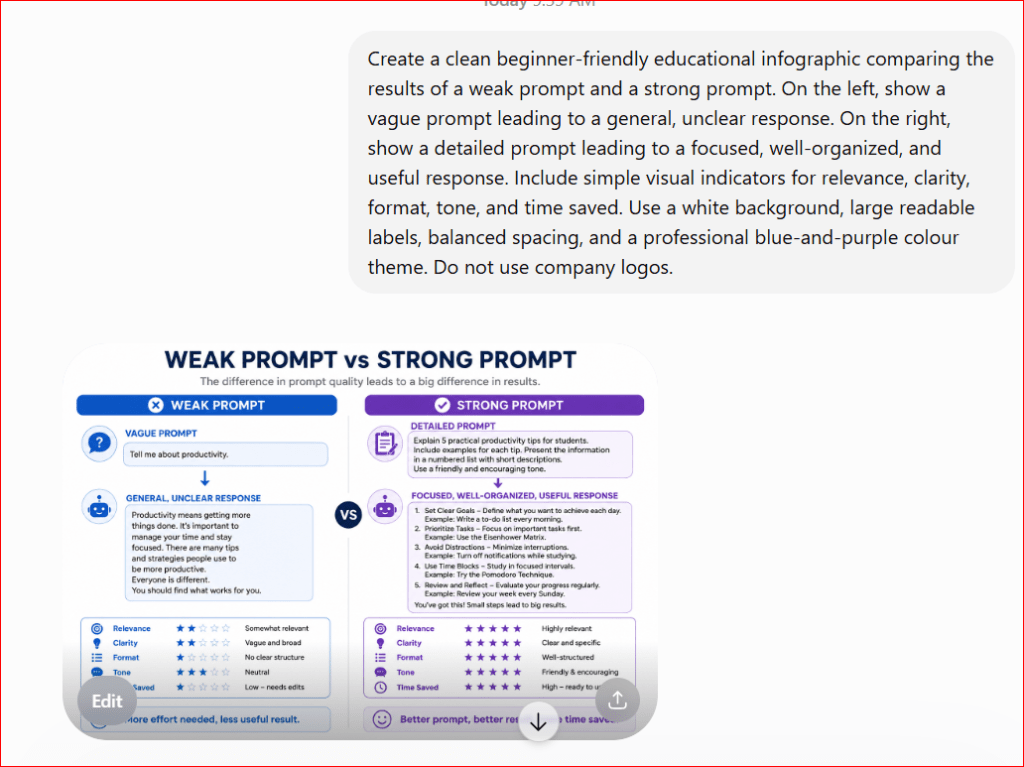
    Other examples include:

    • Customer segmentation
    • Product recommendations
    • Grouping similar photos
    • Market research

    Reinforcement Learning

    Reinforcement Learning teaches a computer by using rewards and penalties. The system learns through trial and error, receiving positive feedback for good decisions and negative feedback for poor ones. Over time, it learns which actions produce the best results.

    For example, a robot learning to walk may fall many times at first. As it receives feedback and continues practicing, it gradually learns how to balance and walk successfully.

    Other examples include:

    • Self-driving vehicles
    • Video game AI
    • Robot navigation
    • Warehouse automation

    Comparison Table

    TypeHow It LearnsEveryday Example
    Supervised LearningLearns from labeled examples with correct answers.Email spam filter
    Unsupervised LearningFinds hidden patterns and groups in unlabeled data.Customer grouping in online shopping
    Reinforcement LearningLearns through rewards and penalties.Robot learning to walk

    The important thing to remember is that each type of Machine Learning solves different kinds of problems. Supervised Learning predicts outcomes, Unsupervised Learning discovers hidden patterns, and Reinforcement Learning improves through experience. Together, these approaches power many of the intelligent systems we use every day.

    Figure 3A. ChatGPT explaining the three main types of Machine Learning.

    Figure 3B. ChatGPT explaining the three main types of Machine Learning.

    This example shows how ChatGPT explains the three main types of Machine Learning in simple language. By using everyday examples and a comparison table, beginners can easily understand how each type learns and where it is used.

    Everyday Examples of Machine Learning

    You probably use Machine Learning every day without realizing it. Many of the apps and services you use rely on Machine Learning to improve your experience by learning from data and recognizing patterns.

    Here are some common examples:

    • Netflix – Recommends movies and TV shows based on what you have watched.
    • YouTube – Suggests videos that match your interests and viewing history.
    • Spotify – Creates personalized music playlists based on your listening habits.
    • Google Maps – Predicts traffic conditions and recommends the fastest routes.
    • Email spam filters – Learn to identify unwanted messages and move them to your spam folder.
    • Online shopping websites – Recommend products based on your browsing and purchase history.
    • Banks – Detect unusual transactions that may indicate credit card fraud.
    • Voice assistants such as Siri, Alexa, and Google Assistant – Improve speech recognition by learning from many voice samples.
    • Social media platforms – Recommend posts, videos, and friends based on your activity.
    • Photo apps – Automatically recognize faces, objects, and locations in pictures.

    These examples show that Machine Learning is already part of everyday life. It helps people save time, receive personalized recommendations, improve security, and make better decisions without even noticing it.

    Figure 4. ChatGPT explaining everyday examples of Machine Learning.

    This example demonstrates how Machine Learning is used in many everyday applications. By recognizing familiar technologies such as Netflix, YouTube, Google Maps, and email spam filters, beginners can better understand how Machine Learning improves the services they use every day.

    Benefits of Machine Learning

    Machine Learning is helping people and businesses work more efficiently by analyzing large amounts of data, identifying patterns, and making accurate predictions. It is used in healthcare, banking, education, transportation, entertainment, online shopping, and many other industries.

    Some of the main benefits of Machine Learning include:

    • Saves time by automating repetitive tasks.
    • Improves accuracy by analyzing large amounts of data quickly.
    • Provides personalized recommendations for movies, music, shopping, and online content.
    • Detects fraud by identifying unusual financial transactions.
    • Helps doctors diagnose diseases and support medical decisions.
    • Predicts future trends using historical data.
    • Improves customer service through intelligent chatbots and virtual assistants.
    • Continuously improves as it learns from new data over time.

    One of the greatest advantages of Machine Learning is its ability to discover patterns that may be difficult or impossible for humans to recognize. This helps organizations make better decisions, improve efficiency, and provide more personalized services.

    Figure 5. ChatGPT explaining the benefits of Machine Learning.

    This example shows how Machine Learning benefits people and organizations in everyday life. From personalized recommendations and fraud detection to healthcare and customer service, Machine Learning helps improve efficiency, accuracy, and decision-making in many industries.

    Limitations of Machine Learning

    Although Machine Learning is a powerful technology, it is not perfect. Like all computer systems, it has limitations and can make mistakes. Understanding these limitations helps people use Machine Learning more effectively and make better decisions.

    Some of the main limitations of Machine Learning include:

    • Requires large amounts of data to learn effectively.
    • Can make incorrect predictions if the training data is incomplete or inaccurate.
    • May reflect bias if the data used for training contains unfair or unbalanced information.
    • Does not understand information like humans; it recognizes patterns rather than thinking or reasoning.
    • Requires regular updates to maintain accuracy as new data becomes available.
    • Can be expensive to develop and maintain for complex applications.
    • May be difficult to explain why some Machine Learning models make certain decisions.
    •  

    Although Machine Learning can improve its performance over time, it still depends on the quality of the data and the way it is designed. Human supervision remains essential to verify results, correct mistakes, and ensure that Machine Learning systems are used responsibly.

    Figure 6. ChatGPT explaining the limitations of Machine Learning.

    This example shows that while Machine Learning is a valuable technology, it also has important limitations. Understanding these challenges helps beginners use Machine Learning more responsibly and recognize that human judgment is still essential in many situations.

    Machine Learning vs. Artificial Intelligence

    Many people use the terms Artificial Intelligence (AI) and Machine Learning (ML) as if they mean the same thing. Although they are closely related, they are not identical. Machine Learning is one branch of Artificial Intelligence, but Artificial Intelligence includes many other technologies besides Machine Learning.

    Artificial Intelligence is the broad field of creating computer systems that can perform tasks requiring human intelligence, such as understanding language, recognizing images, solving problems, and making decisions. Machine Learning is one technique used to build AI systems by allowing computers to learn from data instead of following only fixed instructions.

    Think of Artificial Intelligence as a large umbrella. Under that umbrella are several technologies, including Machine Learning. In other words, all Machine Learning is Artificial Intelligence, but not all Artificial Intelligence is Machine Learning.

    Comparison Table

    FeatureArtificial Intelligence (AI)Machine Learning (ML)
    DefinitionThe broad field of creating intelligent computer systems.A branch of AI that learns from data.
    GoalPerform tasks that normally require human intelligence.Improve performance by learning from experience.
    Learns from DataSometimesYes
    Uses AlgorithmsYesYes
    Everyday ExamplesChatGPT, Siri, Google AssistantNetflix recommendations, spam filters, fraud detection

    The easiest way to remember the difference is that Artificial Intelligence is the overall concept, while Machine Learning is one of the methods used to create intelligent systems. Many popular AI applications today rely on Machine Learning to improve their performance over time.

    Figure 7. ChatGPT explaining the difference between Artificial Intelligence and Machine Learning.

    This example shows that Artificial Intelligence and Machine Learning are closely connected but serve different purposes. Artificial Intelligence is the broader field, while Machine Learning is one of the key technologies that enables AI systems to learn from data and improve over time.

    Machine Learning vs. Deep Learning

    Machine Learning (ML) and Deep Learning (DL) are closely related, but they are not the same. Deep Learning is a specialized branch of Machine Learning that uses artificial neural networks to solve more complex problems.

    Machine Learning can learn from data using different algorithms and often requires humans to help select the most useful information, known as features. Deep Learning, on the other hand, can automatically identify important patterns from large amounts of data with much less human intervention.

    Because Deep Learning requires more data and computing power, it is typically used for more advanced tasks such as image recognition, speech recognition, language translation, and AI chatbots like ChatGPT.

    For many everyday business applications, traditional Machine Learning is often sufficient. Deep Learning is generally used when solving highly complex problems involving massive amounts of data.

    Comparison Table

    FeatureMachine Learning (ML)Deep Learning (DL)
    DefinitionA branch of AI that learns from data.A specialized branch of Machine Learning using neural networks.
    Data RequiredModerate amounts of dataLarge amounts of data
    Human InvolvementMore human guidanceLess human guidance
    Speed of TrainingUsually fasterUsually slower
    Computing PowerModerateHigh
    Everyday ExamplesSpam filters, fraud detection, recommendationsChatGPT, image recognition, speech recognition

    The easiest way to remember the difference is that Deep Learning is an advanced form of Machine Learning.

    Understanding the relationship between Machine Learning and Deep Learning makes it easier to understand how many modern AI applications, including image recognition, voice assistants, and AI chatbots, are built.

    While all Deep Learning systems are Machine Learning systems, not all Machine Learning systems use Deep Learning.

    Figure 8. ChatGPT explaining the difference between Machine Learning and Deep Learning.

    This example shows that Deep Learning is a specialized form of Machine Learning designed to solve more complex problems. By comparing the two side by side, beginners can better understand when each technology is used and why Deep Learning powers many of today’s most advanced AI applications.

    Common Myths About Machine Learning

    Many people have misunderstandings about Machine Learning. The following myths can make the technology seem more complicated or more powerful than it really is.

    Myth 1: Machine Learning thinks like humans.

    Reality: Machine Learning does not think, understand, or have emotions. It learns by recognizing patterns in data and making predictions based on what it has learned.

    Myth 2: Machine Learning always gives the correct answer.

    Reality: Machine Learning can make mistakes. Its accuracy depends on the quality of the data it was trained on and the way it was designed.

    Myth 3: Machine Learning can learn anything by itself.

    Reality: Machine Learning still requires humans to collect data, train models, test results, and monitor performance. It does not learn completely on its own.

    Myth 4: Machine Learning is only for programmers.

    Reality: Many Machine Learning tools are designed for beginners and can be used without programming knowledge. People use Machine Learning every day through apps, websites, and AI assistants.

    Myth 5: Machine Learning and Artificial Intelligence are exactly the same.

    Reality: Machine Learning is one branch of Artificial Intelligence. AI is the broader field, while Machine Learning is one of the technologies used to build intelligent systems.

    Understanding these myths helps beginners develop realistic expectations about Machine Learning. While it is a powerful technology, it still depends on human guidance, quality data, and responsible use.

    Frequently Asked Questions

    What is Machine Learning?

    Machine Learning is a branch of Artificial Intelligence that enables computers to learn from data and improve their performance without being explicitly programmed for every task.

    Is Machine Learning the same as Artificial Intelligence?

    No. Artificial Intelligence is the broader field of creating intelligent computer systems, while Machine Learning is one of the methods used to build AI by learning from data.

    Does Machine Learning think like humans?

    No. Machine Learning does not think, understand, or have emotions. It identifies patterns in data and uses those patterns to make predictions or decisions.

    Where is Machine Learning used?

    Machine Learning is used in many everyday applications, including Netflix recommendations, YouTube suggestions, email spam filters, online shopping, fraud detection, healthcare, voice assistants, and self-driving technology.

    Do I need programming skills to learn Machine Learning?

    No. You can begin by learning the basic concepts and understanding how Machine Learning works before studying programming or more advanced topics.

    Key Takeaways

    Remember these important points:

    • Machine Learning is a branch of Artificial Intelligence.
    • Machine Learning learns from data instead of relying only on fixed instructions.
    • The three main types of Machine Learning are Supervised Learning, Unsupervised Learning, and Reinforcement Learning.
    • Machine Learning is used in many everyday applications, including recommendation systems, fraud detection, and voice assistants.
    • Deep Learning is a specialized branch of Machine Learning.
    • Machine Learning offers many benefits but also has important limitations.
    • Understanding Machine Learning provides a strong foundation for learning more advanced AI technologies.

    What’s Next?

    Congratulations! You have completed this beginner’s guide to Machine Learning.

    You now understand what Machine Learning is, how it works, the different types of Machine Learning, its benefits and limitations, and how it relates to Artificial Intelligence and Deep Learning.

    The next step is to learn about Deep Learning, a specialized branch of Machine Learning that powers many of today’s most advanced AI applications, including image recognition, speech recognition, and AI chatbots like ChatGPT.

    Final Tip for Beginners

    Every expert starts as a beginner. Focus on understanding one concept at a time, practice with real-world examples, and continue exploring how Machine Learning is used in everyday life.

    Focus on understanding the basic ideas before learning the technical details. As you continue practicing and exploring real-world examples, the concepts will become much easier to understand.

    Building a strong foundation today will make learning more advanced AI topics much easier in the future.

    Continue Learning

    Ready to continue your AI journey?

    Explore our beginner-friendly tutorials to learn more about Artificial Intelligence, ChatGPT, Deep Learning, prompt writing, AI image generation, and other practical AI applications.

    Continue Your AI Journey

    Explore these beginner-friendly guides to continue building your AI skills:

    New beginner-friendly AI tutorials will be added regularly, so be sure to check back for more guides and practical examples.

    Thank you for reading. Keep exploring, keep practicing, and enjoy your journey into the exciting world of Artificial Intelligence.

  • What Is Artificial Intelligence? A Beginner’s Guide (2026)

    What Is Artificial Intelligence? A Beginner’s Guide (2026)

    Estimated Reading Time: 8 minutes

    Last Updated: July 2026

    What You’ll Learn

    By the end of this guide, you’ll be able to:

    • Understand what Artificial Intelligence (AI) is.
    • Learn how AI works in simple language.
    • Recognize examples of AI in everyday life.
    • Understand the difference between AI, Machine Learning, and Deep Learning.
    • Learn the benefits and limitations of AI.
    • Build a solid foundation for learning more advanced AI topics.

    Introduction

    Artificial Intelligence (AI) is transforming the way we live, work, learn, and communicate. From voice assistants and online shopping recommendations to medical diagnosis and self-driving cars, AI is becoming an important part of everyday life.

    Although AI may seem complex, understanding the basics is easier than many people think. You don’t need a technical background or programming experience to begin learning about artificial intelligence.

    If you’re new to AI, you may also enjoy our Create a ChatGPT Account (Step-by-Step Beginner Guide 2026), ChatGPT Basics for Beginners (Complete Guide 2026), and Best ChatGPT Prompts for Beginners (2026) guides.

    What Is Artificial Intelligence?

    Artificial Intelligence (AI) is a branch of computer science that enables computers and machines to perform tasks that normally require human intelligence. These tasks include learning from information, understanding language, recognizing images, solving problems, making decisions, and generating new content.

    Instead of simply following fixed instructions, many AI systems can analyze data, identify patterns, and improve their performance over time. This ability allows AI to assist people in countless areas, from answering questions and translating languages to helping doctors diagnose diseases and businesses make better decisions.

    In simple terms, AI teaches computers to perform certain tasks in ways that resemble human intelligence. While AI is not human and does not think exactly like people, it can process large amounts of information much faster than humans and produce useful results.

    Figure 1. ChatGPT explaining artificial intelligence in simple language.

    Everyday Examples of Artificial Intelligence

    You probably use artificial intelligence every day without realizing it. Here are some examples you may already use every day:

    ChatGPT – Answers questions, writes content, and helps solve problems.

    Google Search – Suggests answers as you type and helps find information quickly.

    Netflix – Recommends movies and TV shows based on your viewing history.

    YouTube – Suggests videos you may enjoy.

    Spotify – Creates personalized music playlists.

    Google Maps – Finds the fastest driving route.

    Siri, Alexa, and Google Assistant – Respond to voice commands.

    Email spam filters – Detect unwanted messages automatically.

    Banks – Identify unusual credit card activity to help prevent fraud.

    Online shopping websites – Recommend products based on previous purchases.

    These examples show how AI helps people save time, make better decisions, and complete everyday tasks more efficiently.

    How Does Artificial Intelligence Work?

    Artificial Intelligence (AI) works by learning from large amounts of data instead of following a fixed set of instructions. During training, AI analyzes thousands or even millions of examples to recognize patterns and learn relationships. Once it has learned those patterns, it can use them to answer questions, make predictions, generate content, or solve problems.

    Think of AI as a student who has read thousands of books. The more examples it learns from, the better it becomes at recognizing patterns and producing useful responses.

    For example, when you ask ChatGPT a question, it does not search the internet for an answer like a search engine. Instead, it analyzes your prompt, identifies patterns it learned during training, and generates a response based on those patterns.

    Although AI can produce impressive results, it does not think, feel, or understand the world the way humans do. It uses mathematics, algorithms, and patterns learned from data to generate responses that appear intelligent.

    One of the easiest ways to understand AI is to compare it to learning through practice. Just as a child becomes better at reading after seeing many books, AI becomes better at recognizing patterns after learning from large amounts of data.
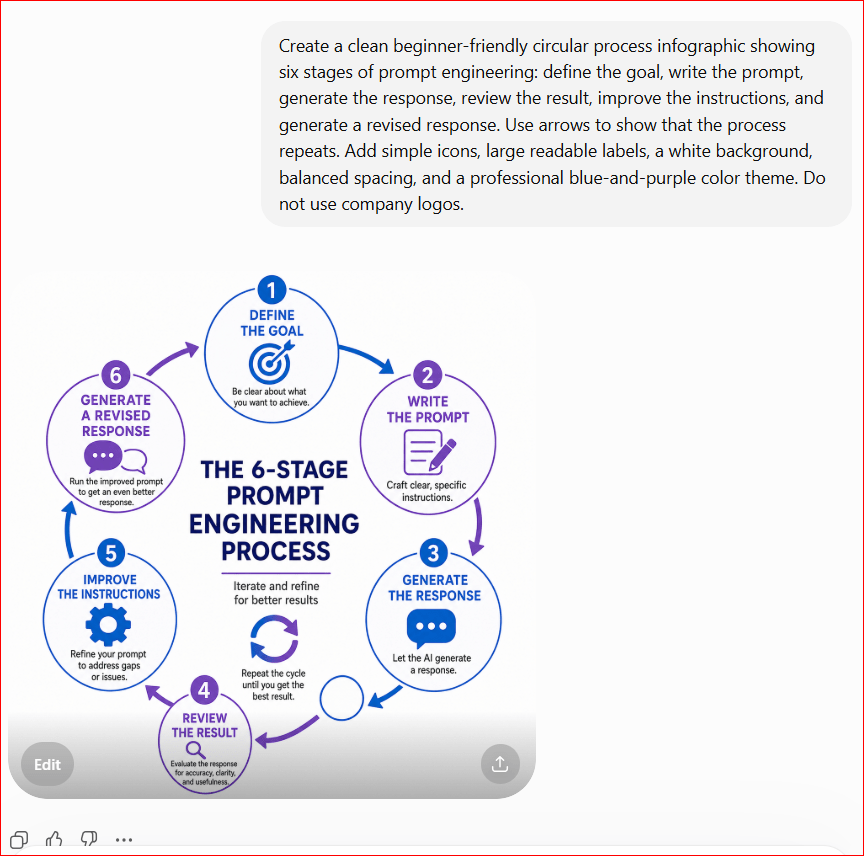
    Figure 2. ChatGPT explaining how artificial intelligence works using an everyday example.

    This example shows that AI learns by recognizing patterns from many examples instead of thinking like a human.

    Types of Artificial Intelligence

    Artificial intelligence is usually divided into three main categories. Although only one type is widely used today, understanding all three helps explain how AI may continue to develop in the future.

    Narrow AI (Today’s AI)

    Narrow AI, also called Weak AI, is designed to perform specific tasks. It cannot think like a human or perform every kind of job, but it can complete the tasks it has been trained for very well.

    Examples of Narrow AI include:

    • ChatGPT

    • Google Translate

    • Siri and Alexa

    • Netflix recommendations

    • Self-driving driver assistance

    Today, nearly every AI tool people use—including ChatGPT, Google Search, Netflix recommendations, voice assistants, and navigation apps—is an example of Narrow AI.

    General AI (Future Goal)

    General Artificial Intelligence (AGI) is a future type of AI that would be able to learn, reason, understand, and perform almost any intellectual task that a human can do. Unlike today’s AI, General AI would be able to transfer knowledge from one task to another without being retrained.

    Researchers around the world continue studying AGI, but it has not yet been achieved.

    Super AI (Hypothetical)

    Super Artificial Intelligence is a theoretical idea describing AI that would become more intelligent than humans in nearly every field, including science, medicine, engineering, creativity, and decision-making.

    At present, Super AI does not exist and remains a topic of research and discussion.

    TypeExists Today?Example
    Narrow AI  YesChatGPT, Siri, Google Maps
    General AI  NoFuture goal
    Super AI  NoHypothetical

    The most important point to remember is that almost every AI application people use today—including ChatGPT—is Narrow AI. General AI and Super AI are ideas for the future and do not yet exist.

    Benefits of Artificial Intelligence

    Artificial Intelligence helps people save time, improve productivity, and solve problems more efficiently. It is used in homes, schools, businesses, hospitals, banks, and many other industries. Rather than replacing people in most situations, AI is designed to assist them by handling repetitive tasks, analyzing large amounts of information, and providing useful suggestions.

    Some of the main benefits of AI include:

    • Saves time by completing tasks quickly.
    • Automates repetitive work.
    • Helps people make better decisions using data.
    • AI systems can operate continuously without becoming physically tired, although they still require electricity, maintenance, and human oversight.
    • Improves accuracy for many routine tasks.
    • Personalizes recommendations for shopping, music, and videos.
    • Assists people with disabilities through voice recognition and accessibility tools.
    • Increases productivity at work and school.

    One of the biggest advantages of AI is that it allows people to focus on more important and creative work while the computer handles repetitive or time-consuming tasks.

    Figure 3. ChatGPT explaining the benefits of artificial intelligence.
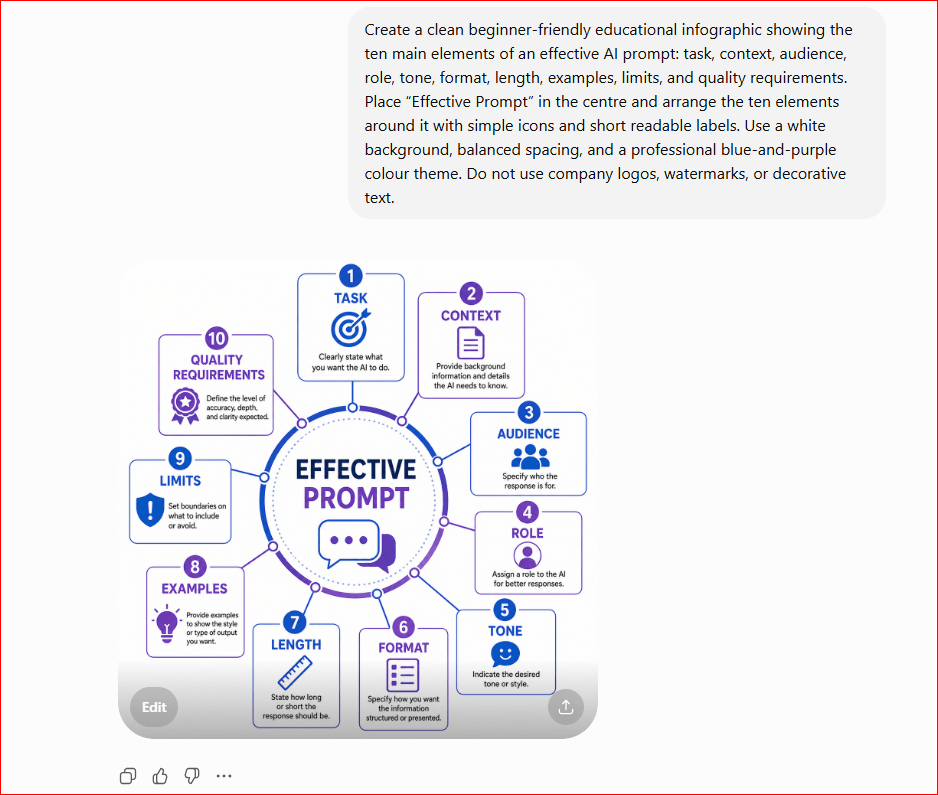
    This example shows how ChatGPT can explain complex topics using simple language and practical examples. Notice how the response uses short bullet points and everyday situations, making the information easy for beginners to understand.

    Why Artificial Intelligence Is Helpful

    AI is becoming part of everyday life. Students use it to learn new subjects, professionals use it to write reports and analyze information, businesses use it to improve customer service, and families use it to organize daily activities. When used responsibly, AI can make many tasks faster, easier, and more accurate.
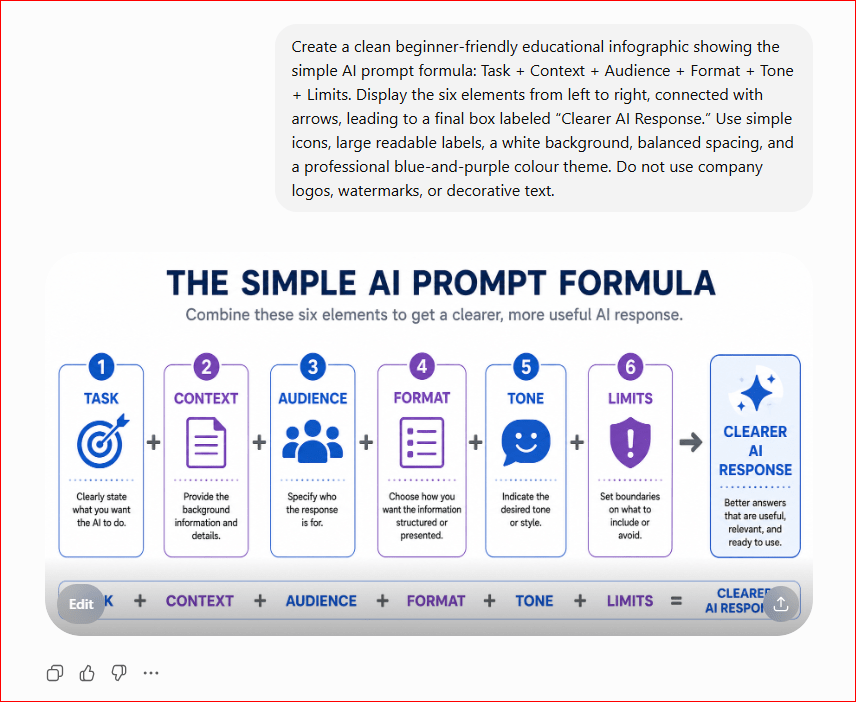
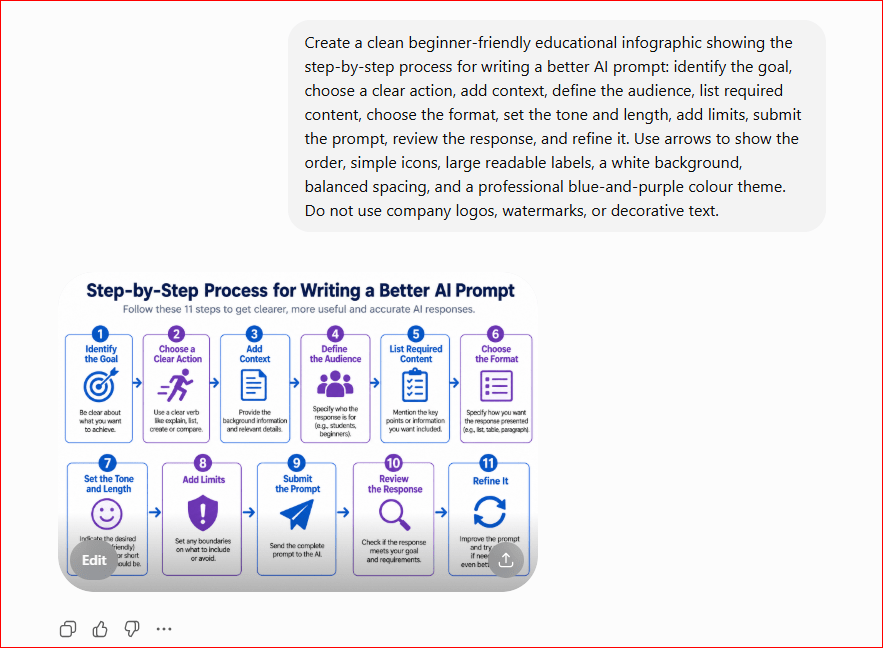
    Limitations of Artificial Intelligence

    Although Artificial Intelligence is a powerful technology, it is not perfect. AI can make mistakes, misunderstand questions, or provide incorrect information. It is important to remember that AI should assist people, not replace human judgment. Some of the main limitations of AI include:

    • It can produce incorrect or misleading information.
    • It may not understand questions exactly as humans do.
    • It depends on the quality of the data it was trained on.
    • It cannot think, feel, or use common sense like a person.
    • It may reflect biases that exist in its training data.
    • It cannot predict the future or guarantee that every answer is correct.
    • Some AI systems do not have access to the latest information.

    Because of these limitations, it is always a good idea to verify important information, especially when making financial, medical, or legal decisions.

    Figure 4. ChatGPT explaining the limitations of artificial intelligence.

    This example shows that although AI is very useful, it also has limitations. Understanding these limitations helps people use AI more safely and responsibly.

    Artificial Intelligence vs. Machine Learning vs. Deep Learning

    Many beginners use the terms Artificial Intelligence (AI), Machine Learning (ML), and Deep Learning (DL) as if they mean the same thing. Although they are closely related, they are different technologies. Understanding the difference will help you better understand how modern AI systems such as ChatGPT work.

    Artificial Intelligence (AI)

    Artificial Intelligence is the broad field of creating computer systems that can perform tasks that normally require human intelligence. These tasks include understanding language, recognizing images, solving problems, making decisions, and generating content.

    Think of AI as the largest umbrella that covers many different technologies.

    Machine Learning (ML)

    Machine Learning is a branch of Artificial Intelligence that allows computers to learn from data instead of being programmed with every rule. Rather than following a fixed list of instructions, a machine learning system finds patterns in examples and improves its performance over time.

    For example, a movie recommendation system learns which films you enjoy by analyzing your viewing history instead of someone manually creating recommendations.

    Deep Learning (DL)

    Deep Learning is a specialized type of Machine Learning that uses artificial neural networks inspired by the human brain. These networks can learn very complex patterns from enormous amounts of data.

    Deep Learning is used in applications such as speech recognition, image recognition, language translation, self-driving vehicles, and AI chatbots like ChatGPT.

    Although Artificial Intelligence, Machine Learning, and Deep Learning are closely related, they are not the same. Artificial Intelligence is the broadest field, Machine Learning is one way to build AI systems, and Deep Learning is a more advanced type of Machine Learning. Understanding these differences makes it easier to understand how modern AI applications work.

    Artificial Intelligence is the overall field of creating intelligent computer systems. Machine Learning is one method used to build AI by allowing computers to learn from data. Deep Learning takes this one step further by using layers of artificial neural networks to recognize complex patterns and make highly accurate predictions. Most modern AI tools, including ChatGPT, image generators, speech recognition, and translation services, rely on Deep Learning to deliver powerful results.

    You can think of these technologies as building blocks. Artificial Intelligence is the foundation, Machine Learning is one of its most important techniques, and Deep Learning is the advanced technology that powers many of today’s most capable AI systems. Learning the relationship between them will help you better understand future AI topics.

    Figure 5. ChatGPT explaining the difference between Artificial Intelligence, Machine Learning, and Deep Learning.

    This example shows how ChatGPT can explain related technical concepts in simple language. By comparing Artificial Intelligence, Machine Learning, and Deep Learning side by side, beginners can easily understand how the three technologies are connected and why they are often mentioned together.

    Comparison Table

    TechnologyWhat it doesExample
    Artificial Intelligence (AI)Makes computers perform intelligent tasks.ChatGPT, Siri
    Machine Learning (ML)Learns from data and improves with experience.Netflix recommendations
    Deep Learning (DL)Uses neural networks to solve complex problems.Image recognition, ChatGPT

    An Easy Way to Remember

    Think of these three technologies like a set of nested circles.

    • Artificial Intelligence (AI) is the largest circle.
    • Machine Learning (ML) is a smaller circle inside Artificial Intelligence.
    • Deep Learning (DL) is an even smaller circle inside Machine Learning.

    In other words:

    Deep Learning is part of Machine Learning, and Machine Learning is part of Artificial Intelligence.

    Real-World Examples of AI, Machine Learning, and Deep Learning

    Although these technologies are closely connected, they are used in different ways in everyday life. The following examples show how AI, Machine Learning, and Deep Learning work together in many popular applications.

    ApplicationAIMachine LearningDeep Learning
    ChatGPTYesYesYes
    Google TranslateYesYesYes
    Netflix RecommendationsYesYesUsually
    Face RecognitionYesYesYes
    Spam Email FilteringYesYesSometimes
    Self-driving CarsYesYesYes

    In many modern applications, Artificial Intelligence is the overall system, Machine Learning helps the system improve by learning from data, and Deep Learning performs the most complex tasks such as understanding images, speech, and natural language.

    Although these technologies have different roles, they work together to create many of the AI tools people use every day. Understanding this relationship makes learning more advanced AI topics much easier.

    Figure 6. Relationship between Artificial Intelligence, Machine Learning, and Deep Learning.

    This diagram shows that Deep Learning is a specialized part of Machine Learning, which is itself a branch of Artificial Intelligence. Understanding this relationship helps beginners see how these technologies fit together.

    Common Myths About Artificial Intelligence:

    Myth 1: AI thinks like humans.

    Reality: AI recognizes patterns and generates responses, but it does not think or have emotions like people.

    Myth 2: AI knows everything.

    Reality: AI can make mistakes and may provide outdated or incorrect information. Important information should always be verified.

    Myth 3: AI will replace every job.

    Reality: AI will automate some tasks, but many jobs still require human creativity, judgment, and communication.

    Myth 4: AI is only for programmers.

    Reality: Anyone can learn to use AI tools. Many AI applications are designed for beginners with no technical background.

    Frequently Asked Questions

    Is Artificial Intelligence the same as ChatGPT?

    No. ChatGPT is one application powered by Artificial Intelligence. AI is the broader field that includes many different technologies such as virtual assistants, recommendation systems, self-driving technology, image recognition, and language translation.

    Can Artificial Intelligence think like humans?

    No. Today’s AI does not think, feel, or have emotions. Instead, it analyzes patterns in data and generates responses based on what it has learned during training.

    Is Machine Learning the same as Artificial Intelligence?

    No. Machine Learning is a branch of Artificial Intelligence. It allows computers to improve their performance by learning from data instead of following only fixed instructions.

    Can anyone learn Artificial Intelligence?

    Yes. You do not need to be a programmer or computer scientist to understand the basics of AI. Many AI tools, including ChatGPT, are designed for beginners and are easy to use.

    Will Artificial Intelligence replace all jobs?

    No. While AI can automate repetitive tasks and improve productivity, many jobs still require human creativity, judgment, communication, and problem-solving. AI is more likely to assist people than completely replace them.

    Key Takeaways

    Remember these important points:

    • Artificial Intelligence enables computers to perform tasks that normally require human intelligence.

    • Most AI systems used today are examples of Narrow AI.

    • Machine Learning is one branch of Artificial Intelligence.

    • Deep Learning is a specialized branch of Machine Learning.

    • AI learns from data and improves by recognizing patterns.

    • Artificial Intelligence offers many benefits but also has important limitations.

    • Understanding AI helps you use modern AI tools more effectively and responsibly.

    What’s Next?

    Congratulations! You have completed this beginner’s guide to Artificial Intelligence.

    You now understand what AI is, how it works, the different types of AI, its benefits and limitations, and how Machine Learning and Deep Learning fit into the bigger picture.

    The next step is to learn how to use AI tools in real life. Start by practicing with ChatGPT, explore different AI applications, and continue building your skills one topic at a time. As you gain experience, you’ll discover how AI can help you learn faster, work more efficiently, and solve everyday problems.

    Final Tip for Beginners

    If you’re just starting your AI journey, don’t try to learn everything at once. Begin by using ChatGPT for simple everyday tasks such as asking questions, writing emails, summarizing information, planning trips, or generating ideas. As you become more comfortable, gradually explore more advanced AI tools and techniques. The best way to learn Artificial Intelligence is through regular practice.

    Continue Learning

    Ready to continue your AI journey?

    Explore our beginner-friendly tutorials to learn more about ChatGPT, prompt writing, AI image generation, productivity tools, and other practical AI applications.

    Continue Your AI Journey

    Explore these beginner-friendly guides to continue building your AI skills:

    Create a ChatGPT Account (Step-by-Step Beginner Guide 2026)

    ChatGPT Basics for Beginners (Complete Guide 2026)

    • Best ChatGPT Prompts for Beginners (2026)

    AI Image Generation for Beginners


    New beginner-friendly AI tutorials will be added regularly, so be sure to check back for more guides and practical examples.

    Thank you for reading. Keep exploring, keep practicing, and enjoy your journey into the exciting world of Artificial Intelligence.