
Estimated Reading Time: 8 minutes
Last Updated: July 2026
What You’ll Learn
By the end of this guide, you’ll be able to:
- Understand what Artificial Intelligence (AI) is.
- Learn how AI works in simple language.
- Recognize examples of AI in everyday life.
- Understand the difference between AI, Machine Learning, and Deep Learning.
- Learn the benefits and limitations of AI.
- Build a solid foundation for learning more advanced AI topics.
Introduction
Artificial Intelligence (AI) is transforming the way we live, work, learn, and communicate. From voice assistants and online shopping recommendations to medical diagnosis and self-driving cars, AI is becoming an important part of everyday life.
Although AI may seem complex, understanding the basics is easier than many people think. You don’t need a technical background or programming experience to begin learning about artificial intelligence.
If you’re new to AI, you may also enjoy our Create a ChatGPT Account (Step-by-Step Beginner Guide 2026), ChatGPT Basics for Beginners (Complete Guide 2026), and Best ChatGPT Prompts for Beginners (2026) guides.
What Is Artificial Intelligence?
Artificial Intelligence (AI) is a branch of computer science that enables computers and machines to perform tasks that normally require human intelligence. These tasks include learning from information, understanding language, recognizing images, solving problems, making decisions, and generating new content.
Instead of simply following fixed instructions, many AI systems can analyze data, identify patterns, and improve their performance over time. This ability allows AI to assist people in countless areas, from answering questions and translating languages to helping doctors diagnose diseases and businesses make better decisions.
In simple terms, AI teaches computers to perform certain tasks in ways that resemble human intelligence. While AI is not human and does not think exactly like people, it can process large amounts of information much faster than humans and produce useful results.
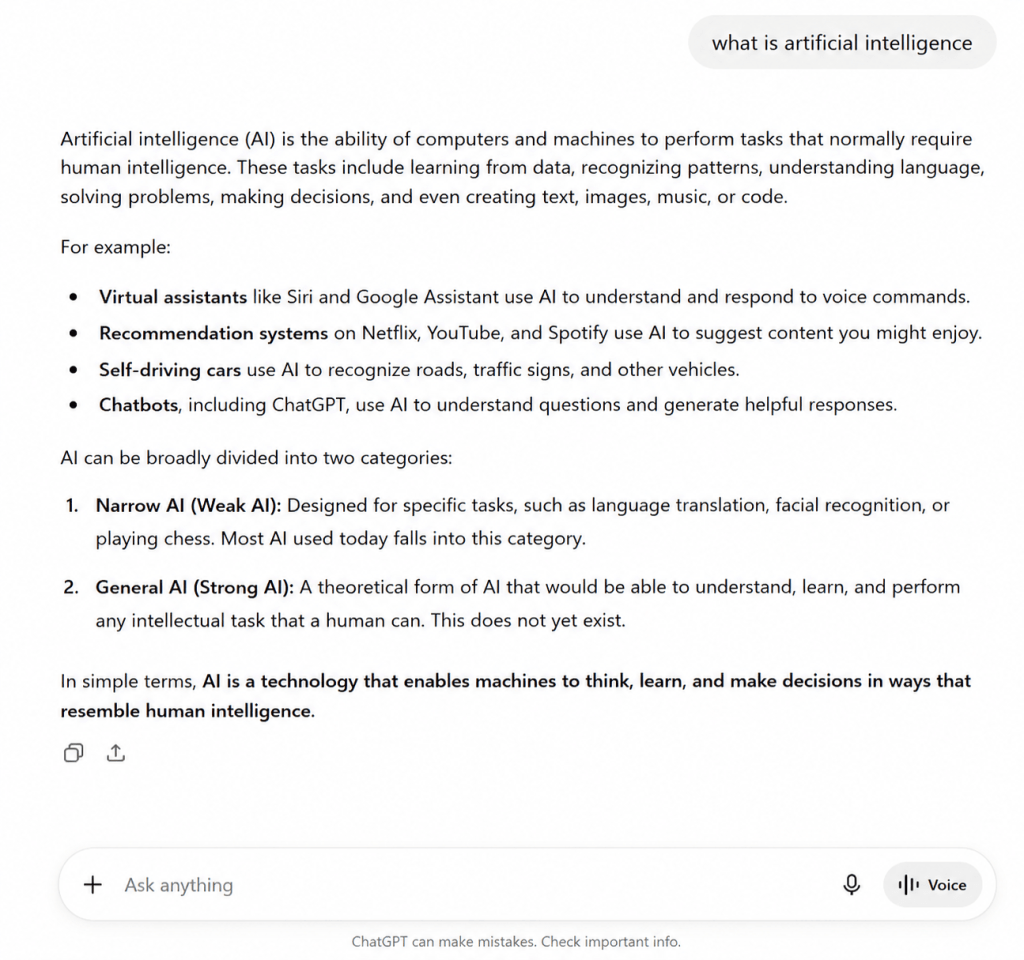
Figure 1. ChatGPT explaining artificial intelligence in simple language.
Everyday Examples of Artificial Intelligence
You probably use artificial intelligence every day without realizing it. Here are some examples you may already use every day:
• ChatGPT – Answers questions, writes content, and helps solve problems.
• Google Search – Suggests answers as you type and helps find information quickly.
• Netflix – Recommends movies and TV shows based on your viewing history.
• YouTube – Suggests videos you may enjoy.
• Spotify – Creates personalized music playlists.
• Google Maps – Finds the fastest driving route.
• Siri, Alexa, and Google Assistant – Respond to voice commands.
• Email spam filters – Detect unwanted messages automatically.
• Banks – Identify unusual credit card activity to help prevent fraud.
• Online shopping websites – Recommend products based on previous purchases.
These examples show how AI helps people save time, make better decisions, and complete everyday tasks more efficiently.
How Does Artificial Intelligence Work?
Artificial Intelligence (AI) works by learning from large amounts of data instead of following a fixed set of instructions. During training, AI analyzes thousands or even millions of examples to recognize patterns and learn relationships. Once it has learned those patterns, it can use them to answer questions, make predictions, generate content, or solve problems.
Think of AI as a student who has read thousands of books. The more examples it learns from, the better it becomes at recognizing patterns and producing useful responses.
For example, when you ask ChatGPT a question, it does not search the internet for an answer like a search engine. Instead, it analyzes your prompt, identifies patterns it learned during training, and generates a response based on those patterns.
Although AI can produce impressive results, it does not think, feel, or understand the world the way humans do. It uses mathematics, algorithms, and patterns learned from data to generate responses that appear intelligent.
One of the easiest ways to understand AI is to compare it to learning through practice. Just as a child becomes better at reading after seeing many books, AI becomes better at recognizing patterns after learning from large amounts of data.
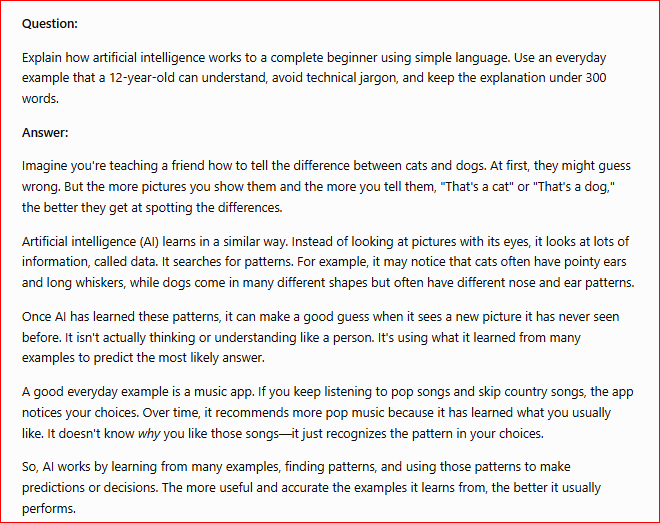
Figure 2. ChatGPT explaining how artificial intelligence works using an everyday example.
This example shows that AI learns by recognizing patterns from many examples instead of thinking like a human.
Types of Artificial Intelligence
Artificial intelligence is usually divided into three main categories. Although only one type is widely used today, understanding all three helps explain how AI may continue to develop in the future.
Narrow AI (Today’s AI)
Narrow AI, also called Weak AI, is designed to perform specific tasks. It cannot think like a human or perform every kind of job, but it can complete the tasks it has been trained for very well.
Examples of Narrow AI include:
• ChatGPT
• Google Translate
• Siri and Alexa
• Netflix recommendations
• Self-driving driver assistance
Today, nearly every AI tool people use—including ChatGPT, Google Search, Netflix recommendations, voice assistants, and navigation apps—is an example of Narrow AI.
General AI (Future Goal)
General Artificial Intelligence (AGI) is a future type of AI that would be able to learn, reason, understand, and perform almost any intellectual task that a human can do. Unlike today’s AI, General AI would be able to transfer knowledge from one task to another without being retrained.
Researchers around the world continue studying AGI, but it has not yet been achieved.
Super AI (Hypothetical)
Super Artificial Intelligence is a theoretical idea describing AI that would become more intelligent than humans in nearly every field, including science, medicine, engineering, creativity, and decision-making.
At present, Super AI does not exist and remains a topic of research and discussion.
| Type | Exists Today? | Example |
| Narrow AI | Yes | ChatGPT, Siri, Google Maps |
| General AI | No | Future goal |
| Super AI | No | Hypothetical |
The most important point to remember is that almost every AI application people use today—including ChatGPT—is Narrow AI. General AI and Super AI are ideas for the future and do not yet exist.
Benefits of Artificial Intelligence
Artificial Intelligence helps people save time, improve productivity, and solve problems more efficiently. It is used in homes, schools, businesses, hospitals, banks, and many other industries. Rather than replacing people in most situations, AI is designed to assist them by handling repetitive tasks, analyzing large amounts of information, and providing useful suggestions.
Some of the main benefits of AI include:
• Saves time by completing tasks quickly.
• Automates repetitive work.
• Helps people make better decisions using data.
• AI systems can operate continuously without becoming physically tired, although they still require electricity, maintenance, and human oversight.
• Improves accuracy for many routine tasks.
• Personalizes recommendations for shopping, music, and videos.
• Assists people with disabilities through voice recognition and accessibility tools.
• Increases productivity at work and school.
One of the biggest advantages of AI is that it allows people to focus on more important and creative work while the computer handles repetitive or time-consuming tasks.
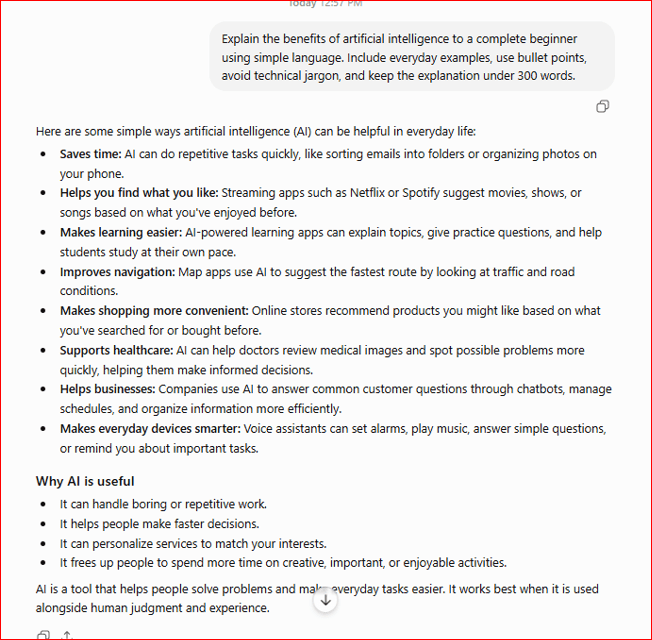
Figure 3. ChatGPT explaining the benefits of artificial intelligence.
This example shows how ChatGPT can explain complex topics using simple language and practical examples. Notice how the response uses short bullet points and everyday situations, making the information easy for beginners to understand.
Why Artificial Intelligence Is Helpful
AI is becoming part of everyday life. Students use it to learn new subjects, professionals use it to write reports and analyze information, businesses use it to improve customer service, and families use it to organize daily activities. When used responsibly, AI can make many tasks faster, easier, and more accurate.
Limitations of Artificial Intelligence
Although Artificial Intelligence is a powerful technology, it is not perfect. AI can make mistakes, misunderstand questions, or provide incorrect information. It is important to remember that AI should assist people, not replace human judgment. Some of the main limitations of AI include:
• It can produce incorrect or misleading information.
• It may not understand questions exactly as humans do.
• It depends on the quality of the data it was trained on.
• It cannot think, feel, or use common sense like a person.
• It may reflect biases that exist in its training data.
• It cannot predict the future or guarantee that every answer is correct.
• Some AI systems do not have access to the latest information.
Because of these limitations, it is always a good idea to verify important information, especially when making financial, medical, or legal decisions.
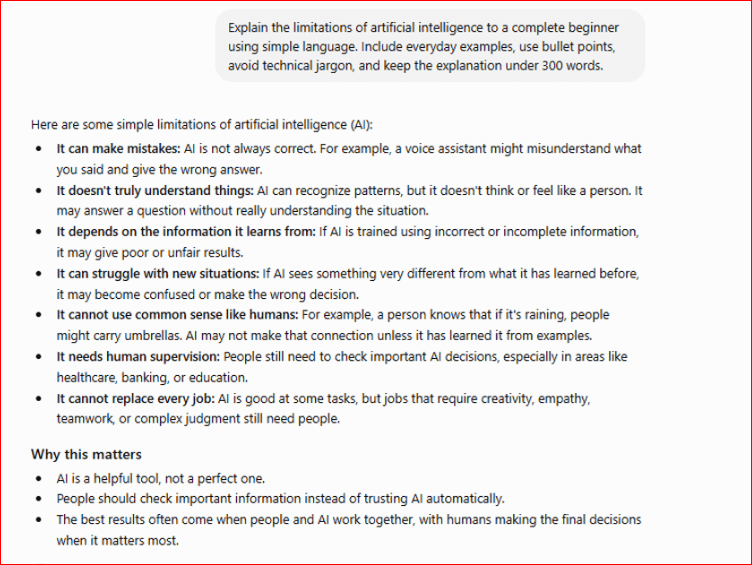
Figure 4. ChatGPT explaining the limitations of artificial intelligence.
This example shows that although AI is very useful, it also has limitations. Understanding these limitations helps people use AI more safely and responsibly.
Artificial Intelligence vs. Machine Learning vs. Deep Learning
Many beginners use the terms Artificial Intelligence (AI), Machine Learning (ML), and Deep Learning (DL) as if they mean the same thing. Although they are closely related, they are different technologies. Understanding the difference will help you better understand how modern AI systems such as ChatGPT work.
Artificial Intelligence (AI)
Artificial Intelligence is the broad field of creating computer systems that can perform tasks that normally require human intelligence. These tasks include understanding language, recognizing images, solving problems, making decisions, and generating content.
Think of AI as the largest umbrella that covers many different technologies.
Machine Learning (ML)
Machine Learning is a branch of Artificial Intelligence that allows computers to learn from data instead of being programmed with every rule. Rather than following a fixed list of instructions, a machine learning system finds patterns in examples and improves its performance over time.
For example, a movie recommendation system learns which films you enjoy by analyzing your viewing history instead of someone manually creating recommendations.
Deep Learning (DL)
Deep Learning is a specialized type of Machine Learning that uses artificial neural networks inspired by the human brain. These networks can learn very complex patterns from enormous amounts of data.
Deep Learning is used in applications such as speech recognition, image recognition, language translation, self-driving vehicles, and AI chatbots like ChatGPT.
Although Artificial Intelligence, Machine Learning, and Deep Learning are closely related, they are not the same. Artificial Intelligence is the broadest field, Machine Learning is one way to build AI systems, and Deep Learning is a more advanced type of Machine Learning. Understanding these differences makes it easier to understand how modern AI applications work.
Artificial Intelligence is the overall field of creating intelligent computer systems. Machine Learning is one method used to build AI by allowing computers to learn from data. Deep Learning takes this one step further by using layers of artificial neural networks to recognize complex patterns and make highly accurate predictions. Most modern AI tools, including ChatGPT, image generators, speech recognition, and translation services, rely on Deep Learning to deliver powerful results.
You can think of these technologies as building blocks. Artificial Intelligence is the foundation, Machine Learning is one of its most important techniques, and Deep Learning is the advanced technology that powers many of today’s most capable AI systems. Learning the relationship between them will help you better understand future AI topics.
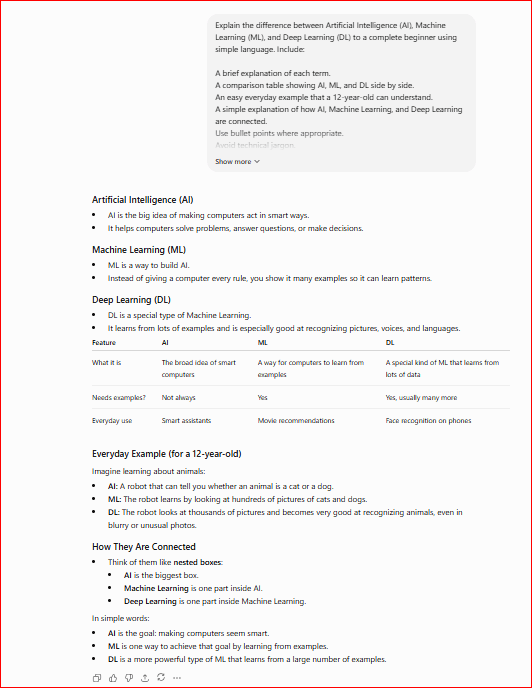
Figure 5. ChatGPT explaining the difference between Artificial Intelligence, Machine Learning, and Deep Learning.
This example shows how ChatGPT can explain related technical concepts in simple language. By comparing Artificial Intelligence, Machine Learning, and Deep Learning side by side, beginners can easily understand how the three technologies are connected and why they are often mentioned together.
Comparison Table
| Technology | What it does | Example |
| Artificial Intelligence (AI) | Makes computers perform intelligent tasks. | ChatGPT, Siri |
| Machine Learning (ML) | Learns from data and improves with experience. | Netflix recommendations |
| Deep Learning (DL) | Uses neural networks to solve complex problems. | Image recognition, ChatGPT |
An Easy Way to Remember
Think of these three technologies like a set of nested circles.
- Artificial Intelligence (AI) is the largest circle.
- Machine Learning (ML) is a smaller circle inside Artificial Intelligence.
- Deep Learning (DL) is an even smaller circle inside Machine Learning.
In other words:
Deep Learning is part of Machine Learning, and Machine Learning is part of Artificial Intelligence.
Real-World Examples of AI, Machine Learning, and Deep Learning
Although these technologies are closely connected, they are used in different ways in everyday life. The following examples show how AI, Machine Learning, and Deep Learning work together in many popular applications.
| Application | AI | Machine Learning | Deep Learning |
| ChatGPT | Yes | Yes | Yes |
| Google Translate | Yes | Yes | Yes |
| Netflix Recommendations | Yes | Yes | Usually |
| Face Recognition | Yes | Yes | Yes |
| Spam Email Filtering | Yes | Yes | Sometimes |
| Self-driving Cars | Yes | Yes | Yes |
In many modern applications, Artificial Intelligence is the overall system, Machine Learning helps the system improve by learning from data, and Deep Learning performs the most complex tasks such as understanding images, speech, and natural language.
Although these technologies have different roles, they work together to create many of the AI tools people use every day. Understanding this relationship makes learning more advanced AI topics much easier.
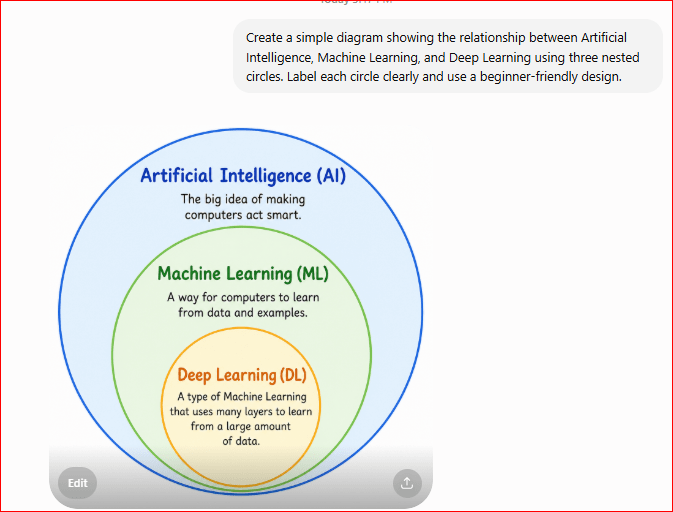
Figure 6. Relationship between Artificial Intelligence, Machine Learning, and Deep Learning.
This diagram shows that Deep Learning is a specialized part of Machine Learning, which is itself a branch of Artificial Intelligence. Understanding this relationship helps beginners see how these technologies fit together.
Common Myths About Artificial Intelligence:
Myth 1: AI thinks like humans.
Reality: AI recognizes patterns and generates responses, but it does not think or have emotions like people.
Myth 2: AI knows everything.
Reality: AI can make mistakes and may provide outdated or incorrect information. Important information should always be verified.
Myth 3: AI will replace every job.
Reality: AI will automate some tasks, but many jobs still require human creativity, judgment, and communication.
Myth 4: AI is only for programmers.
Reality: Anyone can learn to use AI tools. Many AI applications are designed for beginners with no technical background.
Frequently Asked Questions
Is Artificial Intelligence the same as ChatGPT?
No. ChatGPT is one application powered by Artificial Intelligence. AI is the broader field that includes many different technologies such as virtual assistants, recommendation systems, self-driving technology, image recognition, and language translation.
Can Artificial Intelligence think like humans?
No. Today’s AI does not think, feel, or have emotions. Instead, it analyzes patterns in data and generates responses based on what it has learned during training.
Is Machine Learning the same as Artificial Intelligence?
No. Machine Learning is a branch of Artificial Intelligence. It allows computers to improve their performance by learning from data instead of following only fixed instructions.
Can anyone learn Artificial Intelligence?
Yes. You do not need to be a programmer or computer scientist to understand the basics of AI. Many AI tools, including ChatGPT, are designed for beginners and are easy to use.
Will Artificial Intelligence replace all jobs?
No. While AI can automate repetitive tasks and improve productivity, many jobs still require human creativity, judgment, communication, and problem-solving. AI is more likely to assist people than completely replace them.
Key Takeaways
Remember these important points:
• Artificial Intelligence enables computers to perform tasks that normally require human intelligence.
• Most AI systems used today are examples of Narrow AI.
• Machine Learning is one branch of Artificial Intelligence.
• Deep Learning is a specialized branch of Machine Learning.
• AI learns from data and improves by recognizing patterns.
• Artificial Intelligence offers many benefits but also has important limitations.
• Understanding AI helps you use modern AI tools more effectively and responsibly.
What’s Next?
Congratulations! You have completed this beginner’s guide to Artificial Intelligence.
You now understand what AI is, how it works, the different types of AI, its benefits and limitations, and how Machine Learning and Deep Learning fit into the bigger picture.
The next step is to learn how to use AI tools in real life. Start by practicing with ChatGPT, explore different AI applications, and continue building your skills one topic at a time. As you gain experience, you’ll discover how AI can help you learn faster, work more efficiently, and solve everyday problems.
Final Tip for Beginners
If you’re just starting your AI journey, don’t try to learn everything at once. Begin by using ChatGPT for simple everyday tasks such as asking questions, writing emails, summarizing information, planning trips, or generating ideas. As you become more comfortable, gradually explore more advanced AI tools and techniques. The best way to learn Artificial Intelligence is through regular practice.
Continue Learning
Ready to continue your AI journey?
Explore our beginner-friendly tutorials to learn more about ChatGPT, prompt writing, AI image generation, productivity tools, and other practical AI applications.
Continue Your AI Journey
Explore these beginner-friendly guides to continue building your AI skills:
• Create a ChatGPT Account (Step-by-Step Beginner Guide 2026)
• ChatGPT Basics for Beginners (Complete Guide 2026)
• Best ChatGPT Prompts for Beginners (2026)
• AI Image Generation for Beginners
New beginner-friendly AI tutorials will be added regularly, so be sure to check back for more guides and practical examples.
Thank you for reading. Keep exploring, keep practicing, and enjoy your journey into the exciting world of Artificial Intelligence.
 AI Mastery
Leave a comment