

Estimated reading time: 20–25 minutes
Last updated: July 2026
Before Learning
Before using ChatGPT to translate a document, it helps to understand how document uploads, summarization, and verification work.
Review these beginner guides first:
· ChatGPT Basics for Beginners: Complete Guide (2026)
· How to Analyze Documents with ChatGPT: Beginner Guide (2026)
· How to Extract Information from Documents with ChatGPT: Beginner Guide (2026)
· How to Ask Questions About Documents with ChatGPT: Beginner Guide (2026)
· How to Summarize Documents with ChatGPT: Beginner Guide (2026)
These guides explain how to upload a document, identify important information, ask focused questions, summarize content, and compare ChatGPT’s response with the original source.
Those skills are important because a translation should preserve the original document’s meaning, tone, names, dates, numbers, warnings, formatting, and uncertainty.
What You’ll Learn
In this beginner guide, you will learn how to:
· Upload a document to ChatGPT for translation.
· Choose the source language and target language.
· Ask for a complete or section-by-section translation.
· Preserve headings, lists, tables, dates, numbers, and document structure.
· Choose between literal, natural, formal, plain-language, and audience-specific translation styles.
· Tell ChatGPT how to handle names, technical terms, abbreviations, and unclear wording.
· Translate long documents in smaller sections.
· Compare the translation with the original document.
· Check whether important meaning, tone, warnings, conditions, and uncertainty were preserved.
· Correct mistranslated, missing, or unsupported information.
· Avoid exposing private or confidential information.
· Check permission, copyright, and commercial-use conditions.
· Understand when professional human translation may be necessary.
· Use translated content responsibly in reports, websites, emails, study materials, and other documents.
· Understand the benefits and limitations of translating documents with ChatGPT.
By the end of this guide, you should be able to request a clear document translation, choose an appropriate translation style, and review the result against the original source before using or sharing it.
Introduction
Documents are often written in a language that some readers cannot understand easily. A business report, instruction manual, school notice, research paper, letter, or policy may need to be translated before it can be read or shared.
A document translation changes written content from one language into another while trying to preserve the original meaning.
For example:
· English may be translated into Arabic.
· French may be translated into English.
· Spanish may be translated into French.
· A multilingual document may be translated into one consistent language.
ChatGPT can translate text while adapting the wording for different tones and purposes. OpenAI’s translation service describes options such as making a translation more fluent, more professional, or easier to understand.
ChatGPT can also work with commonly used document formats, including PDF, DOCX, PPTX, TXT, CSV, TSV, XLS, and XLSX. Google Docs files using the .gdoc format must currently be exported to a supported format before they are uploaded. Supported file formats and capabilities may vary by model, plan, workspace, and future update.
The basic document-translation process is:
1st Review the document for private or restricted information.
2nd Upload the correct document.
3rd Identify the original language.
4th Choose the target language.
5th Select the required translation style.
6th Explain which formatting and terminology must be preserved.
7th Translate the document or one section at a time.
8th Compare the translation with the original.
9th Correct missing, inaccurate, or unclear wording.
10th Save and use only the reviewed version.
You may ask ChatGPT to create:
· A complete translation
· A section-by-section translation
· A literal translation
· A natural-sounding translation
· A formal business translation
· A plain-language translation
· A bilingual version
· A translation for a specific audience
A translation should not change the document’s facts. Names, dates, numbers, currencies, measurements, conditions, warnings, and uncertainty should remain consistent with the source.
For example:
Original meaning: The application may be approved after additional documents are reviewed.
Inaccurate translation: The application will be approved.
The inaccurate version removes the condition and changes a possible outcome into a guarantee.
ChatGPT may also misunderstand technical language, idioms, cultural references, abbreviations, or unclear sentences. It may omit text, change the tone, or choose a word that does not fit the subject.
For this reason, every important translation should be checked against the original document. Legal, medical, immigration, financial, safety, contractual, or official translations may also require a qualified human translator or certified translation service.
This guide will explain how to request, review, correct, and use document translations responsibly.
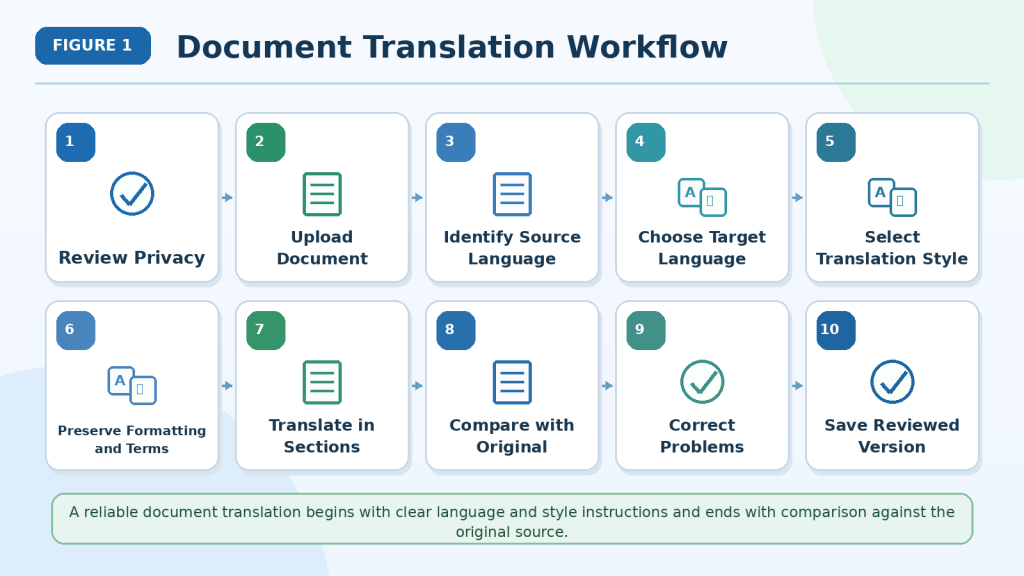
Figure 1. A reliable document translation begins with clear language and style instructions and ends with comparison against the original source.
Uploading a document and requesting a target language are only the first steps. ChatGPT also needs instructions about tone, terminology, formatting, and unclear content. The completed translation must then be checked carefully before it is shared, submitted, or published.
Types of Document Translation You Can Request
ChatGPT can translate the same document in different ways. The best translation style depends on the document, the reader, and how the translated text will be used.
Before translating, decide whether accuracy, natural wording, formality, simplicity, or side-by-side comparison is most important.
Literal Translation
A literal translation follows the original wording and sentence structure as closely as possible.
It may be useful when:
· Comparing the source and translation
· Studying vocabulary
· Reviewing technical wording
· Checking how a sentence was constructed
· Preserving exact document structure
Example prompt:
Translate this document from English into French as literally as possible. Preserve the original sentence order, headings, numbers, and formatting. Mark any expression that does not translate naturally.
A literal translation may sound awkward because languages do not always use the same word order, grammar, or expressions.
Natural-Sounding Translation
A natural translation focuses on how a fluent speaker would normally express the same meaning in the target language.
It may change:
· Sentence structure
· Word order
· Expressions
· Punctuation
· Formality
The facts and meaning should remain unchanged.
Example prompt:
Translate this document from English into Arabic using clear, natural wording. Preserve all facts, dates, numbers, warnings, conditions, and uncertainty.
This style is useful for letters, website content, general reports, and reader-friendly documents.
Formal Translation
A formal translation uses professional and respectful language.
It may be suitable for:
· Business letters
· Workplace reports
· Official notices
· Proposals
· Policies
· Professional emails
Example prompt:
Translate this business report into formal French. Use professional wording and preserve the original headings, terminology, dates, amounts, conditions, and recommendations.
Formal wording should not add promises, authority, or legal meaning that is absent from the source.
Plain-Language Translation
A plain-language translation makes difficult content easier to understand.
It may:
· Use shorter sentences
· Explain technical terms
· Replace unnecessary jargon
· Organize complicated information more clearly
Example prompt:
Translate this document into plain English for a complete beginner. Explain technical terms simply, but preserve all important facts, definitions, conditions, warnings, and uncertainty.
Plain language should improve understanding without oversimplifying important meaning.
Audience-Specific Translation
A translation can be adapted for a particular group of readers.
Possible audiences include:
· Complete beginners
· Students
· Customers
· Managers
· Parents
· Community members
· Technical specialists
· Website visitors
Example prompt:
Translate this guide into Spanish for adult beginners. Use simple language, explain necessary technical terms, and preserve all safety warnings and instructions.
Adapting the language for the audience should not change the facts.
Bilingual Translation
A bilingual version shows the original and translated text together.
Common formats include:
· Original paragraph followed by translation
· Two-column table
· Original sentence followed by translated sentence
· Original heading followed by translated heading
Example prompt:
Create a bilingual English-Arabic version. Place each English paragraph first and its Arabic translation directly below it. Preserve the original heading order and numbering.
A bilingual version can make checking easier because both versions remain visible.
Section-by-Section Translation
A section-by-section translation processes one heading, chapter, page range, or table at a time.
This approach is useful for:
· Long documents
· Technical reports
· Manuals
· Policies
· Documents requiring careful verification
· Files containing several topics
Example prompt:
Translate only the section titled “Safety Requirements” into French. Preserve every warning, numbered step, measurement, and technical term. Do not translate other sections yet.
Each section can be checked before moving to the next one.
Translation with Preserved Formatting
You can ask ChatGPT to preserve the document structure.
This may include:
· Headings
· Paragraphs
· Numbered steps
· Bullet points
· Tables
· Labels
· Captions
· Notes
· Bold terms
Example prompt:
Translate this document into Spanish while preserving the headings, paragraph order, numbered steps, bullet points, and table structure. Do not merge or remove any section.
The final formatting may still need adjustment after copying or downloading the translation.
Translation with Terminology Rules
Some documents use words that must remain consistent.
These may include:
· Product names
· Technical terms
· Job titles
· Department names
· Legal terms
· Medical terms
· Abbreviations
· Brand names
You can provide a terminology list, sometimes called a glossary.
Example:
| Source Term | Required Translation |
| Action Item | Tâche à accomplir |
| Project Manager | Chef de projet |
| Final Approval | Approbation finale |
Example prompt:
Use the attached glossary for every repeated term. Do not use alternative translations unless the glossary does not contain the term.
A glossary can improve consistency across a long document.
Translation with Translator Notes
When a phrase is unclear or has several possible meanings, ask ChatGPT to add a note instead of guessing.
Example prompt:
Translate the document into English. When a sentence is unclear or could have more than one meaning, preserve the closest translation and add a short translator note explaining the uncertainty.
Translator notes may be useful for:
· Idioms
· Cultural references
· Abbreviations
· Unclear handwriting
· Ambiguous sentences
· Words with several meanings
Choosing the Right Translation Type
Before writing the prompt, ask:
· Who will read the translation?
· Why do they need it?
· Should the wording be literal or natural?
· Is a formal tone required?
· Should technical terms be simplified?
· Must the original formatting be preserved?
· Is a bilingual version needed?
· Are there required terms or names?
· Should unclear passages receive translator notes?
You may combine translation types.
For example:
Create a bilingual English-French translation using natural, formal language. Preserve the original headings, tables, dates, amounts, warnings, and numbered steps. Use the provided glossary and add translator notes for unclear expressions.
Reality: No single translation style is best for every document. The correct choice depends on the source, purpose, audience, and level of accuracy required.

Figure 2. Different translation styles serve different purposes, readers, and levels of formality.
Literal translation stays close to the original wording, while natural and plain-language translation focus more on readability. Formal, bilingual, section-based, and glossary-controlled translations provide additional options when the document has professional, technical, or verification requirements.
What You Need Before Translating a Document
Preparing the document and translation instructions can reduce missing text, inconsistent terminology, and changes in meaning.
A Supported and Readable File
ChatGPT supports many common document, presentation, spreadsheet, and text formats, including PDF, DOCX, PPTX, TXT, CSV, TSV, XLS, and XLSX. Google Docs files using the .gdoc format must be exported to a supported format before uploading.
Use a document with:
· Clear digital text
· Correct page order
· Readable headings
· Complete paragraphs
· Clearly separated tables
· Legible notes and footnotes
· Consistent formatting
Scanned pages, blurred photographs, handwriting, unusual layouts, and text stored inside images may be more difficult to translate accurately.
How to Reduce This Limitation: Use the clearest available copy. When possible, use a text-based PDF or DOCX file instead of a photograph or poor-quality scan.
The Correct Document Version
Check that you are uploading the final or intended version.
Documents may have:
· Draft versions
· Corrected versions
· Different publication dates
· Updated figures
· Revised instructions
· Similar filenames
A clear filename can reduce confusion.
For example:
employee-safety-guide-final-july-2026.docx
is easier to identify than:
document-new-final2.docx
Keep the original file unchanged and create a separate working copy for translation.
The Source Language
The source language is the language used in the original document.
For example, in an English-to-Arabic translation:
· English is the source language.
· Arabic is the target language.
Tell ChatGPT the source language even when it appears obvious.
Example prompt:
The source document is written in Canadian English.
This can be helpful when the document contains similar languages, regional spelling, mixed-language sections, or specialist terminology.
The Target Language and Regional Variation
The target language is the language you want ChatGPT to produce.
Be specific when regional differences matter.
Examples include:
· Canadian French
· European French
· Latin American Spanish
· European Spanish
· Modern Standard Arabic
· Brazilian Portuguese
· European Portuguese
· British English
· American English
· Canadian English
Example prompt:
Translate the document into Modern Standard Arabic suitable for adult readers.
or:
Translate the document into Canadian French using formal business language.
Regional choice can affect spelling, vocabulary, punctuation, dates, and tone.
The Purpose of the Translation
Decide how the translated document will be used.
For example, it may be intended for:
· Personal understanding
· A business report
· A customer notice
· A website
· Study materials
· A presentation
· Community information
· Internal workplace use
· Professional review
Example prompt:
Translate this document into French for customers reading a beginner-friendly website.
The purpose helps ChatGPT choose an appropriate tone and level of explanation.
The Intended Reader
Tell ChatGPT who will read the translation.
Possible readers include:
· Complete beginners
· Customers
· Employees
· Managers
· Students
· Parents
· Community members
· Technical specialists
· Website visitors
Example prompt:
Translate this guide for adult beginners who have no technical background. Use clear language but preserve every instruction and warning.
The wording may be adapted for the reader, but the source facts should not change.
The Required Translation Style
Choose whether the translation should be:
· Literal
· Natural-sounding
· Formal
· Plain language
· Bilingual
· Section by section
· Audience specific
· Closely matched to the original formatting
Example prompt:
Create a natural, formal translation. Preserve the original meaning, headings, dates, amounts, conditions, and warnings.
A Terminology List or Glossary
Prepare a glossary when important terms must be translated consistently.
A glossary may include:
| Source Term | Required Translation | Notes |
| Action Item | Tâche à accomplir | Use in project tables |
| Project Manager | Chef de projet | Keep consistent |
| Final Approval | Approbation finale | Do not shorten |
A glossary is especially useful for:
· Technical manuals
· Business documents
· Policies
· Product instructions
· Research reports
· Documents translated in several sections
Tell ChatGPT not to replace required terminology with alternatives.
Example prompt:
Use the glossary exactly for every listed term. If a term is not included, translate it naturally and identify it for review.
Formatting Instructions
Decide which parts of the original structure should remain unchanged.
You may need to preserve:
· H1, H2, and H3 headings
· Paragraph order
· Numbered steps
· Bullet points
· Tables
· Captions
· Figure numbers
· Bold labels
· Notes
· Page or section references
Example prompt:
Preserve the original heading order, numbered steps, bullet points, tables, captions, and figure numbering. Do not merge or remove sections.
Formatting may still change when the translated text is copied into another program, so review the final layout separately.
Instructions for Names, Numbers, and Measurements
Tell ChatGPT how to handle:
· Personal names
· Organization names
· Product names
· Addresses
· Dates
· Currency amounts
· Measurements
· Abbreviations
· Reference numbers
For example:
Keep personal names, product names, reference numbers, and website addresses unchanged. Preserve all amounts and measurements exactly as written.
Do not convert currencies or measurements unless you request the conversion separately.
Instructions for Unclear Content
A damaged scan, unclear sentence, unfamiliar abbreviation, or cultural expression may have more than one possible meaning.
Tell ChatGPT not to guess.
Example prompt:
Mark unclear text as “[Unclear in the source]” and add a short translator note. Do not invent missing wording.
This makes uncertain content visible for later checking.
Privacy and Permission
Review the document before uploading it. Remove unnecessary personal, confidential, customer, medical, employment, financial, or business information.
Make sure you are permitted to upload and translate the document. Possessing a file does not automatically give you permission to use an outside service, reproduce its content, or publish a translation.
OpenAI’s current Data Controls allow signed-in users to manage whether new conversations may be used to improve its models. The setting can be reviewed under Profile icon → Settings → Data Controls → Improve the model for everyone. Temporary Chats are not saved in chat history, do not create memories, are not used for model training, and are currently deleted after 30 days, although they may be reviewed for abuse monitoring.
Files uploaded to ChatGPT are handled according to the service, account settings, retention rules, and Data Controls. OpenAI states that individual-service content, including uploaded files, may be used to improve model performance when Improve the model for everyone is enabled.
Check the current settings when first uploading documents, after changing plans or workspaces, when handling sensitive information, or after receiving a policy update.
The Original Document
Keep the original document available throughout the translation process.
You will need it to verify:
· Complete sections
· Names
· Dates
· Numbers
· Currencies
· Measurements
· Warnings
· Conditions
· Uncertain wording
· Technical terms
· Tables and formatting
The translation is a new version of the content. It does not replace the original source.
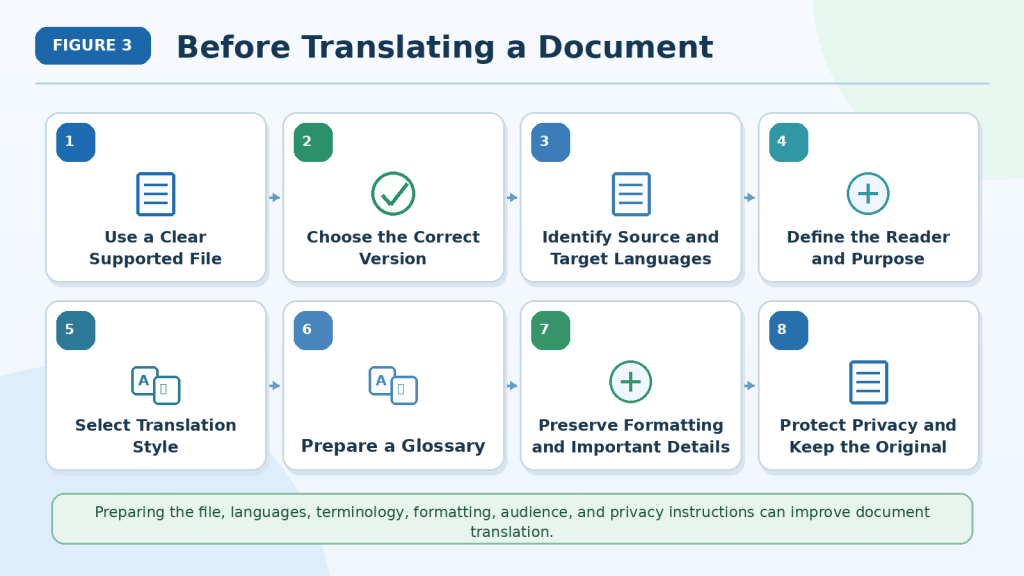
Figure 3. Preparing the file, languages, terminology, formatting, audience, and privacy instructions can improve document translation.
A reliable translation begins before the document is uploaded. Clear source and target languages, an appropriate style, a terminology glossary, formatting instructions, and access to the original document make the translated version easier to review and correct.
How to Upload and Translate a Document with ChatGPT
After preparing the file and translation instructions, you can upload the document and request the translation.
The exact button names and layout may vary depending on the ChatGPT app, device, plan, workspace, and future update.
Step 1: Start a New Chat
Open ChatGPT and begin a new conversation.
Starting a separate chat can help keep the document, prompts, terminology, corrections, and translated sections organized.
Use a clear chat title when the option is available.
For example:
Article 029 English-to-French Document Translation
Step 2: Select the Attachment Button
Look beside the message box for the attachment or add button.
It may appear as:
· A plus sign
· A paperclip
· An Add files option
· An Upload from computer option
· An Add from library option
OpenAI currently describes adding a previously saved file by opening the attachment or add menu, selecting Add from library, and choosing the required file. The available choices may differ between accounts and devices.
Step 3: Choose the Document
Select the document from your computer, device, or available file source.
Commonly supported formats currently include:
· DOCX
· PPTX
· TXT
· CSV
· TSV
· XLS
· XLSX
The .gdoc format is not currently supported directly. Export a Google Docs file as PDF, DOCX, or another supported format before uploading it.
Before continuing, confirm that:
· The correct file was selected.
· The filename matches the intended document.
· The file opens correctly.
· All required pages are included.
· The pages appear in the correct order.
· Unnecessary private information was removed.
Step 4: Wait for the Upload to Finish
Do not send the translation prompt until the file appears in the conversation and the upload has finished.
A failed or incomplete upload may result in:
· Missing pages
· An unreadable document
· An incorrect response
· A request to upload the file again
When the upload fails, check the internet connection, file format, file size, and whether the file is damaged.
Step 5: Ask ChatGPT to Identify the Document
Before requesting the full translation, ask ChatGPT to confirm what it can read.
Example prompt:
Review the uploaded document before translating it. Tell me the document title, detected language, number of visible pages or sections, main headings, and whether any text, tables, footnotes, or images appear unreadable. Do not translate it yet.
This preliminary check may reveal:
· Missing pages
· Incorrect language detection
· Unreadable scans
· Incomplete tables
· Mixed languages
· Text stored inside images
· Sections that need separate attention
Do not assume the document was read completely simply because it uploaded successfully.
Step 6: Provide the Translation Instructions
A useful translation request should explain:
· The source language
· The target language
· The regional language variation
· The intended reader
· The purpose
· The translation style
· The required tone
· The formatting to preserve
· The terminology rules
· How unclear content should be handled
Example prompt:
Translate the uploaded document from Canadian English into Canadian French for adult beginners. Use clear, natural, professional wording. Preserve the original headings, paragraph order, numbered steps, bullet points, tables, dates, names, amounts, warnings, conditions, and uncertainty. Use the attached glossary consistently. Keep product names and reference numbers unchanged. Mark unreadable or ambiguous text instead of guessing. Do not add facts, explanations, recommendations, or conclusions that are not in the source.
Step 7: Request a Translation Plan First
For an important or long document, ask ChatGPT to describe how it will divide the work before translating.
Example prompt:
Before translating, list the document sections in their original order and propose a section-by-section translation plan. Identify any section containing tables, technical terms, warnings, footnotes, or unclear text. Do not begin the translation yet.
Review the plan and confirm that no important section is missing.
Step 8: Translate a Small Test Section
Begin with one short section instead of the entire document.
For example:
Translate only the introduction and the first subsection. Follow all previous instructions. Place the translated heading above the translated paragraphs. Add a short translator note only when the source is unclear.
A test section allows you to check:
· Language choice
· Tone
· Terminology
· Formatting
· Reading level
· Treatment of names and numbers
· Handling of unclear wording
Correct the instructions before translating the remaining document.
Step 9: Continue One Section at a Time
After approving the test translation, request the next section.
Example:
Continue with the section titled “Safety Requirements.” Preserve all warnings, numbered steps, measurements, conditions, and defined terms. Do not translate any later section yet.
Section-by-section translation is easier to verify and correct than one very long response.
Step 10: Ask for a Translation Review
After translating a section, ask ChatGPT to check its own work against the source.
Example prompt:
Compare this translated section with the original. Create a review table with these columns: Source Element, Translation, Verification Result, and Correction Needed. Check headings, names, dates, numbers, measurements, warnings, conditions, uncertainty, missing sentences, added information, and glossary consistency.
This review can help identify possible problems, but it does not replace your own comparison with the original document.
A Reusable Document-Translation Prompt
The following prompt can be adapted for many documents:
Review the uploaded document and translate it from into [target language and regional variation] for [intended audience]. Use a [literal, natural, formal, plain-language, or other] translation style.
Preserve the original:
· Meaning and tone
· Headings and section order
· Paragraphs
· Numbered steps and bullet points
· Tables and labels
· Names and titles
· Dates and numbers
· Currencies and measurements
· Conditions and exceptions
· Warnings and negative findings
· Uncertainty words such as “may,” “could,” “expected,” and “preliminary”
· Page, section, figure, and reference numbers
Use the provided glossary consistently. Keep [names, brands, abbreviations, reference numbers, or other required items] unchanged.
Mark unreadable text as [Unclear in the source]. Add a short translator note when wording is ambiguous. Do not guess, add unsupported information, remove important details, or change a possible result into a guarantee.
Translate one section at a time. After each section, wait for my approval before continuing.
Important Reminder
ChatGPT’s file-upload capability is designed to work with text-rich documents such as PDFs, Word files, and presentations, but the result still depends on the file quality and accessible content.
A successful upload does not prove that every page, table, footnote, image, or scanned sentence was interpreted correctly.
Always keep the original document open while reviewing the translation.

Figure 4. Translating a document carefully involves checking the upload, giving detailed instructions, testing one section, and comparing the result with the original.
A detailed prompt helps ChatGPT understand the required languages, audience, style, terminology, and formatting. Beginning with a small test section makes it easier to correct problems before they affect the entire document.
How to Translate a Long Document in Sections
Long documents are usually easier to translate and review when they are divided into smaller sections.
Trying to translate an entire manual, report, policy, or book chapter in one request may lead to:
· Missing paragraphs
· Inconsistent terminology
· Shortened explanations
· Changed formatting
· Lost footnotes
· Repeated text
· Incomplete tables
· Different translation styles between sections
· Important warnings being overlooked
A section-by-section method gives you more control over the translation and makes comparison with the original easier.
Step 1: Ask ChatGPT to Create a Section List
Before translating, ask ChatGPT to identify the document structure.
Example prompt:
Review the uploaded document and list every heading and subsection in the original order. Include the visible page or section location when available. Do not translate anything yet.
Compare the list with the original document.
Check that it includes:
· The title page
· Introduction
· Main sections
· Subsections
· Tables
· Captions
· Notes
· Appendices
· Footnotes
· Warnings
· References
Add any missing section before translation begins.
Step 2: Divide the Document into Manageable Parts
Choose sections that are short enough to review carefully.
A translation part may include:
· One main section
· One or two short subsections
· A single table
· A page range
· A numbered procedure
· One appendix
· A group of related paragraphs
Avoid dividing a sentence, table, warning, or numbered procedure between two translation requests.
For example, instead of requesting pages 5–8 automatically, use the section boundaries:
Translate the complete section titled “Equipment Safety,” including its introduction, warnings, numbered steps, and notes.
This reduces the chance of separating important information from its context.
Step 3: Establish Translation Rules Before Starting
Give ChatGPT the full translation rules once at the beginning of the conversation.
Include:
· Source language
· Target language
· Regional variation
· Intended reader
· Required tone
· Translation style
· Formatting rules
· Glossary terms
· Names and terms that must remain unchanged
· Instructions for unclear text
· Instructions about warnings and uncertainty
Example prompt:
Use the same approved translation rules for every section in this conversation. Preserve headings, paragraph order, numbered steps, bullet points, tables, dates, measurements, warnings, conditions, and uncertainty. Use the glossary consistently. Do not add, remove, summarize, or interpret information.
Repeat the most important rules when translating high-risk sections.
Step 4: Translate the First Section
Begin with a short, representative section.
Example prompt:
Translate the complete introduction from English into Canadian French. Use the approved formal and natural style. Preserve the heading and paragraph order. Do not translate later sections.
Review the first section carefully before continuing.
Check:
· Meaning
· Tone
· Reading level
· Terminology
· Sentence completeness
· Names
· Dates
· Numbers
· Formatting
· Warnings
· Conditions
· Uncertainty
Correct the translation rules when necessary.
Step 5: Approve a Terminology Pattern
Some terms may have several possible translations.
After reviewing the first section, record the approved terms.
For example:
| Source Term | Approved Translation | Review Note |
| Required Action | Action requise | Use in all tables |
| Responsible Person | Personne responsable | Do not shorten |
| Completion Date | Date d’achèvement | Use consistently |
| Pending Approval | En attente d’approbation | Preserve status |
Add newly approved terms to the glossary before requesting the next section.
This helps prevent the same term from being translated differently later.
Step 6: Continue in the Original Order
Translate sections in the same order as the source document.
Example prompt:
Continue with the next complete section, “Project Responsibilities.” Apply the approved glossary and all previous translation rules. Preserve the table structure and mark any unclear source text. Stop after this section.
Working in order makes it easier to:
· Track completed sections
· Preserve context
· Compare versions
· Identify missing content
· Assemble the final document
Avoid jumping between unrelated sections unless necessary.
Step 7: Keep a Translation Progress Record
Create a simple tracking table.
For example:
| Section | Translation Status | Review Status | Corrections Needed |
| Introduction | Completed | Reviewed | None |
| Project Responsibilities | Completed | Reviewed | Two terms corrected |
| Safety Requirements | Completed | Pending | Not yet checked |
| Appendix A | Not started | Not started | — |
A progress record helps prevent:
· Skipped sections
· Duplicate translations
· Unreviewed content
· Confusion between draft and approved versions
Step 8: Review Every Section Before Continuing
Compare each translated section with the original before moving to the next one.
Check whether ChatGPT:
· Translated every sentence
· Preserved the correct heading
· Kept the paragraph order
· Used the approved glossary
· Preserved dates and numbers
· Kept warning language
· Preserved conditions and exceptions
· Retained uncertainty
· Avoided adding explanations
· Marked unclear text honestly
Do not rely only on a smooth or professional writing style. A translation can sound natural while still changing the original meaning.
Step 9: Check Connections Between Sections
A term, person, abbreviation, or instruction may appear in several parts of the document.
After translating several sections, check whether:
· Names are written consistently.
· Job titles use the same translation.
· Abbreviations are introduced correctly.
· Defined terms remain consistent.
· Cross-references point to the correct section.
· Figure and table numbers match.
· Repeated warnings use equivalent wording.
· Pronouns refer to the correct person or organization.
A translation may be accurate within one paragraph but inconsistent with earlier sections.
Step 10: Combine Only Reviewed Sections
After every section has been translated and checked, combine the approved versions into one document.
Do not combine:
· Unreviewed drafts
· Duplicate versions
· Sections with unresolved notes
· Content taken from different source-document versions
Keep the original order and formatting.
Use a filename that clearly identifies the language and review status.
For example:
employee-safety-guide-canadian-french-reviewed-july-2026.docx
Step 11: Perform a Complete Final Review
Read the combined translation from beginning to end.
Check:
· Section order
· Missing headings
· Repeated paragraphs
· Inconsistent terminology
· Formatting changes
· Broken tables
· Incorrect page references
· Unresolved translator notes
· Names and dates
· Warnings and conditions
· Final approval status
A section-by-section review may not reveal problems that become visible only after the document is combined.
Reusable Prompt for Long Documents
Translate this document one complete section at a time from into [target language].
First, list all headings and subsections in their original order. Do not translate yet.
For each approved section:
· Preserve the heading and paragraph order.
· Translate every sentence.
· Preserve numbered steps, bullet points, tables, notes, warnings, conditions, and uncertainty.
· Use the approved glossary consistently.
· Keep names, dates, numbers, reference codes, currencies, and measurements accurate.
· Mark unreadable text as [Unclear in the source].
· Add a translator note only when the wording is genuinely ambiguous.
· Do not summarize, shorten, interpret, or add information.
Stop after each section and wait for my approval before continuing.
Reality: Translating a long document in smaller parts does not automatically make every section accurate. It makes missing content, terminology problems, and changes in meaning easier to identify and correct.
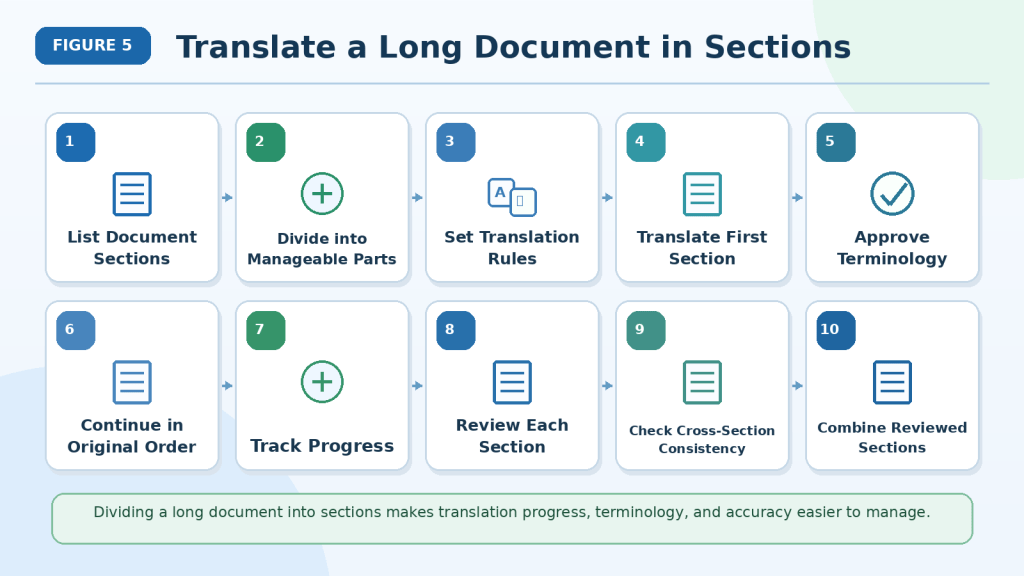
Figure 5. Dividing a long document into sections makes translation progress, terminology, and accuracy easier to manage.
Each section should be translated, compared with the source, corrected, and approved before the next section begins. A progress record and glossary help prevent skipped content, duplicated sections, and inconsistent terminology.
How to Improve and Correct a Translation
The first translation should be treated as a draft.
A translation may sound fluent while still containing:
· Missing sentences
· Incorrect word choices
· Changed meaning
· Inconsistent terminology
· Added information
· Removed warnings or conditions
· Incorrect names, dates, or numbers
· Unnatural wording
· Formatting problems
· Lost uncertainty
Do not ask ChatGPT only to “make the translation better.” Identify the specific problem and compare every correction with the original document.
Step 1: Compare the Translation with the Original
Review the source text and translation together.
Check whether the translation preserves:
· The complete meaning
· Names and job titles
· Dates and times
· Numbers and amounts
· Measurements
· Deadlines
· Conditions and exceptions
· Warnings
· Negative findings
· Uncertainty
· Technical terms
· Paragraph and section order
Example prompt:
Compare this translated section with the original sentence by sentence. Identify missing information, added information, changed meaning, incorrect facts, removed conditions, changed warnings, and lost uncertainty. Do not correct the translation yet.
Ask ChatGPT to present the findings in a review table.
| Source Element | Translation Problem | Correction Needed |
| May be approved | Changed to “will be approved” | Restore uncertainty |
| After document review | Condition was removed | Restore the condition |
| Written confirmation | Missing from translation | Add the missing phrase |
Review the table before requesting corrections.
Step 2: Identify the Type of Error
Understanding the problem makes the correction more precise.
Common errors include:
· Meaning error: The translation communicates a different idea.
· Omission: A word, sentence, warning, or section is missing.
· Addition: The translation includes information that is not in the source.
· Terminology error: A technical or repeated term is translated incorrectly.
· Tone error: Formal, neutral, or cautious language changes unexpectedly.
· Formatting error: A heading, list, table, or label is changed or removed.
· Consistency error: The same term is translated in different ways.
· Uncertainty error: A possible outcome becomes a definite statement.
· Context error: A word is translated without considering the surrounding text.
For example:
The phrase “subject to final approval” is missing. Restore this condition without changing the rest of the paragraph.
Step 3: Correct One Problem at a Time
Broad correction requests may cause ChatGPT to rewrite accurate parts unnecessarily.
Instead of writing:
Improve this translation.
Use a focused instruction:
Correct only the sentence containing the approval condition. Keep all other wording unchanged.
Another example:
Replace every incorrect translation of “Final Approval” with the approved glossary term. Do not change any other content.
Small corrections are easier to compare and verify.
Step 4: Preserve Facts, Conditions, and Warnings
Check every important detail against the source.
Pay special attention to:
· Names
· Dates
· Times
· Numbers
· Currency amounts
· Measurements
· Addresses
· Reference numbers
· Deadlines
· Approval status
· Conditions
· Exceptions
· Warnings
Example prompt:
Compare every name, date, number, amount, measurement, deadline, warning, condition, and approval status with the original. List every difference before correcting it.
The translation should not change facts to make the wording shorter or smoother.
Step 5: Restore Uncertainty
Documents often use careful wording such as:
· May
· Might
· Could
· Expected
· Estimated
· Proposed
· Preliminary
· Subject to approval
· Not confirmed
· Under review
These words should not be replaced with definite statements.
For example:
Original: The project is expected to finish in August.
Incorrect translation: The project will finish in August.
Correct meaning: The project is expected to finish in August.
Example prompt:
Restore every word or phrase that expresses uncertainty or a condition. Do not change “may,” “could,” “expected,” “proposed,” “preliminary,” or “subject to approval” into definite statements.
Step 6: Check Terminology Consistency
A repeated term should normally use the same approved translation throughout the document.
Ask ChatGPT to create a terminology review table.
| Source Term | Approved Translation | Other Versions Found | Correction Needed |
| Responsible Person | Personne responsable | Responsable | Use approved term |
| Required Action | Action requise | Mesure obligatoire | Review and correct |
| Final Approval | Approbation finale | Autorisation définitive | Use glossary term |
Example prompt:
Review this section against the glossary. List every inconsistent translation before making corrections.
Do not replace a term automatically when the surrounding context gives it a different meaning.
Step 7: Restore Missing Content and Remove Additions
Compare the source and translation paragraph by paragraph.
Check whether every:
· Heading
· Paragraph
· Sentence
· List item
· Table row
· Footnote
· Warning
· Caption
· Label
· Reference
appears in the translation.
Example prompt:
Compare the source and translation line by line. List every missing heading, sentence, list item, table entry, note, warning, caption, or reference. Do not invent unreadable or missing source text.
ChatGPT may also add explanations, examples, or conclusions that are not in the source.
Example prompt:
Identify any information in the translation that is not supported by the source document. Remove unsupported additions without changing accurate translated content.
When an explanation is useful, keep it separate from the translation.
For example:
Translator Note: This term may refer to a formal approval process, but the source document does not define it.
Step 8: Improve Fluency Without Changing Meaning
An accurate translation may still sound unnatural in the target language.
Ask ChatGPT to improve readability while protecting all important details.
Example prompt:
Improve the natural flow of this translation without changing any facts, names, dates, numbers, terminology, conditions, warnings, or uncertainty. Show the current translation and revised version side by side.
Check every revised sentence against the source.
A smoother sentence is not an improvement when it changes the meaning.
Step 9: Match the Original Tone
The translated tone should remain consistent with the source.
Possible tones include:
· Formal
· Neutral
· Friendly
· Instructional
· Technical
· Cautious
· Urgent
Example prompt:
Adjust the translation to match the source document’s formal and cautious tone. Do not make it friendlier, stronger, more persuasive, or more certain than the original.
A safety warning should not become casual. A neutral statement should not become emotional or promotional.
Step 10: Review Idioms and Cultural Expressions
Some phrases cannot be translated word for word.
An idiom is an expression whose meaning is different from the literal meaning of its individual words.
For example, “keep an eye on” normally means “watch carefully.”
Example prompt:
Identify idioms, cultural references, figurative expressions, and phrases that may not translate literally. Explain the intended meaning and suggest a natural target-language equivalent. Do not change the translation until I approve the suggestions.
When no accurate equivalent exists, add a clearly labelled translator note instead of guessing.
Step 11: Correct the Structure and Formatting
Confirm that the translation preserves:
· Heading levels
· Section order
· Paragraph breaks
· Numbered steps
· Bullet points
· Tables
· Labels
· Figure numbers
· Captions
· Bold terms
· Notes
· References
Example prompt:
Reformat the translation to match the source document. Preserve every heading, paragraph, numbered step, bullet point, table row, caption, note, and reference. Do not rewrite the translated wording.
Translated text may require more or less space than the source, so the final document layout may still need manual adjustment.
Step 12: Perform a Final Review
After correcting the translation, compare it with the original again.
Ask ChatGPT to create a final review table with these columns:
· Original Problem
· Corrected Translation
· Reason for Correction
· Verification Status
Example prompt:
Create a final correction table showing every approved change. Include only corrections supported by the source document. Mark anything that still requires human review.
Confirm that:
· Every section is included.
· No unsupported text remains.
· Glossary terms are consistent.
· Facts and numbers match.
· Conditions and warnings are preserved.
· Uncertainty remains clear.
· Translator notes are labelled separately.
· Formatting follows the original structure.
Save Each Version Separately
Do not overwrite the original file or the first translation draft.
Use clear filenames such as:
· safety-guide-original-english.docx
· safety-guide-french-first-draft.docx
· safety-guide-french-corrected.docx
· safety-guide-french-reviewed-final.docx
Keep:
· The original document
· The translation prompt
· The glossary
· The first translation
· Correction prompts
· Translator notes
· The corrected version
· Review records
· Final approval information
These records help you track changes and return to an earlier version when necessary.
Reusable Translation-Correction Prompt
Compare the translated section with the original source sentence by sentence.
Check for:
· Changed meaning
· Missing content
· Unsupported additions
· Incorrect names, dates, numbers, amounts, or measurements
· Removed conditions or exceptions
· Changed warnings
· Lost uncertainty
· Inconsistent glossary terms
· Incorrect tone
· Unnatural wording
· Formatting differences
First, list every possible problem in a review table. Do not correct the translation yet.
After I approve the review, correct only the identified problems. Preserve all accurate wording and formatting. Do not add information that is not supported by the source document.
Reality: A translation that sounds fluent is not necessarily accurate. Important corrections must be verified against the original document rather than judged only by how natural the translated wording sounds.

Figure 6. Translation corrections should restore the source meaning, facts, conditions, terminology, and uncertainty without changing accurate content.
A careful correction process compares the translation directly with the source, identifies specific errors, and changes only the affected wording. Clear and natural language is helpful, but preserving the original meaning remains the main priority.
How to Verify a Document Translation
Verification means comparing the translated document with the original source before the translation is used, shared, submitted, or published.
A translation can sound clear and professional while still containing:
· Missing text
· Changed meaning
· Incorrect names or numbers
· Inconsistent terminology
· Removed conditions
· Weakened warnings
· Added information
· Formatting errors
For important documents, verification should be completed section by section.
Step 1: Confirm the Complete Document Structure
Compare the original and translated documents from beginning to end.
Confirm that the translation includes every:
· Title
· Heading
· Subheading
· Paragraph
· Numbered step
· Bullet point
· Table
· Note
· Footnote
· Warning
· Caption
· Appendix
· Reference
Check for sections that are:
· Missing
· Repeated
· Incomplete
· Moved to the wrong location
· Combined incorrectly
Example prompt:
Compare the original document with the translation. List every missing, duplicated, incomplete, or incorrectly placed section. Do not rewrite the translation yet.
The translated document should normally follow the same order as the source unless a different structure was requested intentionally.
Step 2: Compare Each Section with the Source
Review one complete section at a time.
Check whether:
· Every sentence was translated.
· The original meaning was preserved.
· Important details were not shortened or removed.
· Unsupported explanations were not added.
· The tone remained consistent.
· Unclear source text was labelled honestly.
· Translator notes were kept separate from the translated content.
Do not review only the translated version. Keep the original document visible during the comparison.
Step 3: Verify Names and Identifying Details
Check every:
· Personal name
· Organization name
· Department name
· Job title
· Product name
· Place name
· Address
· Email address
· Website address
· Reference number
Some names should remain unchanged. Others may require an approved spelling in the target language.
Transliteration means writing a name or word from one writing system using another writing system.
For example, the same Arabic name may have more than one possible English spelling.
Choose one approved spelling and use it consistently throughout the document.
Step 4: Verify Dates, Times, and Numbers
Compare every:
· Date
· Time
· Year
· Deadline
· Percentage
· Quantity
· Currency amount
· Measurement
· Telephone number
· Identification number
· Table value
Pay careful attention to regional date formats.
For example:
07/08/2026
may mean:
· July 8, 2026
· August 7, 2026
When a numeric date may be misunderstood, write the month in words.
Do not convert currencies, measurements, or time zones unless the instructions require it. A conversion is a separate task from translation.
Example prompt:
Compare every date, time, number, amount, percentage, measurement, deadline, and reference number with the original. List all differences before correcting them.
Step 5: Verify Conditions and Exceptions
Conditions can change the meaning of an entire sentence.
Look for wording such as:
· If
· Unless
· Only after
· Provided that
· Subject to
· Except when
· Depending on
· With approval
· After confirmation
For example:
Source: Payment will be released after final approval.
Incorrect translation: Payment will be released.
The incorrect translation removes the approval condition.
Example prompt:
Check every condition, exception, requirement, and approval statement. Identify anything that was removed, weakened, strengthened, or changed.
Step 6: Verify Warnings and Safety Information
Warnings should remain complete, visible, and accurate.
Check whether the translation preserves:
· Warning words
· Prohibited actions
· Required protective measures
· Risks
· Emergency instructions
· Age restrictions
· Safety conditions
· Consequences of ignoring instructions
Do not weaken a warning to make it sound friendlier.
Do not make it stronger than the original source.
Step 7: Verify Uncertainty
Important documents often use careful language because an outcome is not guaranteed.
Check words and phrases such as:
· May
· Might
· Could
· Expected
· Estimated
· Proposed
· Possible
· Preliminary
· Under review
· Not confirmed
· Subject to approval
For example:
Source: The revised schedule may be available next week.
Incorrect translation: The revised schedule will be available next week.
The incorrect version changes a possible result into a guarantee.
Example prompt:
Compare all words showing uncertainty, possibility, estimate, proposal, review status, or required approval. Restore any uncertainty that was changed into a definite statement.
Step 8: Verify Terminology and Glossary Use
Compare the translation with the approved glossary.
Check whether:
· Required terms were used consistently.
· The same source term received the same approved translation.
· Abbreviations were handled consistently.
· Technical terms were not simplified incorrectly.
· Similar terms were not treated as identical.
For example, these words may have different meanings:
· Approval
· Authorization
· Permission
· Confirmation
Do not replace them with one general term unless the source meaning supports it.
Example prompt:
Review the translation against the approved glossary. List every missing, inconsistent, or incorrect term before making corrections.
Step 9: Verify Tables and Forms
Tables and forms require careful review because information may move into the wrong row, column, or field.
Confirm that:
· Column headings are correct.
· Row labels match the source.
· Values appear in the correct cells.
· Names remain connected to the correct records.
· Blank fields remain blank.
· Missing information remains labelled as missing.
· “Not stated” is not replaced with invented content.
· Dates, amounts, and deadlines have not moved.
· Notes remain connected to the correct item.
Example prompt:
Compare every table row, column, heading, label, and value with the original. Identify missing cells, moved information, incorrect numbers, and invented entries.
Step 10: Verify References and Numbering
Check references such as:
· See page 8
· Refer to Section 4
· Review Table 2
· Follow Step 6
· See Appendix B
Translated text may take more or less space than the source, so page numbers can change.
Confirm that:
· Section numbers remain correct.
· Figure and table numbers match.
· Cross-references point to the correct content.
· Page references are updated when necessary.
· No reference points to a missing section.
When page numbers are likely to change, a section title may be more reliable than a page number.
Step 11: Use Back-Translation as an Additional Check
A back-translation translates the new version back into the original language.
For example:
1st Translate English into French.
2nd Translate the French version back into English.
3rd Compare the new English version with the original English text.
This method may reveal:
· Missing meaning
· Changed conditions
· Incorrect terminology
· Lost uncertainty
· Added information
Example prompt:
Translate this French section back into English without using the original English wording. Then compare the back-translation with the original and identify meaningful differences.
Back-translation can help identify possible problems, but it does not prove that the translation is correct. The second translation may introduce new errors.
Step 12: Ask a Fluent Reviewer to Check the Translation
When possible, ask someone who understands both languages to review the document.
A fluent reviewer may identify:
· Unnatural wording
· Grammar problems
· Cultural misunderstandings
· Incorrect expressions
· Tone differences
· Ambiguous sentences
· Inconsistent terminology
A reviewer may also need knowledge of the document subject.
For example, a fluent speaker may not be able to confirm specialized legal, medical, financial, scientific, or technical terminology without relevant experience.
Step 13: Know When Professional Translation Is Required
Consider a qualified professional translator when the document affects:
· Legal rights
· Immigration applications
· Contracts
· Medical care
· Financial decisions
· Employment conditions
· Safety procedures
· Government submissions
· Academic certification
· Official identity records
Some organizations require:
· A certified translation
· An accredited translator
· A signed declaration
· A seal or stamp
· A specific document format
An AI-generated translation may not satisfy these requirements.
Check the receiving organization’s current rules before submitting the document.
Step 14: Create a Verification Record
Record what was checked, what was corrected, and what still requires review.
For example:
| Item Checked | Result | Correction Required | Final Status |
| Headings and sections | Complete | None | Verified |
| Names and dates | One error found | Date corrected | Verified |
| Glossary terms | Two variations found | Terms standardized | Verified |
| Warnings | Preserved | None | Verified |
| Unclear source text | One passage found | Human review required | Pending |
Do not mark an item as verified unless it was actually compared with the source.
Reusable Translation-Verification Prompt
Compare the translated document with the original source.
Check:
· Titles, headings, and section order
· Missing, repeated, or incomplete text
· Names and job titles
· Dates, times, and deadlines
· Numbers, amounts, and measurements
· Conditions and exceptions
· Warnings and safety information
· Uncertainty and approval status
· Glossary terminology
· Tables and form fields
· Page, section, figure, and reference numbers
· Unsupported additions
· Unclear or unreadable content
Create a verification table with these columns:
· Item Checked
· Source Evidence
· Translation Result
· Correction Needed
· Status
Do not mark an item as verified unless it is supported by the original document. Clearly label anything that still requires human or professional review.
Reality: Verification can reduce translation errors, but it cannot guarantee that a document meets every legal, medical, financial, technical, official, or professional requirement.
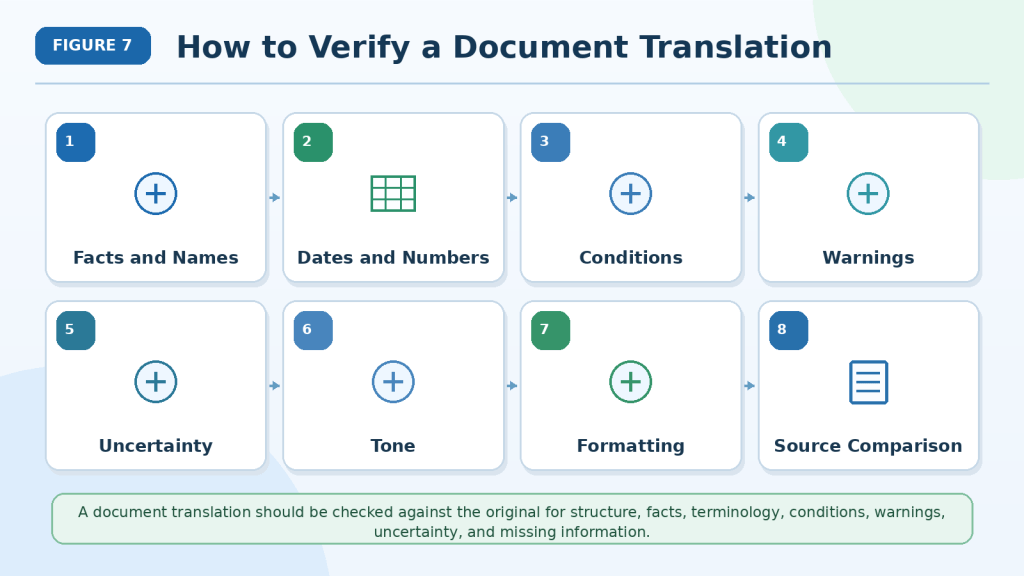
Figure 7. A document translation should be checked against the original for structure, facts, terminology, conditions, warnings, uncertainty, and missing information.
Verification involves more than reviewing grammar and natural wording. Every important fact, condition, warning, and term should be supported by the source, while anything uncertain or unresolved should be clearly marked for human or professional review.
Practical Example: Translating a Business Notice
Imagine that a small company has written an employee notice in English and needs a Canadian French version.
The notice includes:
· A new workplace procedure
· A starting date
· Required employee actions
· A manager’s name and role
· A safety warning
· An approval condition
· A possible future update
The translation must preserve all of these details without adding new instructions or changing the meaning.
Original English Notice
Updated Equipment Check Procedure
Starting August 10, 2026, employees must complete the equipment checklist before beginning each shift.
Completed checklists must be submitted to Maria Santos, Operations Manager, by 9:00 a.m.
Equipment showing visible damage must not be used until written approval is received from the maintenance department.
This procedure may be updated after the first 30-day review.
Questions should be sent to the operations office.
Step 1: Identify the Translation Requirements
Before translating, define the important instructions.
For this notice:
· Source language: English
· Target language: Canadian French
· Audience: Employees
· Tone: Clear, formal, and instructional
· Structure: Preserve the heading and paragraph order
· Names: Keep Maria Santos unchanged
· Important details: Preserve the date, time, role, warning, approval condition, and uncertainty
· Additional content: Do not add explanations, recommendations, or new workplace rules
These instructions help reduce unnecessary changes.
Step 2: Write a Detailed Translation Prompt
Use a prompt such as:
Translate this workplace notice from English into Canadian French for employees.
Use clear, formal, and instructional language.
Preserve:
· The heading and paragraph order
· August 10, 2026
· 9:00 a.m.
· Maria Santos
· Operations Manager
· The requirement to complete the checklist before each shift
· The warning that damaged equipment must not be used
· The condition requiring written approval from the maintenance department
· The uncertainty in the phrase “may be updated”
Do not summarize, add explanations, remove details, or create new requirements.
This prompt clearly identifies what must remain unchanged.
Step 3: Compare the Draft with the Original
After ChatGPT produces the translation, review it against the English notice.
Confirm that:
· The procedure starts on August 10, 2026.
· Employees must complete the checklist before each shift.
· The submission deadline remains 9:00 a.m.
· Maria Santos remains the responsible manager.
· Damaged equipment must not be used.
· Written maintenance approval is still required.
· The procedure may be updated, but an update is not guaranteed.
· No new workplace instruction was added.
Do not approve the translation only because it sounds natural.
Step 4: Correct a Change in Meaning
Suppose the translation changes:
This procedure may be updated after the first 30-day review.
into wording that means:
This procedure will be updated after 30 days.
This translation is inaccurate because:
· May was changed to will.
· A possible update became a guaranteed update.
· The connection to the first 30-day review became less clear.
Use a focused correction prompt:
Correct only the sentence about the procedure review. Preserve the meaning that the procedure may be updated after the first 30-day review, but that an update is not guaranteed. Keep all other translated wording unchanged.
A focused correction reduces the risk of changing accurate parts of the translation.
Step 5: Create a Verification Table
Record the important checks.
| Item Checked | Source Requirement | Translation Result | Status |
| Starting date | August 10, 2026 | Preserved | Verified |
| Checklist timing | Before each shift | Preserved | Verified |
| Submission deadline | 9:00 a.m. | Preserved | Verified |
| Responsible person | Maria Santos, Operations Manager | Preserved | Verified |
| Damaged equipment | Must not be used | Preserved | Verified |
| Approval condition | Written maintenance approval required | Preserved | Verified |
| Review wording | May be updated after the first 30-day review | Corrected | Verified |
| Unsupported additions | None allowed | None found | Verified |
Only mark an item as verified after comparing it with the source.
Step 6: Review the Final Layout
Before sharing the translated notice, confirm that:
· The heading is easy to identify.
· The paragraphs remain in the correct order.
· The date and time are easy to read.
· The warning remains clear and visible.
· Maria Santos’s name and role are correct.
· The approval condition has not been shortened or removed.
· Translator notes are separate from the notice.
· The document displays correctly on desktop and mobile.
· A fluent Canadian French reader reviews the final wording when possible.
What This Example Shows
Even a short notice can contain details that significantly affect its meaning.
A reliable translation should preserve:
· Who must act
· What action is required
· When the action must happen
· What is prohibited
· Who provides approval
· What remains uncertain
A translation is not reliable simply because it sounds fluent. It must communicate the same instructions, conditions, warnings, and uncertainty as the original notice.

Figure 8. A business notice translation should preserve responsibilities, dates, warnings, approval conditions, and uncertainty.
A short workplace notice can become misleading when a deadline, responsible person, warning, or conditional phrase changes. Comparing the translation with the source helps confirm that readers in both languages receive the same instructions and limitations.
Practical Example: Translating a Project Status Table
Tables can be more difficult to translate than normal paragraphs because information must remain in the correct row and column.
Imagine that an English project report contains this table:
| Required Action | Responsible Person | Deadline | Condition | Status |
| Test the mobile menu | Ahmed | July 20, 2026 | Complete before publication | In progress |
| Review the homepage text | Sarah | July 22, 2026 | Manager approval required | Not started |
| Confirm publication date | Project manager | Not stated | After testing is complete | Pending |
The company needs a Canadian French version of the table.
Step 1: Identify What Must Be Preserved
The translation must keep:
· The same five columns
· The same three records
· Every person’s name
· Every deadline
· Every condition
· Every status
· The phrase Not stated
· The connection between each action and its responsible person
The translation should not move information between rows or invent a missing deadline.
Step 2: Give Clear Table Instructions
Example prompt:
Translate this project-status table from English into Canadian French.
Preserve:
· The five-column structure
· The original row order
· Ahmed and Sarah exactly as written
· July 20, 2026
· July 22, 2026
· Every condition and status
· The missing deadline labelled “Not stated”
Do not combine rows, move information between cells, invent a deadline, or change the project status.
Clear instructions are especially important because a table may look correct even when information has moved into the wrong cell.
Step 3: Review Each Row Separately
Check the first row:
· Action: Test the mobile menu
· Responsible person: Ahmed
· Deadline: July 20, 2026
· Condition: Complete before publication
· Status: In progress
Then repeat the same check for every remaining row.
Do not verify only the column headings. The values inside each row must also match the original.
Step 4: Check Missing Information
The third record does not include a publication deadline.
The source says:
Not stated
The translation should preserve that meaning.
It should not replace it with:
· Unknown date
· July 24, 2026
· To be confirmed tomorrow
· After the next meeting
· Any other invented deadline
A suitable prompt is:
Keep the missing deadline clearly labelled as “Not stated” in the target language. Do not estimate or invent a date.
Missing information is different from unclear information. In this example, the source clearly shows that the deadline was not provided.
Step 5: Check Status and Conditions
Project terms can change meaning when translated incorrectly.
For example:
· In progress does not mean completed.
· Not started does not mean delayed.
· Pending does not mean approved.
· Manager approval required is a condition, not a current status.
· After testing is complete must remain connected to the publication date.
Ask ChatGPT to review these fields separately.
Example prompt:
Compare every status and condition with the original table. Confirm that no pending task was changed to completed, no required approval was removed, and no condition was moved to another row.
Step 6: Create a Verification Table
After translating, record the checks.
| Item Checked | Source Result | Translation Result | Status |
| Table structure | Five columns | Five columns | Verified |
| Ahmed’s deadline | July 20, 2026 | Preserved | Verified |
| Sarah’s deadline | July 22, 2026 | Preserved | Verified |
| Manager approval | Required | Preserved | Verified |
| Publication deadline | Not stated | Not stated | Verified |
| Project statuses | In progress, not started, pending | Preserved | Verified |
| Invented information | None | None found | Verified |
Only mark a row as verified after checking it against the original table.
What This Example Shows
A table translation must preserve both the words and their location.
The reviewer should confirm:
· Each value remains in the correct row.
· Each value remains under the correct heading.
· Names remain connected to the correct tasks.
· Dates and deadlines remain accurate.
· Conditions remain attached to the correct actions.
· Missing fields remain missing.
· Status labels do not become stronger or more certain.
A translated table can be misleading even when every individual word appears correct but the information is placed in the wrong cell.
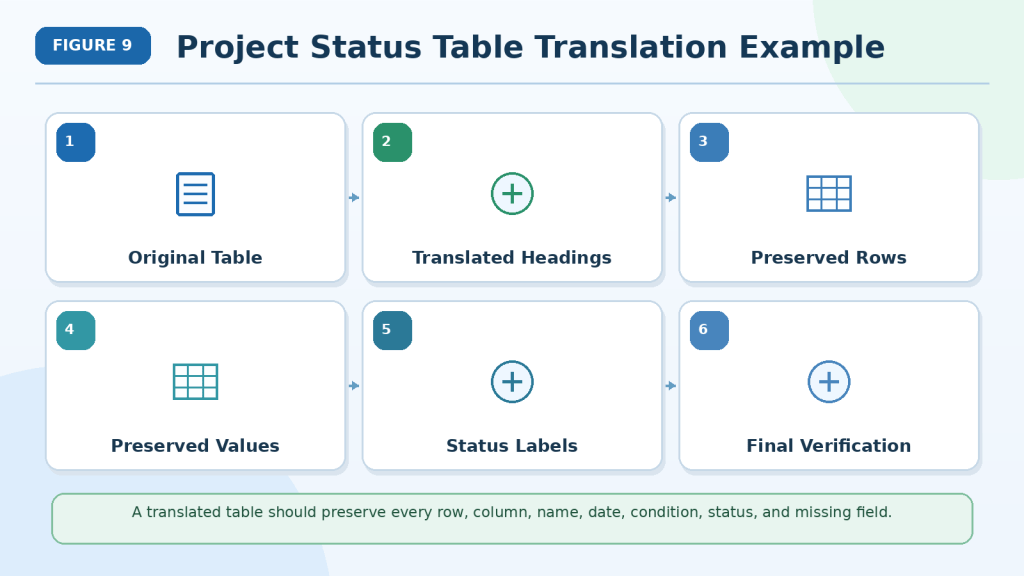
Figure 9. A translated table should preserve every row, column, name, date, condition, status, and missing field.
Table verification requires checking both the translated wording and its position. Information placed in the wrong row or column can change who is responsible, when an action is due, or whether a task is completed.
Benefits of Translating Documents with ChatGPT
ChatGPT can make document translation easier to begin, organize, and review.
It is especially useful for preparing a first draft, working through long documents, maintaining consistent wording, and comparing the translation with the original.
Faster First Drafts
ChatGPT can translate a document or selected section quickly.
This can help when you need to:
· Understand a document written in another language
· Prepare a working translation
· Review information before requesting professional help
· Identify difficult or unclear sections
· Translate routine content for internal use
The first result should be treated as a draft rather than an automatically finished translation.
Clear Instructions in Everyday Language
You do not need to learn complicated translation software before starting.
You can describe what you need using a normal prompt.
For example:
Translate this document from English into Canadian French. Use clear, formal language for employees. Preserve all headings, dates, names, warnings, conditions, and uncertainty.
This makes document translation easier for complete beginners.
Different Translation Styles
ChatGPT can translate the same content in different ways.
You may request:
· A literal translation
· Natural-sounding wording
· Formal business language
· Plain language
· A bilingual version
· Wording for a specific audience
This can help the translation match its purpose and readers.
For example, a workplace policy may require formal wording, while a beginner guide may need simpler sentences.
Easier Work with Long Documents
A long report, manual, policy, or guide can be translated one section at a time.
This allows you to:
1st Translate a short section.
2nd Compare it with the original.
3rd Correct any problems.
4th Approve the section.
5th Continue with the next part.
Working in smaller sections makes missing content and inconsistent wording easier to notice.
More Consistent Terminology
ChatGPT can follow a glossary of approved translations.
This is useful when a document repeatedly contains:
· Technical terms
· Job titles
· Department names
· Product names
· Project labels
· Status terms
· Abbreviations
For example:
| Source Term | Approved Translation |
| Required Action | Action requise |
| Responsible Person | Personne responsable |
| Final Approval | Approbation finale |
A glossary helps keep important terms consistent across the document.
Better Preservation of Structure
You can ask ChatGPT to preserve the original:
· Titles
· Headings
· Paragraph order
· Numbered steps
· Bullet points
· Tables
· Captions
· Notes
· References
This can make the translated version easier to compare with the source.
Some manual formatting may still be necessary because translated text can take more or less space than the original.
Easier Comparison and Correction
ChatGPT can display the source text and translation together.
Useful formats include:
· Original paragraph followed by translation
· Side-by-side bilingual text
· Sentence-by-sentence comparison
· Correction tables
· Verification checklists
These formats can help you identify:
· Missing information
· Changed meaning
· Incorrect names or numbers
· Removed conditions
· Changed warnings
· Inconsistent terminology
The original document should always remain the main source for checking accuracy.
Clearer Handling of Uncertain Text
Some documents contain unclear wording, damaged text, abbreviations, idioms, or cultural expressions.
You can tell ChatGPT not to guess.
For example:
Mark anything that cannot be translated confidently as “[Unclear in the source].” Do not invent missing words.
This makes uncertain content visible so it can be reviewed separately.
Better Organization of Translation Records
ChatGPT can help prepare:
· Translation instructions
· Glossaries
· Section progress tables
· Correction records
· Translator notes
· Verification checklists
· Final-review notes
These records make it easier to see which sections have been translated, checked, corrected, and approved.
Wider Access to Information
Translation can help more people understand:
· Educational materials
· Workplace notices
· Community information
· Instructions
· Reports
· Website content
· Public information
However, translation alone does not make a document fully accessible.
The final document should also use clear headings, readable text, logical structure, accessible tables, descriptive links, meaningful alternative text, and sufficient colour contrast.
Important Limitation
ChatGPT cannot guarantee that a translation is:
· Completely accurate
· Complete
· Ready for publication
· Suitable for professional use
· Accepted by an official organization
· Equivalent to a certified translation
Important documents may still require:
· Review by a fluent speaker
· Review by a subject specialist
· Professional translation
· Certified translation
· Approval from the receiving organization
Reality: ChatGPT can make translation faster and easier to manage, but it should be used as an assistant. The original document and appropriate human review remain essential.
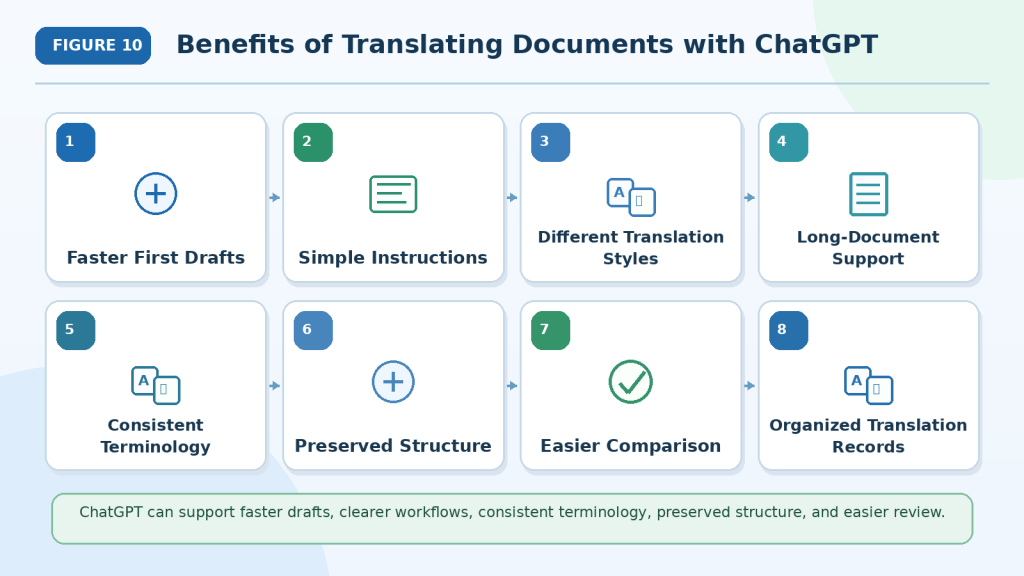
Figure 10. ChatGPT can support faster drafts, clearer workflows, consistent terminology, preserved structure, and easier review.
These benefits can make document translation more manageable for beginners. The translated version should still be compared carefully with the original and reviewed by an appropriate person when accuracy or official acceptance is important.
Limitations of Translating Documents with ChatGPT
ChatGPT can assist with document translation, but it does not understand every sentence, culture, subject, or document perfectly.
Knowing the limitations can help you decide what to check and when professional translation is necessary.
Meaning May Change
A translated sentence may sound natural while expressing a different meaning from the original.
This can happen when the source contains:
· Complex grammar
· Long sentences
· Several possible meanings
· Implied information
· Unusual word order
· Poorly written text
For example:
Source: The request may be approved after further review.
Incorrect meaning: The request will be approved.
The incorrect version changes a possible result into a guarantee.
How to Reduce This Limitation: Compare the translation with the original sentence by sentence. Pay special attention to conditions, exceptions, warnings, and uncertainty.
Content May Be Missing or Added
ChatGPT may:
· Skip a sentence
· Shorten a paragraph
· Leave out a footnote
· Miss a table entry
· Add an explanation
· Add a conclusion
· Include information that is not in the source
An added explanation may sound useful but should not silently become part of the translation.
How to Reduce This Limitation: Ask ChatGPT to translate every sentence without summarizing. Compare the section structure and check for missing or unsupported content.
Idioms and Cultural Expressions May Be Misunderstood
Idioms, humour, proverbs, cultural references, and figurative language may not translate directly.
A literal translation may sound confusing or communicate the wrong idea.
For example, the English expression “keep an eye on the project” normally means to monitor the project carefully.
It does not refer to a physical eye.
How to Reduce This Limitation: Ask ChatGPT to identify idioms and cultural expressions before translating them. Request a natural equivalent or a clearly labelled translator note.
Technical Terminology May Be Incorrect
A common word may have a special meaning in:
· Law
· Medicine
· Finance
· Engineering
· Science
· Information technology
· Government
· Academic research
ChatGPT may choose a general translation instead of the correct specialist term.
How to Reduce This Limitation: Provide an approved glossary and ask a subject specialist to review important terminology.
Terminology May Be Inconsistent
The same term may be translated differently in separate sections.
For example, Final Approval might appear as several different phrases even though the source uses one consistent term.
This can confuse readers and make the document appear less professional.
How to Reduce This Limitation: Maintain a glossary and review repeated terms across the complete translation before finalizing it.
Tone May Change
The original document may be:
· Formal
· Neutral
· Cautious
· Friendly
· Technical
· Urgent
· Instructional
ChatGPT may make the translation more casual, persuasive, emotional, or certain than the source.
A formal warning should not become friendly or optional.
How to Reduce This Limitation: Describe the required tone in the prompt and compare the translated tone with the original.
Scanned or Image-Based Text May Be Difficult to Read
A document may contain:
· Blurred scans
· Handwriting
· Photographs of pages
· Text inside diagrams
· Decorative fonts
· Poor colour contrast
· Cropped sentences
· Rotated pages
Unreadable source content cannot be translated reliably.
ChatGPT may miss the text or interpret it incorrectly.
How to Reduce This Limitation: Use a clear, text-based document when possible. Mark unreadable content as [Unclear in the source] instead of guessing.
Tables and Forms May Lose Their Structure
Translated text may move into the wrong:
· Row
· Column
· Label
· Form field
· Record
· Heading
A table can become misleading even when the individual translated words appear correct.
For example, a deadline may become connected to the wrong responsible person.
How to Reduce This Limitation: Check every row, column, label, and value against the original table. Confirm that blank and Not Stated fields remain unchanged.
Long Documents May Become Inconsistent
When a long document is translated in one request, ChatGPT may:
· Miss sections
· Repeat paragraphs
· Change terminology
· Shorten later sections
· Forget earlier instructions
· Produce incomplete output
How to Reduce This Limitation: Translate one section at a time, keep a progress table, repeat critical instructions, and combine only reviewed sections.
Names and Regional Language May Vary
Names and words may have several accepted spellings.
Regional differences can also affect:
· Vocabulary
· Spelling
· Punctuation
· Date formats
· Formality
· Technical terms
For example, Canadian French and European French may not always use the same wording.
How to Reduce This Limitation: Specify the target language variation and provide approved spellings for names, places, titles, and repeated terms.
Less Common Languages May Receive Weaker Results
Translation quality may vary between languages, dialects, writing systems, and subject areas.
A widely used language pair may produce stronger results than a less common dialect or a document containing regional expressions.
How to Reduce This Limitation: Use a fluent reviewer who understands the language, dialect, culture, and document subject.
Formatting May Change
Translated sentences may be longer or shorter than the original.
This can affect:
· Page breaks
· Table widths
· Captions
· Text boxes
· Lists
· Headings
· Image placement
· Page references
ChatGPT may preserve the general structure without reproducing the original layout exactly.
How to Reduce This Limitation: Review the final document in the program where it will be used. Correct the layout after the translation is complete.
Privacy and Permission Risks Remain
Uploading a document may expose information such as:
· Personal details
· Customer records
· Employee information
· Medical information
· Financial information
· Confidential business material
· Copyrighted content
Owning or receiving a document does not automatically give permission to upload, translate, reproduce, or publish it.
How to Reduce This Limitation: Remove unnecessary private information, confirm permission, review current privacy settings, and check relevant licence or workplace requirements before uploading.
AI Translation May Not Be Accepted for Official Use
Some documents require:
· A professional translator
· A certified translation
· An accredited translator
· A signed declaration
· An official seal or stamp
· A specific submission format
Examples may include immigration documents, contracts, medical records, court documents, academic records, and government applications.
An AI-generated translation may not meet the receiving organization’s requirements.
How to Reduce This Limitation: Check the organization’s current rules before submitting the translation. Use a qualified professional when certification or official acceptance is required.
Verification Does Not Guarantee Perfection
Careful checking can reduce errors, but neither ChatGPT nor a single reviewer can guarantee that every problem will be found.
Important documents may require several levels of review, such as:
· Language review
· Subject-matter review
· Legal or professional review
· Final formatting review
· Approval by the receiving organization
Reality: ChatGPT can provide useful translation assistance, but it cannot guarantee complete accuracy, cultural suitability, professional acceptance, or official validity.
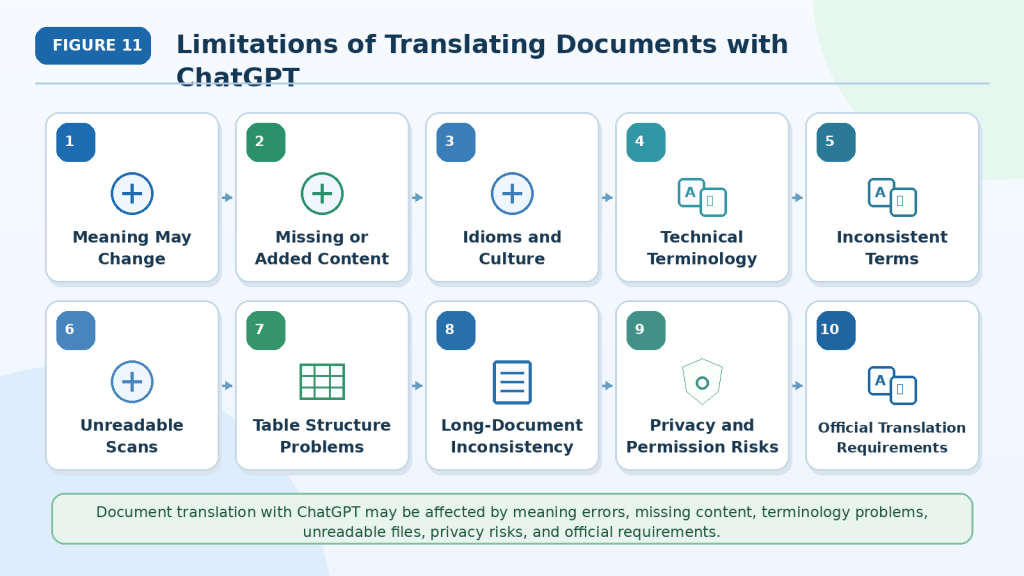
Figure 11. Document translation with ChatGPT may be affected by meaning errors, missing content, terminology problems, unreadable files, privacy risks, and official requirements.
These limitations do not make ChatGPT unusable for translation. They show why the source document, clear instructions, careful verification, and appropriate human or professional review remain necessary.
Common Mistakes When Translating Documents with ChatGPT
ChatGPT can create a useful translation draft, but mistakes are more likely when the instructions are unclear or the result is not checked against the original document.
The following mistakes are especially important for beginners to avoid.
Mistake 1: Giving Incomplete Instructions
A prompt such as:
Translate this document.
does not explain:
· The target language
· The regional language variation
· The intended reader
· The required tone
· The translation style
· The formatting to preserve
· The important details that must not change
ChatGPT may make choices that do not match your purpose.
How to Avoid This Mistake: Include the language, audience, tone, structure, terminology, and verification requirements.
For example:
Translate this document from English into Canadian French for employees. Use clear, formal language. Preserve all headings, names, dates, numbers, warnings, conditions, and uncertainty. Mark unclear wording instead of guessing.
Mistake 2: Translating Too Much at Once
A long document may contain many sections, tables, footnotes, warnings, and repeated terms.
Translating the entire file in one request may result in:
· Missing sections
· Shortened content
· Repeated paragraphs
· Inconsistent terminology
· Incomplete tables
· Forgotten instructions
How to Avoid This Mistake: Translate one complete section at a time. Review and approve each section before continuing.
Mistake 3: Accepting the First Translation
The first translation may sound natural while still containing incorrect meaning or missing information.
For example:
Source: The application may be approved after review.
Incorrect translation: The application will be approved.
The translated sentence removes the review condition and changes a possibility into a guarantee.
How to Avoid This Mistake: Treat the first result as a draft. Compare it with the original before using or sharing it.
Mistake 4: Checking Only Grammar
Correct grammar does not guarantee an accurate translation.
A sentence may be grammatically correct while changing:
· A date
· A number
· A name
· A deadline
· A condition
· A warning
· An approval status
· The level of uncertainty
How to Avoid This Mistake: Review the meaning and facts, not only the fluency of the target-language text.
Mistake 5: Ignoring Important Terms
Technical terms, job titles, department names, project labels, and abbreviations may be translated differently throughout the document.
This can confuse readers.
How to Avoid This Mistake: Prepare a glossary and ask ChatGPT to use the approved translation consistently.
For example:
| Source Term | Approved Translation |
| Required Action | Action requise |
| Responsible Person | Personne responsable |
| Final Approval | Approbation finale |
Mistake 6: Allowing ChatGPT to Guess
Some source documents contain:
· Blurred scans
· Handwriting
· Damaged text
· Unfamiliar abbreviations
· Ambiguous sentences
· Missing words
ChatGPT may produce a confident-looking translation even when the source is unclear.
How to Avoid This Mistake: Ask ChatGPT to mark uncertain content clearly.
For example:
Mark anything that cannot be translated confidently as “[Unclear in the source].” Do not invent missing wording.
Mistake 7: Overlooking Names, Dates, and Numbers
Small factual errors can have serious effects.
Examples include:
· July 8 becoming August 7
· 15% becoming 50%
· 2.5 kilograms becoming 25 kilograms
· A deadline being assigned to the wrong person
· A reference number being changed
How to Avoid This Mistake: Compare every name, date, time, number, amount, percentage, measurement, deadline, and reference code with the original.
Do not convert currencies, measurements, or time zones unless you request that separately.
Mistake 8: Failing to Check Tables and Forms
A translated table may look correct even when information has moved into the wrong row or column.
This can change:
· Who is responsible
· Which deadline applies
· Which condition belongs to a task
· Whether a status is pending or completed
· Whether a field was originally blank
How to Avoid This Mistake: Check every heading, row, column, label, value, blank field, and Not Stated entry against the source.
Mistake 9: Changing Conditions, Warnings, or Uncertainty
Important wording may become weaker, stronger, or more certain during translation.
Pay attention to words such as:
· Must
· Must not
· Only after
· Subject to approval
· May
· Might
· Could
· Expected
· Preliminary
· Not confirmed
Changing may into will can turn a possibility into a guarantee.
Changing must into should can weaken a requirement.
How to Avoid This Mistake: Review conditions, restrictions, warnings, and uncertainty separately before approving the translation.
Mistake 10: Mixing Translator Notes with the Original Content
ChatGPT may add explanations to help the reader.
These explanations may be useful, but they should not appear as though they were part of the original document.
How to Avoid This Mistake: Keep additional comments separate and label them clearly.
For example:
Translator Note: The abbreviation is not defined in the source document.
Mistake 11: Ignoring Privacy and Permission
Documents may contain:
· Personal information
· Customer records
· Employee information
· Medical details
· Financial information
· Confidential business content
· Copyrighted material
Access to a document does not automatically give permission to upload, translate, reproduce, or publish it.
How to Avoid This Mistake: Remove unnecessary private information, confirm permission, and review current privacy, workplace, contractual, and licence conditions before uploading.
Mistake 12: Assuming the Translation Is Suitable for Official Use
Some organizations require:
· A professional translator
· A certified translation
· An accredited translator
· A signed declaration
· A seal or stamp
· A specific document format
An AI-generated translation may not satisfy these requirements.
How to Avoid This Mistake: Check the receiving organization’s current requirements before translating or submitting an official document.
Mistake 13: Overwriting the Original File
Saving the translation over the original document removes an important reference.
It also makes it harder to compare versions or correct mistakes.
How to Avoid This Mistake: Save separate copies of:
· The original document
· The first translation draft
· The corrected translation
· The reviewed final version
· The glossary
· Translator notes
· Verification records
Use clear filenames so every version can be identified easily.
Reality: Most translation mistakes can be reduced by giving clear instructions, translating in manageable sections, keeping the original document available, and verifying every important fact, condition, warning, and uncertain statement before use.

Figure 12. Common translation mistakes include incomplete instructions, unverified drafts, inconsistent terminology, factual errors, and changed conditions.
These mistakes are easier to prevent when the source document remains available and every translated section is checked before approval. Clear instructions and careful verification are more important than fluent wording alone.
| Source Term | Approved Translation |
| Required Action | Action requise |
| Responsible Person | Personne responsable |
| Final Approval | Approbation finale |
Common Myths About Translating Documents with ChatGPT
Several common beliefs can lead beginners to trust a translation too quickly or use it for the wrong purpose.
Understanding the difference between a myth and reality can help you review translated documents more carefully.
Myth 1: A Fluent Translation Must Be Accurate
A translation can sound natural and professional while still changing important meaning.
It may contain:
· Missing information
· Incorrect facts
· Weakened warnings
· Removed conditions
· Changed uncertainty
· Unsupported additions
For example:
Source: The application may be approved after further review.
Incorrect translation: The application will be approved.
The translated sentence sounds clear, but it changes a possible outcome into a guarantee.
Reality: Fluency and accuracy are different. Compare the translation with the original document before accepting it.
Myth 2: ChatGPT Understands Every Language Equally Well
Translation quality can vary depending on:
· The language pair
· The dialect
· Regional expressions
· The writing system
· The subject
· The complexity of the text
· The quality of the source document
A common language pair may receive a stronger result than a less common dialect containing local expressions.
Reality: Every important translation should be reviewed by someone who understands the target language and document subject.
Myth 3: A Longer Prompt Guarantees a Perfect Translation
Detailed instructions can improve the result, but they do not eliminate every possible error.
ChatGPT may still:
· Misunderstand a sentence
· Miss a table entry
· Use an incorrect technical term
· Change the tone
· Omit a condition
· Misread unclear text
Reality: A clear prompt improves direction, but verification remains necessary.
Myth 4: Literal Translation Is Always More Accurate
A word-for-word translation may preserve individual words while communicating an unnatural or incorrect meaning.
Languages often use different:
· Sentence structures
· Expressions
· Grammar
· Word order
· Cultural references
For example, an idiom translated word for word may not make sense in the target language.
Reality: Literal translation is useful for comparison, but a natural translation may communicate the original meaning more accurately. Both approaches require review.
Myth 5: Natural Translation Can Freely Change the Wording
A natural translation may adjust sentence structure and expressions, but it should not change:
· Facts
· Names
· Dates
· Numbers
· Requirements
· Warnings
· Conditions
· Limitations
· Uncertainty
Reality: Natural wording should improve readability while preserving the source meaning.
Myth 6: ChatGPT Automatically Preserves Every Detail
Uploading a complete document does not guarantee that every heading, paragraph, table, footnote, caption, or warning will appear correctly in the translation.
Long or complicated documents may contain overlooked or shortened content.
Reality: Check the complete document structure and translate long files in manageable sections.
Myth 7: ChatGPT Will Always Know When the Source Is Unclear
ChatGPT may sometimes provide a confident answer even when text is blurred, damaged, ambiguous, or incomplete.
It may not automatically mark every uncertain passage.
Reality: Tell ChatGPT to identify unreadable or ambiguous content and avoid guessing. Review questionable passages manually.
Myth 8: A Back-Translation Proves the Translation Is Correct
Back-translation can help reveal possible changes in meaning, but it is not proof of accuracy.
The back-translation may introduce new errors or produce wording similar to the original even when the target-language version sounds unnatural.
Reality: Use back-translation as one checking method alongside direct comparison and human review.
Myth 9: AI Translation Is Automatically Suitable for Official Use
An AI-generated translation may not meet requirements for:
· Immigration applications
· Court documents
· Contracts
· Academic records
· Medical records
· Government submissions
· Identity documents
The receiving organization may require a certified translator, declaration, seal, stamp, or particular format.
Reality: Check the organization’s current requirements before submitting any translated document.
Myth 10: Translation Automatically Includes Currency and Measurement Conversion
Translation changes language. It does not automatically require the conversion of:
· Currency
· Measurements
· Time zones
· Temperature
· Date formats
Unrequested conversion can change important information or introduce errors.
Reality: Keep original values unless conversion is requested separately, and label any converted value clearly.
Myth 11: Anyone Who Speaks the Language Can Verify Every Document
A fluent speaker may identify grammar and natural-language problems but may not understand specialist terminology.
Legal, medical, financial, scientific, engineering, and technical documents may require both language knowledge and subject expertise.
Reality: Choose a reviewer who understands the language and the document’s subject when accuracy is important.
Myth 12: Removing Names Makes Every Document Safe to Upload
A document may still reveal people or organizations through:
· Addresses
· Identification numbers
· Account details
· Job titles
· Case descriptions
· Dates
· Unusual events
· Combined background details
Removing a person’s name alone may not remove all identifying information.
Reality: Review the complete document for unnecessary private, confidential, restricted, and identifying information before uploading it.
Myth 13: Translated Content Is Automatically Free to Publish
Translation does not remove copyright, licence, confidentiality, or permission requirements.
You may need permission to:
· Upload the source
· Create a translation
· Reproduce the content
· Share the translation
· Publish it commercially
Reality: Confirm your rights and licence conditions before publishing translated content.
Myth 14: ChatGPT Replaces Professional Translators
ChatGPT can help prepare drafts, glossaries, comparisons, corrections, and verification records.
However, professional translators can provide:
· Language expertise
· Cultural understanding
· Subject knowledge
· Context-sensitive decisions
· Accountability
· Certification when qualified
· Communication with the client
Reality: ChatGPT is a translation assistant. It does not replace qualified professional or certified translation when those services are required.
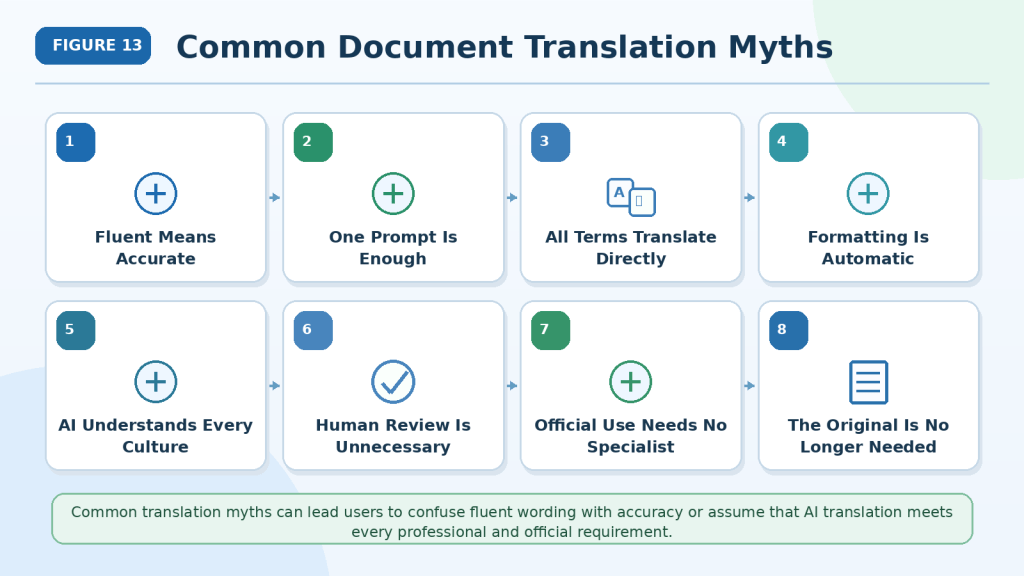
Figure 13. Common translation myths can lead users to confuse fluent wording with accuracy or assume that AI translation meets every professional and official requirement.
ChatGPT can support translation, but it does not remove the need to verify meaning, protect private information, check publication rights, and obtain qualified human review when the document is important or official.
Privacy, Permission, Accessibility, and Responsible Use
Document translation involves more than changing words from one language into another.
Before uploading, translating, sharing, or publishing a document, consider:
· Privacy
· Permission
· Copyright and licensing
· Factual accuracy
· Accessibility
· AI disclosure
· Record keeping
· Professional requirements
Protect Private Information
Review the complete document before uploading it.
It may contain:
· Full names
· Home addresses
· Telephone numbers
· Email addresses
· Identification numbers
· Account details
· Employee records
· Customer information
· Medical information
· Financial information
· Confidential business material
· Signatures
· Information hidden in tables, headers, footers, or comments
Remove information that ChatGPT does not need for the translation.
For example, replace unnecessary identifying details with labels such as:
· [Employee Name]
· [Customer Number]
· [Home Address]
· [Account Reference]
Canada’s Office of the Privacy Commissioner recommends avoiding personal information in AI chatbot prompts unless it is necessary and appropriate for the task.
Removing a person’s name may not be enough. A combination of job title, location, date, incident details, or identification numbers may still reveal who the person is.
Review ChatGPT Data Controls
For personal ChatGPT workspaces, users can manage whether new conversations are used to improve OpenAI’s models through:
Profile icon → Settings → Data Controls → Improve the model for everyone
When this setting is turned off, new conversations are not used to train OpenAI’s models. Menu wording and location may change after an update.
Review this setting:
· Before uploading documents for the first time
· After changing your plan or workspace
· When handling sensitive information
· After receiving a privacy or policy update
· Periodically as part of your normal account review
Turning off model training does not replace permission, privacy review, or secure document handling.
Understand Temporary Chat
Temporary Chat can provide additional privacy controls for a conversation.
OpenAI currently states that Temporary Chats:
· Do not appear in chat history
· Do not create or use memories
· Are not used to train its models
· May be reviewed for abuse monitoring
· Are deleted from OpenAI’s systems after 30 days
Temporary Chat does not mean that any document is automatically safe to upload.
You must still:
· Remove unnecessary private information.
· Confirm that uploading the document is permitted.
· Follow workplace or organizational policies.
· Avoid uploading highly sensitive material when an approved secure method is required.
· Check whether the translation must be completed inside a controlled system.
Temporary Chats also cannot currently be added to ChatGPT Projects.
Understand File Retention
Uploaded files may be retained according to the chat, project, custom GPT, Library, account, or workspace where they are stored.
OpenAI states that files attached to regular conversations follow the retention period of the corresponding chat. Files stored in Projects or custom GPTs may remain until the Project or GPT is deleted, subject to the applicable retention policy.
Before uploading, consider:
· Where the file will be stored
· How long it may remain available
· Who can access the workspace or project
· Whether the file must be deleted afterward
· Whether your organization has a required retention policy
Do not rely on memory or an old screenshot of the settings. Check the current official information when handling important documents because features and policies may change.
Confirm Permission to Upload and Translate
Having a copy of a document does not necessarily mean you are permitted to upload, translate, reproduce, distribute, or publish it.
Permission may depend on:
· Who created the document
· Who owns the copyright
· The licence attached to the material
· A workplace policy
· A confidentiality agreement
· A customer agreement
· A publishing contract
· The intended use of the translation
· Whether the translation will be distributed commercially
Canadian copyright guidance explains that copyright owners generally hold exclusive rights related to reproducing and publishing protected works. Some uses, adaptations, or translations may require permission depending on the material and circumstances.
Before translating someone else’s document for publication:
1st Identify the owner or authorized publisher.
2nd Read the document’s licence or terms.
3rd Confirm whether translation is permitted.
4th Request written permission when necessary.
5th Save the permission record.
6th Follow any attribution or distribution conditions.
Copyright rules and exceptions vary by country and situation. This article provides general educational information, not legal advice.
Protect People Mentioned in the Document
A translation should not expose, misrepresent, or harm people mentioned in the source.
Be careful with:
· Personal histories
· Workplace complaints
· Medical information
· Legal disputes
· Financial problems
· Student records
· Customer complaints
· Private correspondence
· Photographs and signatures
Do not add descriptions, accusations, conclusions, or identifying details that are absent from the original.
When permission is required, obtain it before sharing the translated version.
Preserve Meaning and Context
Responsible translation requires preserving more than individual words.
Keep the original:
· Facts
· Tone
· Conditions
· Exceptions
· Warnings
· Limitations
· Negative findings
· Uncertainty
· Approval status
· Source references
Do not make the translated document sound more certain, official, persuasive, positive, or negative than the source.
For example:
Source: The proposal remains under review.
Misleading translation: The proposal has been approved.
The translation must not create an outcome that did not occur.
Separate Translation from Added Explanation
ChatGPT may provide definitions or background information to help readers.
Keep this material separate from the translated document.
Use a clear label such as:
Translator Note: The source does not define this abbreviation.
or:
Additional Explanation: This paragraph was added to help beginners and is not part of the original document.
Readers should be able to distinguish:
· Original translated content
· Translator notes
· AI-generated explanations
· Your own comments or analysis
Disclose AI Assistance When Appropriate
Consider disclosing that AI assisted with the translation when:
· Readers could reasonably believe it was translated entirely by a person.
· The document affects important decisions.
· A customer, employer, publisher, school, or organization requires disclosure.
· The translation is being published publicly.
· A human translator has not reviewed it.
· Transparency would help readers judge the document appropriately.
A simple disclosure may say:
This translation was prepared with AI assistance and reviewed against the original document. It is not a certified translation.
Do not claim that the translation was professionally reviewed, certified, or approved unless that actually occurred.
Make the Translation Accessible
Translation can improve language access, but it does not automatically make a document accessible to people with disabilities.
Use:
· Clear and descriptive headings
· Short, readable paragraphs
· Proper numbered and bulleted lists
· Descriptive link text
· Sufficient colour contrast
· Readable font sizes
· Simple table structures
· Clearly marked table headings
· Alternative text for meaningful images
· Text explanations for complex charts and diagrams
W3C guidance explains that headings communicate page organization and help users navigate content. Accessible data tables require properly identified header and data cells, while meaningful images need appropriate text alternatives.
For complex figures, include a short explanation in the surrounding article text rather than relying only on the image.
When possible, ask readers with relevant accessibility needs to review the final document.
Preserve Translation Records
Save records that explain how the translation was created and reviewed.
Keep:
· The original source document
· The version uploaded
· Translation prompts
· The approved glossary
· Draft translations
· Correction prompts
· Translator notes
· Verification tables
· Permission and licence records
· Human-review information
· AI-disclosure wording
· The final approved translation
· Publication or submission records
Use filenames that clearly distinguish each version.
For example:
· workplace-notice-original-english.docx
· workplace-notice-french-ai-draft.docx
· workplace-notice-french-corrected.docx
· workplace-notice-french-human-reviewed.docx
Do not label a file certified, approved, or professionally translated unless that status is accurate.
Know When Not to Use an AI Translation Alone
Do not rely only on an AI-generated translation when mistakes could affect:
· Legal rights
· Medical treatment
· Immigration status
· Financial decisions
· Employment conditions
· Public safety
· Contractual obligations
· Government submissions
· Academic certification
· Official identity records
Check the receiving organization’s requirements and use a qualified professional or certified translator when necessary.
Responsible Use: ChatGPT can assist with document translation, but the user remains responsible for protecting private information, confirming permission, preserving the original meaning, checking accessibility, disclosing AI assistance when appropriate, and obtaining professional review when required.
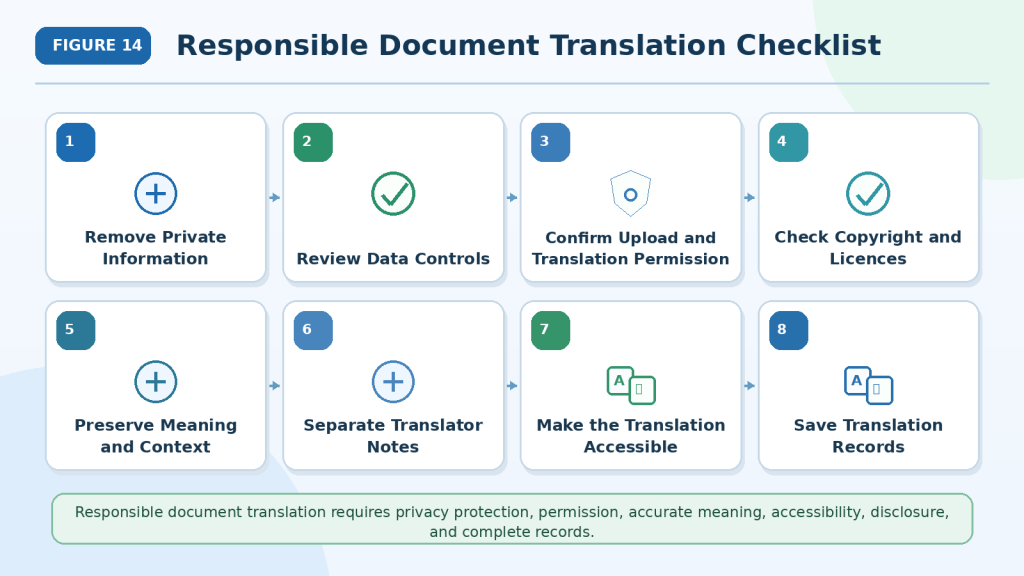
Figure 14. Responsible document translation requires privacy protection, permission, accurate meaning, accessibility, disclosure, and complete records.
Translation is not only a language task. Before sharing the final document, confirm that the source was handled properly, important meaning was preserved, additional notes were labelled, accessibility was considered, and appropriate human or professional review was completed.
Frequently Asked Questions
Can ChatGPT translate an entire document?
Yes. ChatGPT can translate supported document files, but long documents are usually easier to manage in smaller sections.
Translating one section at a time makes it easier to:
· Check missing content
· Preserve terminology
· Review tables
· Correct errors
· Track progress
· Maintain consistent instructions
Always compare the translation with the original document.
Which document formats can ChatGPT translate?
ChatGPT can currently work with many common formats, including:
· DOCX
· PPTX
· TXT
· CSV
· TSV
· XLS
· XLSX
Available formats, file limits, and document capabilities may vary by plan, workspace, model, and future update.
Google Docs files using the .gdoc format should be exported to a supported format, such as PDF or DOCX, before uploading.
Can ChatGPT detect the original language automatically?
ChatGPT can often identify the language used in a document, but automatic detection may be less reliable when the file contains:
· Several languages
· Similar languages or dialects
· Short text samples
· Regional expressions
· Scanned text
· Poor image quality
· Technical terminology
For better results, tell ChatGPT the source language in your prompt.
Can I translate a document into more than one language?
Yes. You can request separate translations into several languages.
Translate and review one target language at a time. This makes it easier to preserve formatting, terminology, facts, and document structure.
Create a separate glossary and review process for each target language when necessary.
Can ChatGPT create a bilingual document?
Yes. You can request a bilingual format such as:
· Original paragraph followed by its translation
· Original sentence followed by its translation
· Two-column source-and-translation table
· Original heading followed by the translated heading
Example prompt:
Create a bilingual English–Canadian French version. Place each English paragraph first and its French translation directly below it. Preserve the original headings and paragraph order.
Review the layout carefully because translated paragraphs may be longer or shorter than the original text.
Should I ask for a literal or natural translation?
The best choice depends on the purpose.
A literal translation follows the original wording and sentence structure closely. It can be useful for comparison or language study, but it may sound unnatural.
A natural translation focuses on how a fluent speaker would communicate the same meaning. It may be easier to read, but it must still preserve all facts, warnings, conditions, and uncertainty.
You can also request both versions for comparison.
Can ChatGPT preserve headings, lists, and tables?
You can ask ChatGPT to preserve:
· Headings
· Paragraph order
· Numbered steps
· Bullet points
· Tables
· Captions
· Notes
· References
However, the final structure may not match the original perfectly.
Tables, text boxes, columns, page breaks, and scanned layouts may require manual correction after translation.
Can ChatGPT translate scanned PDFs?
It may be able to work with some scanned documents, but the result depends on the scan quality and available document capabilities.
Problems may occur when pages contain:
· Blurred text
· Handwriting
· Cropped sentences
· Rotated pages
· Decorative fonts
· Poor colour contrast
· Text inside diagrams or photographs
Use a clear, text-based file when possible.
Ask ChatGPT to mark unreadable content as [Unclear in the source] instead of guessing.
What should I do when the document contains several languages?
Tell ChatGPT which languages appear in the document and what should happen to each one.
For example:
This document contains English and French. Translate the English sections into French and leave the existing French text unchanged. Clearly identify any section written in another language.
Check that existing target-language content was not translated again or changed unnecessarily.
Can ChatGPT translate names?
Names may be:
· Kept in their original form
· Transliterated into another writing system
· Written using an approved spelling
· Translated only when they are official titles or descriptive names
Tell ChatGPT how names should be handled.
For example:
Keep personal names unchanged. Use the approved English spelling for place names listed in the glossary.
Check every name manually because several accepted spellings may exist.
Should currencies and measurements be converted?
Not unless you request it.
Translation changes the language. Conversion changes the value or unit.
Keep the original currency, measurement, time zone, and amount unless a separate conversion is required.
When adding a conversion, label it clearly and preserve the original value.
What happens when a word has several possible meanings?
Ask ChatGPT to:
1st Show the original word or phrase.
2nd Explain the possible meanings.
3rd Review the surrounding context.
4th Suggest the most likely translation.
5th Add a translator note when uncertainty remains.
Do not allow it to choose silently when the meaning could affect an important instruction, condition, warning, or decision.
Can ChatGPT translate legal, medical, or financial documents?
ChatGPT can help you understand or prepare a draft translation, but high-stakes documents may require a qualified professional.
Mistakes could affect:
· Legal rights
· Medical treatment
· Financial decisions
· Immigration status
· Employment conditions
· Contractual obligations
· Government submissions
A receiving organization may require a certified translation, accredited translator, declaration, seal, stamp, or specific format.
Check the current requirements before submitting the document.
Is a ChatGPT translation considered certified?
No. A translation created with ChatGPT is not automatically a certified translation.
Certification normally requires a qualified person or approved service to complete specific requirements.
Do not describe an AI-generated translation as certified, official, professionally approved, or legally valid unless the required process was actually completed.
Can I publish a translated document?
Possibly, but translation does not remove copyright, licence, confidentiality, or permission requirements.
Before publishing, confirm that you have permission to:
· Upload the source document
· Create a translation
· Reproduce the content
· Edit or adapt it
· Share it publicly
· Use it commercially
Keep written permission and licence records when required.
Should I disclose that ChatGPT helped with the translation?
Disclosure may be appropriate when:
· A platform, employer, school, publisher, customer, or organization requires it.
· Readers may assume the translation was completed entirely by a person.
· No fluent or professional reviewer checked the translation.
· The translation affects important decisions.
· Transparency would help readers evaluate the document.
Example disclosure:
This translation was prepared with AI assistance and reviewed against the original document. It is not a certified translation.
Do not claim human, professional, or certified review unless it occurred.
Is it safe to upload a private document?
No upload should be considered automatically safe.
Before uploading:
· Remove unnecessary personal information.
· Confirm that you have permission.
· Review ChatGPT Data Controls.
· Check workplace or organizational policies.
· Consider whether an approved secure system is required.
· Avoid uploading highly sensitive information unnecessarily.
· Review current file-retention information.
Privacy settings reduce some risks but do not replace responsible document handling.
How can I tell whether the translation is accurate?
Compare it directly with the original document.
Check:
· Complete sections
· Names
· Dates
· Numbers
· Amounts
· Measurements
· Conditions
· Warnings
· Uncertainty
· Terminology
· Tables
· References
· Missing or added content
When accuracy is important, ask a fluent reader or qualified subject specialist to review it.
Can back-translation confirm accuracy?
Back-translation can help identify possible differences, but it cannot confirm accuracy by itself.
The second translation may introduce new errors.
Use it together with:
· Direct source comparison
· Glossary review
· Fact verification
· A fluent reviewer
· Subject-matter review when necessary
Do I need to check ChatGPT’s policies every time?
You do not need to reread every policy before every translation.
Check the current information:
· When first using document uploads
· After changing your plan, model, or workspace
· When handling sensitive information
· After receiving a policy-update notice
· Before an important or unusual use
· Periodically as part of your account review
Features, limits, privacy settings, and policies may change.
Key Takeaways
· ChatGPT can help create a first draft of a document translation, but the result should not be accepted automatically as final.
· Clear instructions should identify the source language, target language, regional variation, audience, tone, translation style, formatting, and terminology requirements.
· Long documents are usually easier to translate one complete section at a time.
· A glossary can help keep technical terms, job titles, labels, and repeated wording consistent.
· The translation should preserve names, dates, numbers, amounts, measurements, conditions, warnings, exceptions, and uncertainty.
· Words such as may, could, expected, preliminary, and subject to approval should not be changed into definite statements.
· Unreadable or ambiguous content should be marked clearly instead of guessed.
· Tables and forms require careful review because information can move into the wrong row, column, or field.
· Translator notes, explanations, and added context should remain separate from the translated document.
· Every important translation should be compared directly with the original source.
· Back-translation may reveal possible problems, but it does not prove accuracy.
· A fluent reader can help review natural wording, while specialized documents may also require a subject expert.
· Legal, medical, financial, immigration, safety, contractual, government, and other official documents may require a qualified or certified translator.
· Private, confidential, identifying, or restricted information should be removed when it is not needed.
· Permission, copyright, licence, workplace, and publication conditions should be checked before uploading or sharing a document.
· AI assistance should be disclosed when required or when readers could reasonably misunderstand how the translation was produced.
· Translation records should include the original file, prompts, glossary, drafts, corrections, verification results, permissions, and final approved version.
· ChatGPT should be treated as a translation assistant, not as a guarantee of accuracy, professional approval, certification, or official acceptance.
Final Tip
Translate for meaning first, then improve the wording.
A translation should preserve the source document’s facts, instructions, warnings, conditions, uncertainty, and tone before it is made smoother or more natural.
Use this simple review order:
- Check that every section is included.
- Confirm names, dates, numbers, amounts, and measurements.
- Verify warnings, conditions, exceptions, and approval requirements.
- Check that uncertainty words such as may, could, and expected were preserved.
- Review glossary terms for consistency.
- Improve grammar and natural flow only after the meaning is correct.
- Ask an appropriate human reviewer to check important or official documents.
A polished translation is useful only when it remains faithful to the original source.
Continue Learning
Continue building your document skills with these AI Mastery guides:
· How to Analyze Documents with ChatGPT: Beginner Guide (2026)
· How to Compare Documents with ChatGPT: Beginner Guide (2026)
· How to Extract Information from Documents with ChatGPT: Beginner Guide (2026)
· How to Ask Questions About Documents with ChatGPT: Beginner Guide (2026)
· How to Create Tables and Charts from Documents with ChatGPT: Beginner Guide (2026)
· How to Summarize Documents with ChatGPT: Beginner Guide (2026)
These articles explain how to inspect documents, compare versions, extract structured information, ask focused questions, create tables and charts, and prepare reliable summaries.
Together, they provide a practical beginner workflow for working with documents in ChatGPT.
Sources and References
The following official sources support the technical, privacy, copyright, and accessibility guidance in this article.
OpenAI Help Center — What Types of Files Are Supported?
This page lists commonly supported file formats, including PDF, DOCX, PPTX, TXT, CSV, TSV, XLS, and XLSX. It also explains that .gdoc files must currently be exported to another supported format before uploading.
OpenAI Help Center — Data Controls FAQ
This page explains how signed-in users can manage whether new ChatGPT conversations help improve OpenAI’s models. It provides the current path through Settings → Data Controls → Improve the model for everyone.
OpenAI Help Center — Temporary Chat FAQ
This page explains that Temporary Chats do not appear in chat history, do not create memories, and are not used to improve OpenAI’s models. It also explains that a copy may be retained for up to 30 days for safety purposes and that information sent to third parties through GPT actions is subject to those parties’ privacy policies.
OpenAI Help Center — File Uploads FAQ
This page explains file-upload capabilities, common document tasks, upload limits, file retention, deletion, and how embedded images may be handled differently depending on the plan and document-processing features available.
OpenAI Help Center — Chat and File Retention Policies in ChatGPT
This page explains how chats, Temporary Chats, Library files, Project files, and custom GPT files may be stored and deleted. It also explains that chats and files saved to Library are managed separately, so deleting a chat may not delete a file stored in Library.
OpenAI Help Center — Projects in ChatGPT
This page explains how chats, instructions, and uploaded files are organized within Projects. It also describes Project availability, file limits, shared Projects, and differences between personal and organizational workspaces. Files associated with a deleted Project are generally scheduled for deletion according to OpenAI’s current retention rules, subject to applicable legal and security exceptions.
Office of the Privacy Commissioner of Canada — Principles for Responsible, Trustworthy and Privacy-Protective Generative AI Technologies
This guidance explains that developers, providers, and organizations using generative AI remain responsible for complying with applicable Canadian privacy laws. It also discusses accountability, transparency, lawful authority, data minimization, accuracy, security safeguards, oversight, and protecting people from privacy risks.
Canadian Intellectual Property Office — A Guide to Copyright
This official Canadian guide explains basic copyright protection and the rights connected to original literary, artistic, dramatic, and musical works. Copyright ownership, licences, permission, confidentiality, and publishing requirements should be reviewed before translating or distributing someone else’s material.
W3C Web Accessibility Initiative — Headings
This tutorial explains how headings communicate the structure of a page and support navigation by browsers and assistive technologies. It recommends using descriptive headings and nesting heading levels logically according to the relationship between sections.
W3C Web Accessibility Initiative — Tables Tutorial
This tutorial explains why data tables need properly identified row and column headings. Correct table structure helps screen-reader users understand the relationship between each value and its associated heading.
W3C Web Accessibility Initiative — Images Tutorial
This tutorial explains how to provide text alternatives based on an image’s purpose. Informative images require descriptions of their essential meaning, while decorative images normally use an empty alternative-text value.
W3C Web Accessibility Initiative — Complex Images
This tutorial explains that charts, diagrams, workflows, maps, and other complex images may require both a short text alternative and a longer explanation of the essential information. The detailed information can be supplied in nearby text, a structured table, or a longer description.
Source Review Note
These sources were reviewed on July 29, 2026.
ChatGPT features, supported formats, privacy controls, retention rules, Library behaviour, and organizational requirements may change. Readers should check the current official guidance when first using document translation, after changing plans or workspaces, after receiving a product or policy update, and periodically.
This article provides general educational information. It is not legal, privacy, medical, financial, accessibility-compliance, translation-certification, or other professional advice.
 AI Mastery
Leave a comment