

Estimated Reading Time: 23 minutes
Last Updated: July 2026
What You’ll Learn
By the end of this guide, you’ll be able to:
· Understand what a Large Language Model (LLM) is.
· Learn how LLMs work in simple language.
· Discover how ChatGPT uses an LLM.
· Recognize everyday examples of LLMs.
· Learn the benefits and limitations of LLMs.
· Build a strong foundation for learning more advanced AI concepts.
Introduction
Large Language Models (LLMs) are the technology behind many of today’s most popular Artificial Intelligence tools, including ChatGPT, Google Gemini, Microsoft Copilot, and Claude. They allow computers to understand and generate human language in a natural and conversational way.
Although the name “Large Language Model” may sound technical, the basic idea is simple. An LLM learns from enormous amounts of text and then uses that knowledge to generate helpful responses, answer questions, summarize information, translate languages, and assist with many other tasks.
Every time you ask ChatGPT a question, write an email with AI, summarize a document, or generate computer code, you are using a Large Language Model.
If you’re new to AI, this guide explains Large Language Models using simple language and everyday examples. You do not need any programming or technical knowledge to understand the concepts presented here.
Before reading this guide, you may find it helpful to read our What Is Artificial Intelligence? A Beginner’s Guide (2026), What Is Machine Learning? A Beginner’s Guide (2026), What Is Deep Learning? A Beginner’s Guide (2026), What Is Generative AI? A Beginner’s Guide (2026), and How ChatGPT Works (Explained Simply). These guides explain the technologies that make Large Language Models possible.
What Is a Large Language Model (LLM)?
A Large Language Model (LLM) is a type of Artificial Intelligence that is designed to understand, process, and generate human language. It learns by analyzing enormous amounts of text from multiple sources, which may include publicly available information, licensed material, and content created or reviewed by human trainers.
During training, it identifies patterns in words, grammar, sentence structure, and writing styles.
The term Large Language Model can be understood by looking at each word:
· Large refers to the model’s enormous number of learned mathematical settings, called parameters, as well as the large amounts of data and computing power used during training.
· Language means it works with human languages such as English, French, Arabic, Spanish, and many others.
· Model refers to the AI system that has learned these language patterns and can use them to generate responses.
Think of an LLM as a person who has spent many years reading millions of books, newspapers, and websites. Instead of memorizing every sentence, that person learns how language works and uses that knowledge to answer new questions, explain ideas, and write about different topics. A Large Language Model works in a similar way by recognizing language patterns rather than memorizing information.
Large Language Models power many AI applications, including ChatGPT, Google Gemini, Microsoft Copilot, Claude, AI writing assistants, translation tools, and customer service chatbots.
Although an LLM can generate natural and helpful responses, it does not think, understand, or have personal experiences. It predicts the most appropriate tokens based on patterns it learned during training.
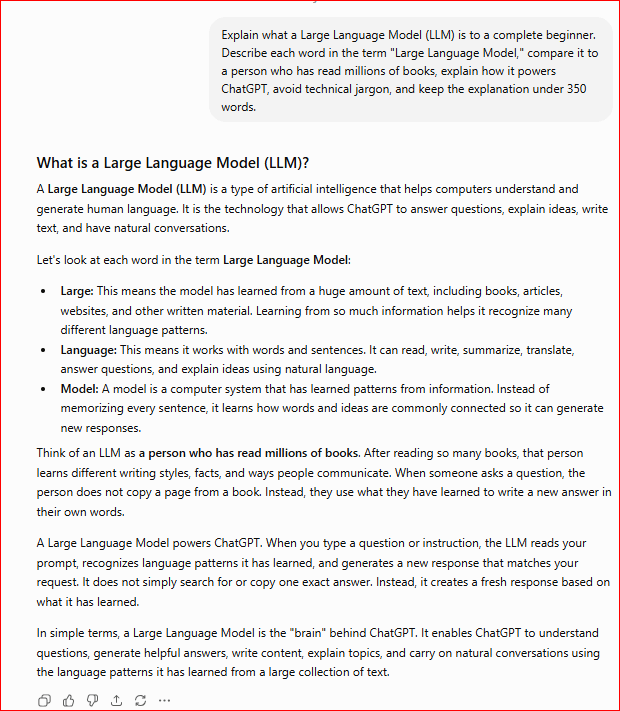
Figure 1. ChatGPT explaining what a Large Language Model (LLM) is.
This example explains Large Language Models using simple language and an everyday comparison. By comparing an LLM to a person who has read millions of books, beginners can better understand how ChatGPT and other AI assistants generate natural and helpful responses.
How Does a Large Language Model Work?
A Large Language Model, or LLM, works by learning patterns from enormous amounts of text. It does not simply memorize every sentence, and the language model itself does not automatically search the internet whenever you ask a question.
During training, an LLM analyzes books, articles, websites, and other written materials. From this text, it learns grammar, vocabulary, sentence structure, common facts, and relationships between words and ideas.
Think of an LLM as a student who has spent many years reading millions of books. The student may not remember every page exactly, but they learn how language works and become skilled at explaining ideas, answering questions, and writing about many subjects.
A Large Language Model works in a similar way. It recognizes patterns in language and uses those patterns to create new responses.
When you enter a prompt into ChatGPT, the model analyzes the words in your request and considers the surrounding context. It then predicts what should come next. The response is generated step by step using small pieces of text called tokens, which may be complete words or parts of words.
For example, suppose you ask ChatGPT to explain photosynthesis. The LLM does not normally locate an article and copy it. Instead, it uses patterns and information learned during training to create an explanation that matches your question.
Although Large Language Models can produce accurate and natural-sounding answers, they do not think or understand the world exactly as humans do. They use advanced mathematics to calculate which tokens are most likely to form a useful response.
Because an LLM predicts language rather than checking every statement against a trusted source, it can sometimes provide incorrect or invented information. Important facts should always be verified.
One of the greatest strengths of Large Language Models is their ability to generate useful responses about many topics. They can assist with learning, writing, programming, brainstorming, translation, research, and everyday problem-solving.
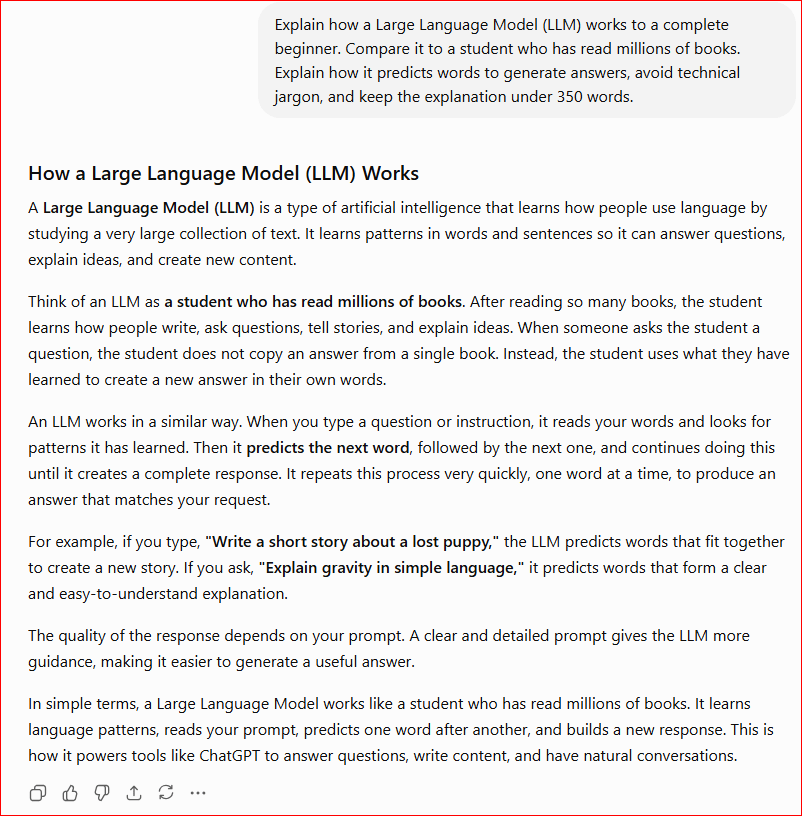
Figure 2. ChatGPT explaining how a Large Language Model works using an everyday example.
This example shows that a Large Language Model generates responses by recognizing language patterns learned during training rather than simply memorizing information or automatically searching the internet. Using an everyday comparison helps beginners understand how AI assistants such as ChatGPT create natural and helpful responses.
How Are Large Language Models Trained?
Large Language Models are trained using enormous collections of written text. This training material may include books, articles, educational websites, public documents, and other forms of written content.
The purpose of training is not to teach the model to memorize every sentence. Instead, the model studies patterns in language and learns how words, phrases, and ideas are commonly connected.
During training, part of a sentence may be shown to the model, and it must predict what comes next.
For example:
The sky is usually…
The model may predict the word blue because it has learned that “blue” commonly follows this sentence.
At first, the model’s predictions are often incorrect. Each time it makes a mistake, its internal mathematical settings are adjusted slightly. This process is repeated billions of times using many different examples.
Over time, the model becomes better at predicting suitable words, completing sentences, answering questions, and generating natural-sounding text.
You can compare this process to a student practising with a very large collection of exercises. The student answers a question, checks the correct answer, learns from the mistake, and tries again. After completing millions of exercises, the student becomes much more skilled.
Training a Large Language Model requires powerful computers, large amounts of data, and significant processing time. Specialized computer chips are used to perform the enormous number of mathematical calculations required during training.
After the main training process is completed, the model may receive additional training using examples created or reviewed by people. Human reviewers can help teach the model to follow instructions, avoid harmful responses, and provide clearer and more useful answers.
However, training does not make an LLM perfect. The model may still misunderstand a question, provide outdated information, or generate an answer that sounds convincing but is incorrect.
For this reason, users should review important information and confirm it using reliable sources.
What Are Tokens in a Large Language Model?
Large Language Models do not read and write text exactly the way humans do. Instead, they break text into smaller pieces called tokens.
A token may be:
· A complete word.
· Part of a word.
· A punctuation mark.
· A number.
· A short group of characters.
For example, the sentence:
ChatGPT can explain artificial intelligence.
may be divided into several tokens. Common words may appear as complete tokens, while longer or less common words may be separated into smaller parts.
You can think of tokens as puzzle pieces. Before a Large Language Model can understand and respond to your prompt, it divides the text into smaller pieces that it can process. The model then examines how those pieces relate to one another.
When ChatGPT generates an answer, it predicts one token at a time. After producing one token, it uses that token and the previous text to predict what should come next. This process continues very quickly until the full response is completed.
For example, suppose the model begins the sentence:
Artificial intelligence can help people…
It may predict that the next token should relate to writing, learning, working, researching, or solving problems. The exact choice depends on the prompt and the surrounding context.
Tokens are also important because Large Language Models have limits on how much text they can process at one time. This limit is called the context window. It includes your prompt, previous messages in the conversation, and the response being generated.
A larger context window allows the model to work with longer documents, remember more of the current conversation, and connect information from different parts of the text.
However, the context window is not the same as permanent human memory. Information may be lost when a conversation becomes too long or when the model is used in a new conversation.
Understanding tokens helps explain why:
· Very long prompts may need to be divided into smaller sections.
· Long documents may require several steps to analyze.
· A model may sometimes forget details from earlier parts of a lengthy conversation.
· Different words can use different numbers of tokens.
Although tokens may sound technical, the basic idea is simple: a Large Language Model breaks language into small pieces, studies the relationships between those pieces, and predicts which piece should come next.
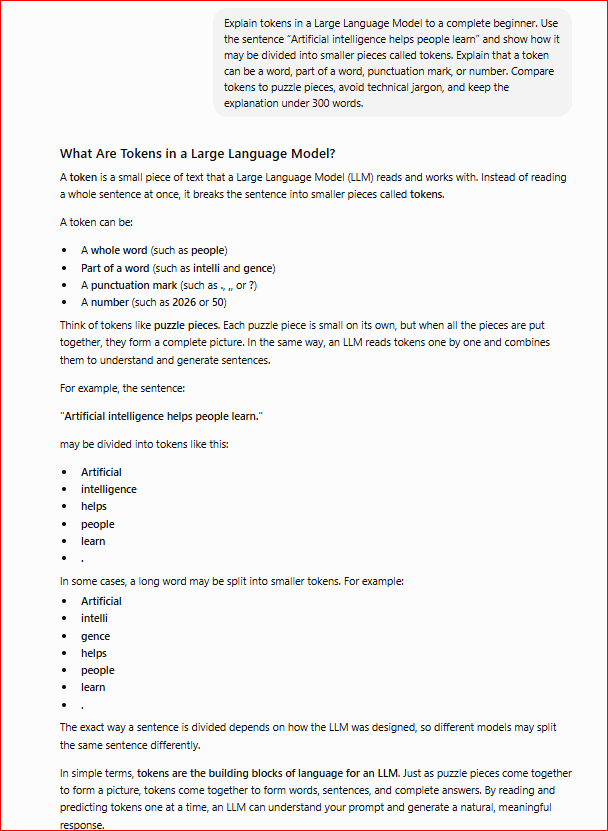
Figure 3. ChatGPT explaining tokens using a simple sentence and an everyday comparison.
This example shows how a Large Language Model breaks text into smaller pieces called tokens before processing it. A token may be a complete word, part of a word, a number, or punctuation. Comparing tokens to puzzle pieces helps beginners understand how an LLM processes prompts and generates responses one small piece at a time.
What Can Large Language Models Do?
Large Language Models can perform many tasks that involve reading, writing, organizing, and explaining information. Their ability to recognize language patterns allows them to respond to many different types of prompts.
Here are some common uses of Large Language Models:
Answer Questions
LLMs can answer questions about history, science, technology, business, education, and many other topics. They can also explain difficult ideas in simpler language.
Write and Improve Text
Large Language Models can help create:
· Emails.
· Articles.
· Reports.
· Social media posts.
· Product descriptions.
· Stories.
· Summaries.
They can also correct grammar, improve sentence structure, and change the tone of writing.
Summarize Information
An LLM can shorten a long passage, article, or document and identify the most important points. This can save time when reviewing large amounts of information.
Translate Languages
Large Language Models can translate text between many languages. They can also explain the meaning of words, phrases, and expressions.
Help with Programming
LLMs can explain computer code, suggest improvements, identify possible errors, and help users write simple programs. However, generated code should always be tested before it is used.
Support Learning
Students and beginners can use LLMs to:
· Explain difficult subjects.
· Create practice questions.
· Prepare study notes.
· Compare ideas.
· Learn step by step.
· Receive examples and simple explanations.
Generate Ideas
Large Language Models can help with brainstorming. For example, they can suggest business names, article topics, marketing ideas, lesson plans, recipes, or project concepts.
Organize Information
An LLM can turn unorganized notes into lists, tables, outlines, schedules, or structured plans. This makes information easier to understand and use.
Assist with Everyday Tasks
People can use Large Language Models to prepare shopping lists, plan trips, draft messages, compare options, create routines, or understand instructions.
Although Large Language Models are powerful, they should be viewed as assistants rather than perfect authorities. They can make mistakes, misunderstand instructions, or provide outdated information.
For important decisions involving health, law, finance, safety, or major purchases, users should verify the information using trusted sources or qualified professionals.
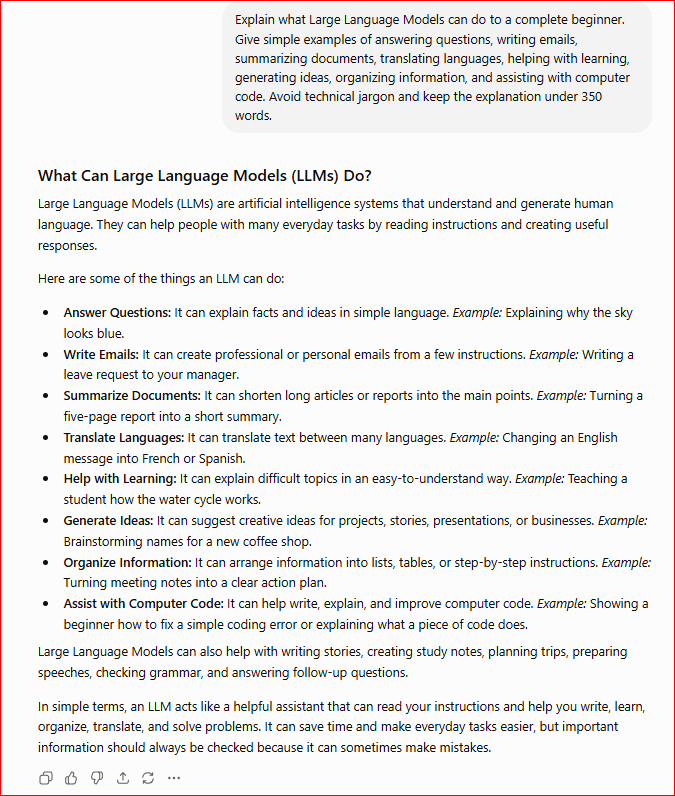
Figure 4. ChatGPT explaining the common tasks Large Language Models can perform.
This example shows how Large Language Models can assist with many language-based tasks, including answering questions, writing, summarizing, translation, learning, brainstorming, organization, and programming. These practical examples help beginners understand how LLM-powered tools can support everyday activities.
Examples of Popular Large Language Models and AI Assistants
Many companies and research organizations have developed Large Language Models. These models may work differently, but they all use language patterns to understand prompts and generate responses.
Here are several well-known examples:
ChatGPT
ChatGPT is an AI assistant created by OpenAI. It can answer questions, explain ideas, write content, summarize information, assist with programming, and help users complete everyday tasks.
ChatGPT is the application people interact with, while the underlying GPT models provide its language-processing abilities.
Google Gemini
Gemini is a family of AI models developed by Google. It can help users write, learn, summarize information, generate ideas, analyze content, and work with different types of information.
Gemini is also available through several Google products and services.
Claude
Claude is an AI assistant developed by Anthropic. It is designed to help with writing, analysis, explanations, document review, brainstorming, and other language-related tasks.
Claude is often used for working with long documents and detailed written instructions.
Meta Llama
Llama is a family of Large Language Models developed by Meta. Unlike some AI models that are mainly accessed through one chatbot, Llama models can be used by developers and organizations to build their own AI applications.
Mistral
Mistral is a family of AI models developed by Mistral AI. These models can be used for writing, answering questions, summarizing information, programming, and developing AI-powered tools.
Microsoft Copilot
Microsoft Copilot is an AI assistant available in several Microsoft products. It can help users write documents, summarize information, create presentations, work with spreadsheets, and complete other productivity tasks.
Copilot is an AI application rather than one single Large Language Model. It uses AI models behind the scenes to understand requests and generate responses.
Are All Large Language Models the Same?
No. Large Language Models can differ in several ways, including:
· The amount and type of data used for training.
· The size of the model.
· The languages it supports.
· The length of text it can process.
· Its ability to work with images, audio, documents, or computer code.
· Its safety rules and response style.
· Whether it is publicly available or privately controlled.
Some models are designed for general-purpose tasks, while others are created for specialized areas such as programming, medicine, science, customer service, or business research.
The best model depends on the task. One model may be better for writing, while another may be more suitable for analyzing long documents or helping with computer code.
Regardless of which model is used, users should remember that all Large Language Models can make mistakes. Important information should always be reviewed and verified.
Benefits of Large Language Models
Large Language Models offer many benefits because they can understand and generate natural-sounding language. They help people complete tasks more quickly, organize information, improve communication, and learn about many different subjects.
Some of the main benefits of Large Language Models include:
Save Time
LLMs can complete many language-based tasks in seconds. They can draft emails, summarize documents, create outlines, answer questions, and organize notes much faster than doing everything manually.
Make Difficult Topics Easier to Understand
A Large Language Model can explain complicated subjects using simple language, everyday examples, or step-by-step instructions.
For example, a student can ask an LLM to explain a scientific topic as if they were 12 years old.
Improve Writing
LLMs can help improve:
· Grammar
· Spelling
· Sentence structure
· Clarity
· Tone
· Organization
They can also rewrite text to make it more professional, friendly, persuasive, or easier to understand.
Support Learning
Large Language Models can act as learning assistants. They can explain lessons, create practice questions, provide examples, summarize chapters, and help students study at their own pace.
Increase Productivity
Businesses and individuals can use LLMs to reduce repetitive work. They can assist with reports, customer messages, meeting notes, research summaries, marketing ideas, and content creation.
Generate Ideas
An LLM can help people brainstorm ideas for:
· Articles
· Business names
· Presentations
· Marketing campaigns
· Stories
· Lessons
· Projects
· Social media posts
This can be useful when someone is unsure how to begin.
Support Multiple Languages
Many Large Language Models can understand and generate text in several languages. They can translate messages, explain unfamiliar words, and help people communicate across language barriers.
Important translations should still be reviewed by a qualified translator.
Help with Programming
LLMs can explain computer code, suggest improvements, identify possible errors, and help users create simple programs.
However, AI-generated code should always be tested before it is used.
Improve Accessibility
Large Language Models can simplify difficult text, summarize long documents, change the reading level, and help users organize their thoughts.
This can make information easier to access for beginners, language learners, and people who need writing assistance.
Assist with Many Different Tasks
One of the greatest benefits of an LLM is its flexibility. The same model may help with education, writing, translation, programming, planning, research, and everyday problem-solving.
Although Large Language Models provide many benefits, they work best when combined with human knowledge, careful review, and good judgment.
Limitations of Large Language Models
Large Language Models are powerful, but they are not perfect. Understanding their limitations helps people use them more safely and avoid relying on incorrect information.
Some of the main limitations of Large Language Models include:
They Can Generate Incorrect Information
An LLM may provide an answer that sounds confident and convincing even when the information is incorrect. This type of mistake is sometimes called an AI hallucination.
The model generates likely language patterns, but it does not guarantee that every statement is true.
Their Information May Be Outdated
A Large Language Model may not know about recent events, updated laws, current prices, new products, or the latest research unless it has access to current information.
Time-sensitive information should always be verified.
They Do Not Understand Like Humans
LLMs can produce natural-sounding responses, but they do not think, feel, or understand the world in the same way humans do.
They generate answers using mathematical calculations and patterns learned during training.
They Can Misunderstand Unclear Prompts
A short, vague, or incomplete prompt may produce an answer that does not match what the user needs.
For example:
Unclear prompt:
Tell me about computers.
Clearer prompt:
Explain how a laptop works to a complete beginner using simple language.
Clear instructions usually produce better results.
They May Reflect Bias
Training information may contain stereotypes, errors, unfair assumptions, or unbalanced viewpoints. An LLM may sometimes repeat these patterns in its responses.
Developers try to reduce bias, but it cannot always be completely removed.
They Have Context Limits
Large Language Models can process only a limited amount of text at one time. This limit is called the context window.
In a long conversation or document, the model may forget earlier details, overlook important information, or provide inconsistent answers.
They Cannot Always Verify Sources
An LLM may mention a study, quotation, book, or website that does not exist or does not support the information provided.
Users should verify references before using them in articles, reports, assignments, or important decisions.
Privacy Can Be a Concern
Users should avoid entering sensitive or confidential information into an AI assistant.
This includes:
· Passwords
· Banking information
· Medical records
· Government identification numbers
· Confidential business documents
· Private customer information
Only share information that is safe and appropriate for the AI service being used.
They Should Not Replace Professionals
Large Language Models can provide general information, but they should not replace qualified doctors, lawyers, accountants, financial advisers, engineers, or other professionals.
Important health, legal, financial, and safety decisions require expert advice.
They Depend on Human Review
An LLM works best as an assistant. People still need to check facts, correct mistakes, review the final result, and decide whether the information is appropriate.
The safest approach is to use Large Language Models to support human judgment rather than replace it.
Common Myths About Large Language Models
Large Language Models are becoming more common, but many people still misunderstand what they can and cannot do. Learning the facts helps beginners use LLMs more safely and effectively.
Myth 1: Large Language Models Think Like Humans
Reality: Large Language Models do not think, feel, or understand information in the same way humans do.
They generate responses by recognizing language patterns and predicting which words or tokens are most likely to come next.
Myth 2: Large Language Models Know Everything
Reality: No Large Language Model knows everything.
Its knowledge depends on the information used during training, later updates, and any additional tools it can access. It may not know recent news, private information, local details, or highly specialized facts.
Myth 3: Every LLM Answer Is Correct
Reality: An LLM can produce an answer that sounds professional and convincing while still containing incorrect information.
Important facts should always be checked using reliable sources.
Myth 4: LLMs Search the Internet for Every Answer
Reality: A Large Language Model does not automatically search the internet whenever it receives a question.
It normally generates an answer using patterns learned during training. Some AI assistants can also use web-search tools when those features are available.
Myth 5: Large Language Models Simply Copy Websites
Reality: LLMs generally create new responses using patterns learned from large amounts of text rather than copying one webpage word for word.
However, generated content should still be reviewed for accuracy, originality, and proper source use.
Myth 6: LLMs Remember Everything Forever
Reality: Large Language Models do not automatically remember every conversation permanently.
They can use information available in the current conversation, but they may lose earlier details when a conversation becomes very long. Some AI services offer optional memory features, depending on the platform and user settings.
Myth 7: Better Writing Means Better Facts
Reality: A clear and polished response is not always accurate.
An LLM can use excellent grammar while providing incomplete, outdated, or incorrect information. Users should evaluate the facts, not only the writing style.
Myth 8: Large Language Models Will Replace Every Job
Reality: LLMs may automate some tasks and change how certain jobs are performed, but they cannot replace every worker.
Many jobs require human judgment, responsibility, physical skills, creativity, trust, emotional understanding, and real-world experience.
Large Language Models are usually most useful as tools that assist people rather than completely replace them.
Myth 9: Only Technology Experts Can Use LLMs
Reality: Most AI assistants powered by Large Language Models are designed for ordinary users.
Students, teachers, writers, business owners, retirees, programmers, and complete beginners can use them by typing questions and instructions in everyday language.
Myth 10: Longer Prompts Always Produce Better Answers
Reality: A longer prompt is not automatically better.
The most effective prompts are clear, specific, and relevant. Too many unnecessary details can confuse the model, while a short but precise prompt may produce an excellent response.
Understanding these myths helps beginners develop realistic expectations about Large Language Models. LLMs are powerful tools, but they work best when combined with human knowledge, careful review, and responsible use.
Frequently Asked Questions About Large Language Models
What Does LLM Stand For?
LLM stands for Large Language Model. It is a type of Artificial Intelligence designed to understand and generate human language.
The word Large refers to the enormous amount of information and mathematical settings used to train the model. Language means it works with written or spoken language, and Model refers to the trained AI system.
Is ChatGPT a Large Language Model?
ChatGPT is an AI assistant that is powered by Large Language Models developed by OpenAI.
The LLM is the technology that processes language and generates responses, while ChatGPT is the application people use to interact with that technology.
How Does a Large Language Model Learn?
A Large Language Model learns by analyzing enormous amounts of text during training. It studies patterns in words, sentences, grammar, facts, writing styles, and relationships between ideas.
It does not learn exactly like a human student. Instead, its mathematical settings are repeatedly adjusted so it becomes better at predicting suitable words and generating useful responses.
Does an LLM Understand What It Writes?
Not in the same way a human does.
An LLM can produce explanations that sound thoughtful and intelligent, but it does not have human awareness, emotions, personal experience, or true understanding. It generates responses by recognizing patterns and predicting which tokens should come next.
Does an LLM Search the Internet for Every Answer?
No. A Large Language Model does not automatically search the internet whenever it receives a question.
It normally generates responses using patterns learned during training. Some AI assistants can also use web-search tools when those features are available and activated.
Are Large Language Models Always Accurate?
No. LLMs can generate incorrect, incomplete, biased, or outdated information.
They may also create convincing details that are not true. Important information should always be checked using reliable sources.
What Can Large Language Models Be Used For?
Large Language Models can help with:
· Answering questions
· Writing and editing
· Summarizing documents
· Translating languages
· Explaining difficult subjects
· Generating ideas
· Organizing information
· Assisting with computer code
Their usefulness depends greatly on the quality and clarity of the prompt.
Do I Need Programming Skills to Use an LLM?
No. Most LLM-powered assistants are designed for ordinary users.
You can communicate with them by typing questions or instructions in everyday language. Programming knowledge is only necessary when building applications or working with advanced AI systems.
Are Large Language Models Safe to Use?
Large Language Models can be useful when used responsibly, but users should protect their privacy and verify important answers.
Avoid entering passwords, banking information, confidential business records, government identification numbers, or sensitive personal information into an AI assistant.
Will Large Language Models Replace Humans?
Large Language Models may automate some tasks, but they cannot replace human judgment, responsibility, experience, creativity, and emotional understanding.
They are most effective when used as tools that assist people rather than make every decision for them.
Key Takeaways
Remember these important points:
· A Large Language Model, or LLM, is an Artificial Intelligence system designed to understand and generate human language.
· LLMs learn by analyzing enormous amounts of text and recognizing patterns in words, sentences, and ideas.
· They generate responses by predicting one token at a time.
· Tokens may be complete words, parts of words, numbers, or punctuation marks.
· Large Language Models can answer questions, write content, summarize documents, translate languages, support learning, and assist with computer code.
· Popular LLM-powered tools include ChatGPT, Google Gemini, Claude, Microsoft Copilot, Meta Llama, and Mistral.
· LLMs can save time, improve productivity, support creativity, and make difficult information easier to understand.
· Large Language Models can still generate incorrect, biased, incomplete, or outdated information.
· They do not think, feel, or understand the world in the same way humans do.
· Important information should always be checked using reliable sources.
· LLMs work best as helpful assistants rather than replacements for human judgment.
· Writing clear and specific prompts usually produces better answers.
What’s Next?
Congratulations! You have completed this beginner’s guide to Large Language Models.
You now understand what an LLM is, how it learns from large amounts of text, how it uses tokens to generate responses, and the different tasks it can perform.
You have also learned about popular Large Language Models, their benefits, their limitations, and the importance of checking AI-generated information before relying on it.
Large Language Models are the technology behind many modern AI assistants, including ChatGPT, Google Gemini, Claude, and Microsoft Copilot. Understanding how LLMs work gives you a stronger foundation for using these tools safely and effectively.
With this knowledge, you are ready to explore more practical AI topics, including prompt writing, AI image generation, productivity tools, and other beginner-friendly AI applications.
Final Tip for Beginners
Large Language Models work best when you give them clear and specific instructions. Instead of asking a very general question, explain exactly what you want, who the answer is for, and how you would like the response presented.
For example, instead of writing:
Explain Large Language Models.
Try:
Explain Large Language Models to a complete beginner using simple language, one everyday comparison, and three practical examples.
The second prompt gives the LLM more direction and usually produces a clearer and more useful response.
Do not accept every AI-generated answer automatically. Ask follow-up questions, request simpler explanations, compare important information with reliable sources, and correct anything that appears inaccurate.
Like any new skill, using Large Language Models becomes easier with practice. Keep experimenting with different prompts and use human judgment to decide whether the final response is accurate, useful, and appropriate.
Continue Learning
Ready to continue your AI journey?
Explore these beginner-friendly guides to strengthen your understanding of Artificial Intelligence and learn how to use AI tools more effectively:
· Create a ChatGPT Account — Step-by-Step Beginner Guide 2026
· ChatGPT Basics for Beginners — Complete Guide 2026
· What Is Artificial Intelligence? A Beginner’s Guide 2026
· What Is Machine Learning? A Beginner’s Guide 2026
· What Is Deep Learning? A Beginner’s Guide 2026
· What Is Generative AI? A Beginner’s Guide 2026
· How ChatGPT Works — Explained Simply
· Best ChatGPT Prompts for Beginners 2026
· AI Image Generation for Beginners
· Prompt Engineering for Beginners
New beginner-friendly AI tutorials will be added regularly. Check back for more practical examples, step-by-step guides, and simple explanations of important AI concepts.
Thank you for reading. Keep exploring, keep practicing, and enjoy learning how Large Language Models are changing the way people communicate, learn, work, and create.

